

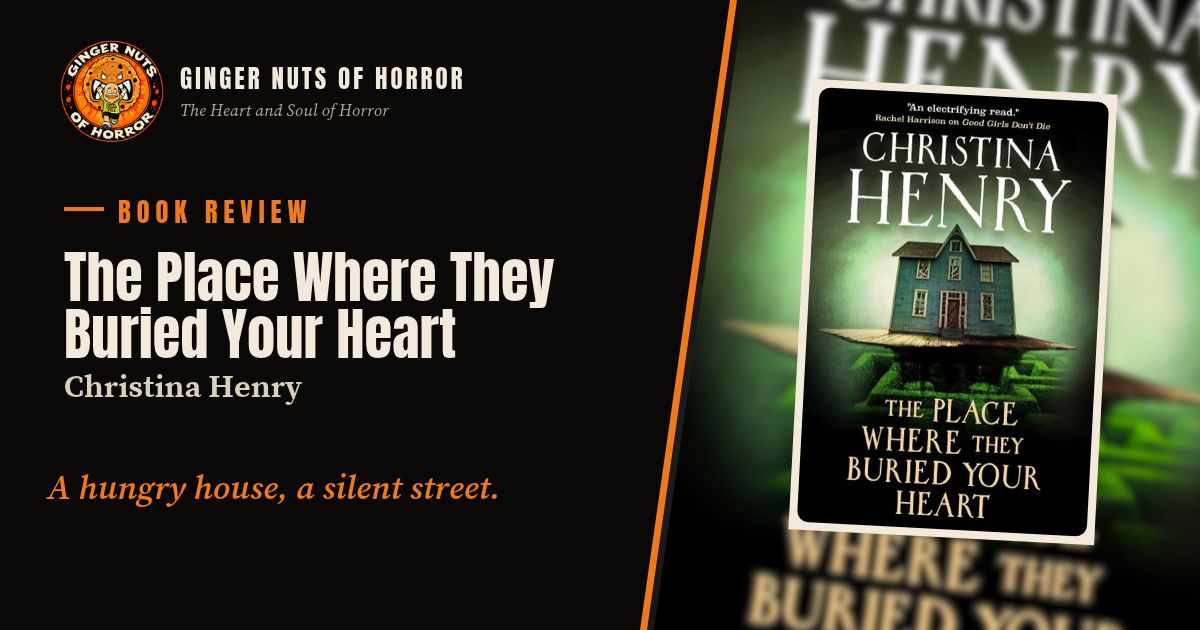
The Place Where They Buried Your Heart | Christina Henry | Titan Books | 4 November 2025 |

- Author Christina Henry
- Publisher Titan Books
- Published 4 November 2025
- Pages 352
- Format Paperback
- ISBN 9781835412640
- Subgenre Haunted house horror
- Reviewed by Jim McLeod
A boy walks into the empty house at the end of a Chicago street in 1993 and never walks out. His sister grows up a few doors away, waiting for it to get hungry again.
The Place Where They Buried Your Heart by Christina Henry is a haunted house novel set on one ordinary Chicago street, and it may be the strongest thing she has written. A boy goes into the empty McIntyre house in 1993 and never comes out. His big sister spends the years that follow living a few doors from the thing that took him. If you want a haunted house horror novel with real teeth and a real heart, this is the one to read before Halloween.
A haunted house novel where the real horror is a street that chose to look away. Christina Henry builds her dread from guilt, grief and the families we make when ours fall apart. Only a rushed final stretch keeps it from full marks.
A Street That Closed Its Windows
Every street has a house the kids are told to leave alone. Most of the time the warning is about rotten floors and broken glass. Sometimes it is about something the grown-ups would rather not say out loud.
On this street, the house belonged to the McIntyres. In 1973, Glen McIntyre killed his wife and children, then himself. The neighbours had heard trouble from that house for a long time. They shut their windows. Nobody called the police. Afterwards they boarded the place up and taught their children to cross the road.
That detail is the key to the whole book. The house is hungry, yes. It eats children. But the street fed it first, with silence, and Henry never lets you forget it.
Twenty years on, in 1993, thirteen-year-old Jessie Campanelli is stuck at home, grounded. Her eight-year-old brother Paul is out with his friends, Jake and Richie, and Jessie has dared him to go into the McIntyre house. Three boys go in. Jake comes out without an arm. Richie comes out without a mark on him. Paul does not come out at all, and the neighbours who run to help can hear him inside, calling for his sister.
The adults decide a stranger must have taken him. The boys say the house ate him. Jessie believes the boys.
Say it out loud and it falls into the beat of a counting rhyme, the sort children chant in a playground. Three. Two. Then a sum that is not a number at all. The “and” keeps coming, with no comma to rest on, the way a guilty mind runs the same loop at three in the morning. There is no flourish. Not one adjective. Henry trusts plain words to carry the weight, and they do, because a thirteen-year-old would do the maths exactly like this. The arithmetic of guilt is simple. It just never balances.
That line is the engine of the book. Everything after it is Jessie trying to make the sum come out differently.
Paul’s loss takes the Campanelli family apart, slowly and then all at once. Her father never comes back from it. Her mother and Jessie can barely stand to share a room. Henry does not soften any of this, and she does not ask you to pick a side. Grief does different things to different people, and none of them is pretty.
What fills the gap is the street itself, or the best of it. Ted Dobrowski, the neighbour who pulled Jake and Richie clear that night, becomes the steady father Jessie’s own parents can no longer be. Jake, an arm short, grows into something close to a brother. A couple of women on the block step in where her mother stepped back. This found family is the warm centre of a cold book, and it is why the scares land. You care who the house might take next.
Jessie is not always easy company. She is guarded, sharp and sometimes selfish, and plenty of readers have bristled at her. I think that is the point. Grief at thirteen does not make a girl sweet. It makes her wary. She tells her own story in the first person, with the dry, flat patience of someone who has been waiting a long time for a bad thing to happen again. By the time she is grown, still living on the same street, with a small son of her own close to the age Paul was, that patience has hardened into something like a vigil.
Henry is clever about how she tells it. Jessie becomes a collector of the house’s stories, and the book lets other voices in: accounts from people who crossed that threshold, or stood too near it, and what it cost them. Over the years more people are hurt and more go missing. An attempt to knock the place down goes very badly. Meanwhile the street changes around it. New families move in who do not know the rules, and the old families have to decide, all over again, whether to speak up or shut the window. That is the book’s sharpest idea. The house does not need anyone to love it. It only needs people to look away.
There is another way to read the McIntyre house, and once you see it you cannot unsee it. It behaves like an abuser. It isolates. It wears people down. It keeps a whole family in its grip long after the worst has happened, and it makes leaving feel impossible even when the door is wide open.
Glen McIntyre ran his home by fear, and the house seems to have learned the trick from him. Jessie’s long years on the street start to look less like courage and more like the pull a bad home has on the people who grew up in it. Henry never spells this out. She lets the shape of the story say it for her, which is far more unsettling than a speech would be.
The setting matters too. This is a working Chicago neighbourhood of brick houses and long memories, with the wooden McIntyre place sitting among them like a bad tooth. Families have lived here for generations. People know each other’s business, and they know which business not to mention. Henry, who lives in Chicago, writes it with an insider’s ease, and the street feels lived in rather than built for the plot. That ordinary life is what the house is feeding on.
It also gives the last part of the book its sharpest tension. As a mother, Jessie faces the choice every parent on that street has dodged for twenty years. She could take her son and run. She could stay and stand guard, so that no other family loses what hers lost. Both choices cost something. Henry does not pretend either is easy, and she lets Jessie be wrong, stubborn and frightened in a way that feels true to a woman who has never once been allowed to stop watching that door.
Is The Place Where They Buried Your Heart Scary?
Yes, though not in the way a jump-scare film is scary. Henry holds the supernatural back for long stretches, and that restraint makes each appearance hit harder. A mouth opens in the wallpaper. A voice in the dark borrows the sound of someone you lost. Small fingers reach out from under a closet door. When the violence comes, it is quick and brutal and it does not linger, which somehow makes it worse.
Most of the dread, though, is built from ordinary things. A mother counting heads at dusk. A kid taking the long way home. The particular hush when someone new on the street asks about the empty house. Reading Henry’s prose here is like standing in a tidy kitchen where something terrible once happened: everything plain, everything in its place, and the neatness is what makes your skin crawl.
A word of caution for some readers. Children die in this book, and so do adults, and Henry does not cut away. The content is never there for shock value, but it is there.
How It Compares to Christina Henry’s Earlier Novels
Henry made her name taking apart other people’s stories. Alice, Red Queen, Lost Boy, The Mermaid and Looking Glass all twisted a classic into something darker. The Girl in Red did it to Red Riding Hood, and Horseman went back to Sleepy Hollow. Alongside those came The Ghost Tree, Near the Bone and Good Girls Don’t Die, which Valerie Lester covered in our Good Girls Don’t Die review, and then The House That Horror Built.
This novel drops the borrowed frame entirely. There is no famous source text to push against. The McIntyre house is her own myth, and freed from somebody else’s story she writes with more room to breathe. The characters get years to grow. The street gets a history. With Pinfeathers due from Titan this November, it will be interesting to see whether she keeps building her own worlds from scratch.
As for where it sits in the genre, the bones are classic. You can feel Shirley Jackson’s Hill House, a house that is simply wrong, and the Marsten House from Stephen King’s ‘Salem’s Lot, squatting over a town that would rather not think about it. The closer cousin, though, is King’s It, where the grown-ups of Derry have learned not to notice when children go missing. Haunted houses have had a busy few years on our horror book reviews pages, from Carissa Orlando’s The September House to Micaiah Johnson’s The Unhaunting. Henry’s book stands out by being less interested in the ghosts than in the neighbours.
There is one real problem, and it is hard to miss. The ending comes too fast. Henry spends most of the novel building pressure with great care, then lets it out in a final stretch that feels hurried. The climax is over almost before it starts, and the resolution is a touch neater than everything before it has earned.
Part of the trouble is a late figure who turns up to explain where the house’s hunger comes from. He fills in useful history, but he arrives late and slips away without ever feeling woven into the street the way everyone else is. Another fifty pages to settle him in, and to let the finale breathe, and this would be a five-star book without argument.
It is a real flaw. It is also the only one. Everything that leads up to it is Henry at her best: patient, humane, and quietly merciless.
Every street has that house. Read this, and you will start wondering what yours has been fed.
The Verdict: Is The Place Where They Buried Your Heart Worth Reading?
The verdict
A haunted house novel with real grief at its core, held back only by an ending that arrives too soon.
Read it if: you want haunted house horror built on character, guilt and found family, and you loved It or The September House.
Skip it if: the death of children is hard reading for you right now, or you need a slow, thorough finale.

Keep reading on Ginger Nuts of Horror
 Good Girls Don’t Die by Christina Henry – Horror Book Review
 The No-End House by Jeremy Bates, Book Review
 This House Isn’t Haunted But We Are by Stephen Howard

About Ginger Nuts of Horror
Ginger Nuts of Horror is an independent horror review and culture site based in Edinburgh, Scotland. Edited by British Fantasy Award nominee Jim McLeod, it publishes horror book reviews, film reviews, author interviews, features and cover reveals. Ginger Nuts of Horror won Best Inclusive Film & Book Review Platform at the SME News UK Enterprise Awards 2026.