
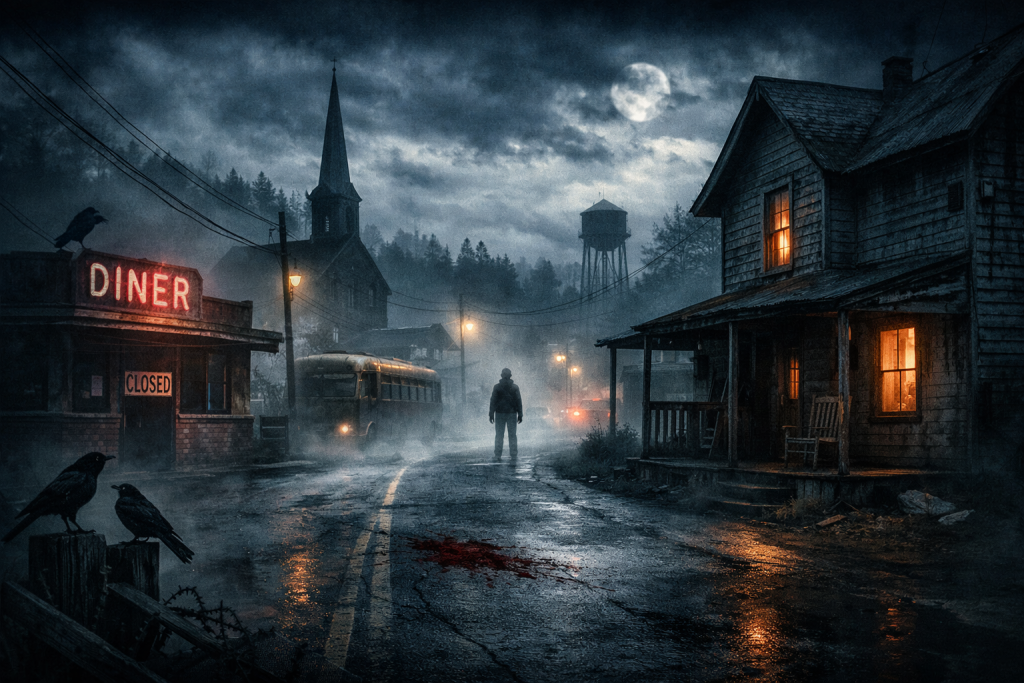
Small-town horror stays powerful because fear grows inside ordinary routines. A closed diner, one dark porch, or a missed bus can shift the mood fast. In a city, danger may pass without context. In a small town, every change gets noticed and remembered.
That setting also gives horror a tighter frame. People know the roads, the houses, and the family names. Therefore, a threat rarely feels random. It feels local, personal, and much harder to escape.
Why Small Towns Create Stronger Fear Than Cities
A small town gives characters fewer ways to disappear. Neighbours see who comes home late and who avoids familiar places. That constant visibility adds pressure before the plot fully turns. As a result, horror can begin with social tension rather than direct violence.
Familiar places also carry more weight in a small community. One school, one church, and one gas station can shape daily life for years. If one of those places feels wrong, the whole map changes. Consequently, fear spreads through routine, not scale.
This is why the setting feels so stable in horror. The town already has rules, habits, and quiet expectations. Once one rule breaks, people start reading danger into every detail. That slow shift is often stronger than a sudden attack, which is why it remains so visible in Canadian horror cinema.
Before looking at specific examples, it helps to see why the structure works so well. Small-town horror depends on pressure that builds through repetition. It also turns ordinary spaces into warning signs. Those traits explain why the pattern returns so often:
- Limited privacy raises tension fast.
- Familiar places become unstable.
- Social judgment blocks escape.
- Old events stay present in daily life.
These points matter because they shape both plot and mood. A writer does not need constant action when the setting keeps producing unease. In film, the same logic works through roads, porches, schools, and empty lots. That is why the setting remains effective across decades.
When Dark Escapism Extends Beyond Books and Film
Horror audiences often want to keep that sense of tension alive after a novel or film ends. Some continue the mood through late-night forums and rankings, while others move toward more interactive forms of suspense. For some Canadian readers, that can include browsing CasinosAnalyzer to view available bonus deals and extend the same exciting leisure time through casino games.
That side habit works best when it stays brief and secondary. The main draw is still horror, with its tension, atmosphere, and lasting images. Yet, some readers move from one kind of suspense to another during the same evening. In that context, casino bonuses can appear as part of casual browsing, not the core subject.
Family History, Gossip, and the Weight of Closed Communities
Small-town horror becomes sharper when the past never leaves the street. Canadian film culture helps keep that tradition visible through institutions such as TIFF and its Canadian Film Encyclopedia. That matters because local dread is not only about place. It is also about who controls the story of what happened before.
One old accident can shape three families for twenty years. One fire, one disappearance, or one public scandal can become local folklore. Because of that, fear feels inherited rather than sudden. The threat enters the story long before the first major scene.
Gossip adds another layer that cities often weaken. A rumour can move across a small-town in one afternoon. It changes how people speak, whom they trust, and which doors stay locked. In this way, social talk becomes part of the machinery of fear.
Closed communities intensify that effect. People defend relatives, former classmates, and local figures even when something is clearly wrong. So silence becomes part of the danger itself. A haunted house may be frightening, but a town that will not speak can be worse.
Canadian Horror That Uses Local Dread With Precision
Canadian horror often draws force from weather, distance, and restraint. Snow slows movement, winter darkness cuts the day short, and long roads reduce options fast. These details are simple, yet they shape every decision. For that reason, local dread feels physical as well as emotional.
Bruce McDonald’s Pontypool is a strong example. TIFF describes it as a film directed by McDonald and based on Tony Burgess’s novel, and the story is tied to the Ontario town in its title. Much of its fear comes from isolation, language, and the limits of a local radio station. The scale stays small, yet the pressure keeps rising.
Ginger Snaps uses a more suburban frame, yet it shows the same logic clearly. TIFF’s Canadian Film Encyclopedia calls it a horror film with emotional force, while TIFF also notes its later cult standing. The threat works because ordinary streets and teenage routines stop feeling safe. In other words, horror enters daily life instead of arriving from some distant place.
The Changeling is another useful example. TIFF’s Canadian Film Encyclopedia presents it as a haunted house film that combines horror and mystery, while also pointing to its lasting place among Canadian features. The film shows how one private setting can hold grief, secrecy, and fear at the same time. In that way, it reflects the broader logic of small town horror, even within one home.
These examples show that local dread depends on recurring pressures, not only on plot twists. Place matters because it shapes how people move, hide, and remember. The emotional force grows when the setting feels specific. That is why Canadian horror often feels precise rather than generic.
Key elements that keep local dread active
The same pattern appears in several repeated details. Climate, family history, and social pressure do not act as decoration. Instead, they create the conditions that let fear settle in. The points below show the main pressures at work:
- remote roads and severe weather;
- inherited guilt within families;
- silence around past violence;
- pressure from tight social circles;
- distance from outside help.
Together, these elements keep the setting active from start to finish. They give horror a structure that feels believable without making the story too large. Even a brief glance at an online casino feels minor beside that deeper tension. The real source of fear remains place, memory, and social control.
Why This Setting Keeps Returning in Horror Stories
Writers and directors keep returning to small towns because the setting creates pressure from several directions at once. It limits escape, keeps old events visible, and turns ordinary routines into sources of fear. Urban horror can move faster, yet it often loses that tight social tension. By contrast, small-town horror keeps danger close to daily life, much like an online casino keeps risk tied to immediate choice and habit.
This setting also works across many horror forms, from ghost stories to slashers and psychological plots. One buried secret can sustain a 90-minute film or a long novel without losing force. More importantly, small towns make private shame feel public, and that shift is deeply unsettling. Once familiar roads, schools, and family names stop feeling safe, the horror becomes much harder to contain.