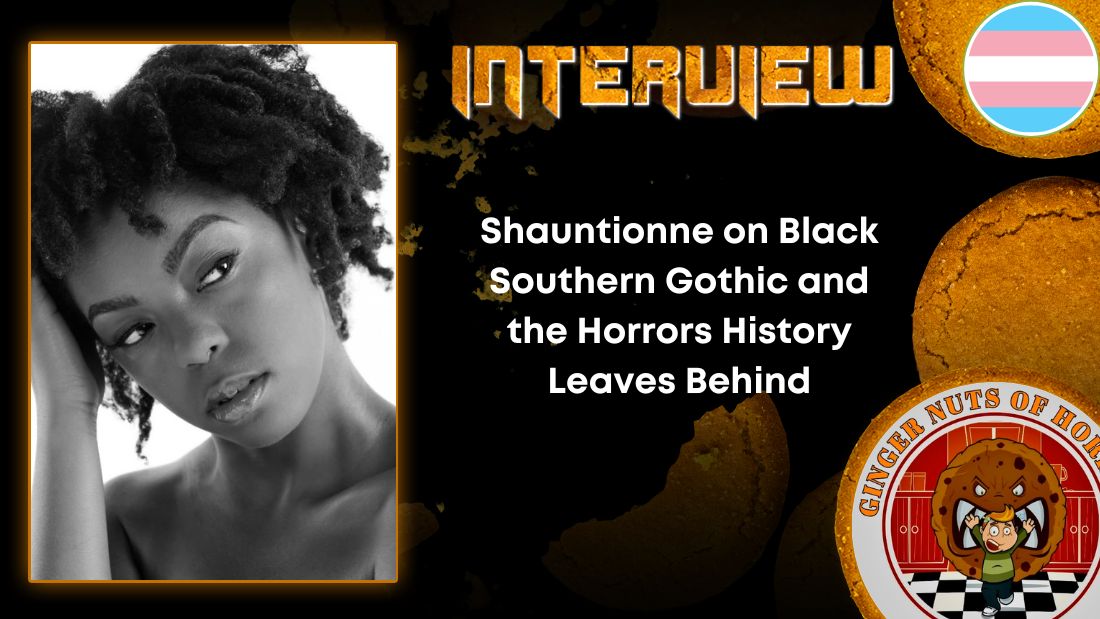
Shauntionne writes from a place where the soil remembers what the living try to forget. The Louisville, Kentucky native, now navigating a creative path shaped by stints in Atlanta, Los Angeles, Chicago, and time abroad, constructs fiction that refuses to look away from the abandoned corners of American history. Her work, which spans poetry, essays, and erotica, finds its sharpest edge in the horror genre. This Black Southern Gothic fiction profile examines the mechanics of a writer who sees the graveyard not as a backdrop for cheap thrills but as a site of narrative justice and deep ancestral reckoning.
Her most recently published short story, Greenwood, is not interested in the jump scare. It is interested in the long, slow dread of being forgotten and the physical weight of ground that has been denied proper care. She asks difficult questions in her work. How do the dead feel when their resting place is abandoned? Do they recognize the living who share their state of neglect? These are not rhetorical exercises for Shauntionne; they are the foundational pillars of a writing practice grounded in rigorous research and a commitment to the Black diaspora.
Behind the public persona of the published author is a woman fueled by travel and the humbling realization of how small we all are against the backdrop of global history. She speaks with clear admiration for the lineage of griots and storytellers that she sees as embedded in her DNA. This is not a writer seeking to escape reality through fantasy. Rather, she uses the tools of speculative and Southern Gothic horror to expose the monstrous realities that already exist in the archive. The process, she explains, always begins with a question.
For Greenwood, the question was visceral and unflinching: a meditation on the consciousness of the abandoned dead. From that initial spark, she dives into research rabbit holes, pulling at threads of history until they unravel into a narrative structure. The writing is deliberate. The voice is measured. Fans of Ginger Nuts of Horror can read Greenwood in its entirety for free at the conclusion of this interview. The result is a form of horror that informs as much as it unsettles, a stark reminder that the past is never really dead. It is not even past.
Where the dead are not silent and the past demands a witness.

Let’s start at the very beginning. For our readers, please introduce yourself. Beyond the author bio, tell us a little about who you are when you’re not writing, what you love doing, what fascinates you, and what fuels your
creativity.
My name is Shauntionne and I’m a writer originally from the city of Muhammad Ali. Louisville, Kentucky is as city as Kentucky gets, but bourbon, Bibles, and basketball are still king. Since graduating from the University of Kentucky an x amount of time ago, I’ve lived in Atlanta, Los Angeles, Chicago, and abroad. Traveling inspires me to put pen to paper (or hands to keys). It amazes me how small we truly all are. The Black diaspora fuels my creativity. From griots to authors, storytelling is embedded in our DNA.
In the early stages of a new project, what tends to come to you first: a compelling character voice, a central thematic question, or a vivid image/scenario? How does that initial spark then guide you in building the rest of the story?
It’s always a question. When writing my most recently published short story, Greenwood, the question that came to me was:
How do dead bodies feel when they’re resting ground is abandoned? Are they angry? Do they recognize the living who are also lost and abandoned?
Then I started to research. That’s the best part about writing to me. It gives me an excuse to go down random rabbit holes, and be inspired for more stories while doing so.
Every story has its own unique set of problems to solve. What was the most difficult ‘puzzle’ you had to crack while writing
this story? Was it a plot hole, a character’s motivation, the structure, or something else entirely?
It was definitely the structure. Some may think that short stories are easier because of the length, but it’s actually the length that makes it difficult. I struggled with the pacing of this story. It doesn’t follow the rules of pacing, but then I decided that I don’t have to follow the rules. I wanted it to feel rushed because the character was in a rush to get home. Rushing because bad things happen to girls that look like her when they take their time going anywhere.
The journey from a finished draft to a story in a reader’s hands can be a surprising one. What was the most significant way your book evolved during the
editing and publishing process, something you didn’t anticipate when you typed ‘The End’?
I rewrote the scene in Greenwood the graveyard over fifty times I’m sure. There was so much to say, so much I wanted to say. I had a desire to make this story just as informative as it was scary. After a while I wasn’t sure if I was writing this for a living audience or a dead one. I felt the need to tell the stories of those dead and abandoned people which is something I didn’t anticipate.
Once a story is published, it no longer entirely belongs to the author; it belongs to the readers and their interpretations. Has a reader’s reaction or analysis ever revealed something about you
r own work that surprised you?
In 2023 I was writing for Lustery (based in Berlin, Germany). Erotica was never my forte, so I was surprised that it was received so well! In all my work, I aim for my readers to see themselves in the characters I create. With erotica, I wanted to pay an ode to everyday sexy people. The ones that aren’t on tv. The ones with ugly birthmarks and who laugh when they climax. I received numerous DMs and emails about my stories for Lustery. Some from readers outside of my home country. I was flattered, surprised, and blushing at the same time.
Writing is a demanding, often solitary pursuit. Beyond the apparent goal of ‘telling a story,’ what is the specific, personal fuel that keeps you going through the difficult stretches? Is it the joy of discovery, the need to understand something yourself, the connection with a future reader, or something else?
The desire to “win.” Winning to me is doing whatever it is I say I’m going to do. Scarface is one of my least favorite movies on this planet (don’t judge me), but Tony Montana did say at least one thing of substance: “All I have in this world is my balls and my word…” Sometimes the fuel that keeps me going is that I’m a woman of my word and I do what I say I’m going to do. I don’t break promises. Especially the ones I made to myself. When I finish a story that’s been stuck in my mind, that’s a win for me.
We often hear about authors
being influenced by other books. What are some non-literary influences on your work, such as a specific piece of music, a historical event, a scientific theory, or even a landscape, that have profoundly shaped your storytelling?
Black history is a horror story. We talk about our triumphs a lot and what all Black people across the diaspora have persevered, but at what cost? As much as I love learning about the history of my people, you have to take mental health breaks when doing deep research on Black History. The fact that I have ancestors that could’ve been killed for being literate inspires me to write even more.
Is there an author, living or dead, whom you consider a ‘silent mentor’? Not necessarily someone you try to imitate, but whose approach to the craft made you feel permission to write in your own way?
Tananarive Due is my favorite author. Her interpretation of southern gothic is relatable to me as a Black woman from the American south. Through her writing, I feel I have permission to tell my stories, and that maybe someone will even listen and relate. She inspires me to be more imaginative, and not hold back.
Who was the first person to see your early drafts, and why did you trust them with your unpolished work? What is the most valuable piece of feedback they gave you?
I have a trusted group of friends who are also writers that I affectionately refer to as, “The Circle.” I trust them with my work because they love me. It sounds cheesy, but it’s true. When people love you as a person and as a writer, they know that you want your work to be your best at all times. So that means they won’t sugarcoat their opinions. I need critique. Live for it, actually, and they know that.
When they ask questions about a certain line or paragraph, it’s valuable to me because I need to know if this is a place my readers would be stuck on or confused with as well. This prompts me to rework the piece.
Horror is often most potent when it’s internal. Beyond external monsters, how do you explore the slow unravelling of a character’s sanity or the horror of their own mind?
In the world we live in today, everything seems to be falling apart around us. There’s a scary kind of urgency that comes with that. I have to figure this out, NOW. When every avenue you’ve explored doesn’t seem to work out, that’s when people panic and become desperate. It’s a constant theme in my horror stories.
Setting in horror is often described as a character in its own right. How do you approach transforming a location, whether a house, a town, or a landscape, into a source of active dread?
In Greenwood it was a bit easy since the setting is a place of the dead. I believe I transformed it by telling the readers about the history, which in itself is horrific. Soldiers who didn’t have the right to be buried alongside white soldiers (who are buried in a more kept cemetery) being abandoned and forgotten in death as they were in life. And how the descendants of those people are often abandoned and forgotten as well.
Writing a terrifying buildup is one skill; delivering a satisfying payoff is another. How do you decide when to finally show the monster or reveal the source of the horror?
It depends on the story. With my most recent piece, I skipped the subtleties. If you walk past a graveyard of abandoned bodies, someone or something is bound to grab hold of you.
The horror genre is rich with established tropes and archetypes. How do you engage with these familiar elements, the haunted house, the ancient curse, the final girl, in a way that feels fresh and surprising? Do you consciously seek to subvert a trope, or do you
focus on executing it with such depth and authenticity that it becomes new again?
In my next work, RUMPLE, I took the fairytale of Rumplestilkskin and warped it into a new, more horrific world. Nursery rhymes and fairytales often have a more horrific origin, and I want to bring that horror back. In this work, I play with the trope of mothers and children. Often used in horror to toy with the emotions of readers who are sympathetic to this demographic.
How do you approach writing scenes of intense terror or violence to make them feel physically impactful without tipping into gratuitousness?
I tap into the feelings. We all feel. How would you feel if a dead person who died in the 1900s was standing before you, with a decayed bone sticking out of their leg, and asked you if you were lost? Our minds are incredible and dangerous at the same time. The “fight or flight” instincts we have are both useful and jarring. I use that as a tool when I write.
Do you have a favourite line or passage from your work, and would you like to share it with us?
“Rid myself of the reality of how easy it is for someone who looks like me and my momma to become dead and forgotten.”
What is the specific, core truth you are trying to expose or explore through your horror?
Justice. What makes Black Horror fiction such a reliving genre is that it showcases what we (Black people) know to be scary. Who the monsters and villains of our world are. And it gives us the sort of justice we idealize, but rarely ever see in this world. Even in my work where the villain is the victor, there’s a sense of justice behind their tormented minds. A justice I believe they deserve.
You have precisely two minutes in a crowded bookstore to hook a reader who is sceptical of the entire horror genre. They look at your book’s cover and ask, ‘Convince me. Why should I read this? I don’t even like being scared.’
If you’re a person who’s curious about small towns and twisted histories, then this is the story for you. Yes, it’s a bit scary, but so is being lost and never found. To risk your life only to be forgotten in death is a horror that none of us usually imagine.
Greenwood by Shauntionne
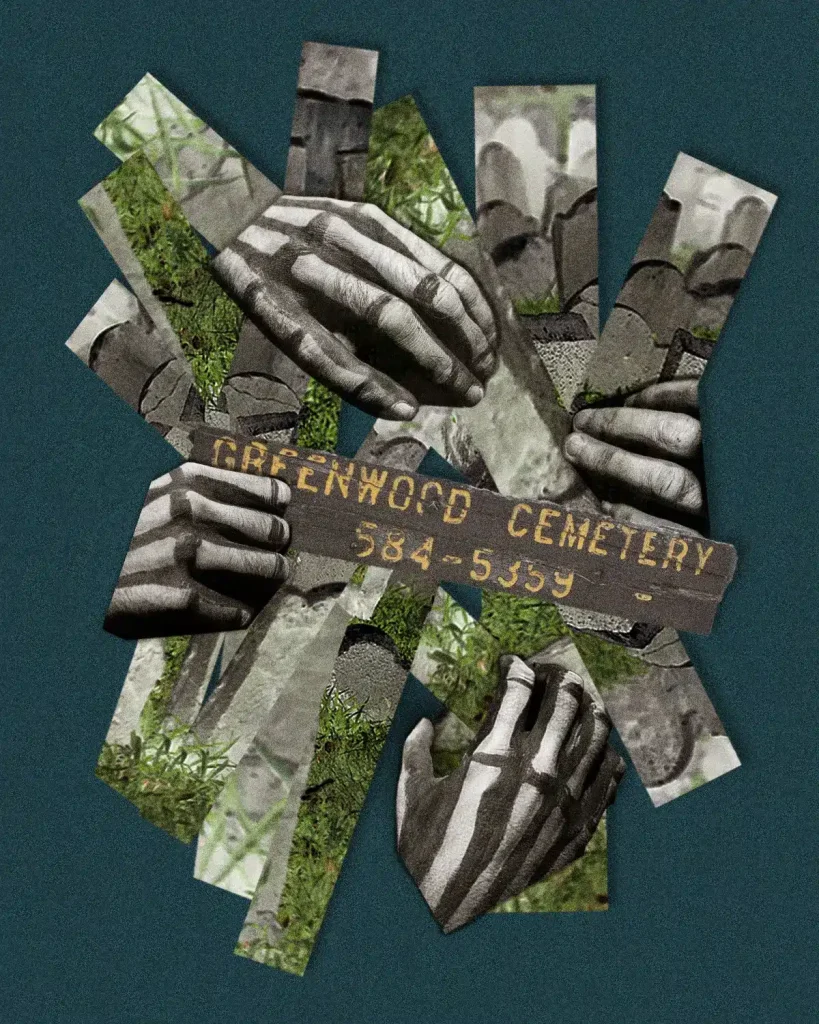
young Black woman walks home through the West End of Louisville, her mother’s warning—“Head on swivel”—echoing in her mind alongside news alerts of missing women who look just like her. She tries to bury herself in her coat against the autumn chill, but the cold seeps through.
Her path takes her past Greenwood Cemetery. Once the final resting place for Black Civil War veterans denied burial alongside white soldiers, it is now an abandoned field of sunken headstones, suffocated by decades of neglect and overgrown grass. The gate, bent and broken, stands eternally open. As the streetlights begin to flicker on, a voice from inside the gate stops her in her tracks: “Miss, are you lost?”
Against her will, she is pulled into a world where the forgotten dead do not rest. They rise. A chorus of gray-faced apparitions from across the centuries emerges, their spirits bound to the soil that history has forsaken. They have been waiting for a witness. They have been waiting for justice.
In Greenwood, Shauntionne delivers a terrifying and essential work of Black Southern Gothic fiction. This is not a story about things that go bump in the night; it is a story about what happens when the past is left to rot. With unflinching precision, she explores the true horror of a history abandoned and the visceral dread of being forgotten.
A woman tries to rush home. The dead have other plans.
Check out Shauntionne’s brand new story Greenwood here
Shauntionne
Shauntionne is a writer during the day, and writes creatively off the clock. Her short stories, poetry and essays have been featured in online and print publications throughout the US and Europe. When she’s not writing, you can find her gossiping with her cat or reading anything by Tananarive Due.