- Philip Fracassi’s Gothic: The Horror of Wanting Too Much
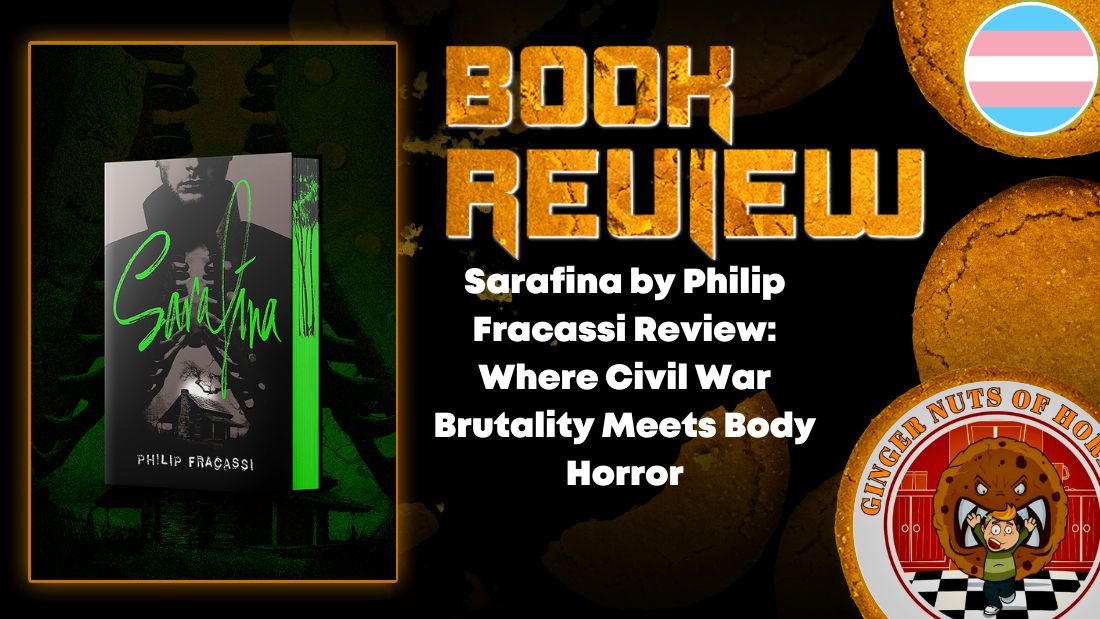
- Sarafina by Philip Fracassi Review: Where Civil War Brutality Meets Body Horror
- The Autumn Springs Retirement Home Massacre by Philip Fracassi: A Review
- Boys in the Valley by Philip Fracassi
They deserted the war. But they found something worse waiting in the woods.
Philip Fracassi’s Sarafina is a brutal mashup of Civil War drama and folk horror that asks whether survival is worth the cost of your soul. Set during the bloody aftermath of the Battle of Shiloh in 1862, three brothers desert the Confederate army only to stumble into a remote cabin owned by a mysterious woman who offers salvation. But the food rots in their stomachs, the water whispers secrets, and the land hungers for payment. This Sarafina Philip Fracassi review explores how the author blends historical accuracy with body horror to create a terrifying meditation on guilt, brotherhood, and the rot of wartime America.
Sarafina by Philip Fracassi Review: Where Civil War Brutality Meets Body Horror
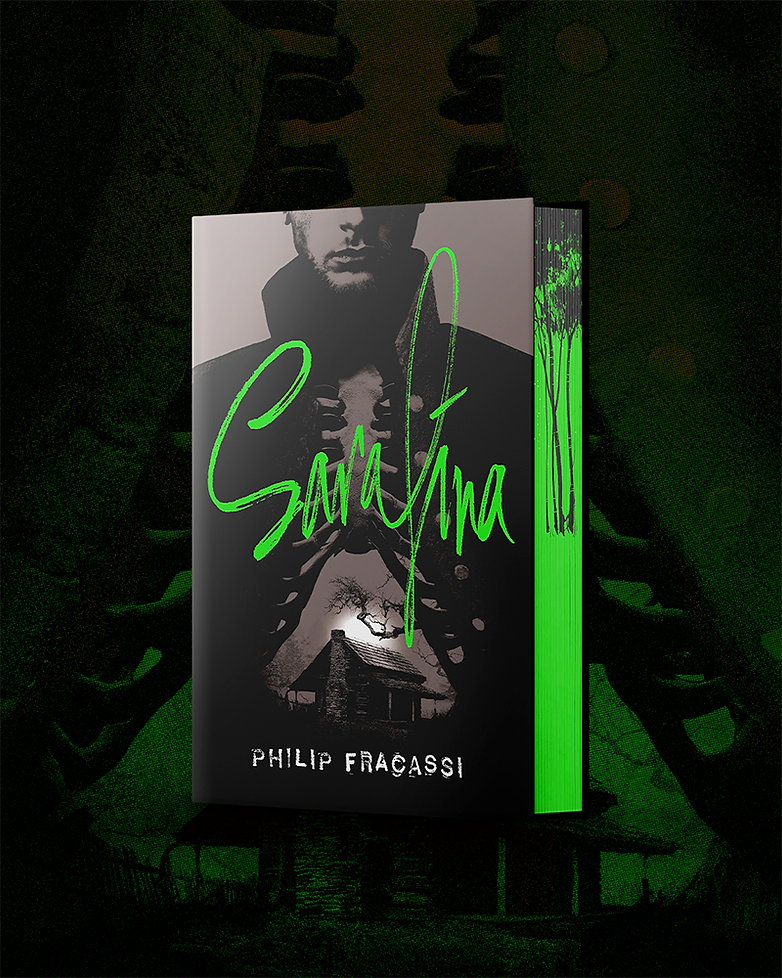
The year is 1862, and you’re a Confederate soldier who’s just watched a cannonball turn the man next to you into pink mist. You decide to run. That’s the easy part. The hard part comes when you stumble out of a swamp, starving and half-dead, and a beautiful woman in a pristine cabin offers you a warm meal and a soft bed. Because in Philip Fracassi’s Sarafina, that moment of salvation isn’t the end of your suffering. It’s the beginning of a far more intimate and perverse kind of damnation. This is a novel that weaponises hope, turning every sigh of relief into a prelude for something monstrous.
The book’s greatest trick is how it makes you complicit in its horrors. We meet the three Belle brothers, Ethan, Mason, and Archie, after they’ve deserted the Confederate army following the bloody Battle of Shiloh in 1862. They’re not heroes. They’re starving, paranoid, and willing to do ugly things to survive. When they find Sarafina’s homestead, a place of impossible plenty with fruit trees blooming out of season and a creek that seems to glow, the reader feels the same desperate lurch of joy the brothers do. You want this to be real. You want them to be safe. And that’s where Fracassi traps you.
Many readers have noted that the novel’s strength lies in its slow-burn dread, and they’re right. But Fracassi doesn’t just build tension; he builds a dependency. Sarafina, the enigmatic woman of the house, fixes Archie’s bullet wound with folk medicine that seems to work miracles. She feeds them, clothes them, and asks for almost nothing in return.
Except, of course, her dogs sometimes rip trespassers apart, and the youngest brother, Ethan, starts feeling like a fly stuck in amber. The genius of the pacing is that by the time you realise the cabin is wrong, you’ve already accepted its rules. The brothers have traded the chaos of war for the tyranny of domesticity. Fracassi asks a simple question: Would you rather die in a field for a cause you don’t believe in, or sell your soul for a hot meal and a feather bed? The answer is more terrifying than any ghost.
If you read Boys in the Valley, you know Fracassi loves to trap vulnerable people in confined spaces with something hungry. That book was a brutal masterpiece of claustrophobia. But Sarafina feels different. It feels bigger.
There’s a sentiment common among critics that Fracassi has levelled up here, moving from a promising genre writer to a heavyweight. I’d argue he’s stopped trying to scare you with the monster and started scaring you with the choice. In his earlier work, the horror was often external, a force that arrives and consumes. Here, the horror is a negotiation.
It’s a contract signed in blood because you’re too tired to read the fine print. The prose is less frantic, more confident. He lets the silences breathe. He trusts the reader to feel the wrongness of a pear tree in winter before he explains why it’s there. That takes a mature writer. He’s no longer proving he can write horror; he’s proving he can write literature that happens to be horrifying.
“Sarafina weaponises hope, turning every sigh of relief into a prelude for something monstrous. Philip Fracassi proves he’s not just a horror writer; he’s a literary force who uses the Civil War as a backdrop for a terrifying meditation on survival, guilt, and the price of peace.”
Reading Fracassi’s prose in Sarafina feels like watching a master glassblower working with smoke. The sentences are solid and crisp on the page, structurally sound, but the meaning inside them keeps shifting and morphing. You think you’re looking at a description of a fireplace, and then the heat distorts the air, and you realise you’re looking at a portal to hell. He uses a very specific, clean vocabulary to describe grotesque acts. When a body transforms or a deal goes wrong, he doesn’t lean on purple prose. He states the physical facts with a cold, journalistic precision that makes the skin crawl.
The narrative voice is also deceptively tricky. Most of the story is filtered through Ethan, the youngest brother, and his internal reckoning with the war. He notes quietly that “we’ve all lost a small part of who we are; some element piece I can’t define”. This is a young man hollowed out by violence. But Fracassi also interjects with chapters from the perspective of Ellie, Ethan’s twin sister, who is back home waiting for her brothers to return. These shifts are jarring at first, breaking the immersion of the woods. But they serve a vital purpose.
Ellie represents the “real world” that the brothers have left behind. Her chapters are grounded in the logic of 1862, the struggle of managing a farm, the fear of Union raids. They remind you that while Ethan is dealing with cosmic horror and ancient blood pacts, the war is still happening out there. It’s a brilliant structural choice that keeps the historical weight from floating away into pure fantasy.
On the surface, Sarafina plays with the trope of the “weird woman in the woods.” Horror is full of witch figures and folk devils. But Fracassi subverts this by making Sarafina neither purely victim nor villain. She offers a deal. It’s a terrible deal, but it’s fair. She doesn’t lie to the brothers; she simply omits the cost.
The novel feels like a missing link between the southern gothic dread of Michael McDowell’s The Elementals and the raw, emotional body horror of Clive Barker’s The Hellbound Heart. Like McDowell, Fracassi understands that the South is haunted not just by ghosts, but by the land itself. The creek and the cavern beneath the cabin are ancient, pre-dating the war, pre-dating America. Like Barker, he realises that pain and pleasure are often the same currency when dealing with the supernatural. What do you want? And what are you willing to lose?
The book also sits comfortably alongside something like Daniel Kraus’s The Ghost That Ate Us, using a realistic, almost mundane setting (a fast food restaurant in Kraus’s case, a farmhouse in Fracassi’s) to explore how group dynamics collapse under the weight of an irrational threat. The brothers distrust the woman, yes. But they distrust each other more. And that internal fracture is the real horror.
This isn’t just a story about a monster. It’s a story about the American Civil War, told from the losing side. Fracassi doesn’t romanticise the Confederacy. The brothers desert precisely because they see the cause is lost, “willing to risk execution rather than be killed in a losing war”. They are not heroes; they are survivors.
There is a deep rot in this book, a sense that the land itself is cursed by the violence of men. Sarafina might be a witch, but she is also a product of a world that has no place for women except as wives or specters. The book spotlights how the war shattered the concept of honour. The brothers are criminals in the eyes of the law, but saints in the eyes of their desperate mother.
When the supernatural elements erupt, they feel less like fantasy and more like the logical conclusion of a culture that worships power and violence. The creek isn’t magical because of some ancient god; it’s magical because it has been soaking up the blood of dying boys for three years.
Sarafina is a savage, beautiful, and deeply unsettling novel. It is the literary equivalent of a cannonball, but one that’s been rusting in the mud for a hundred and sixty years, waiting to infect the person who digs it up. You’ll turn the pages slowly, not because you’re bored, but because you’re afraid of what happens when you reach the bottom.
The moment Ethan makes a deal with Sarafina to save his brother, swapping his mortality for a promise he doesn’t understand, the book shows its true teeth. He thinks he’s buying time. He’s actually buying an eternity of watching the people he loves turn into things that don’t love him back. That’s the kicker. The war didn’t turn the brothers into monsters. Sarafina just gave them the space to realise they already were.
You don’t survive Sarafina. You just make it to the last page before the rot sets in.
Sarafina by Philip Fracassi
PRE-ORDER | ESTIMATED SHIPPING MID-LATE MAY 2026
SARAFINA By Philip Fracassi with an introduction by Nick Cutter
A historical horror novel where three brothers go AWOL during one of the most violent battles of the Civil War, but find something much worse waiting in the woods.
Choosing to risk execution rather than be killed in a losing war, three brothers desert their posts and begin a long, arduous journey back home. After weeks of dealing with rough terrain while evading bandits and home guard soldiers—starving, injured, and exhausted—the brothers find a miracle deep in the dark woods. A home.
Living in a remote cabin is a beautiful woman, Sarafina, and her young son, Titus. Sarafina takes the soldiers in, cares for them, feeds them, offers them a place to rest. But the youngest of the brothers is wary—something is not what it seems. After discovering a mysterious creek and a strange underground cavern, he gets a strong sense that the cabin, and the fertile land surrounding it, might be harbouring something nefarious, terrifying, and dangerous.
What ensues is a nightmare beyond imagination, an escalation of horrors that the brothers must somehow fight to survive. With tensions high, the country divided, and loyalties put to the test, Sarafina spotlights that Fracassi is a star of modern horror.
‘Builds his horrific tales slowly and carefully . . . he’s especially skilful at creating, and sustaining, suspense’ The New York Times
‘A shape-shifting fever dream: part historical epic, part coming of age—
but its horrors are one-hundred-proof: pure, potent, and wholly terrifying’ Nick Cutter
‘A fairy tale like no other, Fracassi has crafted a nightmarish story weaving together threads of mythology, history, fantasy, and horror that explores the bonds of brotherhood through a terrifying landscape of war, religion, and the supernatural’ Scream Magazine
‘The literary equivalent of a cannonball that’ll leave you bruised, bloody, and broken. . . will twist your stomach and shred your nerves’ Tyler Jones
- Product Details
- Signed and Numbered Royal Hardback
- Strictly limited to 1000 copies
- Alternate Colourway
- Designed artwork, endpapers and edges by Rian Hughes
- Debossed board artwork
- Brillianta Cloth Boards
- 90gsm Acid-Free Paper
- Sewn Binding
- Head & Tail Bands
- Block Sprayed Top and Bottom
- Litho Print