 By Jim Mcleod
Kenzie Jennings, Putting the Splatter into Splatterpunk
A Horror Author Interview by Lionel Ray Green
The debut novel Reception by Kenzie Jennings received, well, quite the reception, earning a Splatterpunk Awards nomination in 2020. The following year, her Splatter Western novella Red Station garnered another nomination. In 2023, Jennings received another nom for her debut collection Always Listen to Her Hurt.
The Florida author explains why she thinks her work resonates with peers and readers — and it’s not because of the splatter.
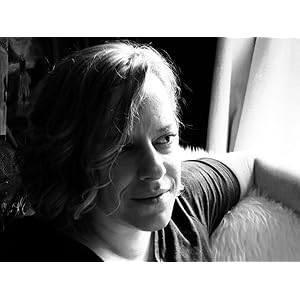
“To me — and I know I’m oversimplifying this — Splatterpunk seems to be about shattering boundaries and expectations,” Jennings says. “In other words, it often feels like a defiant ‘fuck you, I do what I want’ in your horror. However, it’s not pointless — it’s not necessarily gratuitous, in other words. At least, that’s how I feel about the Splatterpunk work that I enjoy.
“For example, Kristopher Triana’s Full Brutal shows the evolution of a psychopath, and her actions grow worse and worse, never reaching ‘full brutal’ until she’s hit the apex of her transformation. The extreme violence in it has purpose even while it’s utterly shocking. I think that’s essential in good Splatterpunk horror.
“I think my work resonates somewhat with readers, not for the Splatterpunk aspect of it but for the character building and having those characters go through such violent acts in the story. I like having readers wonder how those characters are going to get out of the literal bloody mess of a situation they’re in.”
Kenzie Jennings agreed to an exclusive interview with Lionel Ray Green for Ginger Nuts of Horror. The author shares how personal experiences influence her work, discusses her love story to Mad Max and Judge Dredd, and explains her approach to writing Splatter Westerns.
Kenzie Jennings, Putting the Splatter into Splatterpunk
A Horror Author Interview by Lionel Ray Green
Lionel Ray Green: What did the Splatterpunks Awards nomination for Reception mean to you as a first-time novelist?
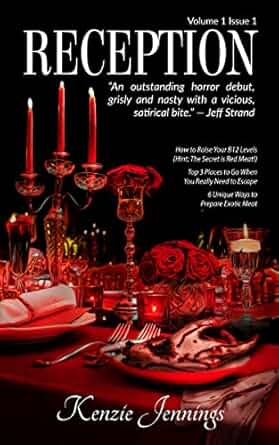
Kenzie Jennings: Working on Reception left me anxious in a way that’s hard to describe succinctly. For one, I NEVER thought I’d write anything so violent and gory, and I knew that would be an issue for readers, particularly people in my life who love books. Still, one can’t really write about cannibals without all the guts and body parts involved. Not only that,but Reception exposed something I’d been going through that was deeply personal.
We write what we know, and I knew about benzodiazepine withdrawal syndrome (BWS) as I was living through it at the time (some of those side effects still haven’t abated).
To have the protagonist dealing with that, and have it the core premise of the story, would be a gamble when it came to readership. Once it was out in the world, though, I was over the moon and relieved that folks enjoyed it. There were even some readers who reached out to me, sharing their own experiences of BWS. For a first-time novelist, I was able to see, in readers’ responses, the importance of that old writing “rule” — we write what we know, and that itself was thrilling … and deeply moving.
Lionel Ray Green: You were nominated for your Splatter Western titled Red Station. Your short story “About Her Given Name” was also in 2023’s Hot Iron and Cold Blood: An Anthology of the Weird West. What’s your explanation for why the American West of the 1800s became such a popular setting for the Splatterpunk subgenre in the 2020s?
Kenzie Jennings: I’ve absolutely no idea as to why or how the splatter western subgenre suddenly grew popular, especially since there have been notable authors who had written them well before the subgenre was even coined. Cormac McCarthy’s Blood Meridian and S. Craig Zahler’s Wraiths of the Broken Land immediately come to mind. Based on readers’ responses to Death’s Head Press’ series of splatter westerns, of which Red Station is a part, I think it was both the novelty and the focus on an old, familiar setting where extreme violence was not out of the ordinary whatsoever.
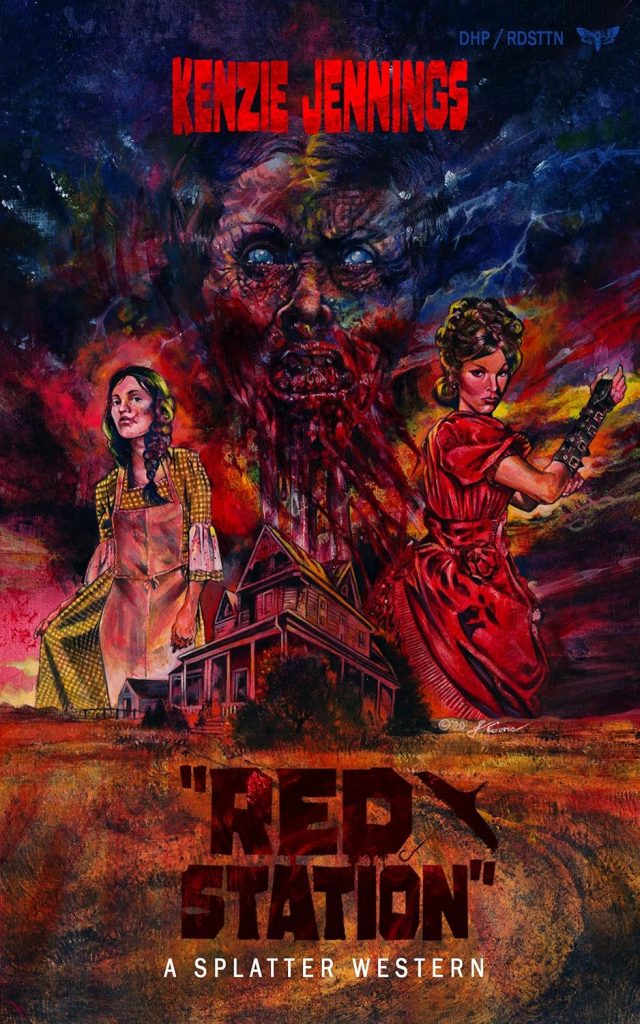
I must credit Patrick C. Harrison III, who’d been co-owner of DHP at the time, for bringing the subgenre to everyone’s attention. He invited a few of us authors who’d previously published with DHP to write a stand-alone book. I took part because the challenge of it excited me. For one, I didn’t like westerns much.
I found them so male-centric. Writing one though allowed me to switch things up a bit, including my approach. I wasn’t writing a horror novel for western fans. Instead, I was writing a western for horror fans. That made the overall premise easy, and as a result, the research was much more interesting to me. Basically, I wrote a slasher that took place in a single location. The details around that simple premise, especially in its characters, were what made Red Station an engaging time.
Lionel Ray Green: Your short story collection Always Listen to Her Hurt featured an emotional introduction. You write about being haunted as a child by the Wall Face, a memory that continues haunting you as an adult in various guises. It even led to a revealing conversation with your mother. How much do those experiences influence your dark fiction today?
Kenzie Jennings: There are certainly some elements of my work that are influenced in some way by personal experiences, and I find it therapeutic to incorporate those experiences in horror stories. I realize, of course, that’s not particularly unique. Sometimes, however, it’s necessary to get those memories, or traces of them, the acceptance and/or closure that may be needed.
I don’t know about other authors, but lately, writing has also revealed repressed memories. For instance, I’ll be working on a scene and have a character do something … or witness something … or act in some way that feels familiar to me, and later, the memory suddenly comes to me, clear as day. It’s overwhelming when it does, but I’m also grateful that it had surfaced, that I hadn’t gaslit myself by denying its existence in my life.
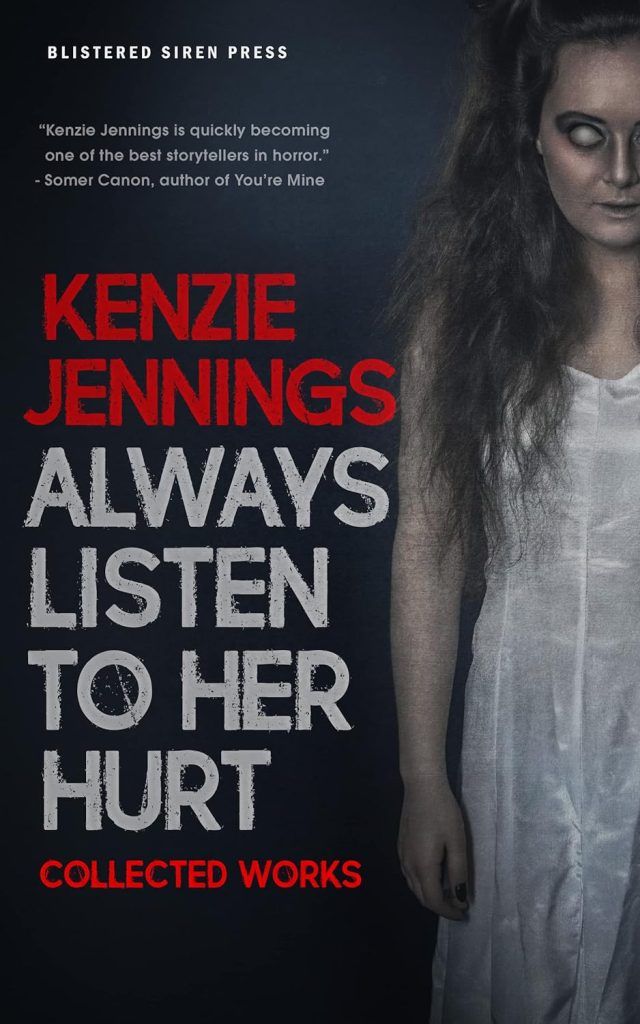
Lionel Ray Green: My favorite Kenzie Jennings story is the opening tale in Always Listen to Her Hurt titled “Wreckers.” It’s a banger of a cult story with a cinematic flair. You’ve had several short stories in various anthologies and collections in addition to your longer fiction. Which one is the best introduction to your work?
Kenzie Jennings: You’ve actually mentioned the story that I think is the best introduction to my work, particularly my horror fiction. “Wreckers” is not only my favorite piece, it’s also the story that has actually given me nightmares. I’d always wanted to write a story centered around a cult since cults have fascinated me for quite some time.
The fact that it only takes a seductive leader with a unifying message to get people to join them is frightening to contemplate. I took that one step further and made it a worldwide cult, with a number of cells, intending to cause an apocalyptic event as revenge for what humans have done to destroy the earth. What the cult does out of revenge is a deep personal fear of mine:
They cause vehicle crashes deliberately, ones that are utterly devastating. I’ll add that two of the most dangerous roads in the U.S. exist in central Florida close to where I live, US27 and I-4. Every time I have to take either of those roads to get somewhere outside of the county, my stomach ties in tight, scratchy knots. I mean, how could I not turn that into a horror story?
Lionel Ray Green: In 2023, you released a post-apocalyptic love story titled The Poisoner’s Last Ride. Can you share a brief description of the plot for those who haven’t read it, and what inspired the story?
Kenzie Jennings: The Poisoner’s Last Ride is the closest I’ll get to writing any sort of fan fiction. The story centers on a couple living in a post-apocalyptic city where certain citizens, such as the couple, are assigned to be executioners as a method of population control. When we’re introduced to them, it’s their last day there as they’ve plotted their escape to the wastelands. The whole experience in The Poisoner’s Last Ride is a glorified love letter to Mad Max and Judge Dredd fans like myself, and I’ve added a few Easter eggs that suggest that this could be set in those worlds.
Lionel Ray Green: In your 2024 short story collection A Woman Like Jo, you say you like to write about “interesting, smart women in strange and horrifying situations.” What’s been the strangest, most horrifying situation that you’ve put one of your female characters in?
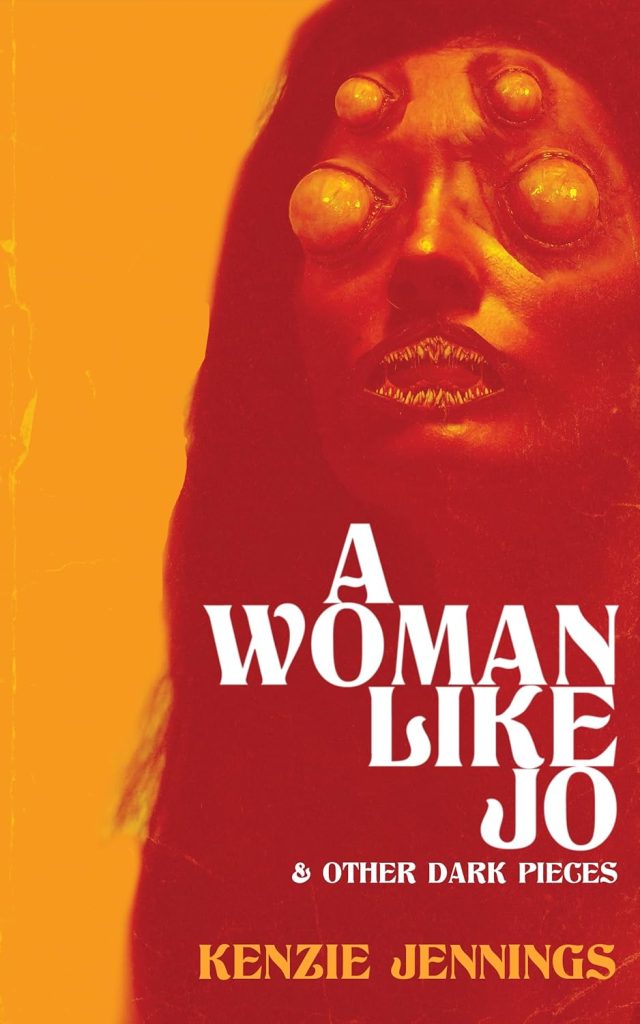
Kenzie Jennings: I don’t know if it’s symbolic, representing a significant part of my life, but looking back, I realize now that a number of my stories center around heroines escaping something horrifying. However, there is a story in A Woman Like Jo — “The Third Woman” — where the protagonist experiences a variety of terrifying situations in her life, and she doesn’t necessarily escape them.
“Tell Greg,” a story that had been published originally in Monstorm: A Charity Anthology of Horror (Madness Heart Press), had a strange and frightening situation happening to its protagonist too. In it, a thief has broken into a house during a hurricane, and she winds up being stuck there in flooded surroundings with a sinister, supernatural presence lurking in the dark with her. Hurricanes are bad enough as it is. I could only imagine the added horror of something inexplicable and evil there as well.
Lionel Ray Green: What is your next project in the works and when can us fans expect it?
Kenzie Jennings: The next project that will be out before the end of the year is a somewhat collaborative endeavor. Four Florida based authors — K. Trap Jones (who came up with this project’s premise), Armand Rosamilia, Lucas Milliron, and I — have written zombie-themed novelettes set in the regions of Florida where we’re each located (mine’s central Florida, obviously).
The other catch, besides being set in Florida, is that there are some infected who are decaying only on the outside while their vital organs are, for the most part, still active. Due to that anomaly, these infected have to hire black market doctors called “Stitchers” who specialize in procuring and stitching exterior parts that need replacing due to rot. My tale, The Baby Stitcher: A Tale In Soft Parts, is about a motel employee working in a “Trap Zone” — one out of a number of reclaimed tourist trap areas that basically make up much of what’s left of central Florida.
One night while she’s on duty, she winds up in an improvised baby-saving mission. I had such a great time writing this one. It has a dark fairy tale vibe to it that I hope readers catch on to and enjoy.
Further Reading
If you’re a fan of horror literature and cinema, then you absolutely need to check out the horror interview section of Ginger Nuts of Horror.
Firstly, the interviews feature a diverse range of authors, filmmakers, and horror enthusiasts, allowing readers to gain a multifaceted understanding of the genre. Each interview is an opportunity to explore the creative processes, inspirations, and personal stories behind the minds that produce some of the most chilling and thought-provoking works in horror today. From seasoned veterans to up-and-coming talents, the variety of voices ensures that readers can find something that resonates with them.
Moreover, these interviews often delve into the nuances of what makes horror such a compelling genre. Contributors share their thoughts on the psychological aspects of fear, the societal influences on horror trends, and the ways in which horror reflects cultural anxieties. This deeper exploration not only enriches one’s appreciation for horror stories but also fosters discussions about broader themes, such as identity, morality, and existential dread.
The interviews frequently touch on practical advice and industry insights. Writers and creators often share the hurdles they faced in their careers, tips for aspiring horror writers, and the realities of getting published or produced. This wealth of knowledge is invaluable for anyone looking to navigate the sometimes challenging waters of the horror genre. Readers interested in breaking into horror writing or filmmaking will find a treasure trove of wisdom that could pave their path toward success.
Lastly, the community aspect of Ginger Nuts of Horror cannot be overlooked. Engaging with these interviews allows readers to feel connected to a larger community of horror enthusiasts. Comment sections and social media interactions often follow, enabling fans to discuss their thoughts and engage with both the interviewees and fellow readers.
In conclusion, the horror interview section of Ginger Nuts of Horror is an essential resource for anyone interested in the genre. It provides rich insights, guidance, and inspiration that can deepen one’s appreciation for horror while fostering a vibrant community among fans and creators alike. Don’t miss out on the chance to delve into the minds of your favorite horror creators!