
Luc Besson’s Dracula
When a 15th-century prince denounces God after the devastating loss of his wife, he inherits an eternal curse and becomes Dracula. Condemned to wander the centuries, he defies fate and death, guided by the hope to be reunited with his lost love.
Initial release: 30 July 2025
Director: Luc Besson
Running time: 2h 9m
Music composed by: Danny Elfman

For over a century, one name has cast a longer shadow across cinema than any other monster, superhero, or folk hero: Dracula. Since his first unauthorised cinematic outing in 1922, the Transylvanian Count has proven to be truly undead, resurrected in hundreds of films that range from revered artistic masterpieces to curious, forgetful misfires. As each new filmmaker, like Luc Besson, takes up the mantle, they join a lineage stretching back through the decades, attempting to find fresh blood in a story we all know by heart. This is the rich, complex, and often surprising history of Dracula on film, a tale of iconic performances, bold reinventions, and the perpetual struggle to make a timeless monster feel new again.
The journey begins not with a bang, but with a silent theft. F.W. Murnau’s Nosferatu (1922) was an unauthorized adaptation of Bram Stoker’s novel, forced to change names and details but unable to disguise its source. Yet, this act of cinematic piracy birthed an icon. Max Schreck’s Count Orlok, with his rodent-like features and palpable menace, presented a vampire stripped of romanticism—a pure, unsettling creature of pestilence. The film’s chilling atmosphere and Expressionist visuals set a high bar for Gothic horror, proving the power of Stoker’s creation even when ripped from its original context.
The defining image of the vampire, however, came from an official source. Bela Lugosi’s performance in Dracula (1931) didn’t just play the Count; it crystallized him for the popular imagination. With his hypnotic stare, deliberate cadence, and sweeping cape, Lugosi’s portrayal established the archetype of the vampire as a sophisticated, seductive, and foreign aristocrat. His thick Eastern European accent, though not from the novel, became inseparable from the character for generations. This film launched Universal’s classic monster era and made Dracula a household name, though it typecast Lugosi for life.
In 1958, Hammer Film Productions reinvigorated the genre with Horror of Dracula, introducing a new kind of monster for a new era. In vivid Technicolor, Christopher Lee’s Dracula was a revelation—a physically imposing, ferociously sexual, and explosively violent predator. Lee brought a “dark, brooding sexuality” to the role, presenting Dracula as a figure of terrifying allure. Alongside Peter Cushing’s vigorous Van Helsing, this film injected a potent dose of blood and sensuality into the mythos, spawning a long-running franchise and forever altering the vampire’s image from creeping menace to dynamic threat.
The quest for a definitive, faithful adaptation seemed to culminate with Francis Ford Coppola’s Bram Stoker’s Dracula (1992). Positioning itself as the novel’s true cinematic counterpart, the film was a lavish, operatic, and wilfully excessive spectacle. Gary Oldman’s transformative performance spanned centuries, from a tragic medieval warrior to a refined old-world nobleman, grounding the film’s central, invented theme: a tragic romance across time.
While praised for its audacious visual style, sumptuous production design, and commitment to Gothic excess, the film also faced criticism for narrative indulgence and uneven performances. Yet, its cultural impact was undeniable, winning Academy Awards and reinforcing the idea of Dracula as a tragic, romantic anti-hero.

For every high point, the path is littered with creative misfires that test the loyalty of even the most devoted fans. The list of strange and unsuccessful adaptations is long: from the disco-era styling of 1979’s Dracula starring Frank Langella to the baffling space-bound horror of Dracula 3000 and poorly received attempts like Dracula 3D. These films serve as a reminder that the Count’s immortality is no guarantee of quality; he is as vulnerable to bad scripts and misguided concepts as any mortal character. The very frequency of these adaptations highlights the central challenge: in a landscape where everything from the monster’s origins to his romantic motivations has been explored, what is left to say?
This endless cycle of homage and reinvention brings us to the latest attempt to solve this eternal puzzle: Luc Besson’s Dracula. As a filmmaker known for stylized action, Besson enters a conversation started over a hundred years ago, one where the shadow of Coppola’s 1992 romantic epic looms particularly large.
The central question for any new adaptation is no longer just about fear, but about originality itself: in a landscape where every angle seems explored, can a director find a new vein to tap, or are we destined to see the same immortal story retold? It is this very challenge that critic Hope Madden examines in her review of Besson’s film, asking whether his take “merit[s] another go” in the endless procession of the Count.
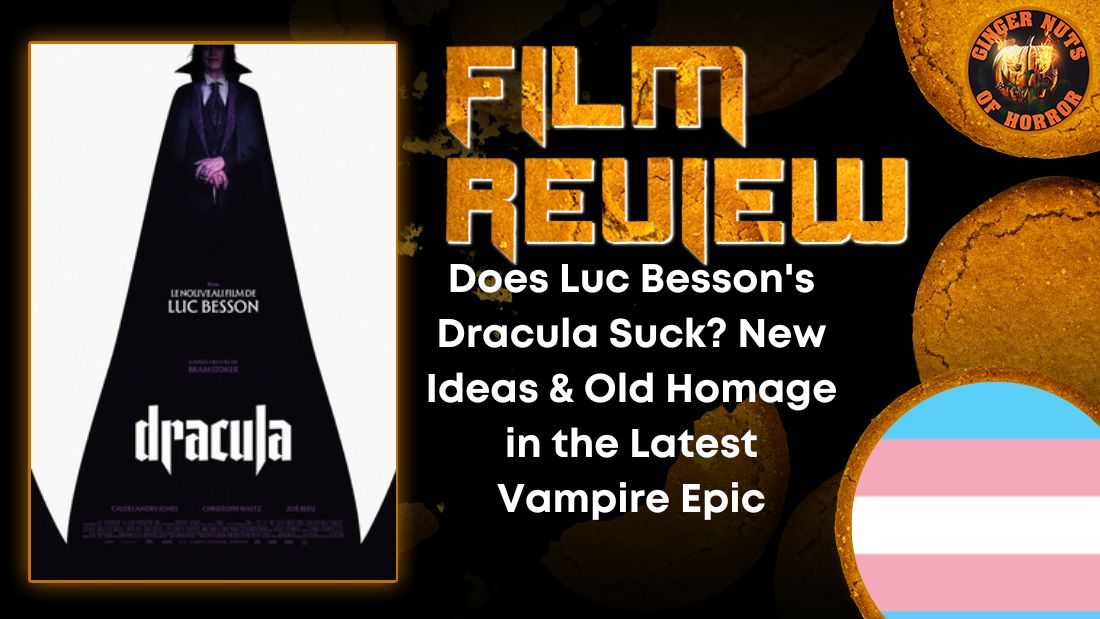
Does Luc Besson’s Dracula Suck? New Ideas & Old Homage in the Latest Vampire Epic
A Horror Movie Review by Hope Madden
There are those who would call Francis Ford Coppola’s 1992 film Bram Stoker’s Dracula a masterpiece. The score is undeniable, the costuming and set design glorious, the use of shadow, the creature design, the pulsing sensuality, Gary Oldman—all of it is exquisite. The entire balance of the ensemble? Terrible. There, I said it.
Still, it’s a memorable take—for many, a beloved all-timer—on Stoker’s vampire classic. I will assume that French filmmaker Luc Besson (Léon: The Professional, La Femme Nikita) is a fan. While his Dracula delivers much in the way of new ideas, the source material for his script is less Stoker’s novel than Coppola’s film.
He’s not hiding it. He even borrows—homages—bits and pieces of Wojciech Kilar’s score.
Caleb Landry Jones is Vlad the Second, Count Dracul. He loves his wife, Elizabeta (Zoë Bleu). He fights the Crusades to eradicate Muslims for God. But God does not protect his Elizabeta, so he curses God and searches the endless centuries, hoping for his loves return.
This storyline is 100% Coppola, not in the novel at all. Landry Jones is a talented actor, and versatile. See Nitram. But his performances tend to be somewhat interior, and you cannot help but compare his anguish over Elisabeta with Oldman’s in the ’92 film. Landry Jones comes up short.
And though Besson manages one pretty impressive wide shot of the Vlad armies, the earth burning behind them, nothing can compare to the macabre puppet masterpiece Coppola brought to the same scene.
But, after Act 1, the film settles into some new territory. France! No Renfield, no Van Helsing, no fight for Lucy’s hand, no Demeter. Christoph Waltz (a little bit autopilot here) is a priest whose order has been tracking vampires for 400 years. With this storyline, Besson, who wrote the script, forges some new ideas. Newish. And Matilda De Angelis is a particular joy as Dracula’s helper.
Fresh ideas aside, Besson doesn’t bring much Besson to the film. There’s too little action here, and most of it is carried out by little CGI gargoyles, more comedic than thrilling. One scene doesn’t naturally lead to the next, characters feel disconnected to the plot, and, worst of all, it’s very talky and a bit dull. I’d call it a fanciful period piece before I called it horror.
It’s OK to borrow. What’s hard is to come up with anything original, because no fictional character has been on screen more often in the history of film than Dracula. Even Jesus hasn’t been depicted as often in film. So, it’s fine to borrow as long as you can do something new to merit another go. Besson just about accomplishes that. Just about.
Why Ginger Nuts of Horror is the #1 Resource for Horror Fans
Unmatched Depth & Legacy in Horror Books
Reviews: With 17 years of reviewing horror, we offer an unparalleled perspective. Our reviews expertly guide you from mainstream bestsellers to under-the-radar indie gems, helping you find your perfect, terrifying read.
Exclusive Access to Horror Authors: Go behind the scenes with in-depth interviews that reveal the minds behind the madness. We connect you with both legendary and emerging horror authors, exploring their inspirations and creative processes.
Award-Nominated Authority & Community: Founded by Jim McLeod, Ginger Nuts of Horror has evolved from a passion project into an award-nominated, essential horror website. We are a global hub for readers who celebrate horror literature in all its forms, from classic ghost stories to the most cutting-edge dark fiction.
Experience the Difference of a Genre-Dedicated Team
What truly sets us apart is our dedicated team of reviewers. Their combined knowledge and authentic enthusiasm ensure that our coverage is both intelligent and infectious. We are committed to pushing the genre forward, consistently highlighting innovative and boundary-pushing work that defines the future of horror.
Ready to dive deeper?
For horror book reviews you can trust, a horror website that champions the genre, and a community that shares your passion, Ginger Nuts of Horror is your ultimate destination. Explore our vast archive today and discover why we’ve been the top choice for horror fans for over 17 years.