
The New Role of Video Games in Modern Education
There is a moment most gamers know well. The one where hours pass without notice, not because the game is mindless, but because the brain is genuinely locked in. Problem solving, pattern recognition, resource management, split second decisions. None of that feels like learning. But it is.
That gap between what feels productive and what actually is has been widening for decades in formal education. Sitting in a lecture hall copying notes from a slide deck does not automatically produce understanding. Yet for the longest time, that was the default. The conversation around video games in education is really a conversation about that gap, and whether closing it is finally being taken seriously.
It is. Slowly, but it is.
From Suspicion to Strategy
For a long time, video games existed in educational spaces mostly as a reward or a cautionary tale. Finish the worksheet, then maybe play Oregon Trail. Too much screen time, the story went, rots attention spans and ruins grades. The research simply did not support that framing, but the perception stuck.
What changed things was not a single study. It was the accumulation of evidence across institutions that started treating game based learning as a legitimate pedagogical approach rather than an experiment. MIT’s Education Arcade project, for one, spent years building the case that well designed games can teach systems thinking, historical reasoning, and scientific inquiry far more effectively than passive reading. Around the same time, Writeanypapers expanded its reach to support students navigating complex academic expectations, a sign that traditional instruction alone was leaving real gaps in comprehension and confidence.
The shift from skepticism to strategy happened because educators started asking a different question. Instead of “should students be playing games,” the question became “what are games doing that classrooms are not.”
What the Data Actually Shows
Numbers help ground this conversation. According to a 2023 report from the Joan Ganz Cooney Center, students who engaged with curriculum integrated games showed a 12 percent improvement in retention rates compared to those in traditional instructional settings. That is not a marginal difference.
The Entertainment Software Association reported that roughly 76 percent of American children under 18 play video games regularly. That is not a trend educators can afford to ignore. When the majority of students already arrive fluent in the logic and mechanics of digital games, refusing to leverage that fluency is a choice, not a neutral default.
A growing body of research around gamification in education also suggests that even surface level game mechanics, things like progress bars, achievement badges, or timed challenges, can meaningfully shift student motivation. For students navigating complex academic demands alongside these evolving learning environments, access to resources like custom dissertation writing help can further support their ability to stay engaged and succeed. Dr. Jane McGonigal, whose work at the Institute for the Future helped put this conversation on the map, has argued for years that games train people to believe their efforts will produce results. That belief, she argues, is one of the most transferable skills imaginable.
What Good Implementation Actually Looks Like
There is a difference between educational video games for students that are genuinely well designed and digital worksheets dressed up with point systems. The distinction matters.
The best examples share a few characteristics:
- Failure is expected and instructive. Games like Kerbal Space Program, used in physics and engineering programs at schools including the University of Florida, penalize poor planning but reward iteration. Students crash rockets dozens of times before a launch succeeds. That process teaches more about Newton’s laws than any textbook chapter.
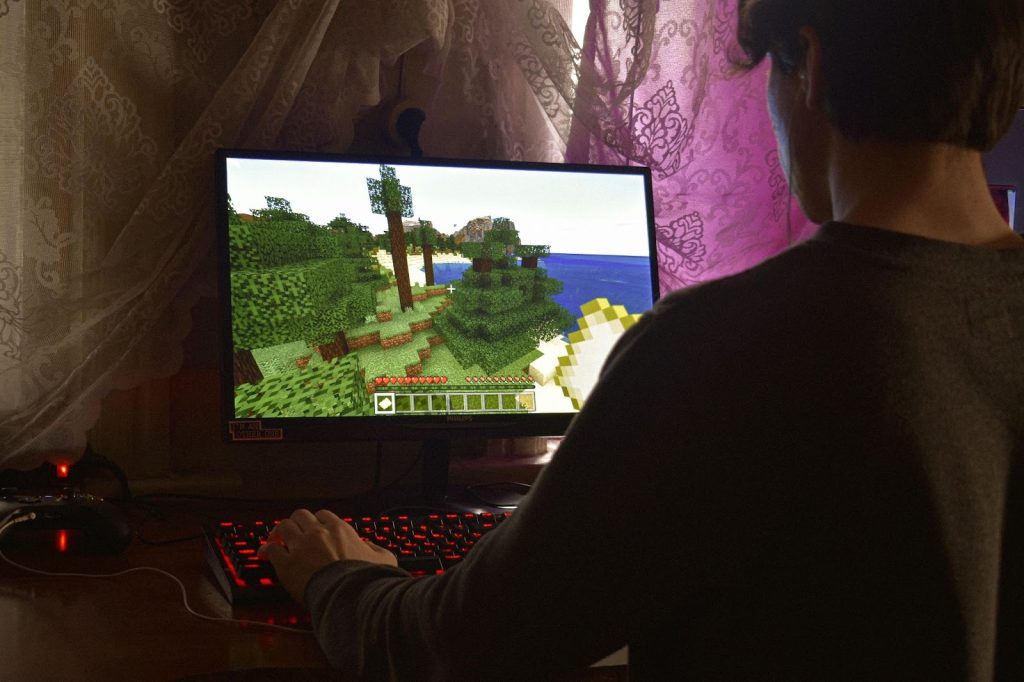
- Agency is real, not simulated. Students make choices that shape outcomes. This is what separates something like Minecraft: Education Edition from a glorified quiz app. The open ended construction mechanics require genuine spatial reasoning and collaborative problem solving.
- Feedback is immediate. A student who gets a quiz back a week later cannot easily connect that feedback to the thinking they were doing when they answered. Games provide feedback in real time, which is how learning actually sticks.
- The content is not bolted on. Games where the academic subject is woven into the mechanics, rather than just used as a theme, consistently outperform those where learning objectives feel like interruptions.
The table below illustrates a few commonly referenced games across subject areas and the skills they develop:
| Game | Subject Area | Core Skill Developed |
| Kerbal Space Program | Physics / Engineering | Iterative problem solving |
| Minecraft: Education Edition | STEM / Collaboration | Spatial reasoning, teamwork |
| iCivics | Civics / Government | Policy thinking, cause and effect |
| DragonBox | Mathematics | Algebraic reasoning |
| Civilization VI | History / Geography | Systems thinking, strategy |
The Classroom Is Not the Only Venue
One thing that gets overlooked in discussions about the benefits of video games in the classroom is that formal instruction is only part of the picture. Students learn outside school, too. The rise of self directed educational content on platforms like YouTube and Twitch, channels where educators speedrun history lessons or streamers narrate their thought processes in real time, suggests that the line between entertainment and instruction is dissolving on its own.
Duolingo has over 500 million registered users. Its success has almost nothing to do with being a traditional language app and almost everything to do with being a well designed game that happens to teach vocabulary and grammar. The lesson there is not subtle.
Higher education institutions are beginning to catch up. Quest to Learn, a New York City public school that built its entire curriculum around game design principles since 2009, has produced graduates who consistently outperform national averages in problem solving assessments. The school did not invent a new pedagogy from nothing. It borrowed heavily from what games already do well: structured challenge, collaborative play, iterative design.
The Resistance Worth Taking Seriously
None of this means the skeptics are simply wrong. There are legitimate concerns about screen dependency, about the uneven quality of educational software, and about what gets sacrificed when play replaces direct instruction in core subjects. Not every student thrives in game based environments, and a 13 year old who already struggles with impulse control does not necessarily benefit from more time in front of a screen, even a “learning” one.
The strongest criticism of gamification in education is that it can mistake engagement for learning. A student who is highly engaged but not acquiring transferable knowledge or critical thinking skills has not been well served. Points and badges, stripped of meaningful content, are just noise.
That criticism holds. But it is an argument for doing this well, not for abandoning it.
Where the Field Goes Next
The trajectory here is not hard to see. Adaptive learning platforms are becoming more sophisticated. AI integration in educational software is moving from novelty to infrastructure. Virtual reality applications in medical education, already in use at institutions like Case Western Reserve University, are beginning to influence how other disciplines think about immersive learning environments.
The future of video games in education is not about replacing teachers or classrooms. It is about giving educators better tools, and recognizing that students who spend hours mastering a complex game are already demonstrating the exact cognitive habits that formal education is supposed to cultivate. Persistence, pattern recognition, creative problem solving, tolerance for failure.
Those skills were always the point. The medium that develops them is less important than whether they actually develop. Right now, for many students, games are doing the work that other formats have not managed to do. That deserves a serious and honest response from the institutions that are supposed to care about learning outcomes.