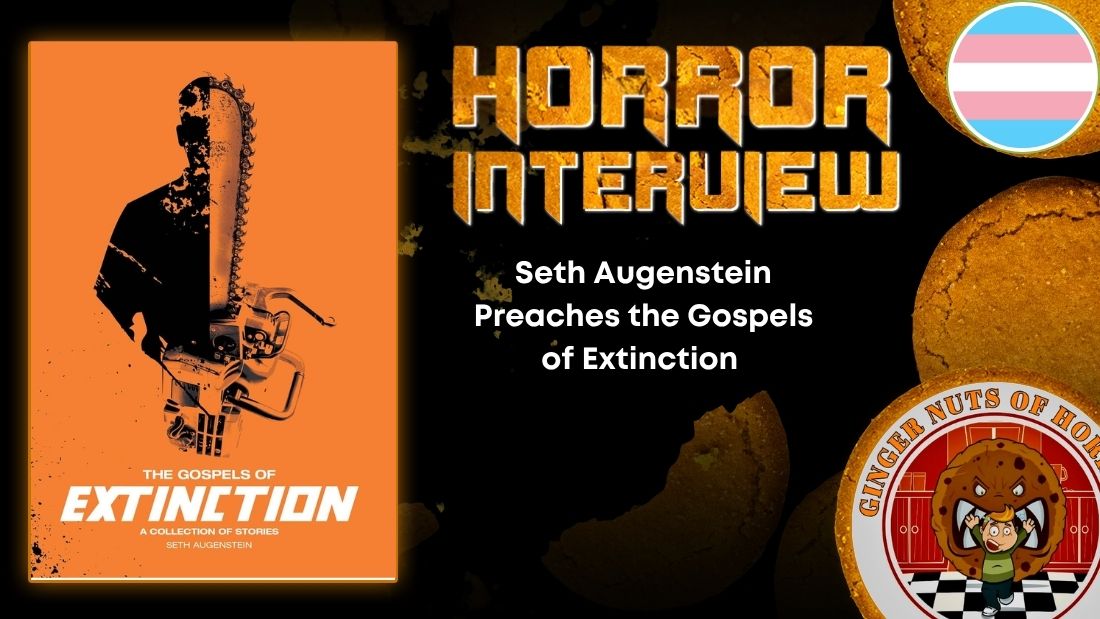
Gallows humor. Ancient curses. Family trauma. One hell of a collection.

Seth Augenstein spent years as a newspaper reporter chasing real crimes and tragedies. He saw enough genuine darkness to know that sometimes fiction makes better sense of it all. His debut short story collection, The Gospels of Extinction, arrives June 1 from Lost Meridian Press. It brings together dozens of his previously published stories into one place.
This is not a typical horror short story collection. Augenstein writes literary horror with a sharp edge. He mixes gallows humor with genuine dread. One story features Ayn Rand wielding a chainsaw during a marital breakdown. Another follows an annoyed ghost watching a tour group wander through her home. The book includes cannibalism, ancient curses, family trauma, and a lot of dark laughs along the way.
Augenstein cites influences ranging from Goya’s Black Paintings to Shostakovich’s eighth string quartet. He names Brian Evenson, Jeffrey Ford, and Laird Barron as his silent mentors. But the voice here is his own. Calm. Confident. Unafraid to let a sentence run long or cut it short for effect.
The title says it all. These are gospels for a hostile world. Not religious texts, but stories that wrestle with injustice, extinction, and the strange hope buried inside despair. If you like horror that thinks while it scares you, this collection deserves your attention. Let’s dig in.
Let’s start at the very beginning. For our readers, please introduce yourself. Beyond the author bio, tell us a little about who you are when you’re not writing, what you love doing, what fascinates you, and what fuels your creativity.
I’m a curious pain-in-the-you-know-what from New Jersey. As a young newspaper reporter, I was pretty relentless in finding out what was actually going on around me in my place and time. I’ve always been an addict of history – and in many ways I have always felt that I am trying to help write the History of My Time (as limited as it may be).
My first novel was a sci-fi medical thrilled called Project 137 which took the horrific WWII history of Unit 731 – and the true-life cover-up – and set it on a rocket to the future, incorporating pandemic conspiracies in the year 2087. It was pretty well received, and it has been optioned for film.
My second, was a strange avant-garde project. A kind of Western set in a war-torn corner of the world: Innermost Asia and Mongolia at the turn of the 20th century. It was very well received, but it did not sell well. Both novels went out of print when my publisher went out of business in 2025.
Throughout, my foundational love of horror was reserved for short stories – the sweetest spot of all for intensely-distilled visions. I have published dozens of these stories in small magazines, and on podcasts. They are all now coming together in my first story collection, The Gospels of Extinction, coming June 1 from Lost Meridian Press.
In the early stages of a new project, what tends to come to you first: a compelling character voice, a central thematic question, or a vivid image/scenario? How does that initial spark then guide you in building the rest of the story?
“What if” is the way that stories bubble up within me – and this is especially true with the best ones that I see through to completion and through the editing process.
I think of two of these stories. One was while I was doing my daughter’s bedtime – and she was telling me a story from that day at summer camp. She was telling me a story, and it was about the counselors not being great, and I thought about what would happen if these counselors were part of a longtime blood curse from the hatred against the local natives people. That became “Bedtime Story.” Another one was when I was sitting on my old wraparound porch and I mused on what would happen if a dead loved one came right up the walk at that moment. Mix that with some personal formative experiences, my beloved Mossberg shotgun, and a bit of death-cult Mesoamerican history, and voila! “Inheritance” was bored.
Every book has its own unique set of problems to solve. What was the most difficult ‘puzzle’ you had to crack while writing this book? Was it a plot hole, a character’s motivation, the structure, or something else entirely?
The biggest puzzle was how these “gospels” all fit together. I left a half-dozen published stories on the cutting-room floor – and I left aside another dozen or so which are newer but involve different themes. The Gospels of Extinction is a book that fits 2026, and this middle-aged version of my writer’s mask: it has anxiety of family, ghosts of ruinous and unjust pasts, future terrors, a lot of cannibalism, and a bunch of gallows humor at all the doom around us. People NEED this book now (I believe this utterly).
The journey from a finished manuscript to a book in a reader’s hands can be a surprising one. What was the most significant way your book evolved during the editing and publishing process, something you didn’t anticipate when you typed ‘The End’?
I didn’t think this book would end up in the same place where it started. I published my first novel in 2019, and my second in 2023. In the years between that, and between editing on those projects, I wrote dozens and dozens of stories. This was at the behest of Ray Bradbury who challenged writers by saying (I paraphrase): write a hundred stories… not all of them will be bad. And I found a bunch of ones which came out of a monklike COVID existence… and some of these tales taught me about myself, and what I believe about the world and humanity (or lack thereof). That’s where you get a title like The Gospels of Extinction, after all!
Once a book is published, it no longer entirely belongs to the author; it belongs to the readers and their interpretations. Has a reader’s reaction or analysis ever revealed something about your own work that surprised you?
Yes – continually. Whenever people have read and reviewed my stuff, they generally pick up what I’m doing. But I think a lot of the play – the humor and the lighthearted stuff – goes overlooked. It’s subtle. But then again, my favorite current short-story writer, Brian Evenson, is absolutely hilarious in intermittent bursts, and he doesn’t get enough credit for that, either.
Writing is a demanding, often solitary pursuit. Beyond the apparent goal of ‘telling a story,’ what is the specific, personal fuel that keeps you going through the difficult stretches? Is it the joy of discovery, the need to understand something yourself, the connection with a future reader, or something else?
All of that – discovery, need for insight, connection with others, all of it. But mostly it’s my form of prayer. I grew up religious and I have since lost that pretty thoroughly. By this form of quasi-devotional meditation, I am finding my place in the universe. And it is my way of grappling with what I perceive to be problems in this only plane of existence that we know.
As per horror: wrestling with true injustice and terror through metaphor (supernatural or otherwise) is a way to exorcise those demons. I wrote a lot of true-crime as a reporter for newspapers and for Forensic Magazine, but I have since developed a kind of aversion for that. It’s too real. I need to wrestle with that in other ways, in horror fiction.
We often hear about authors being influenced by other books. What are some non-literary influences on your work, such as a specific piece of music, a historical event, a scientific theory, or even a landscape, that have profoundly shaped your storytelling?
Non-literary influences on this book include:
- Goya’s “Black Paintings”
- The genocide of Native Americans
- Shostakovich’s Op. 110, 8th string quartet
- Manic Street Preachers, “The Holy Bible” album
- A cemetery in the middle of the forest, formerly a bustling mining town in New Jersey, destroyed in part by an industrial tragedy
- A haunted house down the road from me
- The poem “Frost at Midnight” by Samuel Taylor Coleridge
- Crimes too innumerable to list here, especially the familicides of John List in my childhood hometown.
- DNA science, especially about man’s earliest beginnings – and what we inherit in our genes
- The now-blown-up Georgia Guidestones (Stonehenge of the Deep South in America)
- The Battle of the Somme
- Offices of dying newspapers
- The Theory of Relativity
Is there an author, living or dead, whom you consider a ‘silent mentor’? Not necessarily someone you try to imitate, but whose approach to the craft made you feel permission to write in your own way?
It depends on the projects. With my last novel, Cormac McCarthy loomed large. With this collection, it’s definitely a triad of living authors of incredible story collections who I pretentiously think I’m in “conversation with” : the aforementioned Evenson, Jeffrey Ford, and Laird Barron. I also really really liked Kate Folk’s last collection.
As ever, however, we are all Poe’s children. I am inheritor of him that came before.
Who was the first person to see your early drafts, and why did you trust them with your unpolished work? What is the most valuable piece of feedback they gave you?
All these stories were published, and only after my wife read each of them a bunch of times. She has absolutely no patience with bad writing, so if she brushed me off, I knew I had not yet polished that particular gem to what I though it could be. There are probably a dozen which were so rebuffed by her that they are now lost to the ether – and probably rightfully so.
Horror is often most potent when it’s internal. Beyond external monsters, how do you explore the slow unravelling of a character’s sanity or the horror of their own mind?
Hard question. But I think I always try to employ the empathy I have for people, which I think is considerable from talking to hundreds if not thousands of people who were victims of crime or tragedy over my years as a reporter. From there, I try to inhabit that mind/soul – and then turn the suffering “up to eleven,” in the parlance of Spinal Tap. That’s where you get the makings of intensity, literature – and horror.
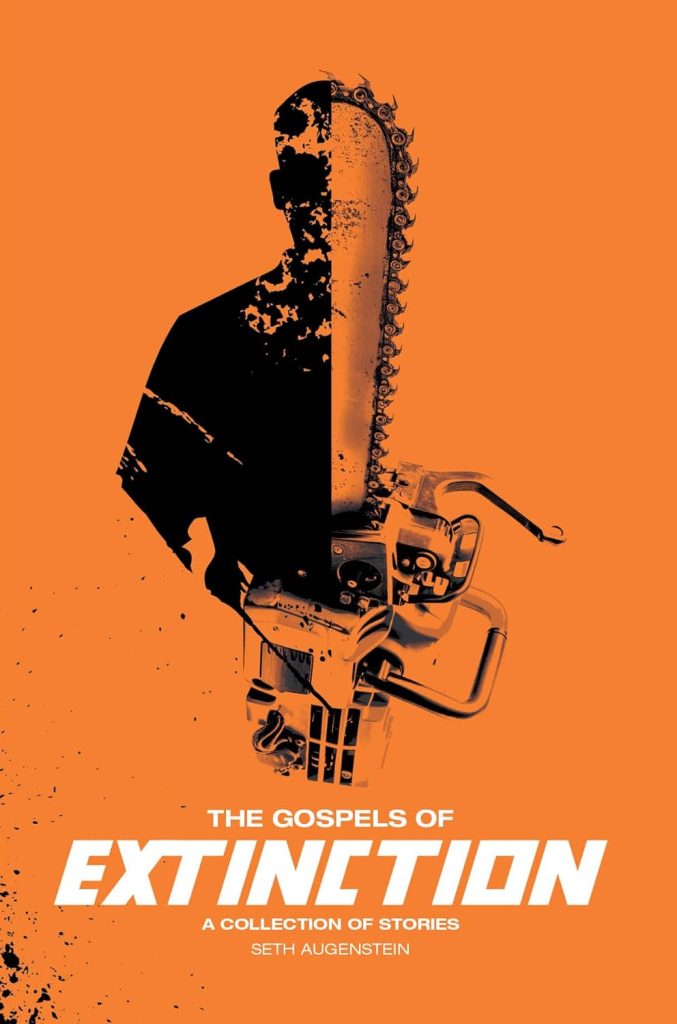
One of my Gospels is “Ayn Rand’s Chainsaw” which is all from my own struggles with trying to be a parent, and marital strife, about a decade ago. The nightmare that results is within the narrator’s mind – and involves the titular philosopher carving the “hero” in two with a big Stihl. I think it’s hilarious – and terrifying if you’ve ever had a disintegrating relationship.
Setting in horror is often described as a character in its own right. How do you approach transforming a location, whether a house, a town, or a landscape, into a source of active dread?
You describe but sparingly – you let the reader fill in their own fears. Too many adjectives shuts out the reader’s intuition and participation. If you employ just the right amount of ingredients, they are going to color in their own shadows if they’re engaged enough. I try to do this as artfully as possible. The afore-aforementioned Evenson is truly the master at this.
Writing a terrifying buildup is one skill; delivering a satisfying payoff is another. How do you decide when to finally show the monster or reveal the source of the horror?
This aspect is all in the timing. Especially in this time of digital-now-now-fun-hoopla, readers need to be grabbed and grappled, trussed up, and never given an inch to escape. It’s better to never reveal anything than to reveal too soon. I think of my story “Bedtime Story” which closes out the collection. The ending is only revealed in the final few words – and it turns everything you’ve come to understand totally on its head. I am a long devotee of Rod Serling and especially his “Twilight Zone.” He taught me much!
The horror genre is rich with established tropes and archetypes. How do you engage with these familiar elements, the haunted house, the ancient curse, the final girl, in a way that feels fresh and surprising? Do you consciously seek to subvert a trope, or do you focus on executing it with such depth and authenticity that it becomes new again?
I always try to look at these archetypes and do what I think works best from my worldview – and perhaps because I can be a contrarian, I end up taking a different path. The first story in the collection, “Aria” is written from the vantage point of an annoyed ghost watching a tour come through her home – and she comes to have a connection to that very tour that is surprising, which makes it quickly into a warmer and lighter story. “Vantage” is a tale heavily indebted to my favorite M.R. James story – but in my hands it becomes a 9/11 ghost story. “ . atrick C met ry” (pronounced “a trick symmetry”) is a “slasher” story – but the social-justice turn the story takes halfway through and where it ends up will delight fans of all the best franchises in the subgenre. “Revelation Radio” originally appeared on The No Sleep Podcast” and will titillate and frighten those people who are as alarmed as they should be about the “AI Revolution.”
How do you approach writing scenes of intense terror or violence to make them feel physically impactful without tipping into gratuitousness?
Everything is in the language – the sound and the rhythm and the fury of the prose, and the dialogue. If the sentences are crisp and full of onomatopoeia when someone is being hacked with an axe, the reader can fell it. If the words wind on and have a bit of a droop to them when you describing the slow flow of blood, you can get taken along that red river, too.
Do you have a favourite line or passage from your work, and would you like to share it with us?
‘His followers are an elite race of fearsome leaders with feet in both worlds: the seen, and the unseen. Their Lord controlled rains,
kept the skids of the sun greased on its way along the sky. These warrior-priests changed everything about these sleepy
farmers. Xipe Totec was convincing, the results undeniable. The harvests were bountiful, the births soared and the deaths plummeted.
But the debts mounted. The whims of the Flayed Lord needed to be cultivated as carefully as any crop.
“Blood and meat and skin were in arrears. The warrior-priests finally unveiled the unthinkable price to the stunned farmers: human sacrifice, cannibalism and routine atrocity, the extraction of the hearts and the wearing of the skins. The warrior-priests directed them to strike out in every direction to vanquish their enemies. It was the only way to ensure success. And for more than a century, they were correct.“
What is the specific, core truth you are trying to expose or explore through your horror?
It’s mostly there in the title. These are Gospels of a different kind, for a hostile and unforgiving world. But there is hope there – the glimmers – if you look long and hard at it. Even if death is the release, that can be a victory in and of itself.
You have precisely two minutes in a crowded bookstore to hook a reader who is sceptical of the entire horror genre. They look at your book’s cover and ask, ‘Convince me. Why should I read this? I don’t even like being scared.’
Think “The Twilight Zone” – another dimension, and another strange gloaming view on the world. The whole thing to these stories is “What if” – and that is core to all the best horror and speculative fiction. This is something that is going to entertain and Affect first and foremost… but these tales are going to stay with you, as well. You might come away with a different view on this askew planet.
Seth Augenstein

Seth Augenstein is a writer of fiction and non-fiction. His debut short story collection, The Gospels of Extinction, comes out June 1 from Lost Meridian Press. His novel Lama with a Gun(2023) was called an “exhaustively researched, bloody, and compelling work of historical fiction” by Kirkus, and his debut, Project 137(2019) won a Readers Favoriteaward. His short stories have appeared in more than a dozen magazines and fiction podcasts, including Writer’s Digest, The No Sleep Podcast, and The Molotov Cocktail. He spent a decade writing for New Jersey newspapers, most recently at The Star-Ledger. He picked up some state journalism awards, along travels to crime scenes, hospital operating rooms, natural disasters, funerals, and quiet homes. He was also the editor of Forensic Magazine, a tour guide at the James Joyce Centre, and a student in Saul Bellow’s final class. Now he lives on a rocky ridge in New Jersey with his wife and daughters.
https://www.sethaugenstein.com
The Gospels of Extinction by Seth Augenstein
A soliloquy from a ghost annoyed by a haunted-house tour coming through her home; a demonic viewfinder that’s indebted to M.R. James; and a bloodthirsty Ayn Rand wielding a chainsaw.
The Gospels of Extinction is a mix of horror, humor, and speculative fiction – all leavened with literary yeast. It’s a short-story collection debut indebted to the great American tradition of the incredible and sometimes terrifying prospects of a New World.
The other stories include a backyard portal to a past of utter American genocide; the disappearing world closing in around the mind of an Alzheimer’s patient; graverobbing Ernest Hemingway; the undiscovered gene linking all serial killers throughout human history; a Thanksgiving gone cannibalistic; a “slasher” story with a social-justice twist; a phone call from the longest distance of all… beyond the grave; and the intergenerational afterlife inheritance from a Mesoamerican death cult. Some of these are brief flash pieces; others are a bit longer. All are little worlds brought to life through the words of Seth Augenstein. They’re sequenced to keep the reader going long past bedtime – and into the realm of that twilight strangeness before the darkness shuts everything out.
Essential Horror Interviews on Ginger Nuts of Horror
For true devotees of the dark and macabre, Ginger Nuts of Horror stands as a premier destination for exclusive horror author interviews and in-depth horror director interviews. Our curated conversations go beyond the surface, offering unparalleled access to the visionaries shaping modern horror.
Why Read Our Horror Creator Interviews?
1. Uncover Creative Processes & Inspirations
Step inside the creative minds behind your favorite nightmares. Our interviews dissect the inspiration behind iconic horror stories and films, exploring how masters of the genre conjure fear. Learn how horror authors develop chilling narratives and how horror directors translate terror to the screen.
2. Gain Unique Industry Insights & Career Advice
Navigate the horror industry with wisdom from those who’ve succeeded. Our conversations provide practical advice for aspiring horror writers and filmmakers, covering:
- Breaking into horror publishing or film
- Overcoming creative and professional hurdles
- Understanding evolving horror trends and audience expectations
3. Explore the Psychology & Culture of Fear
Delve deeper into what makes horror resonate. Our interviews examine the psychology of fear, how horror reflects societal anxieties, and the genre’s exploration of themes like morality, existential dread, and identity.
4. Connect with a Community of Horror Enthusiasts
Join a vibrant community. Each interview sparks discussion, allowing you to engage with fellow fans and sometimes the horror creators themselves through comments and social media.
Featured Insights from Horror’s Finest
Our archive includes conversations with legendary horror authors discussing craft, and visionary horror directors breaking down their filmmaking techniques. Find guidance, inspiration, and a deeper appreciation for the art of horror.
Ready to explore? Visit the Horror Interview Section on Ginger Nuts of Horror today. It’s your essential resource for connecting with the minds that define fear, perfect for fans, aspiring writers, and future horror directors alike.
Searching for the best horror author interviews or seeking wisdom from horror directors? You’ve found your source. Click here to start reading now.