No monsters under the bed. Just bad decisions and the walls closing in.
The silence inside a submarine runs deeper than most people imagine. Aaron Norton spent years in that silence as a U.S. Navy veteran. He also survived a childhood of homelessness. Now he writes gothic horror blended with modern techno-noir. His debut collection, Tales From the Shortbox, collects stories written across twenty-five years. But only recently did Norton decide to share them.
What makes this horror author interview different is the voice behind the work. Norton owns a toy and comic store in Atoka, Tennessee. He runs a defense coaching program for the Navy. He also narrates his own stories as immersive audio dramas on YouTube. The man understands dread from real experience. Not from research. From the walls of a submarine pressing closer each day. From the weight of decisions made at the edge.
His approach to horror avoids cheap violence. No gore for shock value. Instead, Norton builds atmosphere like a 1950s radio play. He credits Rod Serling as his silent mentor. The Twilight Zone gave him permission to guide readers directly. Each story in his collection opens and closes with a Serling-esque frame. The author becomes a host leading you through the dark. Let’s explore how isolation, objects, and bad decisions became his fuel.
Aaron Norton, A Horror Author’s Journey from Submarine Isolation to the Shortbox
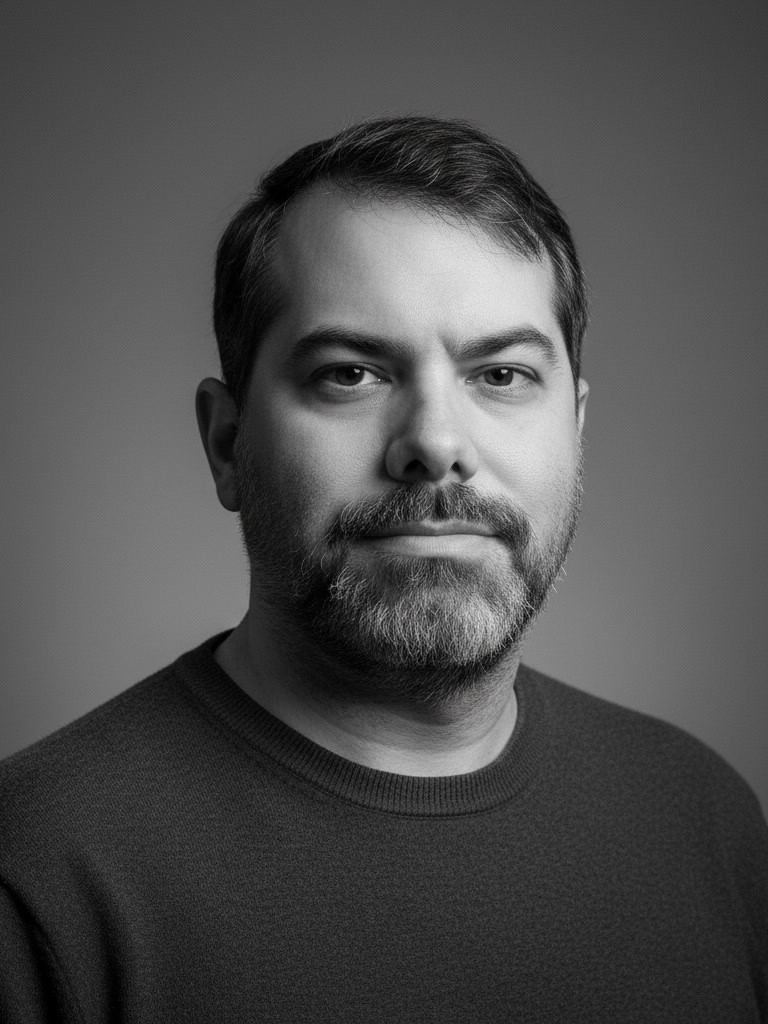
Let’s start at the very beginning. For our readers, please introduce yourself. Beyond the author bio, tell us a little about who you are when you’re not writing, what you love doing, what fascinates you, and what fuels your creativity.
My name is Aaron Norton. I am a retired U.S. Navy Submarine veteran, a defense contractor for the Navy’s coaching and evaluation program, and the owner of Lootz Collectibles in Atoka, Tennessee. My writing was forged in the extremes—from a childhood spent mostly homeless to years of professional isolation in the ‘Silent Service’ underwater.
That background of lived-in psychological pressure informed my work, which blends 1950s-style Gothic Horror with modern Techno-Noir. Because I spent my youth with nothing, I developed an investigative lens for the world; I see value and history in the discarded where others see junk. I’m currently narrating Tales From The Shortbox, Vol. 1 as a weekly serialized audio drama on YouTube, offering readers a multimodal experience via QR codes within the book.
While my writing leans toward the dark, I live for the light; it’s the reason I opened a toy and comic store. Nothing fills me with more joy than seeing a child run into my shop with pure excitement. I am fueled by the desire to make people feel. In a world that often feels stuck in a single note of depression, I want to fight that numbness with every other emotion possible—whether through a chilling story or a shared laugh at the counter.
In the early stages of a new project, what tends to come to you first: a compelling character voice, a central thematic question, or a vivid image/scenario? How does that initial spark then guide you in building the rest of the story?
I tend to look at the world through the lens of a ‘What if?’ test. I believe that there are eight billion stories happening all around us, one for every person on Earth, but I also believe every onject has a story of its own. My initial spark usually comes from something tangible, a fragment of a conversation, a specific silhouette, or even a smell. Once I lock onto something, I start digging into its history in my mind.
How was it made? Where did it come from? Who touched it, and what were they thinking in the moment? Once I begin answering those questions, the object stops being a ‘thing’ and becomes a catalyst. By the time I’ve unraveled the secret life of an object or moment, the story is usually ready to be written.
Every book has its own unique set of problems to solve. What was the most difficult ‘puzzle’ you had to crack while writing this book? Was it a plot hole, a character’s motivation, the structure, or something else entirely?
The most difficult ‘puzzle’ I had to crack wasn’t a plot hole or a character motivation, it was me. I’ve been writing for twenty-five years, but for over two decades, those stories were for an audience of one. Not even my family had read them. I’ve never been the type of person who seeks out the spotlight. I’m the one who will step on stage if called, but I’m certainly not the one raising my hand for the microphone.
Moving from the private isolation of my mind to putting my internal world on a public shelf was a massive hurdle. It took a change in circumstances and the persistent encouragement of my wife and family to convince me that these stories deserved to be read. Solving the ‘puzzle’ was really about giving myself permission to be seen.
The journey from a finished manuscript to a book in a reader’s hands can be a surprising one. What was the most significant way your book evolved during the editing and publishing process, something you didn’t anticipate when you typed ‘The End’?
The biggest evolution was realizing that I wanted to read the stories to anyone who would listen. I decided to turn the anthology into a serialized event. I recorded 12 of the 13 stories as immersive audio dramas, complete with music and sound effects, and I’m releasing them weekly on my YouTube channel. I included a QR code at the start of the book so readers can join that journey. It has changed my relationship with the text—it forced me to find the ‘voice’ of the stories and ensure the pacing was as tight as a 1950s radio play.
Once a book is published, it no longer entirely belongs to the author; it belongs to the readers and their interpretations. Has a reader’s reaction or analysis ever revealed something about your own work that surprised you?
Because I have kept these stories tucked away for twenty-five years, I am currently in a very unique position. The only person who has truly lived with my work is my wife. What surprised me most in her reaction wasn’t a critique of the plot or prose, but the emotional resonance. She loves me despite my flaws, but seeing her moved to tears by something I wrote revealed the power of the silent work I had been doing.
It showed me that these stories weren’t just exercises in relieving my own anxiety or boredom. They had the potential to bridge the gap between my internal world and someone else’s heart. I am now standing on the edge of the cliff, waiting to see what the rest of the world finds in these pages. If I can move a stranger half as much as I move the person who knows me best, I’ll consider the project a success.
Writing is a demanding, often solitary pursuit. Beyond the apparent goal of ‘telling a story,’ what is the specific, personal fuel that keeps you going through the difficult stretches? Is it the joy of discovery, the need to understand something yourself, the connection with a future reader, or something else?
We often hear about authors being influenced by other books. What are some non-literary influences on your work, such as a specific piece of music, a historical event, a scientific theory, or even a landscape, that have profoundly shaped your storytelling?
Is there an author, living or dead, whom you consider a ‘silent mentor’? Not necessarily someone you try to imitate, but whose approach to the craft made you feel permission to write in your own way?
Without question, it’s Rod Serling. To me, The Twilight Zone remains some of the finest storytelling ever created. What I truly admire isn’t just his writing, but his presence. The way he framed every story as an invitation into a specific moral or psychological space. Serling gave me ‘permission’ to be an active guide for my readers. It’s the reason every story in Tales From The Shortbox begins and ends with a ‘Serling-esque’ intro and outro.
I wanted the same sense of curation, where the author isn’t just a name on the cover, but a voice leading you through the dark. This influence is ultimately what drove me to narrate the stories for my YouTube channel; I wanted to step into that ‘host’ role and provide that same atmospheric bookending that made Serling’s work so iconic.
Who was the first person to see your early drafts, and why did you trust them with your unpolished work? What is the most valuable piece of feedback they gave you?
Horror is often most potent when it’s internal. Beyond external monsters, how do you explore the slow unravelling of a character’s sanity or the horror of their own mind?
I rarely write about traditional monsters. When I do, the story is often more comedy than horror. To me, the most terrifying antagonists are the ones we can’t outrun, out own decisions, the environments we are trapped in, or the objects that quietly act upon us. Sometimes, the ‘monster’ is simply another person who has made a different set of choices. My approach to the unraveling of sanity is rooted in the concept of isolation and consequence. Having spent years on the street and in a submarine, I know that you don’t need a creature in the dark to feel dread.
You just need the walls to feel a little closer than they did yesterday. I explore horror as a slow build of external pressures—a bad decision that can’t be unmade, or an environment that becomes hostile, until the character’s internal foundation simply gives way. In my stories, the horror isn’t that something is coming for you; it’s that it was already at your destination when you arrived.
Setting in horror is often described as a character in its own right. How do you approach transforming a location, whether a house, a town, or a landscape, into a source of active dread?
I’m not sure I consciously set out to make a location a character, but my life has been defined by very high-stakes environments that naturally bleed into my writing. Whether I’m writing about a small town or the aisles of my own shop, I focus on the sensory details that make a place feel ‘heavy’. I look for the way a familiar setting shifts when the lights go out or when a specific object is out of place. For me active dread isn’t about a haunted house; it’s about the moment a person realizes their environment is no longer neutral. It’s starting to respond to their presence or their choices.
Writing a terrifying buildup is one skill; delivering a satisfying payoff is another. How do you decide when to finally show the monster or reveal the source of the horror?
I write stories with a twist, which means the ‘payoff’ is the most critical part of my process. I am a firm believer that the best horror reveals itself only when it’s too late for the character to turn back. To me, Edgar Allan Poe’s ‘The Tell-Tale Heart’ and ‘The Cask of Amontillado’ are the gold standards of this approach. In those tales, the horror isn’t an external creature; it’s the weight of a heartbeat under the floorboards or the sound of the final brick being tapped into place. It’s the dread of a situation that the character built for themselves.
The horror genre is rich with established tropes and archetypes. How do you engage with these familiar elements, the haunted house, the ancient curse, the final girl, in a way that feels fresh and surprising? Do you consciously seek to subvert a trope, or do you focus on executing it with such depth and authenticity that it becomes new again?
How do you approach writing scenes of intense terror or violence to make them feel physically impactful without tipping into gratuitousness?
I don’t write scenes of intense violence or gore; there is enough of that in the world without me adding to it. I believe that being startled is not the same as being scared, and being revolted is not the same as being moved. My approach is the ‘slow burn.’
I want to create an atmosphere that leaves the reader holding the book and saying, ‘Wow.’ I want them to be so invested in a few pages, in the character’s psychological state that they are left wondering, long after the story ends, if that person will ever truly get away. To me, the most physically impactful terror isn’t a scene of violence, but the heavy, sinking feeling in a reader’s chest when they realize the character’s fate is sealed.
Do you have a favourite line or passage from your work, and would you like to share it with us?
“Some things aren’t meant to be found. They are meant to stay buried in the back of a box, beneath the weight of better memories.”
What is the specific, core truth you are trying to expose or explore through your horror?
The core truth I’m exploring is that no one is as safe as they think they are. Everyone is exactly one bad decision, one crazy day, or one wrong turn away from being face-to-face with the monster they carry inside them. We spend our lives building walls of routine and civility, but I want to look at what happens when those walls crumble. My horror isn’t about what’s hiding under the bed, it’s about what’s hiding behind the decisions we make when we are pushed to the edge.
You have precisely two minutes in a crowded bookstore to hook a reader who is sceptical of the entire horror genre. They look at your book’s cover and ask, ‘Convince me. Why should I read this? I don’t even like being scared.’
I would tell them: This isn’t about scaring you; it’s about the truth behind the shadows. My stories are heavily influenced by the 1950s EC comics, The Twilight Zone, Ray Bradbury, and Black Mirror. They are morality plays dressed in dark clothes. If you like Science Fiction that makes you question humanity or Gothic tales that explore why we make the choices we do, then you aren’t looking for a scare—you’re looking for a reflection. Tales From The Shortbox is that reflection.
Further Reading
The Archaeology of Dread: Finding the Ghost in the Gears by Aaron Norton
Aaron Norton.
My name is Aaron Norton. I am a retired U.S. Navy Submarine Veteran, a defense contractor, and the owner of a retail collectibles shop. My writing was forged in the extremes—from a childhood spent mostly homeless to years of professional isolation in the ‘Silent Service” underwater. This background of lived-in psychological pressure informs my work, which blends 1950s-style Gothic Horror with Modern Techno-Noir.
I have been married to my wife, Noelle, for over 23 years, and together we have raised four children who are the light that balances my dark. While I spend my days coaching performance and curating history, I spend my nights writing and narrating Tales From The Shortbox, Vol. 1—a multimodal audio drama that explores the potential dark histories hiding in the shadows we are often too afraid to illuminate.
WEBSITE LINKS:
- Amazon Author Page: https://www.amazon.com/author/aaronnortonbooks
- Tales From the Shortbox Audio Playlist: https://www.youtube.com/@LootzCollectibles/playlists
- Goodreads: https://www.goodreads.com/author/show/69736683.Aaron_Shane_Norton?from_search=true&from_srp=true