The gamebook that kills you first, then asks what you want for dinner.
Deadbeat, the debut novel from Maxim Volk and the first entry in Slashic Horror Press’s Extremities series, does something few horror novels try: it kills you on page one and hands you a menu. A choose-your-own-path narrative maze written in relentless second person, Deadbeat follows a gay househusband who dies, is resurrected by a naked cult, and must navigate undead existence with an appetite for human flesh and a long list of unfinished business. What follows is splatterpunk queer horror at its most structurally inventive, funny, genuinely disgusting, and built around choices that feel uncomfortably like your own.
Maxim Volk’s debut tears the choose-your-own-adventure format apart and restuffs it with zombie gore, queer desire, and the specific horror of domestic failure. Deadbeat is funny, nasty, and quietly serious about what it means to be unreliable, hungry, and human — in that order.
Dead Before Page Two: Deadbeat by Maxim Volk, A Choose Your Own Queer Adventure Horror at Its Nastiest
Extremities #1 | Slashic Horror Press, 2026 | Reviewed by Jim McLeod
Maxim Volk drops you dead on page one and dares you to keep reading!
Not metaphorically. The opening pages of Deadbeat, the first entry in Slashic Horror Press’s new Extremities series, kill you outright: carbon monoxide, a dead detector battery, a nap you never wake up from. And then the book hands you a choice. Which is, of course, the whole point. Because Deadbeat is a horror gamebook, a choose-your-own-path narrative maze written in unrelenting second person, and your death isn’t the ending. It’s the starting pistol.
The setup is precise and wildly funny. You are a gay househusband, lounging in your shared bed, frustrated and horny because your husband Matt has just left for a two-week business trip and refused to let you see him off properly. Matt is tall, dark-haired, almost handsome enough to be an archetype. His crotch strains the suit. He calls you ‘baby’ in the same voice a father uses to reassure a child.
You dislike him intensely and love him in the same breath. Before he’s even boarded his flight, you’re already browsing for someone to hook up with — a cruising app you shouldn’t have on your phone, or the local gay sauna, or maybe the principled choice to stay faithful. Those three options fork into wildly different deaths. Carbon monoxide claims you if you stay home and fall asleep post-orgasm with the window shut. The sauna and the app send you somewhere else entirely, toward predators, toward kink dungeons that turn sinister, toward an old man on television who calls himself Rome Samuel, certified zombie hunter.
And then a cult resurrects you.
Brother Johnson, Sister Williams, Sister David, and Brother Thevar perform their ritual in a basement, all of them naked, all of them trying very hard to be helpful, and you wake up unable to speak, repulsed by water, and desperately, catastrophically hungry. From that point, the branching paths of Deadbeat fan out into something almost baroque. Do you eat random strangers? Do you become a hero, targeting only the deserving? Do you go after the specific people who wronged you, Matt included? Do you rip off Brother Thevar’s arm and beat Sister Williams with it? The book doesn’t judge. It just keeps asking you what you want to do next.
Reading Deadbeat is like settling into something you recognise, the mechanics of a childhood Choose Your Own Adventure, that cosy formalism of ‘if you go left, turn to page 12’, and then having that nostalgia slowly punctured by the sheer wrongness of what’s happening inside it.
Volk understands that the gamebook format has a particular relationship with stakes: every choice feels weighty because you know the book is tracking your decisions, rewarding some paths and punishing others. What Volk does is take that moral architecture and fill it with situations where none of the options are clean. The structure produces a particular kind of dread that’s less about atmosphere and more about complicity. You chose this. You turned to this page. The hunger is yours.
The pacing is genuinely strange, and deliberately so. Because the book is nonlinear, any single path through the narrative is relatively short, often ending in a spectacularly bad death before you’ve had time to get comfortable. But the cumulative effect, the accumulation of deaths and restarts and different choices, builds into something almost exhausting. You keep coming back.
You keep feeding yourself to the same world. By the fourth or fifth path, you start to notice the recurring textures: the wet sounds of bone, the specificity of hunger, the way the protagonist keeps assessing every man they encounter with a kind of forensic sexual appraisal that doesn’t stop even after death. The zombie protagonist of Deadbeat is still, fundamentally, a horny gay man who has opinions about bodies. Death hasn’t changed that. Death has just changed what they do about it.
Volk’s prose is blunt and surprisingly funny. The second-person voice so often a trap, producing a kind of anonymous you that no one recognises, works here because it’s so specifically characterised. You have a type. You have grudges. You have a complicated relationship to your husband’s enormous dick and his condescending attentiveness.
At one point the narrative observes, with perfect deadpan, that you should have done more impact play while you were alive this, mid-action, mid-horror, mid-cannibalism. That’s the register Volk operates in: the joke and the gore delivered in the same sentence, with equal weight, and it reads like someone painting with a single colour applied at wildly varying pressure. The strokes are heavy in some places, almost light to the point of absence in others, and the effect is its own kind of destabilising.
The splatter is real, and readers expecting extreme horror won’t be disappointed. Arms come off. Heads come off. The protagonist eats a person in a sequence described with the same matter-of-fact precision the book applies to everything else. What’s interesting is that this gore doesn’t feel gratuitous in the traditional sense it’s not there to shock. It’s there because it’s what happens when you make the wrong choice, or the right choice, or any choice at all. The violence is the consequence of agency, which is the entire thesis of the gamebook form. Volk just pushes that thesis somewhere most gamebooks don’t go.
Beneath all of this is a book seriously interested in what it means to be unreliable, irresponsible, and alive. The protagonist of Deadbeat is not a hero. They cheated on their husband. They lied to him about the carbon monoxide detector. They are petty, horny, easily bored, and not especially interested in being a good person. The book plays this entirely straight there’s no moral correction, no redemptive arc waiting at the end of the right path. What you get instead are consequences that feel fair without being punishing, outcomes that match the scale of the choices you made. This is a book with consistent internal ethics, which is more than most horror novels can claim.
The zombie narrative has been doing cultural work for decades Romero’s original Dead films as critiques of consumerism, The Walking Dead’s exhaustive examination of social collapse, a hundred variations on the theme of who we become when civilisation’s contract is revoked. Volk isn’t interested in that mode. The world of Deadbeat doesn’t collapse.
The zombie is one person: you, newly dead, navigating your ordinary suburban existence with a new set of physical needs. The horror is domestic, not apocalyptic. Your husband comes home and you’re already gone, in every sense. That inversion is where the book finds its genuine strangeness not in the spectacle of undead masses, but in the intimate wrongness of a dead man trying to resolve his unfinished life.
The queerness of the book is not incidental. Slashic Horror Press was founded specifically to publish queer horror where queerness is not the plot’s primary crisis where queer characters exist in stories that are about something else, and their queerness is simply part of who they are. Volk embodies this fully. The protagonist is a gay man whose marriage is strained, whose desires are complicated, whose body carries specific hungers; the horror amplifies these things, but none of them are the source of the horror. The book doesn’t ask you to feel bad about being queer. It asks you to feel bad about eating people.
The natural genre neighbours for Deadbeat aren’t the obvious zombie novels. The closest kin, tonally and structurally, might be Max Brallier’s Can You Survive the Zombie Apocalypse, which applied the adult gamebook format to similar material, or the splatterpunk short fiction that has exploded in the past few years through venues like Carnage House.
Another recent book that shares Deadbeat’s fusion of gamebook structure and extreme content is Duncan P. Bradshaw’s Congratulations! You’ve Accidentally Summoned A World-Ending Monster. What Now? — a choose-your-own-adventure comedy horror that, as the review at GNoF Horror describes, kicks off with a Scrabble game that unleashes the demon QZXPRYCATJ and then hurls the reader through a maze of surreal, scatological set-pieces involving Margaret Thatcher Burger Bar employees, failed anti-capitalist suicide bombers, and a pub from hell.
Bradshaw’s book is built on branching paths and what he calls “Sliding Doors” options, and it shares with Deadbeat a commitment to making every decision fork into something appalling; the difference is that where Volk’s second-person voice traps the reader in an intimate nightmare of queer hunger and domestic failure, Bradshaw weaponises the same format for pure farce gross-out gags, relentless punchlines, and a brown-sauce scene so infamous the reviewer warns you’ll never look at a burger the same way again. Both books treat the reader’s complicity as the engine of the horror, but Deadbeat makes it a moral crisis, while What Now? makes it a ride you can’t stop laughing through.
But Volk’s book is more intimate than either comparison suggests. The humour is queerer, drier, more observant about desire and domesticity. The gore is less theatrical. What Deadbeat most resembles, in terms of what it’s doing and why, is a very particular strand of transgressive queer horror that treats the body as contested territory not battleground, but negotiation. The zombie’s hunger is not separate from the protagonist’s sexuality. They’re the same drive, differently directed.
The Extremities series is described by Slashic Horror Press as ‘a series of narrative mazes that will disgust you, haunt you, and make you beg for more,’ and Deadbeat earns all three. It’s the kind of debut that makes you curious about what the author does when they’ve had more time, more space, more room to extend their range. For now, though, Deadbeat is its own complete thing: funny, nasty, internally rigorous, and built around a structural conceit that most horror writers wouldn’t attempt.
The real horror in Deadbeat isn’t that you became a zombie. It’s that you keep choosing to come back.
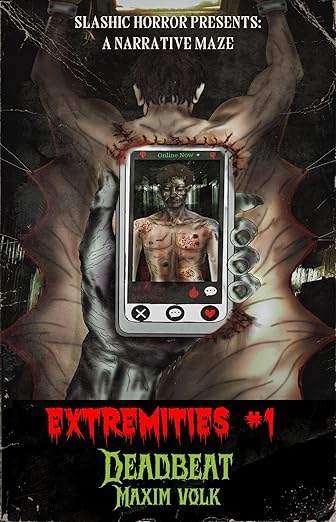
Deadbeat by Maxim Volk
Welp, you’re dead. Weird, right?
That’s usually how these books end, but here you are, at the beginning, dead as a doornail. Good news? There’s a magical cult ready and willing to resurrect you. Bad news? You’ve reawakened with an insatiable hunger for human flesh. You’ve always had a penchant for eating ass, but this is ridiculous. Who should you eat first?
The choice is up to you. There’s a lot of tasty guys out there just waiting to be eaten.
Welcome to Extremities: A series of narrative mazes that will disgust you, haunt you, and make you beg for more. Which death will you choose?