

The Demoness is horror‘s an unapologetically fun oddity.
There is a particular breed of low-budget horror that arrives with no fanfare, no aggressive marketing campaigns, no posh festival laurels plastered across a pretentious poster. It just appears, like a strange package left on a doorstep. Andrew de Burgh‘s The Demoness is that package. And what spills out is not the usual catalogue of tired jump scares or grey, lifeless moodiness. It‘s a splash of crimson across a beige suburban canvas, a laugh in the dark that feels both threatening and strangely charming.
The Demoness Review: Indie Horror‘s Strangest Succubus

This is a succubus story, sure, but not one you have seen before. The film follows a tormented demoness from hell who awakens in the house of a struggling Los Angeles couple, Jack Gerrard (Xander Bailey) and Sarah Lallana (Bella Glanville). With the guidance of her lover Satan, she soon makes her way into the lives of the couple and into the city itself to wreak havoc on unsuspecting individuals. Released in December 2025 by Indie Rights, the film runs approximately 93 minutes, a runtime that suggests efficiency rather than excess.
What does watching The Demoness actually feel like? It feels like you have stumbled into a party where you don‘t know the host, the music is slightly too loud, and you cannot bring yourself to leave. The film opens with marital tension so thick you could spread it on toast. Sarah and Jack are a couple crashing against each other in a small, cramped house, their arguments the quiet, cutting kind, full of resentment and exhausted silence.
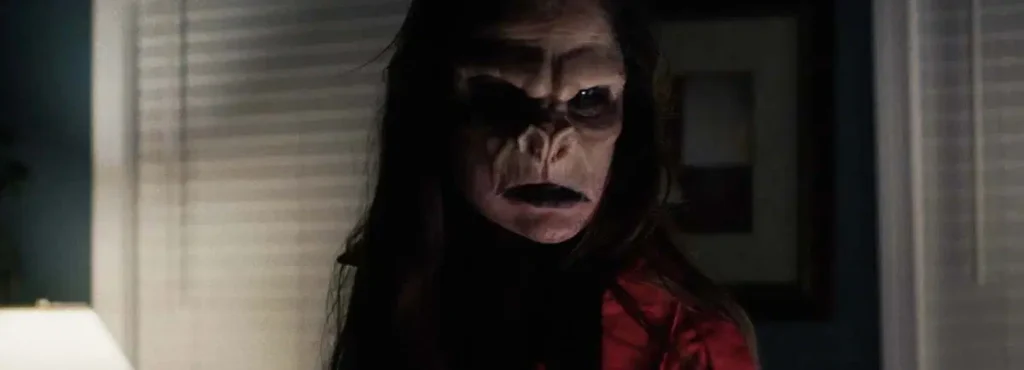
Then the demoness arrives. Not with a jump scare but simply there, a shape in the dark, her monstrous form designed with a practical quality that feels like a direct callback to the rubber-suited creatures of the 1980s. De Burgh‘s visual language is a pop‑art nightmare filtered through a dirty mirror. The colour palette is dominated by cool blues and washed-out suburban beiges, which makes the demoness herself, often draped in a fiery red or standing as a stark silhouette, pop like a wound.
The atmosphere is not one of relentless dread but something more slippery: a constant, low-grade unease that keeps you leaning forward. The pacing has a lurching quality, from domestic argument to supernatural intrusion to a club scene that pulses with a strange, hypnotic rhythm. It‘s the filmmaking equivalent of a magpie‘s nest, shiny and chaotic, built from stolen bits of eighties slashers and nineties creature features, but it holds together.
The Demoness is an unapologetically fun oddity. Sydney Culbertson‘s laughing, twitching succubus turns Los Angeles into a buffet of sins, and you will not look away.
Craft-wise, de Burgh reveals himself as a director who understands that a low budget is not a limitation but a discipline. The camera is rarely static, but the movement never feels arbitrary. In the early scenes between Sarah and Jack, de Burgh holds on medium shots that emphasise their physical distance from each other. They occupy the same frame but do not share it. When the demoness enters, the editing rhythm shifts.

There are sudden jump cuts, quick zooms, and the occasional disorienting Dutch angle that tilts the world just enough to make you feel the floor drop. One of the film‘s most striking choices is how it handles the demoness‘s physicality. Sydney Culbertson, in the title role, moves with a jerky, spasmodic quality that is both eerie and darkly funny. She does not glide like a traditional seductress; she twitches and cackles, her limbs moving in ways human limbs should not. It is a performance built from the body as much as the face, and de Burgh‘s camera follows her like a curious child, always just a step behind.
The makeup effects, designed by Brittany Jamison-Lackey, who previously collaborated with de Burgh on The Seductress from Hell, deserve their own paragraph. The demoness‘s true face is a piece of specialised prosthetics that shows. There is a tactile, gross quality to the creature, a sense that you could reach out and touch the uneven texture of her skin. De Burgh does not hide his monster in shadow; he puts her front and centre, lit plainly, and trusts that the design will do the work. It does.
Beneath the surface, The Demoness is not really about a demon from hell. It‘s about a city already full of them. Los Angeles, as de Burgh presents it, is a buffet of sins waiting to be consumed. The human characters the demoness encounters are not innocent bystanders. The tech bro, the film producer, the corrupt detective, the seemingly polite neighbours with their own dark secrets: they are already half-damned.
It is a dark comedy about exposure. The real horror is not the creature with the prosthetic face. It is the ease with which ordinary people, given a little push, will walk themselves off a cliff. De Burgh has cited the Terrifier series as a major inspiration, and you can feel that influence in the unapologetic glee of the violence, but The Demoness is less interested in gore for its own sake than in the punchline that follows.
When the demoness kills, she laughs. And the film invites you to laugh with her. The social commentary is there, buried in the subtext, but it is never preachy. It suggests that perhaps the devil does not need to work so hard. We are doing a perfectly fine job on our own.
With The Demoness, de Burgh embraces the chaotic, punk energy that has clearly been bubbling underneath. He sheds the restraint of his debut and leans into the darkly comedic, intentional camp that makes the film so endearing. The recurring motif across his filmography is the figure of a powerful, mysterious woman who upends the lives of broken men. But where those earlier films played the drama mostly straight, The Demoness is the first time de Burgh allows himself to really have fun with it.
Where does this film sit in the current horror landscape? Right now, horror has the prestige of “elevated horror“ and the brutalist revival of slasher films like Terrifier. The Demoness occupies a messy, wonderful space somewhere between, pulling from both and committing fully to neither. Its natural neighbours are films like Jennifer‘s Body for its darkly comedic take on the female monster, The Guest for its pulpy, synth-driven atmosphere, and perhaps Mandy for its willingness to dissolve into pure, uncut style.
But de Burgh‘s film is its own creature. It belongs to the micro-budget horror movement that thrives on streaming platforms, a corner of the genre where personality and ambition matter more than polish. It is a film that understands the rules of its sub-genre just well enough to break them with confidence.
The shape-shifting succubus narrative has been done to death, but The Demoness keeps it alive by refusing to take itself too seriously while still landing its punches. It looks forward by looking back, embracing the practical effects and lurid colour schemes of eighties horror without drowning in nostalgia. It‘s not trying to reinvent the wheel. It‘s trying to make the wheel a bit more fun to spin.
The closing credits roll, and you might find yourself smiling. Not because the film is over, but because it got you. Andrew de Burgh has made a movie that is too strange to be mainstream, too confident to be dismissed, and too damn watchable to ignore. It keeps its edges jagged. It laughs when it should scream. It shows you the seams and asks you to appreciate the stitching.
It suggests that hell is not a place you go. It is a place you already live. The demoness just helps you notice the decor.