

- Trad Wife by Sarah Langan: A Feminist Horror Novel for 2026
- Sarah Langan: How Trad Wife Turns the First‑Person Perspective into a Weapon of Horror
Across five novels, a collection, and a shelf of awards that includes three Bram Stoker trophies, Langan has developed a particular instinct for making the familiar feel treacherous. Suburbia, in her hands, is never just a cul‑de‑sac. Neighbourhood cookouts hum with a low, predatory frequency. Domesticity itself becomes the monster wearing a welcome mat. When Good Neighbors arrived in 2021, it pulled the skin off aspirational community life and found something feral underneath, a novel that understood how easily the people next door become the threat.
Before that, Audrey’s Door took a woman’s search for affordable New York housing and twisted it into a portal to something older and hungrier than any rent‑stabilised lease could justify. Time and again, Langan’s fiction insists that the places we are told to want, the tidy homes and the curated marriages and the performing of happiness for an audience, are exactly where the rot takes root first.
Her new novel, Trad Wife, pushes that instinct into territory that feels almost too timely to be comfortable. The book arrives from Atria in 2025, landing square in a cultural moment saturated with social media personas, platform economies, and a resurgence of gender performance that calls itself traditional while operating with thoroughly modern machinery. The novel opens with Jenny Kaplan, an investigative journalist, walking into the Instagram‑perfect world of Mia Wright, a trad wife influencer whose Black Swan Farm looks like a sepia‑toned daydream of sourdough and gingham.
Jenny expects the ordinary rot behind the image: financial fraud, a miserable marriage, the usual gap between social media and reality. What she finds instead is a neo‑gothic horror novel wearing the clothes of a domestic thriller, a story that morphs so gradually and so completely that readers report losing their bearings right alongside the narrator.
Sarah Langan: How Trad Wife Turns the First‑Person Perspective into a Weapon of Horror
Sarah Langan’s Trad Wife lures the reader with a voice so conversational and warm that you don’t feel the narrative architecture shift under your feet, not until the farmhouse door locks behind you and the first‑person perspective reveals itself as the horror’s true engine.

The novel opens with Jenny Kaplan as an outsider, an investigative journalist ready to pierce the veil of Mia Wright’s curated world. But as the story progresses, the narrative architecture itself seems to disintegrate alongside Jenny’s reliability. At what point in the writing process did you decide to fully weaponize the first-person perspective, turning the reader’s trust in the narrator into a structural element of the horror itself?
I knew where the plot was headed from the start—it was a question of getting there. I’m a big Shirley Jackson fan. Though I tried telling the story in different ways, none of them seemed as clean as using Jenny’s eyes alone. Her character converged with plot here—she needed to be someone so practical that she’d never consider the possibility of the supernatural. She also needed to be someone very giving and self-sacrificing – someone likely to get derailed by her concern for others. I wanted her to be a kind of cypher – someone the reader identifies with, and thinks: Yeah, I’d do that too. Or: I might not do that, but I understand it.
By the end, much as changed, only Jenny didn’t realize it was happening. I’m reminded a little of the end of Dead Ringers, where the twins are getting up, shooting up, finding ways to survive—we see what this is, but they don’t.
The review on FanFiAddict notes the book morphs from a grounded domestic thriller into a “chilling, gross, and downright unnerving neo-gothic horror.” How did you map this tonal shift structurally, and what was the most challenging piece of connective tissue you had to build to ensure that transition felt inevitable rather than like a gear-change?
I think it’s grounded horror in the classic sense, where we learn the setting and roots of the thing, so we understand what blooms. But I did add small beats to act one, so people got the idea something scary was coming – the crumbling publishing industry, that silences Jenny, the Brotherhood of the American agenda, that cancels her, the feeling that the world itself is careening into something ugly and unspoken, that can’t be named.
For the transition, I imagined everything through Jenny’s eyes. Everything about the farm is wrong. The reader knows, because this is a horror novel, that bad things are coming. She doesn’t. So it’s this incremental, easy to ignore stuff. But that’s a lot like life. Nobody walks into a bad situation and locks the door behind them. It just happens, when we’re especially vulnerable, and can’t quite see the trouble.
In your author’s note, you compare the trad wife to “a great and terrible genie in a bottle.” How did you translate that concept of “letting her out” into a narrative that moves from subtle unease to a “demented chaos” finale? Was there a specific scene you wrote as a keystone to support the entire collapse?
I published a story called “I Miss You Too Much,” where I conceived most of the details of the monster—that story is about a codependent mother-daughter relationship, and I think it’s the scariest thing I’ve ever written. I wanted to harness that same energy for Trad Wife – the conflation of two sides of the same dilemma. The scene I had in mind was the final scene in Mia’s shed, and I imagined it like entering the world of the fairies. From the beginning, the narrative of Trad Wife was always headed to that shed.
The book has been described as “The Stepford Wives vs The King in Yellow.” Could you walk us through the process of integrating this cosmic horror element into such a hyper-specific, grounded social critique? How did you balance the “what” of the haunting with the “why”?
You know, the cosmic horror came later, after I’d drafted the book. Corrie’s fire was this loose end—where did Mr. Yellow come from, and how was this New England Devil connected to witch burning? I made it up for fun—what I hope is received as a love letter to horror readers. Every aspect of it was a joy to write.
As for the mechanics, I was trying to address the roots of misogyny. It feels like it has existed forever, and it’s so bad for culture. Men and women are both to blame. In a way, it’s the real original sin we’ve inherited.

Jenny arrives at Black Swan Farm “prepared for the ordinary rot behind it: financial fraud, a miserable marriage, the usual gap between Instagram and reality.” This suggests her horror stems not from the supernatural but from the expected. Given that, how did you go about subverting her, and the reader’s, expectations of what the darkness at Black Swan actually is?
To me, it’s a sliding spectrum– the rot under the image; the mask that eats the face. People who lie to others end-up lying to themselves, and they ultimately end up getting sick—mentally, physically, in the soul – they get sick. That’s an inescapable truth. So it’s not just corruption I wanted to investigate, it was the effects of that corruption, and the manner in which making a living online has been forced increasingly on all of us. It’s an inescapable infection. The horror to me is that survival means compromise – means trying the best you can within the box you’re locked inside. The horror is not only that the box exists, but that it’s invisible.
You’ve written that a trad wife is “repression, a mask of sweetness, and underneath, a destructive con.” Mia Wright seems aware of this con. Do you harbour a secret empathy for her as a character, or do you see her more as a tragic product of a system designed to consume women, with her own agency being part of the tragedy?
Yes to both!
Mia’s a survivor—she’s doing the best she can within the rules of the system she inhabits. So I like her for that. Jenny and Victoria are survivors, too. Jenny’s honest and upfront, Victoria, like Mia, is manipulative. In the story I have empathy. In real life, if I met Mia, I probably would not want to have a beer with her.
*But a housewife—I’ve been that. I like them, I’ve had many beers with them.
The secondary characters, the husband, the children, are often described in reviews as behaving “not right.” How did you map their interiorities, and where did you draw the line between a character who is a victim of the farm’s influence and one who is complicit in its rituals?
I think most people don’t want to know bad things, particularly when those things exist inside their homes. It’s such a scary concept to me, and illustrated very well in Long Legs—the devil lived in the main character’s house the entirety of her childhood, and she never quite realized it.
I think most of them know but don’t know. They’ve internalized the rules without reconciling the reality of why those rules are in place—what monster those rules protect. So I saw them in that way—the supernatural things that occur get locked from their conscious memories. The disconnect makes them act out and misbehave, but they’re not enlightened.
The exception is Victoria. She wants more from her mother, and is at a rebellious age. Her health is also very much in peril. When Jenny arrives, she sees the opportunity for salvation and her survival instinct kicks in.
In your craft, how does a persistent physical disgust, like a bad smell, translate to a character’s moral decay? How do you write a character who begins to accept the unacceptable as normal?
I’m attuned to smells in my stories. What’s interesting about smells is that those nerve receptors lose sensitivity and stop reporting to the brain over time. So, in a bad-smelling room, we eventually forget the bad smell for a reason. It’s not simply that the character in question is too afraid or emotionally stuck to get up and open a window. Their brains have literally stopped giving them that information. It’s a cool metaphor for how easily we’ll accept the acceptable.
So, I think about that—the slow lure of the odd. I also think about the surrounding characters and system that seek to keep the main character from acting out. It’s not just socially inappropriate to shout fire in a movie theater; it’s a crime. So, if you smell smoke, but then it goes away, and no one else in the entire theater notices, do you shout fire?
You’ve said that before, female rage “looked like sickness, migraines, nervous exhaustion, and pettiness.” Jenny loses time and loses her hair. How did you use these physical symptoms of stress not as plot devices, but as genuine manifestations of a character’s past trauma finally breaking through her own curated surface?
I’ve known women who’ve lost their hair from stress. I’ve known women hospitalized for nervous exhaustion. One friend, when she had three small children and her husband was traveling, told me she asked the hospital to keep her for an extra day because it felt like a vacation. I’ve had migraines for days on end, because I was upset. At the time, I had no idea the cause was emotional.
Sublimated rage isn’t exclusive to women, but we are likely to be boxed, contained – both externally, and internally. When you can’t get what you want – you’ve been taught never to ask – you lose the language for it. You self-police. I think that’s how sickness starts.
Jenny’s always wondering if she’s selfish, when she’s clearly not a selfish person. She’s unable to act from her own side of the story, and instead stymies herself by seeing everyone elses’ side.
On your publisher’s blog, you ask a provocative question regarding the trad wife phenomenon: “If your husband is the breadwinner, then why are you earning a living off your influencer channel?” The novel seems to argue that the “trad wife” is not a retreat from capitalism but its purest expression, the commodification of the self as a brand. Was it a conscious choice to let the subtext argue that this “retro” movement is actually hyper-modern, or did that tension emerge organically from the writing?
It was conscious. I came into this thinking of Trad Wives as modern day Amway reps—selling housewives a bill of goods—they surrender their agency in order to give Trad Wives freedom. It’s a pyramid scheme. But the thing is, Trad Wives lose out, too. Only a tiny fraction will make real money, but the platforms—they’ll stay rich forever. So quickly, it stopped being about women hustling women, and became a story about big machines, grinding everybody.
Let’s talk about the symbolic weight of the farmhouse itself. It functions less as a setting and more as a “shadow” to the novel’s main argument about domesticity. If the trad wife is the avatar of “repression,” what does the physical rot of Black Swan Farm represent as its opposite, the inevitable decay that preservation ideology tries to deny?
I like that. I’m going with it! I’d add that I also thought of the farm as a kind of gateway to the curse—the land of the fairies, from which so much of this horror has started and spread.
How did you navigate the tightrope between didacticism and ambiguity when writing a book that is clearly a polemic on sexism and social media, yet also operates as a piece of ambiguous, surreal horror? Where is the line in the sand where you hope a reader will argue with the book’s politics rather than accept them?
I tried my best to put Jenny’s story first. If I’m doing it right, the story should speak for itself, and for the wider institutions I’m evaluating. But there were lines I couldn’t help keeping – Bread and Circus’ in-house lawyer advises Jenny that if she ever gets divorced, she should hire a lawyer and not a mediator, because women get screwed by mediators. I wanted this printed, in case it helped someone reading the book. Jenny’s medical procedure is also there for a reason. Details like felt necessary.
Blair Roberts could have been cut from the story and I did cure her for flow – I’m asking a lot from a horror reader to wait as long as they must. But her story was really resonant to me. She’s an actual traditional wife—someone who has put her family first her whole life. And women like her are the ones getting hurt. Their harm is a great loss.
But at what point should the reader think: I don’t agree with what Langan’s asserting? Every point—as is their right. My hope is that the story is generous enough to allow for shades of interpretation. Are women just victims, here? Is that how I’m painting it? I hope not. Are men dopes? No. But you could make that interpretation. You could also assume I have an axe to grind against a specific, or several, real-life Trad Wife. I don’t.
Many readers might misinterpret the novel’s philosophical core as being simply “the trad wife is bad.” You’ve noted that you weren’t there “to make fun of trad wives, she’s here to take on the system itself.” Where do you believe a reader is most likely to short-circuit the book’s deeper argument, and why might that misinterpretation be a valid and interesting response in its own right?
I think people will come into the book with fixed ideas on Trad Wives. My intention has been to tell a deeper story of two women’s experiences. Jenny’s unabashedly herself, and pilloried for it. Mia is not remotely herself, and adored for it. But neither are happy. And that’s a problem.
But are Trad Wives bad? Maybe. I’m not sure it’s a question worth asking. The question to me is: Why do they exist? Why does the manosphere exist? Who do they serve, aside from the algorithm? Sometimes society demands a trend. Other times, it’s vulnerable to one.
As for the short circuit – the direct to Trad Wives are bad interpretation – it’s fair. I didn’t write a story that reveals their lives are even better than we imagined, their tears made of candy, their families flourishing under the camera like lilacs.
The “children singing strange nursery rhymes at night” feels like an echo of folk horror traditions, which often critique the 6dealized, isolated community. How does the novel use this folk horror element as a critique of the “idyllic farm” as a site of patriarchal control, and how does the book’s ending complicate or subvert the typical folk horror finale of community triumphing over the interloper?
I like what you’re saying here. You’re probably giving me more credit than I deserve.
Hope you mark this as a spoiler! — For me, the ending could read as Jenny finally seeing the invisible box, and acting in her own best interests, to get out of it. So it could be read as a tragedy, but it also could be read as a victory.
Which scene in Trad Wife fought you the most? Was there a moment, perhaps a confrontation between Jenny and Mia, or a particularly brutal piece of body horror, that you wrote, deleted, rewrote, and ultimately had to compromise on to serve the novel’s pacing? Did you “win” that fight, or did the book’s internal logic win?
I love body horror, or any horror. None of that fought me! The hardest part was the opening conversation between Jenny and Mia, and the second conversation, when Mia gets down on her knees and begs Jenny to come back. A lot is happening in there, and I didn’t want to cheat, but I also wanted the story to flow. I rewrote that MANY times.
The book deals heavily with the mechanics of social media influence, from cosmetics lines to the logistics of running a farm for an audience. What was your research-to-imagination ratio for building Mia’s influencer empire? How much did you pull from real-world “trad wife” accounts, and how much did you invent to serve the story’s more surreal elements?
I did a lot of research!
I spoke with some journalists about their jobs and I asked all the women I know about their life experiences. I also researched Mary Kay—there’s a website for former saleswomen who’ve been hosed by the business model. Multi-level marketing ought to be illegal. It’s a predatory practice.
I didn’t spend as much time on Trad Wives. I did notice a whole ecosystem – the Wives, the anti-trad wives earning their livings by criticizing them, the manosphere. My novel will probably be compared to a particular Farming Trad Wife trend, but I didn’t base this on a specific person. I just liked the farm setting. My mom’s from a farm so it was familiar terrain.
Your prose has been described as having “a friendliness to the surface, a conversational warmth, that works as a kind of long con.” Was this tonal approach a deliberate revision strategy, or did you discover in editing that you had to go back and add warmth to the opening chapters to make the horror land harder?
Yes – it was very deliberate. I try to make my work as user-friendly as possible. I wanted readers to like Jenny and her voice. It’s light, a contrast to the action. She doesn’t dwell. She’s not a sad sack. Her survival tactic has always been to push forward, until she gets to Black Swan.
One of the most striking sensory details mentioned is the “cherry-flavoured lip balm” that Jenny finds when she wakes, a detail the reviewer notes as a “structural load-bearing” clue. What does that specific, cloying scent signify within the farm’s logic? Why cherry, and how did you arrive at that particular texture, the waxy, artificial feel of it, as a symbol of the farm’s insidious nature?
This just came from my subconscious. Who knows why? Probably my reason is very weird.
The acoustic landscape of Black Swan Farm is defined by “strange nursery rhymes” sung at night. How did you write these rhymes? Did you compose them yourself, and what was your goal in crafting their specific cadence, rhythm, and the dissonance of children’s voices carrying dark meanings?
I made them up for fun. I always write stuff like this in my stories. In my third novel AUDREY’S DOOR, I wrote entire fake New Yorker articles, because somehow I doubt those guys are ever going to publish my work.
The horror is described as “cellular” and the farm as seeming “to breathe.” How do you imbue a static setting, like a house, with physical agency that affects the characters’ bodies? Did you have a system for mapping Jenny’s physical deterioration alongside the farmhouse’s own decay?
It all came naturally. I didn’t think about it very much. Horror is my favorite thing to write.
The novel has been marketed as horror, but it carries the DNA of a social thriller, domestic noir, and even a workplace drama. If you had to secretly shelve Trad Wife in a different genre than horror, which one would it be, and why does it belong there more than you’d initially admit?
I tend to read literary fiction when I’m not reading horror, and I’d want the book where I could find it. So maybe there? I’m a big fan of Jennifer Egan, Emily St. John Mandel, and Mariana Enriquez. So, wherever their books go!
* What is a convention of the domestic horror or folk horror subgenres that you genuinely hate and sought to dismantle in Trad Wife actively? Was it the “final girl” trope, the isolated house as victim, or perhaps the idea that rural life is inherently more “real” than urban life?
I don’t like misogyny cloaked in feminism. I don’t like the way feminism/female rage has become a watered-down product.
I don’t like stories that validate mindless group think, or dog whistle to either political party.
When I think about AI, which tells us we’re right even when we’re wrong, it makes sense that our corporate-driven culture has created it. It represents contempt for consumers, assuming they lack the wisdom to learn or grow. It ignores that they’re not just bags of money, they’re human beings. Good, humane novels are our connection to the divine.
The review on FanFiAddict notes that it “never seemed to go in the direction I thought it would go.” Is there a specific moment in the narrative where you worried genre purists, or fans of more straightforward domestic thrillers, would “throw the book across the room”? What is that moment, and why did you keep it in despite that risk?
I tried my best to write a page turner so they wouldn’t do that! It’s funny everyone calls it a slow burn. Any book I’ve ever loved set the table first, and gave the thing depth.
From goodreads reviews (I’m a masochist!), I can see some people think the middle is long—but I wonder if that’s the problem, or if it’s so unmooring that they’re uneasy. They’re forced into Jenny’s perspective, like they, too, are losing their minds. In some of those passages, I was trying to show the lived experience of being home alone with small children. It’s not for the weak. And yes, it’s rewarding—you build love. But it’s exhausting and messy.
I worried about the abortion. I knew I had to include it. But I also knew some people would become ENRAGED.
I want to know the precise moment you hope a reader slams the book shut in shock.not at a jump scare, but at a realisation. Is there a specific line of dialogue or a single image you planted as a landmine, waiting for the reader to step on it?
If they slam it down I want them to pick it up again!
I really didn’t think about it as I wrote. I only wanted to write the best story I could.
If you could implant one single line or image from Trad Wife into a reader’s brain permanently, a haunting that stays with them long after they close the book, what would it be? Not a plot point, but a feeling or a visual that encapsulates the whole experience?
That feeling of realizing something about yourself, the way you act and live and react, that comes from deeper place you weren’t aware of.
Finally, what is the emotional arc you designed for the reader to follow? At what exact moment do you hope they begin to feel not just afraid for Jenny, but complicit in her fate, as if they, too, have been lulled by the sourdough videos and the gingham?
I think that’s up to the reader!
What terrifies you more, the woman who knowingly sells the lie of the ‘trad wife’ to millions, or the woman who buys it so completely that she no longer knows she’s lying? And more importantly, which one are you asking us to fear more by the final page of Trad Wife?”
The system that exploits all of us.
Trad Wife by Sarah Langan
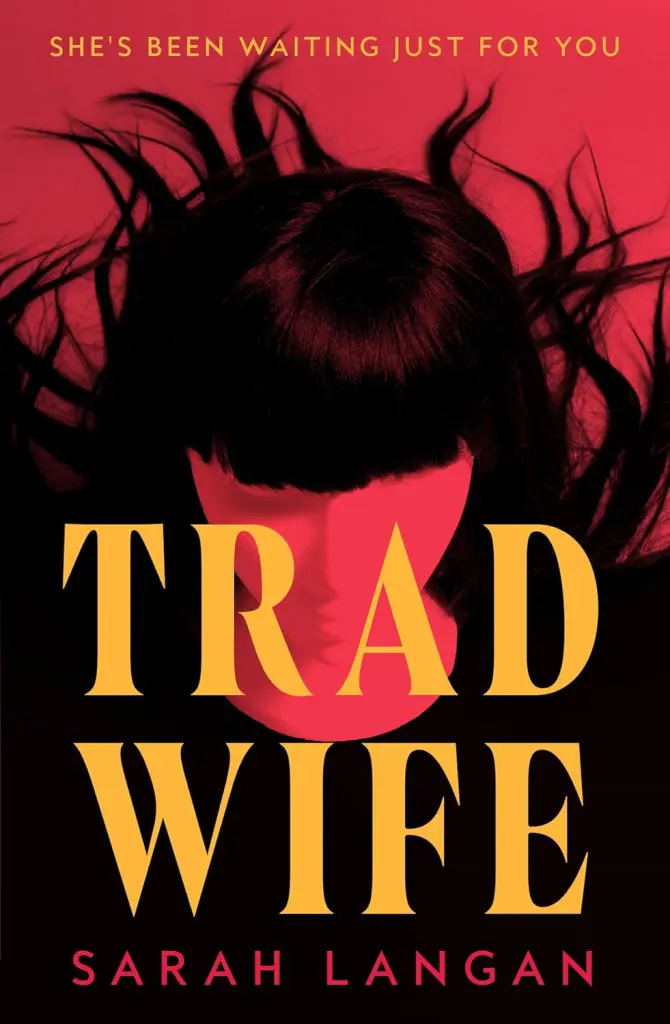
– Sarah Pinborough, bestselling author of Behind Her Eyes
Your favourite influencer is about to be exposed . . .
. . . for fans of a much darker, more horrifying Yesteryear
Every day, millions watch Mia Wright, the “trad wife” queen, on her idyllic 300-acre farm. With her handsome husband, seven perfect children, and a life of from-scratch meals, she’s an icon of modern femininity. But behind every perfect image is a lie.
Desperate to save her tarnished career, journalist Jenny Kaplan arrives at Black Swan Farm to profile Mia. Jenny is ready to write a scathing exposé, determined to uncover the deception behind Mia’s curated life.
But there’s something wrong at the farmhouse.
It slithers through Jenny’s dreams when the children sing strange nursery rhymes at night. She’s losing time. She’s losing her hair. She starts to worry that she’s losing her mind.
There is a horror at the heart of Black Swan, and it’s waiting just for Jenny.
‘Glorious, unhinged and utterly irresistible’
– Catriona Ward, bestselling author of The Last House on Needless Street
‘Gripping, unsettling, enthrallingly layered and utterly laced with doom’
– Olivie Blake, bestselling author of Girl Dinner