What happens to healing when machines replace human touch?

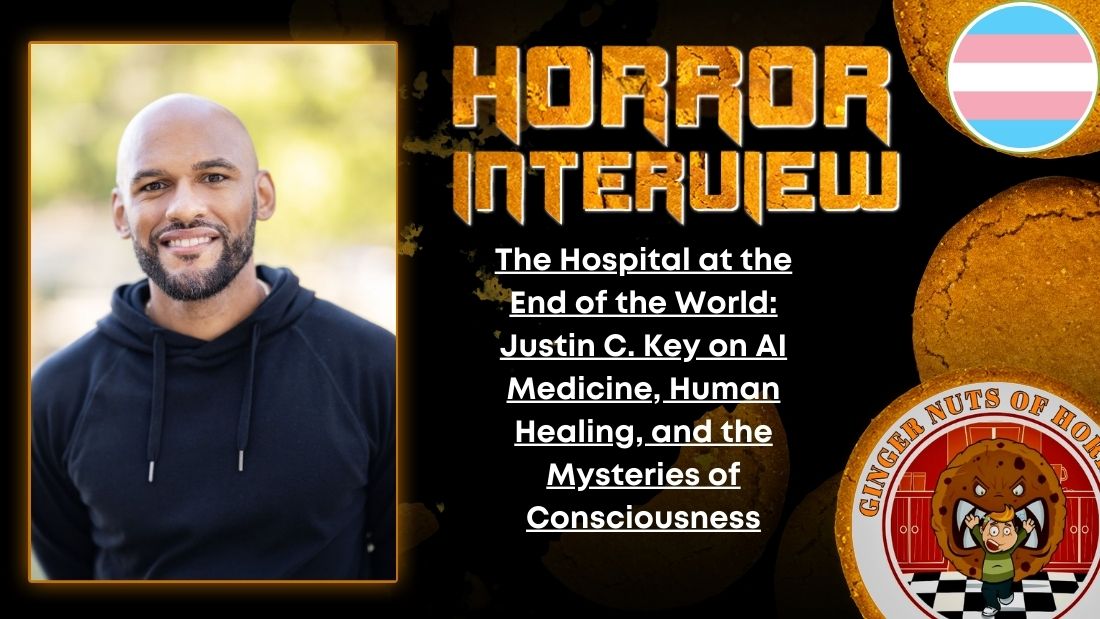
In his electrifying debut novel, The Hospital at the End of the World, acclaimed speculative fiction writer and practising psychiatrist Justin C. Key delivers a gripping medical thriller that pits human intuition against artificial intelligence in a battle for the soul of healing itself.
Set in a near-future where the all-powerful Shepherd Organisation controls every medical institution through global AI systems, except for one renegade school in New Orleans called Hippocrates, the novel follows Pok, a young physician who must confront everything he believed about technology, medicine, and his own family’s legacy. As a mysterious illness strikes those raised under AI rule, Key explores urgent questions about what happens when we outsource our most human connections to machines.
Drawing on his years of clinical experience and his acclaimed short fiction collection The World Wasn’t Ready for You, Key has crafted a visionary work that bridges medical sci-fi, psychological depth, and Afrofuturist tradition. In this wide-ranging conversation, we discuss the real-world medical mentorship that inspired the novel’s central conflict, the challenges of expanding from short stories to a 400-page narrative, and how his work as a psychiatrist informs his exploration of consciousness, “otherness,” and the irreducible elements of human connection that no algorithm can replicate.
Your novel centres on the conflict between AI-driven medicine (The Shepherd Organisation) and human-centric care (Hippocrates). This was inspired by a mentor in medical school who emphasised observing the patient over the machine. How did this personal experience shape the philosophical heart of the novel, and did writing it solidify your own views on technology in healthcare?
I was a third-year medical student on my Anesthesiology rotation and was paired with a relatively young and energetic attending (which is the medical community’s term for a physician who has completed all their training and can now practice independently). He stressed that even with all the technology around him that could tell so much about the patient on the operating table, a physician should know how to gather crucial information by looking at the patient.
It was a reminder and a reinforcement that technology should be a tool to enhance human intuition, not to replace it. In medical school we learn how to identify every since part of the body. One might wonder why this is needed when certainly one day a machine would be able to do it for us. Faster and more accurately. But such technology should be used to reinforce and, when needed, correct human experience and knowledge. By replacing it, the physician will lack competence in the absence of the technology. Or oblivious when it goes wrong.

Pok begins the story as a believer in the Shepherd system, only to be forced to embrace its antithesis. Was it challenging to write a protagonist who starts with a worldview opposed to Hippocrates’ values? How did you balance his scepticism with his need to learn and grow?
Having Pok start off largely pro-AI made it easier in some ways, I think, to explore my own thoughts and fears about technology, especially in relation to how it’s currently shaping up. I had to actively think about what the benefits may look like on the surface and how to juxtapose that with the deeper and at times negative consequences.
Pok’s scepticism shaped his arc from being an outsider—not just ideologically but geographically—to calling Hippocrates his home. I also had to lean on his deep want to be a good physician, which is rooted in his relationship with his father. Although he started off disagreeing with the type of medicine his father stood for, he always admired and respected him and that made him more open to growth and change.
You’ve mentioned researching acupuncture, medicinal herbs, and the history of medicine to inform the holistic approach at Hippocrates. How did you weave these alternative modalities into the fabric of the school and of New Orleans itself to make them feel like a credible, integrated system rather than mere set dressing?
In an unintentional but beneficial way, I approached this backwards. Originally Hippocrates was set far into the future and was a city devoid of technology. And by that, I mean really devoid: they didn’t have electricity! As I was crafting that world I really had to dip into various methodologies and approaches to healing outside of our current Western approach.
In those earlier versions Dr. Verik, for example, leaned more on the humors and the idea of balance in the body to stand in for the lack of vitals monitors and scans. As the book evolved and I brought Hippocrates closer to the future and reintroduced technology, I already had this groundwork. So, for example, the method of ‘alignment’ with EKGs came from overlaying technology with the principles that were already in place.
A mysterious illness afflicts newcomers to New Orleans. Without giving away spoilers, can you discuss how this plague functions as a narrative engine to explore the book’s larger concerns about humanity, connection, and what might be lost in a fully optimised, AI-managed world?
I knew I wanted a medical mystery, which aligns with the core of how doctors are trained to think. We start with a ‘differential diagnosis’—all the things a patient’s presentation could be—and then narrow it down as we collect more information, data, history, test results, etc, until we land on what’s most likely going on and how we want to treat it. Solving a mystery, in a nutshell.
And then there’s the exploration of stigma. Making this an illness that marginally affects people coming from AI-centric cities further creates an ‘other’ that Pok can immediately relate to. He has an inherent connection to the people he’s treating, similar to how patients of color may naturally feel more comfortable when they walk into my office and see that we may have some shared life experiences.
As for the critique on technology and AI, the disease takes the current warnings and implications and makes them more tangible and real, something that society is forced to face and deal with much more than a ‘hypothetical’ of what the history books will look back and say.
Your acclaimed collection, The World Wasn’t Ready for You, established you as a significant voice in short fiction. What was the biggest adjustment in craft and stamina required to expand your vision into the novel form?
The biggest adjustment was scope. With short stories—even the longer ones—revisions would be relatively easy lifts. There are limited characters and limited themes and usually I could implement even major revisions in one or two sittings.
It took me a year to incorporate the revisions needed for the final stages of the novel. Even seemingly small changes can have ripple effects throughout a 400 page narrative. The edits done to Chapter 2 then have to stay consistent with Chapter 4 and Chapter 20 and Chapter 53. So, time management on the editing and revising part of the novel was a big shift.
How does your clinical work with patients’ inner lives directly inform how you build character psychology, especially when dealing with extreme or futuristic scenarios?
From very early on in my journey to becoming a physician I have been very conscientious about keeping my clinical work and writing separate. That said, the variety I’ve seen in the human condition definitely informs the care I put into character development.
I think mainly it is a reminder that while there are similarities to the human experience that continue to surprise us (if you’ve ever seen that post on social media where someone admits a ‘odd’ characteristic that then the majority of us seem to secretly share), there is no set way to grieve, to be depressed, to be terrified, to love. Even with the diagnoses we have in medicine, the actual manifestation in human bodies and brains don’t read the textbooks.
Stepping into the future or when facing extraordinary circumstances, it informs the balance of what reactions may be shared and what might be specific from individual to individual.
In your collection, you used horror and sci-fi tropes to examine race, prejudice, and systemic injustice. Do you see speculative fiction as a potent tool for exploring and diagnosing societal or psychological “illnesses” that are harder to address through realism?
I see speculative fiction as a great tool to explore these issues and to do it in ways that can enlighten and even convince without being too heavy handed. I think of it like the benefit of metaphor. By supplying an outside example that has parallel implications, metaphors allow us to show someone else meaning and nuance in a round about way, in a way that can get past pre-conceived notions and rigid opinions.
Speculative fiction acts through the same process. You may already have your opinions about police brutality or ICE or current global conflicts, for example, and if presented with a story that’s clearly set in the here and now, I’m either preaching to the choir or talking to a brick wall. By taking it into the future I can remove the reader from the present and maybe elicit a ‘okay, I could see how THAT would be a problem.’
In The Hospital at the End of the World, Pok’s father has theories about “essence”, a psychospiritual connection in healing. This seems to bridge psychiatric concepts of therapeutic alliance with more metaphysical ideas. How did you develop this concept, and what does it say about the irreducible human element in medicine?
I’ve always been fascinated about the ‘weird’ of our existence. Quantum mechanics, for instance, or just the fabric of the universe. One such aspect is ‘dark matter’. I’m no expert but from my understanding, we know it exists, we can calculate the influence it has on our universe, but we can’t yet quantify or even ‘point to’ it. That, combined with the very nature of consciousness, set the background for me to create something that we can definitively say ‘this is an aspect of our reality even if we can’t fully explain it yet.’
Creating the ‘essence’ allowed me to take the human connection from possible ‘correlation’ to clear ‘causation’. Much like the progression of the history of scientific discover, it explains a host of characteristics we inherently know. The importance of human connection. The value of the placebo effect. The bond between family members from an early age. It also gave an element that the tech field couldn’t easily dispute or dismiss. Much like dark matter, even if we don’t understand it we have to recognize and respect its influence.
You are a full-time psychiatrist, an author with a major debut novel, and a parent. Your bio even jokes, “don’t ask him how he does it”. So, we have to ask: How do you manage these demanding roles? Do they feel like separate compartments, or do they feed into each other in a symbiotic way?
It helps that I have an inherent and strong urge to excel at all of these roles, not for my own ego but for what I feel I owe to the people on the receiving end. Whenever I see a patient, new or old, I know they are entrusting me with their care.
My children look to me and my wife for their foundations and I won’t ever be able to get pivotal years of their lives back, won’t have room for do-overs, and therefore want the perception of Daddy working all the time to be the exception and not the norm. Books have done such magic in my life and I want to contribute to that for whoever takes the time to pick up one of mine.
All that is to say, I care deeply about not just doing each of my roles but doing them well. I do see them as separate. In both the execution and the rewards. Being there for a patient is a different process than being there for my family is a different process than crafting valuable fiction.
And the joys of one don’t necessarily carry over to the other. I could fully celebrate a win in publishing or that my kids made the Principal’s list and an hour later, when stepping into an appointment with a patient, know that there is independent work that needs to be done. The patient doesn’t know what a good job I’ve done in the other areas of my life. I have to earn the success with them, too.
Your work has drawn comparisons to pioneers like Octavia Butler. Who are the writers, in or out of the genre, who have most shaped your voice? How do you see your work contributing to or expanding the traditions of Afrofuturism and Black speculative fiction?
Growing up, Stephen King, Michael Crichton, and Clive Barker were big influences. As I entered adulthood I was introduced to Tananarive Due and Nalo Hopkinson Maurice Broaddus. I am honored to be a contributor to the broad and diverse landscape of Black speculative fiction and hope that my background in medicine and mental health further enriches the field.
You are a graduate of the prestigious Clarion West writers’ workshop (2015), where you were noted as a standout even among peers. What was the most valuable lesson from that intensive experience that stayed with you through writing this novel?
One of our instructors gave the insight turned advice that, over the years of seeing writers come through Clarion, the best predictor of success was ‘who kept going.’
The 17 voices I’ve gained from my 2015 classmates have also proved invaluable. I was very open to critique and learning how to process and incorporate (and, at times, ignore) the ways other people experienced my work. This story was a page turner but the prose didn’t grab them.
How could I work on making my words sing? What could I read? What could I practice? A certain intimacy scene where a woman character advances on a male character came off to some as nonconsensual, when I was going for fiery passion. What gaps did that expose in my own assumptions about intimacy and masculinity? How could I revise the scene to keep the emotional core without making one character into a villain? And, most importantly, how could I carry those insights with me for every future story.
I also just learned a lot from my classmates and instructors about craft, perspective, and the importance of an open mind.
Your stories often involve radical bodily transformation, consciousness transfer, or non-human perspectives (like the Keplan in your title story from your short story collection). What draws you to these narratives, and what challenges do you face in making these profoundly “other” experiences relatable and emotionally resonant?
I’ve spent the quiet moments of my life pondering about consciousness and what it means to ‘be’ and a lot of my stories explore the shifting and altering of that because it allows me to play with the aspects of this big thing I don’t understand. And then as I’ve grown into my identity as a Black man, a father of Black children, a mental health provider, a husband, etc etc. I think about my experience and who might consider me an ‘other’ and what they could learn from my perspective. And what I can learn from theirs. In a lot of ways writing isn’t only enriching for the reader but for the author as well.
With this novel, you’ve firmly planted a flag in medical sci-fi. Are there other aspects of the healthcare system, psychiatry, or the human body that you’re eager to explore in future stories? Do you see your writing moving closer to or further from the medical world?
Consciousness has always been my holy grail and I suspect I’ll continue to explore that in my fiction and the various implications. From transfer to upload to sleep and dreaming to ‘what’s on the other side’.
I could see it going either way, but I think as I get further away from medical school and the hospital setting, naturally the stories I come up with will move with it. I think of it like a celestial object’s orbit. As I entered medical school and got closer and closer to the healthcare complex, my writing reflected that. This novel came about when I was closest to the sun, so to speak. As I get further and further away from the in-hospital experiences, as I can see and ponder about more distant stars and planets in the night sky, my writing may reflect that shift.
All that said, if I continue with the world of the Hippocrates, I have many ideas about what originally drew me to medicine: surgery. That should be fun.
The Hospital at the End of the World by Justin C. Key Harper

From the author of the acclaimed The World Wasn’t Ready for You comes a thrilling first novel, set in a near future where artificial intelligence runs the world, involving a young medical student who must unravel family secrets to uncover the truth of his father’s mysterious death.
In a time not so far from our own, society is run by a global AI system controlled by an all powerful corporation. The Shepherd Organization oversees every medical school in the country save one in New Orleans, the renegade Hippocrates which still insists on human-led medicine.
It is the last choice school for an ambitious young New Yorker named Pok. But after his father—himself a physician—dies under mysterious circumstance that seems connected to “the shepherds” and their megalomaniacal young CEO, Pok finds himself on a quest for answers that leads right to Hippocrates.
Once enrolled, he stumbles upon a further mystery: a strange illness is plaguing newcomers to New Orleans who grew up under shepherd rule. What is causing this fatal anomaly? And how does it relate to the mystery of Pok’s father’s death and his own mysterious past?

Justin C. Key
Justin C. Key is a practicing psychiatrist and a speculative fiction writer. He is the author of the story collection The World Wasn’t Ready for You, and his stories have appeared in the Magazine of Fantasy & Science Fiction, Strange Horizons, Escape Pod, Lightspeed, and on Tor.com.
Essential Horror Interviews on Ginger Nuts of Horror
For true devotees of the dark and macabre, Ginger Nuts of Horror stands as a premier destination for exclusive horror author interviews and in-depth horror director interviews. Our curated conversations go beyond the surface, offering unparalleled access to the visionaries shaping modern horror.
Why Read Our Horror Creator Interviews?
1. Uncover Creative Processes & Inspirations
Step inside the creative minds behind your favorite nightmares. Our interviews dissect the inspiration behind iconic horror stories and films, exploring how masters of the genre conjure fear. Learn how horror authors develop chilling narratives and how horror directors translate terror to the screen.
2. Gain Unique Industry Insights & Career Advice
Navigate the horror industry with wisdom from those who’ve succeeded. Our conversations provide practical advice for aspiring horror writers and filmmakers, covering:
- Breaking into horror publishing or film
- Overcoming creative and professional hurdles
- Understanding evolving horror trends and audience expectations
3. Explore the Psychology & Culture of Fear
Delve deeper into what makes horror resonate. Our interviews examine the psychology of fear, how horror reflects societal anxieties, and the genre’s exploration of themes like morality, existential dread, and identity.
4. Connect with a Community of Horror Enthusiasts
Join a vibrant community. Each interview sparks discussion, allowing you to engage with fellow fans and sometimes the horror creators themselves through comments and social media.
Featured Insights from Horror’s Finest
Our archive includes conversations with legendary horror authors discussing craft, and visionary horror directors breaking down their filmmaking techniques. Find guidance, inspiration, and a deeper appreciation for the art of horror.
Ready to explore? Visit the Horror Interview Section on Ginger Nuts of Horror today. It’s your essential resource for connecting with the minds that define fear, perfect for fans, aspiring writers, and future horror directors alike.
Searching for the best horror author interviews or seeking wisdom from horror directors? You’ve found your source. Click here to start reading now.