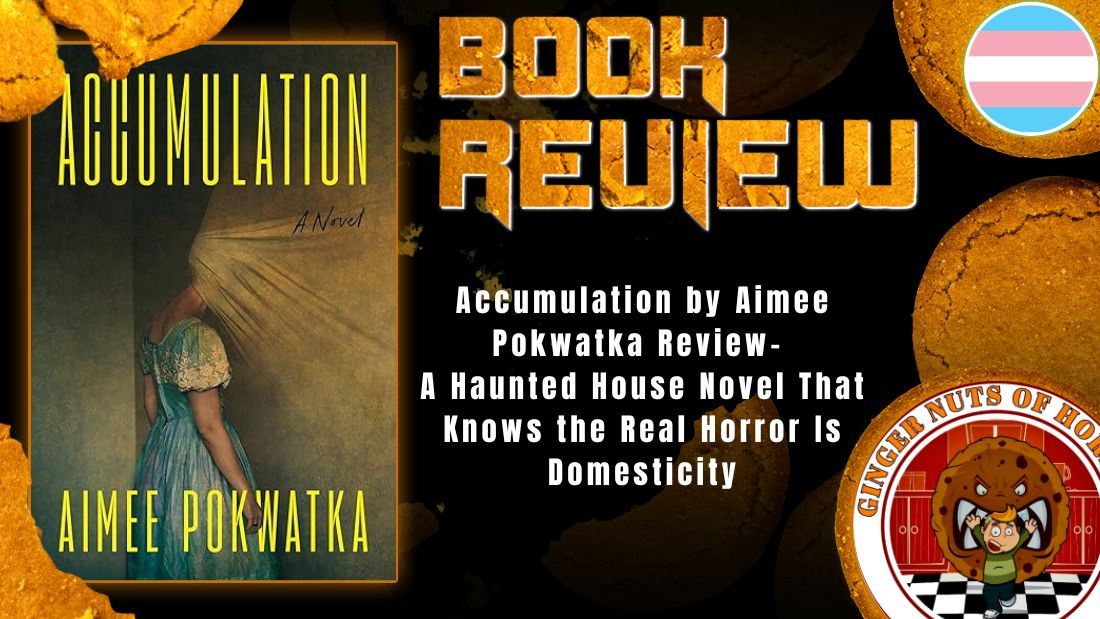
Aimee Pokwatka’s ACCUMULATION writes domestic horror as ambient dread—the terror accumulates in the cracks of a woman’s attention, in the repetition of chores, the slow erosion of identity. This is a haunted house novel where the real ghost is everything she gave up.
Accumulation by Aimee Pokwatka Review: A Haunted House Novel That Knows the Real Horror Is Domesticity
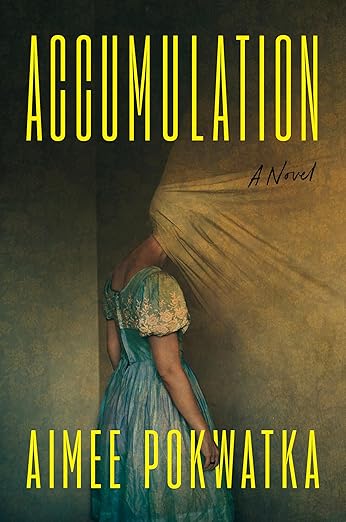
Accumulation centres on Tennessee Cherish, known to everyone as Tenn, a documentary filmmaker who set aside her camera and her professional ambition for marriage and motherhood. Fourteen years into that bargain, her husband Ward buys her a dream house in a new town, a gesture that lands somewhere between a fresh start and a guilt offering.
He’s taken a high-paying job that keeps him frustratingly absent; she’s supposed to manage the household, the move, the children, the endless logistics of domestic life. That house, old and needing love, should be the backdrop for renewal. Instead it becomes something stranger, a space where the everyday starts to loop back on itself in ways that feel just slightly wrong.
A faucet runs at all hours. A creepy doll, found in the front yard ivy, keeps appearing in rooms where no one remembers placing it. A human tooth turns up embedded in the floorboards. The children, Aisling and Anders, begin acting out in unsettling ways. Tenn, distracted by the sheer volume of tasks that come with establishing a new household, doesn’t notice at first.
But Pokwatka notices for her, and for us, and the novel’s architecture of dread is built on precisely this observation: domestic life already runs on repetition. Laundry, dishes, school pickups, the same arguments with your spouse, the same small resentments reheated and served again. All it takes is a slight perturbation, a faint distortion in the loop, for that repetition to turn menacing.
Reading Accumulation feels like standing in a kitchen you know well, only someone has shifted every object two inches to the left. The disorientation is subtle at first, almost ignorable. You could, if you wanted, convince yourself nothing has changed. But the longer you stand there, the more your body protests. Something is off. You can’t name it, but your nervous system already knows.
This is not a novel that grabs you by the throat. It tightens its grip so gradually you don’t register the pressure until breathing requires effort. Pokwatka has written a haunted house story that understands the house is not the source of the dread so much as its amplifier; what resonates through the rooms is the accumulation of fourteen years of compromise, swallowed resentment, artistic sacrifice, and the quiet bargain Tenn made when she traded filmmaking for family.
The supernatural elements, the doll and the tooth and the loops, might be real. They might be manifestations of a psychological fracture. The book is not interested in resolving that question neatly, and that refusal is precisely what gives the novel its staying power.
What kind of horror is this? Psychological horror, certainly. Domestic horror, yes. But those labels feel too neat. Pokwatka writes in a register I’d call ambient dread fiction. Think of the way Brian Eno described ambient music: it must be as ignorable as it is interesting. Most of Accumulation operates at this frequency. The early chapters hum with a tension you could easily dismiss as the ordinary stress of moving house and raising children. But Pokwatka is layering something beneath, looping phrases and gestures and domestic tableaux until the repetition itself becomes the antagonist.
Her sentences are clean, controlled, never showy. She trusts domestic detail to do the heavy lifting: a stuck attic door, a missed day of work, a sick child needing pickup, a job that quietly decides it no longer needs your position. These small defeats accumulate in the reader’s chest like sediment. By the time the overt strangeness escalates, you’re already primed. You’ve been living in Tenn’s loneliness for a hundred pages.
Pokwatka’s great structural innovation here is the loop. The family finds themselves repeating everyday actions, conversations, entire sequences of domestic life, but slightly altered each time, increasingly dangerous. This is a formal choice that echoes the thematic argument of the book with remarkable precision: domesticity itself is a loop, a cycle of tasks that reset the moment they are completed, and within that loop a person can lose herself entirely.
The shifting perspectives Publishers Weekly noted are central to the novel’s method. Pokwatka moves between points of view not to provide comprehensive coverage of events but to blur the boundary between what is objectively happening and what might be Tenn’s perception. In a passage that has stayed with me, something sinister stands in a dark corner of the house; Tenn sees it, but so do the others. The family is experiencing this together, which complicates the easy reading: this is not simply a woman losing her mind in a house. Or it is, and the house is losing its mind right along with her.
The dialogue throughout is natural and unforced. Ward’s absence is rendered not through melodramatic fights but through conversations that feel lived-in, worn smooth by repetition, the kind of exchanges long-married couples have about logistics while something unnamed sits between them. Pokwatka resists the temptation to make Ward a villain. He is instead a man who doesn’t notice, who keeps accepting more work because work rewards him in ways domestic life doesn’t seem to. The novel’s critique of gendered domestic labour is sharp but never polemical; it emerges from the texture of the characters’ lives, not from authorial pronouncement.
Chapter by chapter, the escalation is meticulous. Pokwatka understands that horror works best when the reader is slightly ahead of the protagonist but never entirely sure what they’re seeing. Tenn’s late recognition of the threat mirrors the way real people process danger that doesn’t announce itself dramatically. The structural pivots that some readers might find slow are, to my reading, the book’s greatest asset. They create a reading experience that mirrors the novel’s central question: how much strangeness can a person absorb before she admits something is wrong?
Beneath the haunted house machinery, Accumulation is a novel about what it costs a woman to become a mother and a wife in a culture that still expects her to subsume her own identity into those roles. Tenn was a filmmaker, a documentarian, someone who shaped images and told stories. Now she shoots weddings for money, or she did until the job slipped away. Her husband’s career flourishes while hers dissolves. The house, the dream house Ward bought for her, is both gift and cage, and Pokwatka understands that domestic spaces can be both at once without contradiction.
The novel’s title does real work. Accumulation: of objects, of resentments, of small unspoken disappointments, of the detritus a family generates simply by living. But also accumulation as a financial concept, the accumulation Ward pursues at his high-paying job while Tenn’s unpaid labour holds the household together. And accumulation as a narrative strategy, the layering of eerie incident upon eerie incident until the weight becomes unbearable.
One of the novel’s subtler insights is about attention. Tenn, distracted by the logistics of moving, doesn’t notice the strangeness at first. Her attention is consumed by the invisible labour of motherhood: the scheduling, the planning, the emotional management of children and husband. The horror enters through the cracks in her attention, and this feels devastatingly true to life.
What this book confirms about Pokwatka is that she is a writer profoundly interested in the psychology of women under pressure, and that she will use whatever genre tools serve that interest. She trusts readers to sit with uncertainty, to feel discomfort without demanding resolution.
How many women have been told they’re imagining things when they finally do start paying attention? How many have been dismissed as hysterical, stressed, hormonal? The novel engages seriously with the medical gaslighting of women’s perceptions, a tradition stretching back at least to Charlotte Perkins Gilman’s “The Yellow Wallpaper,” which Accumulation echoes in its DNA without ever becoming derivative.
What sets this book apart from its predecessors is its refusal to pathologise Tenn. She is not a madwoman in the attic. She is not the unstable narrator the horror genre has trafficked in for decades. The ambiguity Pokwatka cultivates, the is-it-real-or-is-it-psychological question, serves a different function here. It asks us to consider that perhaps the haunting is real precisely because the domestic conditions are real, that the accumulation of compromise and erasure might generate its own kind of malevolence, one that doesn’t need ghosts to be terrifying.
Pokwatka arrived in 2022 with Self-Portrait with Nothing, a speculative debut that explored motherhood, identity, and belonging through parallel universes and doppelgängers. Publishers Weekly called it “a deeply felt, introspective meditation on motherhood and the nature of the self.” The novel earned a New York Times Best Fantasy of 2022 selection and a Goodreads Choice nomination. It straddled the line between sci-fi thriller and literary fiction, and its central character, Pepper Rafferty, was wrestling with questions of origin and selfhood that would echo through Pokwatka’s subsequent work.
Then came The Parliament in 2024, a dramatic pivot: a locked-room survival horror about a group of people trapped in a small-town West Virginia library by tens of thousands of homicidal owls. But layered inside that visceral premise was The Silent Queen, a dark fairy tale about a young queen who traded her voice to a monster.
The novel earned starred reviews from BookPage and Library Journal, with BookPage calling it “a master class of intelligent and beautiful writing.” In interviews around that book, Pokwatka described her work as “speculative fiction” that “rarely falls neatly into one clearly-defined category.” She spoke of her love of locked-room stories and pressure-cooker scenarios, of being influenced by fairy tales, Angela Carter, George Saunders, Kelly Link.
What do women give up to be safe? What does it mean to lose your voice, literally or metaphorically? How do creative women negotiate the demands of domestic life? In Self-Portrait with Nothing, the biological mother is an artist who rejects her child. In the Parliament, a cosmetic chemist who has buried herself in survival skills must learn to connect. In Accumulation, a filmmaker has surrendered her art entirely, and the haunting may be what happens when that art demands to be noticed again.
The stylistic evolution across these books is striking. Self-Portrait with Nothing was praised for its “fresh, clever and controlled” prose but noted by some as uneven in pacing. The Parliament revealed a writer comfortable with an ambitious structure, weaving two complete narratives into a seamless whole. With Accumulation, Pokwatka has stripped away the hybridity of her earlier work and fully committed to domestic psychological horror. The prose is tighter, more disciplined, more trusting of the reader. She has learned that what she leaves unexplained is often more powerful than what she clarifies. The cyclical structure, hinted at in The Parliament‘s story-within-a-story, becomes the central formal device here.
What this book confirms about Pokwatka is that she is a writer profoundly interested in the psychology of women under pressure, and that she will use whatever genre tools serve that interest. What it deepens is her commitment to ambiguity as a moral and aesthetic position. She trusts readers to sit with uncertainty, to feel discomfort without demanding resolution.
Accumulation occupies the intersection where literary horror meets domestic psychological horror, a territory currently experiencing a significant renaissance. The last several years have seen a wave of novels that treat the home not as a sanctuary but as the primary site of dread: Carissa Orlando’s The September House, Cherie Priest’s It Was Her House First, and a host of others that understand the haunted house as a metaphor for the family that inhabits it. What distinguishes Pokwatka’s contribution is her rejection of the genre’s default assumption that the family was secretly dysfunctional all along.
In most haunted house narratives, the supernatural presence merely accelerates a disintegration that was already underway. The cracks in the facade were always there; the haunting reveals them. Accumulation takes a different, and to my mind braver, position. This family genuinely loves each other. Tenn and Ward’s marriage is strained but not broken.
The children are acting out, but they are not monstrous. The haunting does not expose hidden cruelty; it pulls a functional family apart from the outside, or from some ambiguous space between inside and outside. As one perceptive early reader noted, the supernatural operates less like a malevolent intelligence and more like pent-up emotion looking for an outlet, like writer’s block made manifest.
This choice places Accumulation in conversation with Shirley Jackson’s The Haunting of Hill House and Stephen King’s The Shining while deliberately refusing their conclusions. The family is not the problem. The house is not merely a stage for psychological breakdown. Something stranger is happening, something Pokwatka declines to fully explain, and the novel is stronger for that refusal.
Horror as a genre is currently in a generative period of questioning what it can do. The literary horror wave, the folk horror revival, the renaissance of socially conscious horror fiction: all of these movements are asking how fear can illuminate rather than merely startle. Accumulation belongs to a strain of horror that takes women’s interior lives seriously, that understands domestic spaces as sites of both love and erasure, that sees motherhood not as a horror trope but as a complex human experience that can, under certain conditions, become genuinely terrifying.
Its natural bookshelf companions include Rachel Harrison’s Such Sharp Teeth, Gus Moreno’s This Thing Between Us, and the domestic uncanny of Shirley Jackson’s lesser-known stories. But Pokwatka’s voice is entirely her own: cooler, more measured, less interested in catharsis than in the slow, sedimentary accumulation of unease.
Tenn was a filmmaker. She understood that the most powerful images are not explosions but glances, not screams but the silence after one. Pokwatka seems to understand the same thing.
Accumulation by Aimee Pokwatka
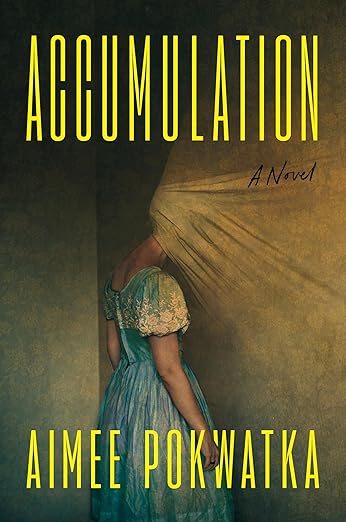
When documentary filmmaker turned stay-at-home mom Tennessee Cherish moves into the dream house her husband bought for her, a brighter future seems to be on the horizon. Even if her husband is frustratingly absent due to his new high-paying job. Even if their two young children begin acting out in strange ways. Even if she feels lonelier than ever. Distracted by the endless details that come with moving into a new town, a new house, and new schools, Tenn doesn’t notice when odd things begin happening at home.
The faucet that runs at all hours. The creepy doll that seems to show up in every room. The human tooth they found in the floorboards. As the kids outbursts and the strange events start to escalate, the family finds themselves increasingly caught in loops, repeating everyday actions with dangerous – and then devastating – effects.
Tenn realizes she must find the source of what is haunting her family, before it kills them all. Taut and twisty, scary and searing, Aimee Pokwatka’s Accumulation lays bare the high price women pay for the promises of domesticity and motherhood, and the many ways in which families can be haunted.