
You know how some towns just feel… hungry? Like the very streets might quietly digest the unlucky or the unaware. That’s Gulpepper. “The Gulp,” as the locals call it. A fictional harbour town on the NSW south coast that seems to swallow people whole.
Alan Baxter built it. And in his latest mosaic novel, The Rise, he returns to it.
The town is the main character, he’ll tell you. A place with the isolated, eerie vibe of an Australian coastal community, but warped through a lens of cosmic weirdness and dark fantasy. It’s where consequences feel inevitable, but never quite predictable.
He started with a map of Kiama and a feeling. The result is a unique geography of horror, a place that has now consumed fifteen interconnected tales across three books. So, let’s start at the beginning, with the thing that started it all…
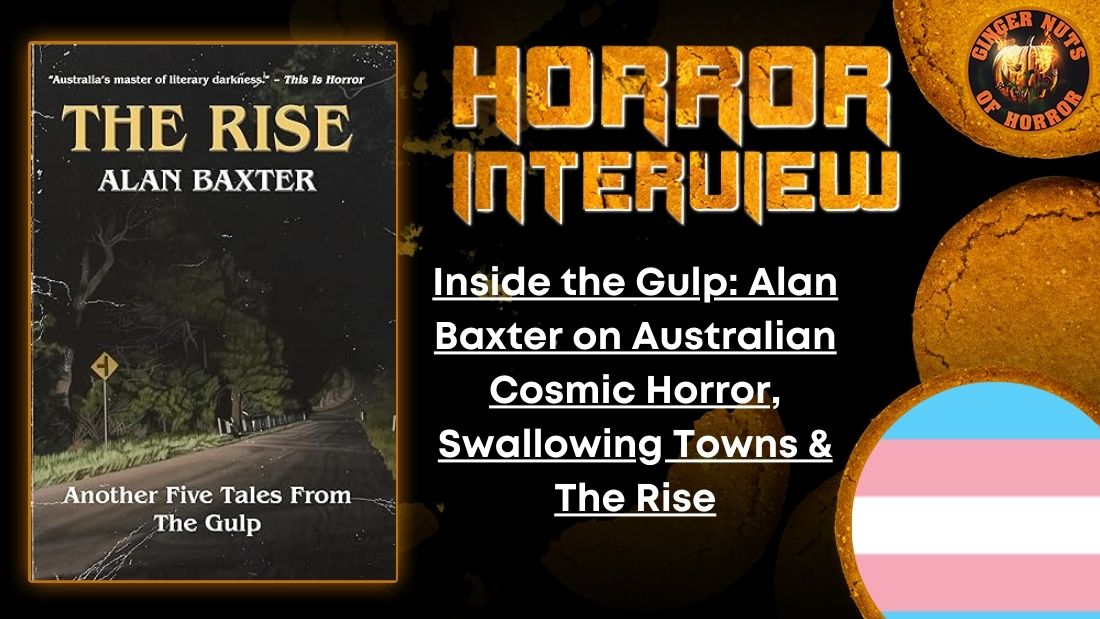
Inside the Gulp: Alan Baxter on Australian Cosmic Horror, Swallowing Towns & The Rise
In earlier interviews, you’ve called Gulpepper, or “The Gulp,” a fictional NSW harbour town that seems to swallow people. What first inspired this setting? Did it come from a real place, a feeling about the Australian coast, or a wish to create a special kind of story world?
All of the above. Initially I wanted to create my own fictional geography that I could return to frequently, like King’s Castle Rock. I wanted it to feature the unique kind of isolation found in Australia, but not the obvious choice of an outback town. I’m fascinated by the ocean and needed to combine that isolated location with a classic harbour town vibe. Think Castle Rock crossed with Innsmouth, but very much my own Australian take on that.
As for it being a real place, it’s absolutely fictional and somewhere on the NSW south coast, not too far from the Victorian border, but I’ve deliberately never given it a more accurate location than that. However, if you took a street map of Kiama in NSW and studied it closely, you might find it strangely familiar. I lived right by Kiama for over fifteen years and it was fun to use that as a template for the layout of Gulpepper.
The Gulp is made up of five connected novellas, which you’ve described as a “mosaic novel.” What drew you to this structure instead of a traditional novel? How did you handle pacing and reveals across stories that are separate but linked?
Originally, I knew I wanted to write a bunch of stories set in this new geography, and I wanted them to be longer than regular short stories, so I thought a collection of novellas would be cool. It was only during the writing that I realised the stories would be fun with overlapping characters and references to each other, and that naturally grew into the mosaic novel The Gulp became. Subsequently I did the same thing again with The Fall—five standalone novellas that also tell a bigger story—but I also tied The Fall back to The Gulp, so it became a bigger mosaic novel across two books.
So of course, I did it again with this latest one, The Rise. Five standalone novellas, that are actually interconnected stories, that also tie back to The Gulp and The Fall. Over three books now there are fifteen novellas that really flesh out the Gulpepper Mythos. There are still unanswered questions, and I’ll return to Gulpepper frequently, I’m sure, but I think I’m done with this format.
You’ve said you “really leaned into Australian horror” and cosmic weirdness with The Gulp. How do you define “Australian horror”? How is it different from simply setting a regular horror story in Australia?
This is tough to answer, because it’s subtle and hard to describe. For me, place is as much a character in any story as the people or monsters or anything else. If one of my stories could be set in another country without changing anything, I haven’t established the character of the place enough. So it’s that almost subconscious sense of Australian-ness that pervades Gulpepper. I hope!
The linked stories hint at a community that’s always affected by the strange. Do you see the town as a main character? Your work often explores the results of people’s actions. In a place like The Gulp, do you think consequences are more certain? If so, why?
Absolutely Gulpepper is the main character in these stories, but its population is a part of it, so they’re inextricably linked. On the one hand, the consequence of being in Gulpepper would seem inevitable—the place has a habit of swallowing people, after all—but some people do get away. Not without cost, of course. And some people are swallowed, but maybe that’s not the worst thing that could have happened to them. Nothing is certain in Gulpepper.
You’ve said that being a British immigrant gives you an “outsider’s view” of Australia, even after living here for years. How does this perspective shape how you write Australian characters and settings? Does it help you create a sense of unease or the “weird”?
Being an immigrant is a strange thing, as you get to a point where you’re never entirely at home anywhere. You’re always aware that you grew up somewhere else to where you live and, whenever you go back to the place you grew up, you realise it’s not home any more. It’s moved on without you. That’s a good and bad thing, but I feel like it allows a certain objective viewpoint of other people. Everyone I encounter, I feel a little like an outsider. It gives an interesting perspective on folks and I try to use that in my writing. It certainly helps me notice the weirdness that other people take for granted.
You often speak up for more non-US/UK horror voices. When you write “unashamedly Australian” stories like The Gulp or The Roo, what do you most want to show or share with readers overseas about Australia?
Mainly, that not all stories need to be set in America or the UK. The vast majority of fiction in English is from the US, probably with the UK in second place, so I want people to see that we have amazing stories to tell in other places too, that are just as accessible, but also different.
Your work is consistently described as a mix of horror, dark fantasy, crime, and noir. How do you balance these elements? For instance, does a story start as a crime plot that attracts the supernatural, or is the horror element the primary driver?
For me, horror, in particular supernatural horror, is just another facet of dark fantasy and crime is just another facet of horror. They all merge perfectly for me and I have the most fun when I draw on all those genre expressions to a greater or lesser degree. Whether a story starts as one or another varies greatly from piece to piece.
The Alex Caine series is a supernatural thriller centred on a martial artist. Your novel Blood Covenant is described as a crime thriller that turns into a supernatural horror. What is the through-line for you between writing urban fantasy action and the more localised, creeping horror of The Gulp?
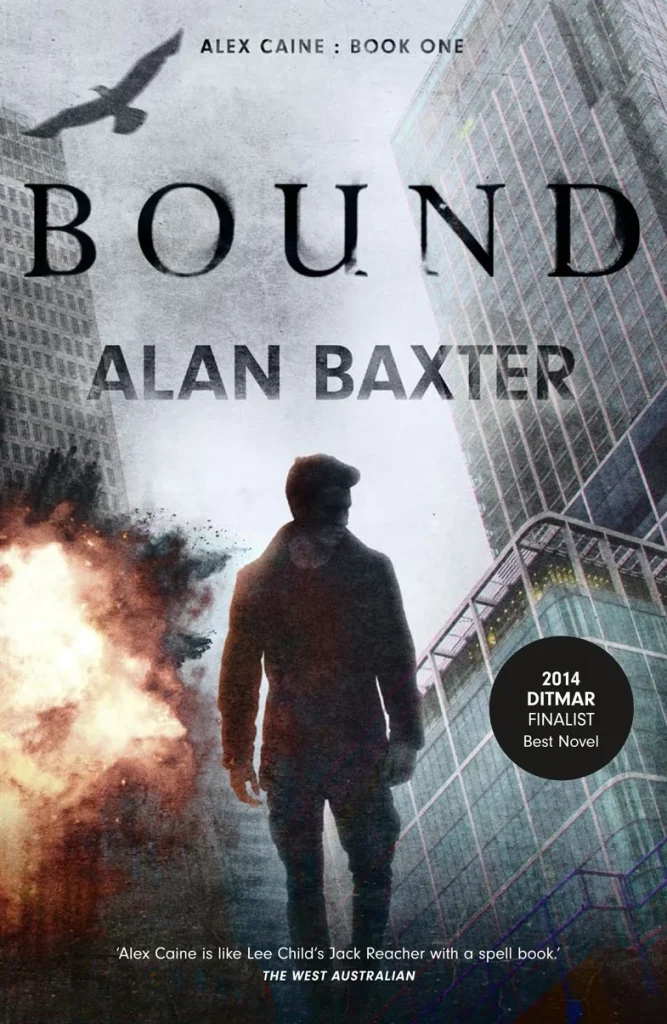
Again, to me they’re the same thing. The Alex Caine Series travels the world and other worlds, the stakes get higher and higher, but the driving principle is largely the same—people trying to stand up against the things that would destroy them. The Gulp is like that too, maybe just with a more focussed lens. Having said that, I’ve moved away from the urban fantasy side of things now. I’m a lot more drawn to the horror, weird, supernatural, crime side of things right now.
The Eli Carver series is described as a “supernatural crime thriller” where a hardened criminal with amnesia is haunted by the ghosts of people he’s killed. How did you approach blending the fast-paced, gritty rules of a crime noir with supernatural horror elements? Did one genre naturally take the lead, or was it always an equal partnership?
This one was very much a crime noir story first, with Eli’s ghosts slowly taking a more and more active role in the story. In the first part, we’re not even certain if the ghosts are real or another part of Eli’s psychosis. As the story goes on, that gets further explored.
The ghosts in Eli’s story aren’t just background horror; they act as a “supernatural peanut gallery,” offering commentary and torment. How did developing this unique relationship between Eli and his ghosts allow you to explore themes of guilt, memory, and identity in ways a standard thriller could not?
Real or not, the ghosts are a manifestation of everything Eli did before the events of the story take place. Given that it’s a first person narrative, it can be hard to explore deeper themes without others to bounce off, so Eli constantly being harangued by these ghosts is excellent for that. How he deals with other people in his life is one thing, but there’s nothing he can hide from his ghosts.
The Roo’s origin story is famously a Twitter dare, but its narrative also carries serious social commentary about rural life and domestic violence. How did you approach blending such a deliberately playful, B-movie concept with these weightier themes without one undermining the other?
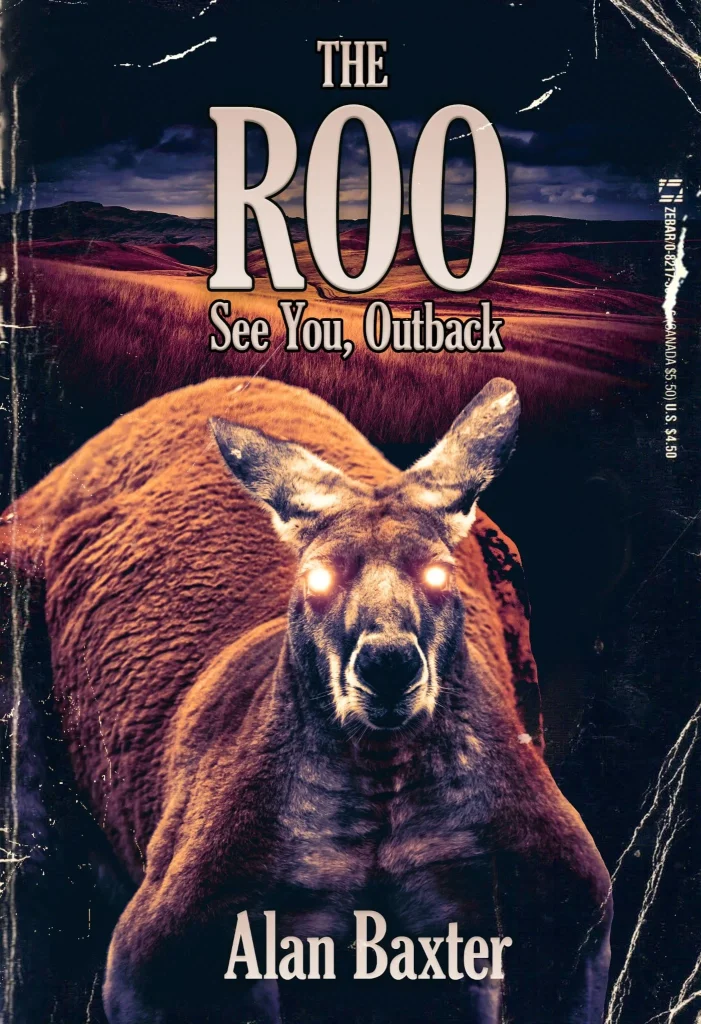
The best gonzo horror has more to say than just entertainment. I try to make sure everything I do is more three-dimensional. Everything in a story serves a greater theme. First and foremost I want to entertain people, but I don’t only want to do that. With The Roo, I had the idea for the background of that story already and needed a monster for the story element. So when that Twitter dare took off, I decided a crazed, demonic killer roo would be my monster.
The Roo is steeped in Aussie slang, setting, and even a national icon turned monster. What specific aspects of the Australian experience or character were you most excited or determined to showcase to an international horror audience through this outrageous story?
I wanted to give a good feel of what small town outback Australia is really like. And I asked all my friends to share their favourite Aussie sayings and I tried to include as many of those as possible. Almost all my work is set in Australia, but only The Roo goes full-Aussie—it’s deliberately almost a parody of itself.
Significant influences on your work include Clive Barker, and Jamie Delano’s Hellblazer. How have these influences evolved in your work? For example, can you see a thread from the urban mystic horror of Hellblazer to the cursed town of The Gulp?
Absolutely there’s a thread. Barker is by far my biggest influence. I’m always striving to write what he called the “dark fantastique” as that’s the vibe that resonates most strongly with me. And the early Hellblazer stories, with their strong working class sensibilities, also hit me right on target. Those among many other things remain strong influences.
It’s been mentioned that The Gulp was written during the early pandemic lockdowns. Did the global atmosphere of anxiety and isolation directly shape the tone or themes of the book, or did it simply provide the focused time to execute an existing idea?
Neither, actually. I started writing these stories during the lockdowns as I didn’t have the headspace to focus on a full-length novel. Pivoting my kung fu classes to Zoom, dealing with homeschooling, etc. all made keeping my head in a novel-length piece of work difficult. So I focussed on shorter stuff, short stories and subsequently these novellas. Funnily enough, they turned into a mosaic novel anyway.
Your collaborations with David Wood, like the Sam Aston Investigations and the Jake Crowley Adventures, merge his action-adventure expertise with your talent for horror and the supernatural. What is your process for blending these distinct authorial voices into a cohesive story? Is there a specific element you each “own” in the partnership?
We’ve got a system pretty well locked down now. We talk a lot about the book we plan to write, chat over Zoom, etc. and get a really good handle on what we want to do. Then Dave does a draft 0.5, which is a pretty detailed chapter by chapter outline. I take that draft 0.5 and write the entire first draft. I’ll often veer away from the plan and we’ll chat and rework stuff as we go. Once I’ve got a first draft done, it goes back and forth between us a few times as we smooth it out until we’re happy.
Your career is also defined by a philosophy of playing the long game, constantly improving your craft, and maintaining a hybrid publishing approach. Looking forward, how do you see these foundational elements, your core themes, your ‘unashamedly Australian’ voice, and your pragmatic, craft-focused career philosophy, guiding and evolving in the stories you plan to tell next?
Honestly, I have no idea. I’ve always said that if I fail at this job, it won’t be because I didn’t work hard enough. I’m always working on the next thing, looking for the next opportunity. Hopefully, I’m also improving all along the way. So I’ll just keep doing what I do, tell the stories I want to tell, and with any luck, I’ll keep finding readers who enjoy them.
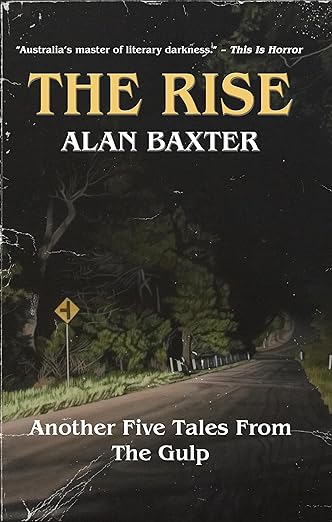
The Rise (Tales From The Gulp #3) by Alan Baxter
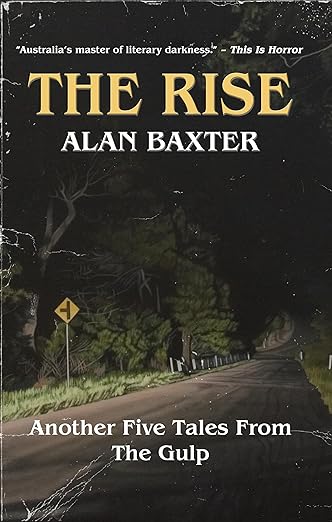
Strange things happen in The Gulp. The residents have grown used to it.
The isolated Australian harbour town of Gulpepper is not like other places. Some maps don’t even show it. And only outsiders use the full name. Everyone who lives there calls it The Gulp. The place has a habit of swallowing people.
A couple of weed dealers give themselves a real headache.
A young man finds joy in a secret place with the new love of his life.
The children of violent, bigoted parents fight for survival.
One of the world’s biggest stars takes time out in Gulpepper’s newest Institution.
The return of an old foe threatens the existence of Gulpepper itself.
Five more novellas. Five more descents into darkness.
Welcome to The Gulp, where nothing is as it seems.
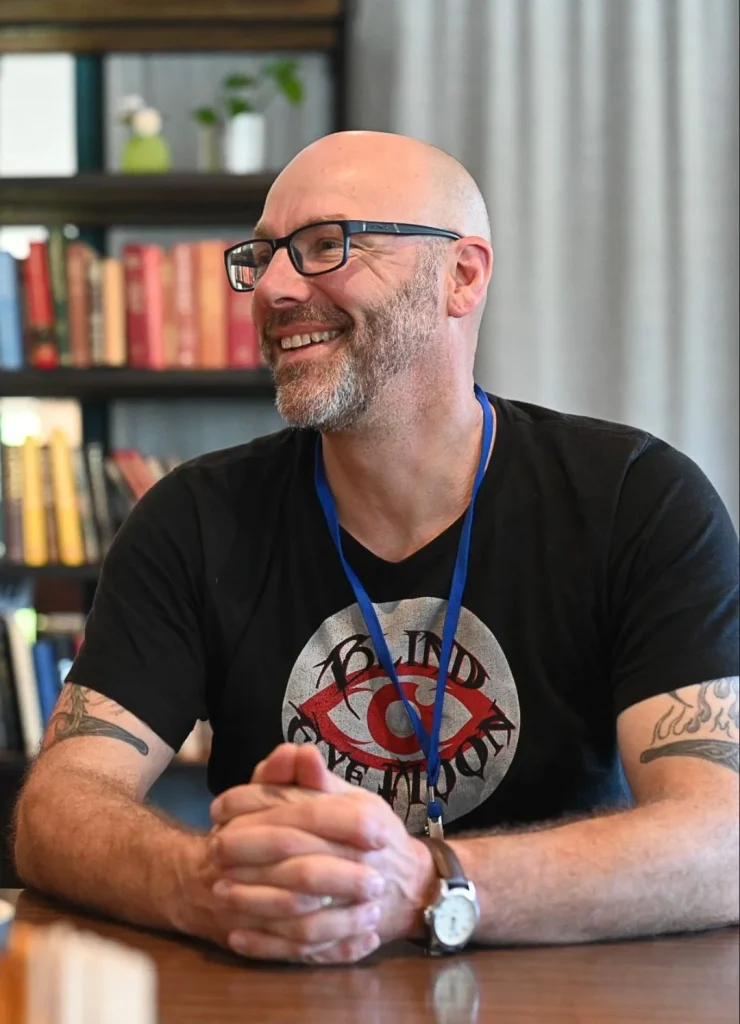
Alan Baxter
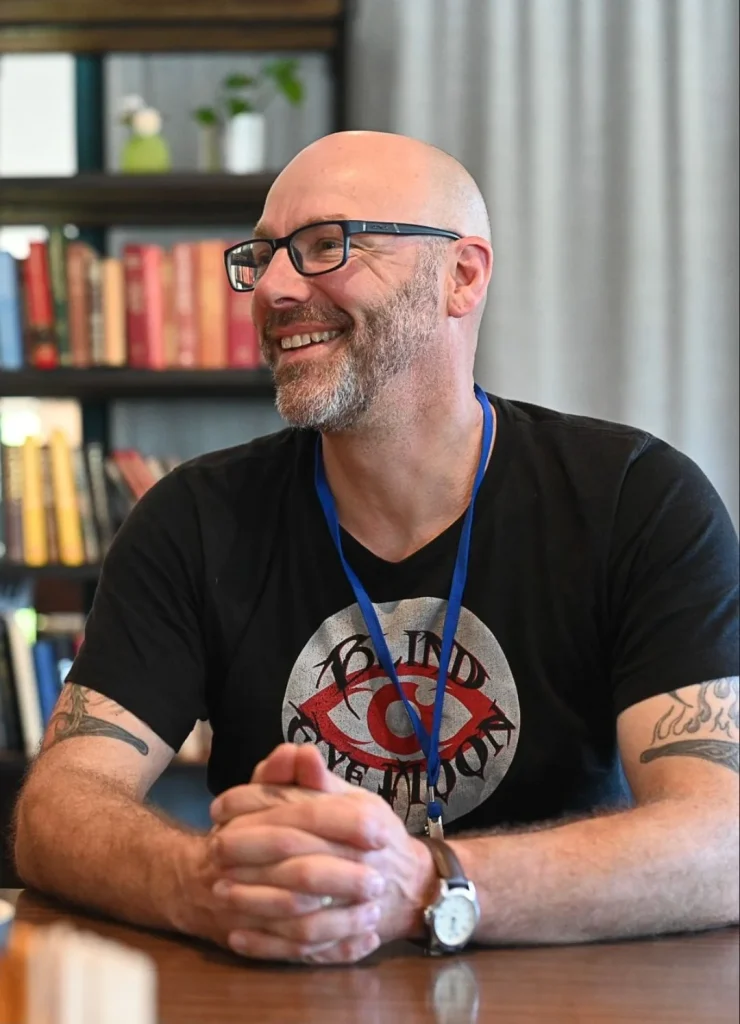
Alan Baxter is a multi-award-winning British-Australian author of horror and weird fiction. This Is Horror podcast calls him “Australia’s master of literary darkness” and the Talking Scared podcast dubbed him “The Lord of Weird Australia.” He’s also a martial artist, whisky-soaked swear monkey, metalhead and dog lover. He writes his darkly strange tales deep in the valleys of southern Tasmania.
Alan is the author of more than twenty novels and novellas and over one hundred short stories published in journals and anthologies in Australia, the US, the UK, France, Germany, Japan and Taiwan, including The Magazine of Fantasy & Science Fiction, Beneath Ceaseless Skies, Daily Science Fiction, and many others. Alan has two award-winning volumes of collected short fiction, Crow Shine and Served Cold. His work has been translated into French, Spanish, German, Italian, Japanese and Taiwanese.
At times, Alan collaborates with US action/adventure bestselling author, David Wood. Together they have co-authored the short horror novel, Dark Rite, four action thrillers in The Jake Crowley Adventures, and three giant monster thrillers in the Sam Aston Investigations series.
Alan has been a fifteen-time finalist in the Aurealis Awards, a nine-time finalist in the Australian Shadows Awards and a fifteen-time finalist in the Ditmar Awards. From those shortlistings he won the 2021 Aurealis Award for Best Collection for The Gulp, the 2014 Australian Shadows Award for Best Short Story (“Shadows of the Lonely Dead”), the 2015 Australian Shadows Paul Haines Award For Long Fiction (“In Vaulted Halls Entombed”), the 2016 Australian Shadows Award for Best Collection (Crow Shine), the 2019 Australian Shadows Award for Best Collection (Served Cold), and the 2023 Australian Shadows Award for Best Short Fiction (“All the Eyes That See”).
He is also a past winner of the AHWA Short Story Competition (“It’s Always the Children Who Suffer”). Alan’s work has made the Preliminary Ballot for the Bram Stoker Awards three times (Crow Shine, 2016 Bram Stoker Award (TM) for Superior Achievement in a Fiction Collection, The Gulp 2021 Bram Stoker Award (TM) for Superior Achievement in a Fiction Collection, and Sallow Bend 2022 Bram Stoker Award (TM) for Superior Achievement in a Novel). Alan’s 2015 Australian Shadows Paul Haines Award-winning story, “In Vaulted Halls Entombed”, was adapted for Season 3 of the Netflix Original Series, LOVE DEATH + ROBOTS.
Alan is also a martial artist, having spent his life since childhood learning a variety of fighting styles. He has competed in a number of competitions in the UK, Australia, and China. In 1996 he won the Wutan Federation British National Championship title in the UK. He’s now an International Master of Choy Lee Fut Kung Fu, and a Fire Dragon Disciple of Grandmaster Chen Yong Fa.
Read extracts from his novels and novellas and find free short stories at his website – www.alanbaxter.com.au and find all his social media links here.
Essential Horror Author & Director Interviews on Ginger Nuts of Horror
For true devotees of the dark and macabre, Ginger Nuts of Horror stands as a premier destination for exclusive horror author interviews and in-depth horror director interviews. Our curated conversations go beyond the surface, offering unparalleled access to the visionaries shaping modern horror.
Why Read Our Horror Creator Interviews?
1. Uncover Creative Processes & Inspirations
Step inside the creative minds behind your favorite nightmares. Our interviews dissect the inspiration behind iconic horror stories and films, exploring how masters of the genre conjure fear. Learn how horror authors develop chilling narratives and how horror directors translate terror to the screen.
2. Gain Unique Industry Insights & Career Advice
Navigate the horror industry with wisdom from those who’ve succeeded. Our conversations provide practical advice for aspiring horror writers and filmmakers, covering:
- Breaking into horror publishing or film
- Overcoming creative and professional hurdles
- Understanding evolving horror trends and audience expectations
3. Explore the Psychology & Culture of Fear
Delve deeper into what makes horror resonate. Our interviews examine the psychology of fear, how horror reflects societal anxieties, and the genre’s exploration of themes like morality, existential dread, and identity.
4. Connect with a Community of Horror Enthusiasts
Join a vibrant community. Each interview sparks discussion, allowing you to engage with fellow fans and sometimes the horror creators themselves through comments and social media.
Featured Insights from Horror’s Finest
Our archive includes conversations with legendary horror authors discussing craft, and visionary horror directors breaking down their filmmaking techniques. Find guidance, inspiration, and a deeper appreciation for the art of horror.
Ready to explore? Visit the Horror Interview Section on Ginger Nuts of Horror today. It’s your essential resource for connecting with the minds that define fear, perfect for fans, aspiring writers, and future horror directors alike.
Searching for the best horror author interviews or seeking wisdom from horror directors? You’ve found your source. Click here to start reading now.