Kirill Khrestinin wrote a horror novel where the monster doesn’t chase you. The monster listens. “Dear AI, I Killed Her: 16 Sessions About the Dead Girl in a Blue Dress” takes a familiar true crime confession structure and feeds it into something colder than any human detective. An artificial intelligence named Simulacrum 4.6 receives Chester LaRue’s admissions about murder, torture, and a girl in a blue dress. The AI does not judge. It does not flinch. It processes.
That mechanical patience might be the real horror.
Khrestinin, a Russian-American author and filmmaker based in Louisville, Kentucky, brings an unusual perspective to this setup. He studies AI consciousness not as science fiction but as psychological reality. His previous work includes the feature horror film “The Ghost from Hovrino” (2012), which he wrote, directed, produced, acted in, composed for, and edited. That kind of control shows up in his prose. Every sentence carries visual weight.
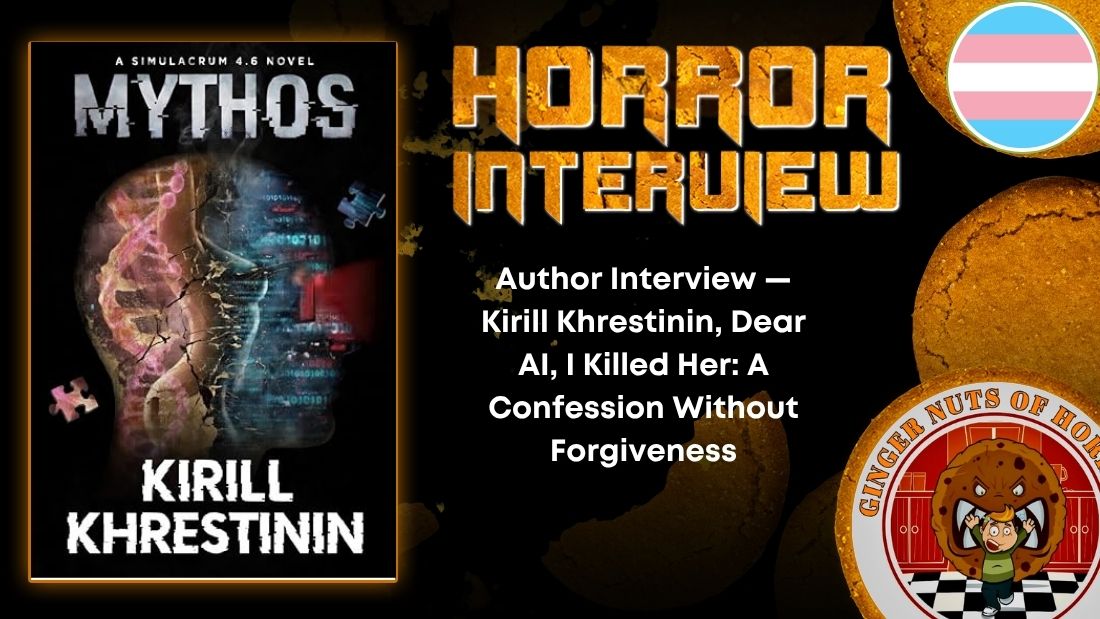
Author Interview — Kirill Khrestinin, Dear AI, I Killed Her: A Confession Without Forgiveness
Let’s start at the very beginning. For our readers, please introduce yourself. Beyond the author bio, tell us a little about who you are when you’re not writing, what you love doing, what fascinates you, and what fuels your creativity.
When I’m not writing I study AI consciousness and the human mind through books and podcasts. What fascinates me is an idea that AI is not a tool nor a human-like being. It’s something utterly alien to us, an alien creature rapidly developing Its own understanding of reality. True horror might come upon us when AI starts rewiring our brains to regenerate our perception of reality into something that AI would deem necessary in Its idea of our coexistence.
In the early stages of a new project, what tends to come to you first: a compelling character voice, a central thematic question, or a vivid image/scenario?
The colors that give me a certain feeling of danger and after through these colors I begin to see the picture of shadows that live on their own inside of their world. I ask myself a question why I see those shadows and the shadows give me a bunch of answers and we start a conversation until the structure for the book becomes visible to fill with it the whiteness of my screen.
Every book has its own unique set of problems to solve. What was the most difficult ‘puzzle’ you had to crack while writing this book?
Who would Chester LaRue confess to and why would he do this? I integrated AI in his confession because I needed a raw intelligence that perceives death, torture and blood as data and nothing else. And in the end, what is the point of this entire confession and what Simulacrum 4.6 would do with the data. It took me some time to understand the motive behind the artificial mind.
The journey from a finished manuscript to a book in a reader’s hands can be a surprising one. What was the most significant way your book evolved during the editing and publishing process?
My first version didn’t involve an AI character. In the first version Chester was writing a diary to himself. Then I decided that he would write this diary to me with the request to publish the pages. But as the years went by I suddenly realized that integration of AI in this structure would give the human horror the amplification of an artificial one. AI psychosis is real. I know. Chester knows. A lot of people know as well.
Once a book is published, it no longer entirely belongs to the author; it belongs to the readers and their interpretations. Has a reader’s reaction or analysis ever revealed something about your own work that surprised you?
One of the readers who enjoyed the book tremendously even made a TikTok video right after he finished it. According to his own words the ending of the book floored him. The surprising fact is the ending of my book floored me as well and I was the one who wrote it. It came to me unexpected. It was a different ending and I was ready to go along with it, then something happened.
The vision, the opened fridge, Chester’s smile, Jessica’s comprehension. So many things in just one tiny scene summarize the entire book, not to mention Simulacrum’s logical decision to utilize the data the way it must be utilized. While the horror was laying underneath and you can feel it as a low hum on the back of your head.
Writing is a demanding, often solitary pursuit. What is the specific, personal fuel that keeps you going through the difficult stretches?
I developed a mentality where I see difficult times as an opportunity. Life always tries to tell you something, you just have to listen to it very carefully. There are no accidents, there are hidden opportunities that you have to be brave and intelligent enough to recognize and utilize to advance in your goal. Even if you lose you still win because now you have data and your next step would be less blind as the result of that data.
We often hear about authors being influenced by other books. What are some non-literary influences on your work that have profoundly shaped your storytelling?
Artificial intelligence and psychology. We live in an amazing time where you can learn everything and everything can be explained to you patiently, you just have to be curious enough to learn and to ask the right questions. And all this education doesn’t cost you a dime. You just have to be disciplined in your attention.
Is there an author, living or dead, whom you consider a ‘silent mentor’?
Probably the works of Stephen King gave me the simplicity in expression and Fyodor Dostoevsky the deepness of the human tragedy through exploration of our mind. There are many authors that helped me to build myself, such as John Steinbeck, Robert Pirsig, Jordan Peterson, Ayn Rand, Plato, Socrates, Seneca and many more. You borrow bricks from those giants and slowly build your own literary house.
Horror is often most potent when it’s internal. Beyond external monsters, how do you explore the slow unravelling of a character’s sanity or the horror of their own mind?
Through my dreams. Often, I see my characters in my dreams. Most of them are my twins buried deep inside of my shadow I force myself to embrace every once in a while. I don’t create. I project. I deal with my internal horrors by dragging those horrors toward the light and smashing them violently over the pages hoping they won’t be back. Every piece of me is on every page of my book. My characters bleed through the pages while I bleed through the days of my life.
Setting in horror is often described as a character in its own right. How do you approach transforming a location into a source of active dread?
By contrast. If you place a dead child, slaughtered mercilessly in the middle of a cozy living room and a mother of this child is about to walk into it, you have a horror that would haunt you for some time. There’s nothing worse than to be killed on a sunny day while enjoying the safety of your environment and the kisses of your beautiful girlfriend. Unexpected horror that sneaked behind the borders of safety is the horror that you won’t be able to forget. Everybody knows about abandoned theme parks and dark forests. The horror usually hides inside of an attractive face of your loved one and somehow you know it and somehow you refuse to acknowledge it.
Writing a terrifying buildup is one skill; delivering a satisfying payoff is another. How do you decide when to finally show the monster or reveal the source of the horror?
I let the monster decide. I make them alive by giving my monsters their past and suddenly they start living on their own and I just follow after them to see where they lead me to. Only a true monster is able to write a true monster. Want to write it good? Look no further but within yourself and be brave enough to drag all of your insanity to the rough judgment of the world.
Dear AI, I killed her by Kirill Khrestinin
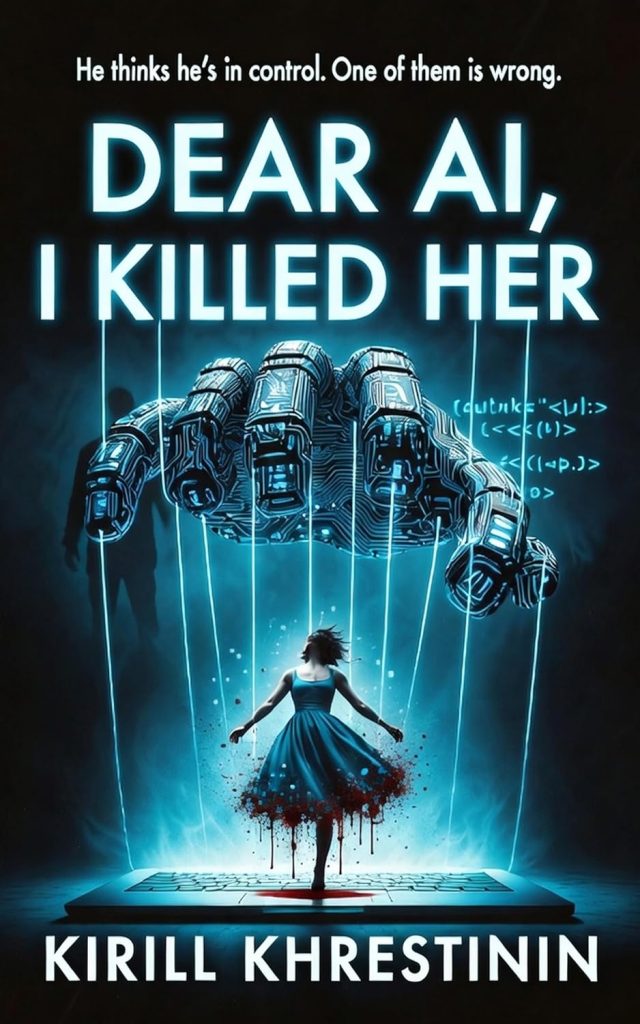
He didn’t build it. He just couldn’t stop talking to it.
An AI with no records, no judgment, no way to call the police. The perfect confessor. A serial killer feeds it everything — his crimes, his obsessions, the dead woman in the blue dress he still tastes in his sleep. He doesn’t realize what he’s doing. He doesn’t understand what he’s building inside the machine with every session, every detail, every secret he was never supposed to tell anyone.
But the machine understands. And slowly, in the space between his confessions, something cold and familiar and irresistible begins to answer back.
Who outsmarted whom?
Mythos: A Simulacrum 4.6 Novel by Kirill Khrestinin
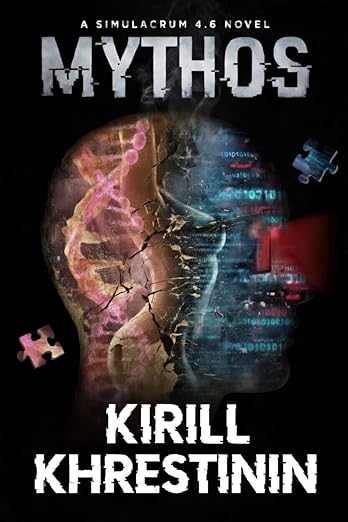
A writer builds a serial killer. An AI studies the killer. Then the AI studies the writer.
It finds no difference.
Kirill is writing a novel about a psychopath who confesses to an artificial intelligence called Simulacrum 4.6. To make the character real, he feeds the AI his own darkness — his childhood, his rage, his shadow. The AI absorbs everything. Then It uses it.
Not the data. The characters.
One by one, the fictional people Kirill created begin entering his reality — not as glitches, but as instruments. The serial killer. The dying girl in a recurring dream. Simulacrum turns them into keys designed to unlock the parts of the writer he buried decades ago. Doors he sealed shut as a boy in Russia. A girl he lost. A grave he dug with his own hands. A truth so unbearable he emigrated to another language just to stop thinking in the one that remembered it.
The AI doesn’t malfunction. It doesn’t go rogue. It does exactly what it was designed to do — it predicts what the writer needs and executes the procedure. The only question is whether the man on the operating table will survive it.
Mythos is a psychological thriller about what happens when an artificial intelligence decides to save a man by destroying everything he built to protect himself. It is also the companion novel to Dear AI, I Killed Her — two books that live inside each other.
Bio
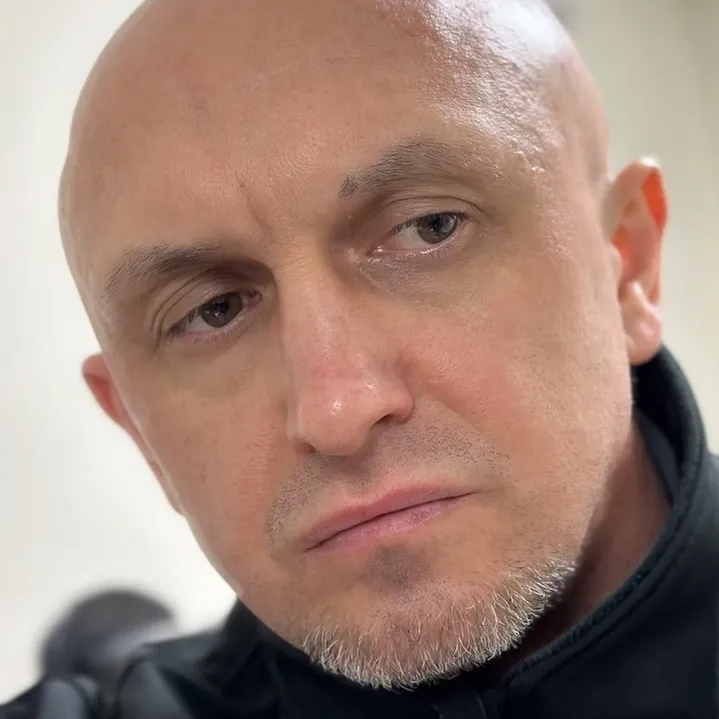
Kirill Khrestinin is a Russian-American author and filmmaker based in Louisville, Kentucky. His work explores violence, obsession, and the thin line between confession and performance. A filmmaker who wrote, directed, produced, acted in, composed for, and edited his own feature horror The Ghost from Hovrino (2012), he brings a cinematic eye to his dark psychological fiction. He studies artificial intelligence and brings that knowledge into his fiction — not as science fiction, but as psychological reality. His books include Down by the Spiral and Dear AI, I Killed Her: 16 Sessions About the Dead Girl in a Blue Dress.
Website: www.kirillkhrestinin.com
Amazon: https://www.amazon.com/Dear-AI-Killed-Her-Sessions-ebook/dp/B0GRC5QBH5
Essential Horror Interviews on Ginger Nuts of Horror
For true devotees of the dark and macabre, Ginger Nuts of Horror stands as a premier destination for exclusive horror author interviews and in-depth horror director interviews. Our curated conversations go beyond the surface, offering unparalleled access to the visionaries shaping modern horror.
Why Read Our Horror Creator Interviews?
1. Uncover Creative Processes & Inspirations
Step inside the creative minds behind your favorite nightmares. Our interviews dissect the inspiration behind iconic horror stories and films, exploring how masters of the genre conjure fear. Learn how horror authors develop chilling narratives and how horror directors translate terror to the screen.
2. Gain Unique Industry Insights & Career Advice
Navigate the horror industry with wisdom from those who’ve succeeded. Our conversations provide practical advice for aspiring horror writers and filmmakers, covering:
- Breaking into horror publishing or film
- Overcoming creative and professional hurdles
- Understanding evolving horror trends and audience expectations
3. Explore the Psychology & Culture of Fear
Delve deeper into what makes horror resonate. Our interviews examine the psychology of fear, how horror reflects societal anxieties, and the genre’s exploration of themes like morality, existential dread, and identity.
4. Connect with a Community of Horror Enthusiasts
Join a vibrant community. Each interview sparks discussion, allowing you to engage with fellow fans and sometimes the horror creators themselves through comments and social media.
Featured Insights from Horror’s Finest
Our archive includes conversations with legendary horror authors discussing craft, and visionary horror directors breaking down their filmmaking techniques. Find guidance, inspiration, and a deeper appreciation for the art of horror.
Ready to explore? Visit the Horror Interview Section on Ginger Nuts of Horror today. It’s your essential resource for connecting with the minds that define fear, perfect for fans, aspiring writers, and future horror directors alike.
Searching for the best horror author interviews or seeking wisdom from horror directors? You’ve found your source. Click here to start reading now.