
The childhood you half-remember, told by the one person who never wanted to remember it at all.
Capture Spiral: An Escape from Memory, a memoir by Jez Conolly, published by Temporal Boundary Press in 2026, is one of the most original and haunting pieces of British life-writing in recent years. Blending autoethnography, horror-cultural criticism, and a distinctly hauntological sensibility, the book traces Conolly’s childhood and adolescence in the faded Lincolnshire seaside resort of Cleethorpes between 1973 and 1983. For readers drawn to nostalgia, Generation X British childhood memoirs, 1970s cultural history, and writers who refuse to flinch, this is a book that rewards patient attention and rewards it generously.
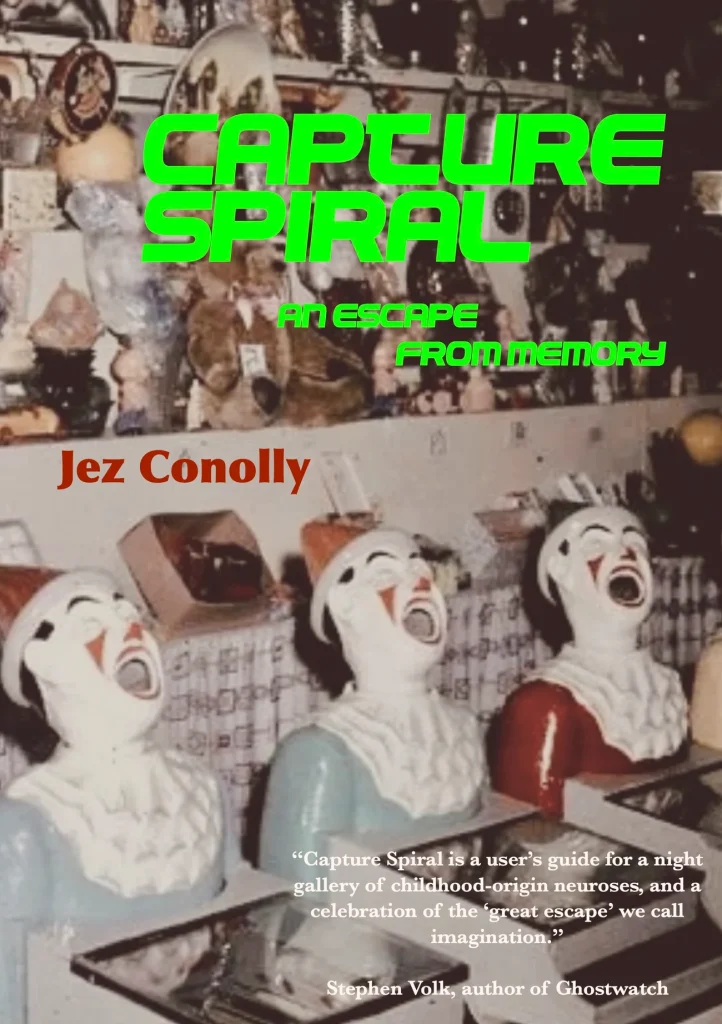
There is a particular kind of English dread that has no name in the dictionary, but that anybody who grew up within walking distance of a seafront amusement arcade will recognise immediately. Coin-operated clowns with mechanical laughter. Ghost trains nobody is queuing for. The smell of chip fat and cold ozone mingled in the off-season air. It is a dread so mundane it loops back around to the surreal, and it is precisely this emotional register, half-comedy, half-gothic, that Jez Conolly inhabits for the whole of Capture Spiral: An Escape from Memory.
Conolly grew up in Cleethorpes, a faded North East Lincolnshire seaside town joined, as he puts it, “at the hip” to the equally jaded former fishing port of Grimsby. He is at pains from the very first page to distinguish this book from the clichéd memoir of self-discovery, and he does so with such sharp, self-aware humour that you feel the ground being laid for something considerably stranger than a conventional coming-of-age story.
This is not an Eat, Pray, Love journey, he insists. Nor is it one of those misery-memoir white-cover affairs that filled WH Smith shelves for a regrettable decade. What it is, ). The self-deprecation is a signal: this book is written by someone who would rather undercut his own authority than let it turn into pomposity.
The memoir covers roughly ten years — 1973 to 1983 — presented across eleven chronological chapters, each anchored to a year and a theme, from “Playing Dead” (1973) to “Hercules Unchained” (1978), with a final exit section stretching into the early 1980s. The structure is both disciplined and, by design, a little permeable. Conolly explicitly invites readers to step on and off at any point, and the prose itself seems to honour this: you could enter mid-chapter and still find yourself immediately inside the grain of his sensibility.
“Capture Spiral is what happens when a writer with genuine critical intelligence turns the lens on his own formation. Conolly’s Cleethorpes childhood becomes a landscape you feel you’ve half-lived yourself: coastal, uncanny, and unexpectedly essential.”
Conolly’s central argument, if you can call it that without flattening it, is that imagination functions as both a coping mechanism and a prison break. The “capture spiral” of the title is his term for the psychic trap of a place, a set of circumstances, a family’s “alrightness” that allows no real acknowledgement of discomfort. Young Jez develops what he calls “creative detachment” as a response, a habit of staring at the ceiling until gravity seems to reverse, or of volunteering to be shot first in childhood war games purely so he can lie still on the grass and watch clouds.
These passages carry genuine phenomenological weight. There is real philosophical curiosity about the nature of imagination here, not mere nostalgia.
That said, the book is also frequently and quietly funny. Conolly’s accounts of running anti-clockwise in PE lessons simply because no one specified a direction, or of refusing to eat as a form of existential protest, sketch a portrait of a child conducting a meticulous guerrilla campaign against normality. His relationship to horror culture, specifically to TV programmes, films, Aurora monster model kits, and eventually John Carpenter’s The Thing, reads as both deeply personal and immediately recognisable to anyone who grew up in Britain in this era with a slightly sideways relationship to the mainstream.
The cultural archaeology here is impeccable. Bagpuss, Schools and Colleges, television programmes watched during sick days, the coin-operated laughing figures on the promenade, Doctor Who conventions in the kind of venues that might generously be described as “characterful.” The chapter centred on Tom Baker’s personal appearance at the Cleethorpes Marineland Zoo, a place already in terminal decline, populated partly by fibreglass dinosaurs that kept filling with rainwater during squalls, is both a miniature masterpiece of comic timing and something genuinely affecting. The detail of Tom Baker smelling of whisky as the photographs were taken lands softly and perfectly.
For readers familiar with Conolly’s earlier critical work, the transition from film analysis to memoir might suggest a gear-change, but it is, on reflection, entirely coherent. His 2013 Devil’s Advocates monograph on Carpenter’s The Thing established his gift for finding the precise pressure point where cultural object and personal psyche meet. In that volume, he brought analytical rigour and enthusiastic engagement together in a way that distinguished his voice from drier academic treatments of the same material. Capture Spiral does something structurally similar, but turns the lens inward. The town of Cleethorpes becomes the text under analysis. Childhood becomes the archive. Horror culture becomes the vocabulary through which the self is articulated.
There is also, running beneath the often wry surface of this book, a genuinely moving account of inheritance. Conolly’s father survived thirty missions as a rear gunner with 156 Pathfinder Squadron during the Second World War, a survival so statistically unlikely as to verge on miraculous given the mortality rates among tail-end aircrew. His mother lost a son to stillbirth between two surviving children, a grief kept so carefully contained that Conolly did not learn of it until adolescence.
Neither parent spoke much of their traumas, and the effect on the household was, as Conolly identifies it, an insistent, protective alrightness, a maintained fiction of normality that the child sensed without quite grasping. When he finally understands the buried history, the memoir gains a quiet emotional depth that the comedy had been holding in reserve.
The Exit section, which covers the difficult years between 1978 and 1983, operates at a different register from the richly detailed earlier chapters. Conolly himself acknowledges this: those adolescent years are, for him, a “grey area,” a period of psychological blotting out from which few specific memories surface cleanly. The writing here becomes necessarily more impressionistic, which is entirely honest but does create a slightly attenuated quality compared to the vivid precision of the earlier material. Whether this registers as a flaw or as a formally honest response to the nature of traumatic memory probably depends on what you brought to the book to begin with.
In terms of genre, Capture Spiral sits within a recognisable tradition of British hauntological memoir: books concerned with the weird residue of Seventies culture, with the uncanny textures of childhood television and public information films and seaside architecture, with the way the past persists as a kind of interference signal in the present.
The Scarred for Life trilogy edited by Stephen Brotherstone and Dave Lawrence, which Conolly references directly and with affection, occupies nearby territory. Andrew Collins’s Where Did It All Go Right? is explicitly name-checked and just as explicitly distinguished from: Collins looks back warmly; Conolly’s retrospective is more fatalistic, more alive to the ways a particular kind of English suburban childhood could feel, if not exactly harmful, then fundamentally wrong-shaped for the person living inside it.
What sets Capture Spiral apart within this tradition is the quality of attention Conolly brings to his own interiority. Most nostalgic memoirs of this type are primarily artefact-driven: here is the toy, here is the TV show, here is the cultural object, let’s talk about it. Conolly does all of this, but he is genuinely more interested in what the child was doing with his mind while the TV flickered, how he was using cultural objects as psychological infrastructure, building an internal world sophisticated enough to sustain him until the exit became possible. The book is as much a portrait of a developing sensibility as it is a period document.
To compare it: readers who love Nick Hornby’s autobiographical register but want less laddishness; anyone who has ever reached for Scarred for Life and wished it went deeper into a single consciousness rather than ranging across a cultural generation. Those readers will find Capture Spiral not just familiar but necessary.
It is imperfect, as the most honest memoirs tend to be. The Exit section’s comparative thinness is real. There are moments where the cultural commentary slightly outpaces the emotional confession. But these are the imperfections of a writer whose primary commitment is to truth rather than to narrative neatness, and that commitment is, in the end, the book’s great strength.
Escape from memory, as it turns out, means going deeper into it first. Conolly goes all the way.
Capture Spiral by Jez Conolly
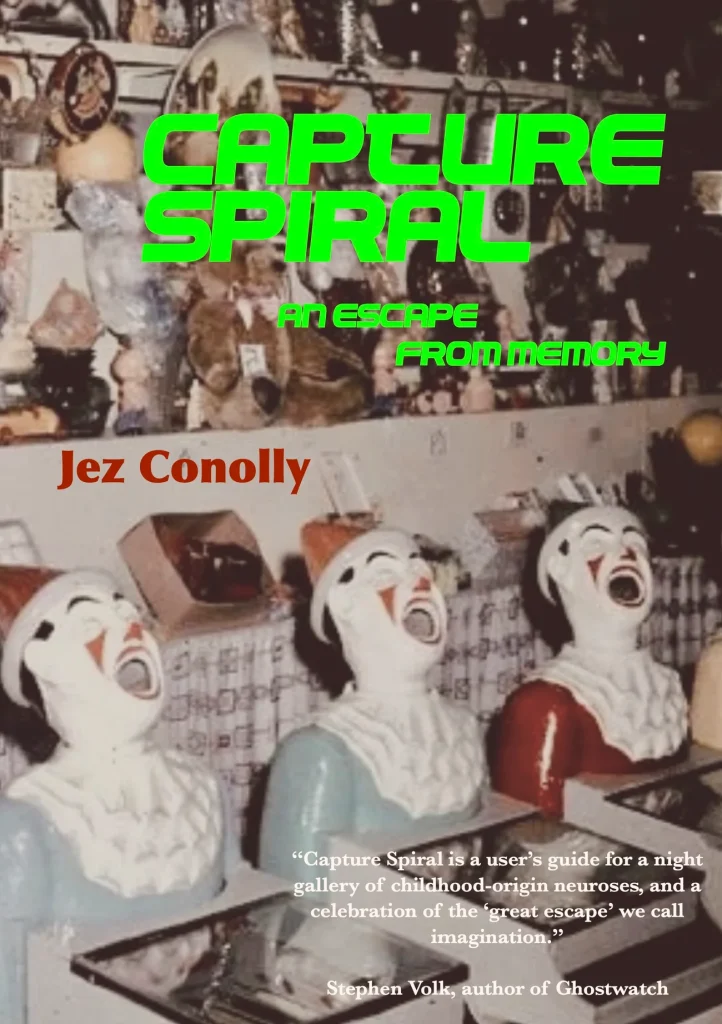
In Capture Spiral: An Escape from Memory, Jez Conolly revisits the haunted textures of a 1970s childhood on the Lincolnshire coast, where faded seaside amusements and family silences conceal deeper undercurrents of curiosity, dread, and wonder. Written with precision, wit, and a lyrical eye for the uncanny, this memoir intertwines personal history with cultural memory, uncovering the makeshift surreal hiding in the mundane. A beautifully unsettling portrait of place, time, and the strange persistence of the past.
“Jez Conolly’s “storied” interior odyssey charts his experiences of the prosaic and incongruous from childhood through puberty, fighting for an inner escape from the strangulating conformity of Cleethorpes. A mixtape of memories past, from two tortoises named Toby to the rotating clown heads of Wonderland. Capture Spiral is a user’s guide for a night gallery of childhood-origin neuroses, and a celebration of the “great escape” we call imagination.”
Stephen Volk, author of Ghostwatch.
“A brilliant, cynical, heart-warming autobiography, wrapped in nostalgia and hauntology, but with poison-tipped needles at its core. Jez Conolly’s tales of growing up in Cleethorpes, the maudlin sadness of Bagpuss, watching queasy Schools and Colleges programmes while off sick from school, and the sheer horror of ‘laughing bags’ and Blackpool’s Doctor Who exhibition should be familiar to anyone from the Scarred For Life era.”
Stephen Brotherstone, author of Scarred For Life.
“Absolutely nails the shabby wonder of a twentieth century British childhood.”
Stephen Gallagher, screenwriter Doctor Who, Silent Witness.
Paperback, 199pp.
CONTENTS
Entrance
Cleethorpes: Recollection and Curiosity (1965-1973)
Chapter One
Playing Dead: The Rebellion of Withholding (1973)
Chapter Two
Wishbones and Watching: The Upside of Being Very Poorly (1973)
Chapter Three
‘One Day, Emily Found A Thing’: Oliver Postgate and The Eco-Ephemera of ‘Sunday Constitutionals’ (1974)
Chapter Four
Flask Tea and Lay-Bys: Family Picnicking by the Side of the Road (1974)
Chapter Five
Fingers and Masks: The Joke Shop Rite of Passage (1974)
Chapter Six
Grand Guignol: Scarborough, Taxidermy and the Gifford Book (1975)
Chapter Seven
Laughter and Birdsong: The Tax Inspector from Nuremberg (1975)
Chapter Eight
Spearmint and Starlight: The Universe in Uncle Harry’s Shed (1975)
Chapter Nine
O Wonderland!: The Nightmare of ‘Fun’ (1976)
Chapter Ten
Out of the Black Pool: The Pleasure of Effigies (1977)
Chapter Eleven
Hercules Unchained: The Tragedy of the Zoo (1978)
Exit
Some Thing to Do: An Escape Through Body Horror (1978-1983)


