

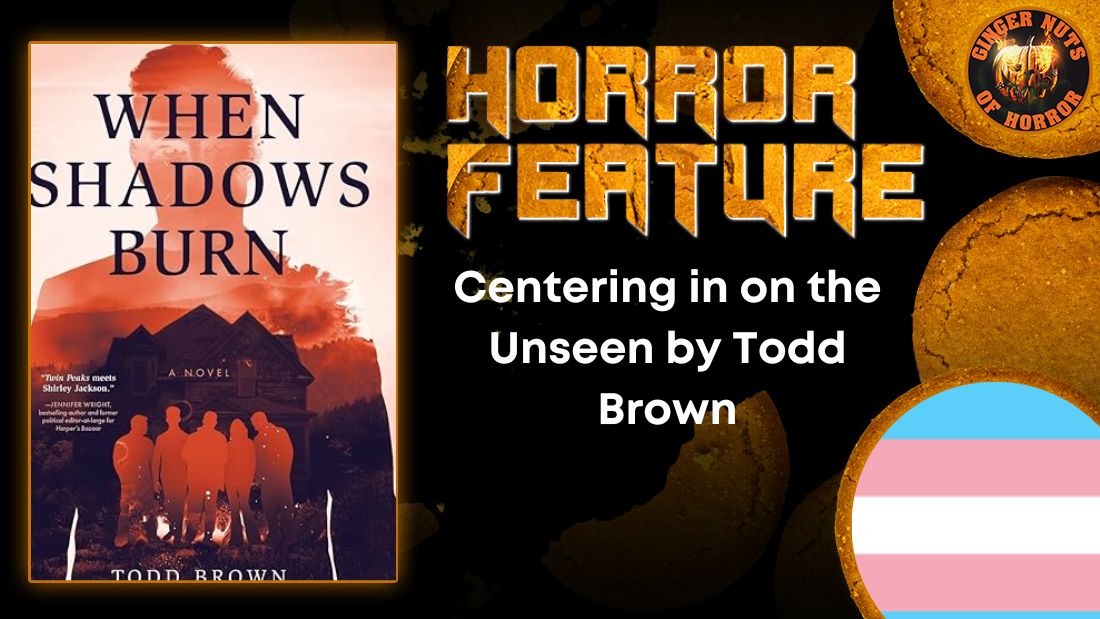

Centering in on the Unseen by Todd Brown
What happens when horror stops looking for monsters in the dark and starts confronting the ones hiding in plain sight? For author Todd Brown, the most profound terror isn’t found in a haunted house, but in the suffocating silence of a community that would rather look away than see the people in its midst.
In this compelling article, Brown challenges the sanitized, exclusionary myth of the American small town. Writing from the perspective of a neurodivergent father of a trans son, he argues that for marginalized people, the true horror is often not supernatural, but social: the neighborly smile that masks prejudice, the willful blindness to injustice, and the violent insistence on “normalcy.”
Through the lens of his debut novel, When Shadows Burn, Brown explores how horror can be a powerful tool for reclamation—not of a genre, but of place and identity. He invites us into a story where the central characters are not victims or metaphors, but fully human, fighting for joy and survival in a world that treats their existence as a political statement.
Centering in on the Unseen by Todd Brown

Horror has always had a way of saying the quiet part out loud. Yes, horror speaks in blood and metaphor, but more importantly, in the uncomfortable moments between survival and silence. But when horror dares to center the lives of queer, trans, neurodivergent, or otherwise marginalized people, not as victims or metaphors, but as human beings, it doesn’t just scare, it reveals.
I write rural fiction through a horror lens, but I do not want to reclaim a genre. I do it to reclaim place. For way too long, the imagined American small town has been a sanitized landscape, where “normal” gets defined by exclusion. Whiteness, straightness, ablebodiedness, and conformity are so often burned into the genre’s sense of nostalgia that people like me, a neurodivergent father of a trans son, are either erased or treated like a threat.
In my debut novel, When Shadows Burn, I wanted to splinter that illusion. The story takes place in Raven’s Cross, a small town in Virginia still haunted by its secrets and silences. It isn’t a horror story because something is lurking in the dark. It’s a horror story because of what the town refuses to see in the light.
There’s no clean line between the supernatural and the social in my work. That’s the point. A vampire might not be real, it might not, but the people who look away while others are targeted are very real. The neighbor who smiles at your family on Sunday, and votes against your rights on Tuesday. The police officer who won’t investigate a hate crime unless someone dies. The friend who loves you “no matter what,” as long as you never ask them to show up when it counts.
These are the everyday horrors that shape life, especially in small rural towns for many marginalized people. And the silence around them is its own kind of violence. When you grow up in places like Raven’s Cross, you learn fast who gets to be visible, and who gets told they’re “too much,” “too loud,” or “not from around here,” even when you were born on the same street. But here’s the thing: we’ve always been here.
I don’t add queer or neurodivergent characters to my work. I write the town as it really is. In When Shadows Burn, the central characters are marginalized survivors, people on the spectrum, and those who have learned to laugh with bruised ribs. Their horror isn’t just about something stalking them. It’s about being told, again and again, that their pain is inconvenient. That their truth is “too political.”
But these characters aren’t reduced to metaphors or martyred for the plot. They joke. They fall in love. They argue. They resist. And yes, they endure. They aren’t heroes. They’re human. And I give them more than just survival. I give them want for joy, safety, and more.
This is what horror can do when we center the marginalized. It unearths the truths we’ve buried under porch lights and politeness. It forces confrontation, not just with monsters, but with archaic ideologies. The myth that small towns are pure, and that queerness is new, or rare, or somehow not “real” if it’s not urban. When done right, horror asks the reader questions such as, What are you afraid to see? Who are you afraid to listen to? And why?
I didn’t write When Shadows Burn to make people comfortable. I wrote it to unsettle the stories we’ve been told about who belongs where and why so many of us had to build our lives in the margins. I wrote it for the kid who never saw themselves in the books they were handed. For the adult who has to look over their shoulder day and night because they just want to be themselves, and for the ones who stay, even when the town tells them not to.
Horror doesn’t just let us survive, it dares us to be unignorable. It’s not about making space at someone else’s table. It’s about dragging our own table into the middle of town, setting it on fire, and asking who still wants to eat. Because once the silence breaks, once you hear what was buried, you can’t pretend you didn’t.
That’s not the end of the story. That’s where it starts.
When Shadows Burn by Todd Brown

Early Praise for When Shadows Burn
“A chilling Southern Gothic for the podcast age. Think Twin Peaks meets Shirley Jackson.”
–Jennifer Wright, bestselling author, columnist, former political editor-at-large for Harper’s Bazaar, featured in The New York Times and The Washington Post.
“A haunting and powerful story about identity, survival, and the quiet cost of being yourself in a world that wants to erase you.”
-Tal Anderson, Netflix’s Atypical, HBO’s The Pitt, and neurodiversity advocate.
“When Shadows Burn is the best kind of thriller. It’s relentless, eerie, and grounded in a world that feels like Anytown, USA. The real nightmares aren’t what you expect, and that’s exactly the point.”
-Emily Woo Zeller, Golden Voice, Audie “Best Voice of the Year,” Independent Audiobook Awards’ Best Female Narrator
A true crime podcaster, Timothy Michaels, returns to his small hometown of Raven’s Cross to confront a disturbing legend: the Scott House. This decrepit mansion, once a source of childhood nightmares, is now owned by strangers, its crumbling facade fueling whispers of suspicion throughout the community. When two teenage girls vanish, the town plunges into chaos, and its citizens quickly point fingers at the outsiders as more disappearances and subsequent deaths occur. Allying with familiar and new partners, Tim embarks on a relentless investigation that reveals a maze of secrets, a dark past steeped in supernatural mysteries, and the potent influence of fear and prejudice.
Todd Brown

I am a computational sociologist, which mostly means I overanalyze human behavior. I’ve spoken at Harvard, Columbia, the CDC, and the NIH. My work has appeared in The New York Times, WIRED, National Geographic, Forbes, and USA Today.
When Shadows Burn is my first novel. My family and I live in a small town in Virginia, and I have an incredible wife and a transgender son who has a main character energy. My son and I have enough neurodivergence to turn comedic dysfunction into an art form. We also have a son who lives in Florida for some reason and is built like Chris Hemsworth.
You can find me on Instagram and Threads @toddbrownwrites unless I’m writing, in which case I’m likely hiding in my horror-themed office.
WEBSITE LINKS
https://www.toddbrownwrites.net
Further Reading
If you’re a fan of spine-chilling tales and hair-raising suspense, then you won’t want to miss the horror features page on The Ginger Nuts of Horror Review Website. This is the ultimate destination for horror enthusiasts seeking in-depth analysis, thrilling reviews, and exclusive interviews with some of the best minds in the genre. From independent films to mainstream blockbusters, the site covers a broad spectrum of horror media, ensuring that you’re always in the loop about the latest and greatest.
The passionate team behind The Ginger Nuts of Horror delivers thoughtful critiques and recommendations that delve into the nuances of storytelling, character development, and atmospheric tension. Whether you’re looking for hidden gems to stream on a dark and stormy night or want to explore the work of up-and-coming horror filmmakers, this page is packed with content that will ignite your imagination and keep you on the edge of your seat.
So grab your favorite horror-themed snacks, settle into a cozy spot, and immerse yourself in the chilling world of horror literature and film. Head over to The Ginger Nuts of Horror and embark on a journey through the eerie and the extraordinary it’s an adventure you won’t soon forget!