
The Horror in the Attic: On Spider Gods, Queer Stories, and the Monsters in Our Minds
You’re staring up into the dark, dusty void of your attic and the image just… arrives. Fully formed. An ancient spider god lurking up there. It’s that simple, and that bizarre, for David-Jack Fletcher. The man’s brain is a factory for the weird, churning out questions most of us would nervously side-step. What if your unsaid words manifested as tiny mouths all over your body? What if the real monster isn’t in the house, but is the house? He’s asking. He’s gotta know.
It’s this obsession with the ‘what if’ that fuels everything. That, and a deep, almost stubborn commitment to authenticity. We’re talking queer horror that isn’t just about the scare, but about the person—flawed, complex, real—experiencing it. His characters are never perfect. Thank god. Because nobody is.
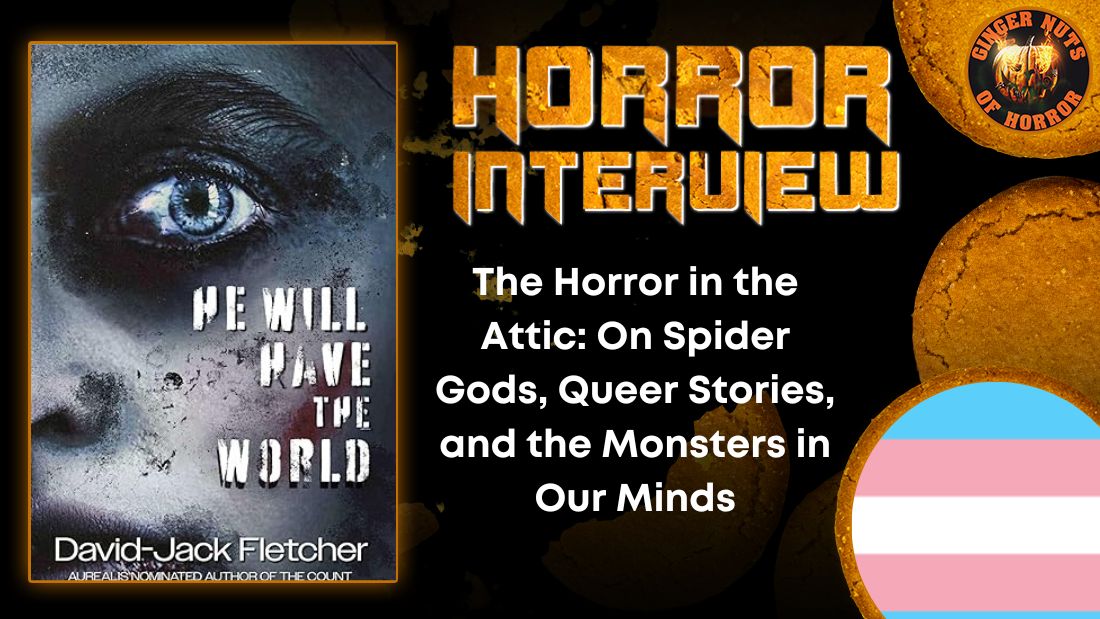
His upcoming book, He Will Have the World, is his most personal yet. A lightning bolt of a story forged at the lowest point in his own life, it’s about a man named Charlie, a voice screaming in his head, and a very real, very physical monster on a plane 40,000 feet in the air. The book itself has been on a hell of a journey, too. Knocked back by publishers for being “too queer,” it’s found its true home with his own indie press, Slashic Horror. A fittingly defiant act for a story that aims to give a voice to those with mental health diagnoses.
The real world, he reckons, is far scarier than anything he could write. Maybe that’s why his horror hits so hard. It’s not just about the spider in the attic. It’s about the one already nesting in your mind.
David-Jack Fletcher on Queer Horror, Mental Health & Writing

Let’s start at the very beginning. For our readers, please introduce yourself. Beyond the author bio, tell us a little about who you are when you’re not writing, what you love doing, what fascinates you, and what fuels your creativity.
First of all, I love horror. Pretty much all horror, although I do tend prioritise body horror. So when I am not writing, I am usually watching a horror movie or TV show. Having said that, I’m currently watching Parks and Recreation for the very first time, and also catching up on Bob’s Burgers. Neither of them are…great?…but they keep my mind occupied.
Other than writing, I love to read. I love spending time with my husband and out two dogs. I don’t really mind what we’re doing, as long as we’re together. I also love seeing my siblings; we don’t get together as often as I’d like, but when we do it is such a nice feeling. I have a few nieces and a nephew now, so spending time with them makes my heart sing.
In terms of what fascinates me, it’s the same thing that fuels my creativity: dreaming of the unknown. Or, more accurately, the ‘what ifs’. What if you bought a house with an ancient spider god hiding out in the attic? (Spoiler, that’s the book I’m working on now 😂) What if everything you never said manifested as little mouths all over your body? I tend to ask weird questions a lot and I think it puts some people off. But I gotta know! Another thing I’d say is nature. Nature is incredible and there is still so much we don’t know. New species are discovered every day, and for me, that drives creativity.
In the early stages of a new project, what tends to come to you first: a compelling character voice, a central thematic question, or a vivid image/scenario? How does that initial spark then guide you in building the rest of the story?
Most of my stories, whether they be novels or short stories, often appear as an image in my head. I get one image and it seems to tell me what the story is that needs to be told. For example, with my upcoming novel, Umbilical, I had an image of a guy standing over a field of unmarked graves during a storm. The rest of the story then just came to me. And for my short, Hollow, I had the image of a creature swimming through a sea of dead bodies, and the rest just falls into place.
For the book I’m working on now, we had an electrician literally fall through our ceiling 🤦♂️ and when I stared up into it, the image of an ancient spider god was just kind of there. In the next few minutes, the story was all but written. I just have to do the work now.
In terms of characters, I never really know what they’re going to look like ahead of time. I know I want them to be authentic, to be people you could live next to or work with, and to be morally complex. Nobody is perfect and nobody is exactly who they appear to be. I like to reflect that in my characters.

For my latest book, He Will Have the World, I had the image of a guy witnessing a lightning bolt enter a plane and then something jump inside one of the passengers. It’s heavily inspired by Matheson’s Nightmare at 40,000 Feet, and I knew before I started writing that mental illness was going to be a massive part of the story.
Exactly what that looked like was unknown to me until I started writing the protagonist, Charlie. The theme of mental health has become central to my last few books as it mirrors where I currently am on my own journey with that sort of thing. I try to use my writing to do something.
With Raven’s Creek it was to challenge notions of humanity, and then with The Count things started to steer towards psychological decay. I think it’s culminated in He Will Have the World, which I wrote at the lowest point in my life. I won’t say too much more, because I’m not ready to share everything yet, but my aim with this book is to give a voice to anyone with mental health diagnoses, and to hopefully spark transparent conversations about how much more work there is to do in that space.
Every book has its own unique set of problems to solve. What was the most difficult ‘puzzle’ you had to crack while writing this book? Was it a plot hole, a character’s motivation, the structure, or something else entirely?
I think the structure of storytelling is sometimes difficult to get right. I know I can’t please everyone, and I always write the story I want to tell (or want to see), but it still needs to be done in a palatable, accessible way. I like to play around with time a fair bit, because for me there is no time. When I remember something, it is like it plays out all over again. When I forget something and someone tries to remind me, it’s like it never happened. So I like to bend time and show how non-linear narratives can impact the story. It really, really doesn’t work for some people, but it seems to resonate for most.
The journey from a finished manuscript to a book in a reader’s hands can be a surprising one. What was the most significant way your book evolved during the editing and publishing process, something you didn’t anticipate when you typed ‘The End’?
Originally, I queried this novel, because I felt the subject and themes of mental health, sui*cide, and stigma etc. are things that need to be read more widely. What surprised me is that it got knocked back for being queer. This was the same as my other novel, Umbilical, and in both cases the excuse of the current US political climate was used.
I will not go into detail about the agents or publishers, because it’s their right to refuse to publish whatever they like. It did just really highlight to me that there is so much left to be done in the queer space, and I am happy to be doing some of that work through my writing—and through the development of the OutWrite Scary Awards.
When I did find a publisher, I was incredibly happy, however there were a few hurdles along the road and I ended up requesting the rights be reverted to me. The publisher handled it incredibly well and very professionally; I can see us working together in the future at some point. But for this book, because it is so personal and so important to me, I ultimately decided to publish myself through Slashic Horror Press.
I didn’t anticipate any of these things, but it feels right to have this one at home with my own press.
Once a book is published, it no longer entirely belongs to the author; it belongs to the readers and their interpretations. Has a reader’s reaction or analysis ever revealed something about your own work that surprised you?
The only thing that has surprised me so far is how time jumping can confuse people. We see this on TV and in films all the time. Lost being a prime example, but there are so many programs that do this. I was genuinely surprised that some readers couldn’t follow, or assumed that the flashbacks were unimportant when they inform the events currently taking place in the book. After reading those reviews that commented on that, I have changed the way I use time slightly so hopefully it is not confusing and more people can understand the method behind my madness.
Writing is a demanding, often solitary pursuit. Beyond the apparent goal of ‘telling a story,’ what is the specific, personal fuel that keeps you going through the difficult stretches? Is it the joy of discovery, the need to understand something yourself, the connection with a future reader, or something else?
I think all of those things apply depending on the day and my mood. There are times where I cannot write at all because my mood is so low I don’t have energy. There are other times where I write 8K words in a day because my fingers cannot stop. The fuel changes a lot. Ultimately, what drives me to write is that I need to. Other authors have said this a lot, so I know it’s not unique to me, but it feels like the words and stories are inside me already and I’m just here to put it on paper.
We often hear about authors being influenced by other books. What are some non-literary influences on your work, such as a specific piece of music, a historical event, a scientific theory, or even a landscape, that have profoundly shaped your storytelling?
Sometimes people influence or shape my storytelling. Certain family members, for example, shape how I write parents. My sister shapes how I write siblings. Beyond that, nature shapes the direction of my stories sometimes, as well as the idea of evolution. In The Haunting of Harry Peck, historical events had a huge impact on how I told that story; I used real historical figures, places, and events, and reshaped them for my weird-ass chicken haunting story.
Is there an author, living or dead, whom you consider a ‘silent mentor’? Not necessarily someone you try to imitate, but whose approach to the craft made you feel permission to write in your own way?
Not really. I wish I could point to some of the greats, but I can’t think of anyone specific that I would classify as a mentor. What I would say is, I used to write very straight stories, and I always felt like they were inauthentic. They were pleasing to people around me, but I wasn’t able to connect with the stories as much as I do now. I had to actually give myself permission to write gay and queer characters. In all honesty, I think for a long time I was scared to do that and to put myself out there authentically. It has been one of the best things I’ve done as an author though.
Who was the first person to see your early drafts, and why did you trust them with your unpolished work? What is the most valuable piece of feedback they gave you?
This answer changes over time, but for He Will Have the World, Indentured, and Umbilical, it’s been Stephanie Sanders-Jacob. We’ve struck up a valuable friendship and I trust her to not only read the work, but to have insights that will help.
Another person I asked for early feedback on He Will Have the World was Marc Ruvolo. The most critical piece of feedback he gave me was to change the devil worshippers (spoiler!) into something more interesting. He was totally right, devil worshipping is very old hat and a little boring now because it’s been done so much. I was able to shift that into something a bit meatier, and which I am hoping people have not seen as much.
Horror is often most potent when it’s internal. Beyond external monsters, how do you explore the slow unravelling of a character’s sanity or the horror of their own mind?
This question is so pertinent to He Will Have the World. One of the monsters in this book is Charlie’s mind itself. The paranoia, the questioning of his own reality, of the people around him. I use a combination of mental and physical cues to represent sanity; for example, sweating, blurry vision, heart rate, tightness in the chest, shaking hands combined with mental fatigue or internal questioning, misremembering of facts and events. That sort of thing. In Charlie’s case, he has a literal voice in his head screaming at him for most of the novel, which also doesn’t help.
Setting in horror is often described as a character in its own right. How do you approach transforming a location, whether a house, a town, or a landscape, into a source of active dread?
One of the things I learned as an undergrad in my creative writing degree was to make the familiar strange. That’s actually a core concept for Cultural Studies, which teaches people how to rethink things they assume as facts. I try to apply that concept to things we often believe to be true or take for granted as everydayness.
In The Count, for example, I transformed the house by playing with space, changing the dimensions of the rooms, giving it a metaphorical (and sometimes literal) heartbeat. In He Will Have the World, it was much easier because a lot of people already have a fear of flying.
The dread in this case is the sense that the plane will eventually land; there is something on board and while the plane stays in the sky it is contained. What happens when they land, though? It’s also the idea that there’s nowhere to hide, there is a great sense of isolation and the fear that someone else is going to die; it could be you and there’s nothing you can do about it.
Writing a terrifying buildup is one skill; delivering a satisfying payoff is another. How do you decide when to finally show the monster or reveal the source of the horror?
I think this depends on the story itself. Sometimes the monster/source of evil needs to be show upfront, other times it needs to slowly emerge as the characters navigate the situation. For He Will Have the World, I wanted the threat of the monster to be apparent quite early on, but not introduce the actual monster until near the end. This was mostly because the fear of the monster needed to be offset by Charlie’s psychological unravelling. If the monster appeared too early, it would detract from that quite a bit.
There is also a skill in revealing a twist, which is where I see the payoff really coming to fruition. I might be jaded or just read between the lines too much, but I am very rarely caught by surprise with twists in films, TV, or books. So I work really hard to build twists that really knock people over. I recently saw a review of Raven’s Creek where they hated the ending because of the twist, even though the whole book is leading up to that exact conclusion if you see the breadcrumbs I was laying out.
So it depends on the book in terms of when this happens. In He Will Have the World there are several key twists that disorient the reader, and I was careful of when to reveal those because they each serve a specific purpose for Charlie’s state of mind.
The horror genre is rich with established tropes and archetypes. How do you engage with these familiar elements, the haunted house, the ancient curse, the final girl, in a way that feels fresh and surprising? Do you consciously seek to subvert a trope, or do you focus on executing it with such depth and authenticity that it becomes new again?
I take the view of making the familiar strange, as I mentioned earlier. For example, a lot of people think The Count is a haunted house novel, but it’s actually a vampire novel. There’s no physical vampire, it just uses the vampiric lore of bloodlust, eternal life at a high cost, and a slow descent towards the inhuman. There’s also a great sense of being controlled by a power you can’t understand or even keep at bay. In that way, I tried to make the familiar vampire story, and the familiar tropes, unrecognizable by eliminating the physical vampire. In a lot of ways, it is revealed that the Earth itself is the vampire.
So I would say I consciously try to subvert or find a way to make things unfamiliar for the reader so it feels fresh. This is another reason I use morally ambiguous characters; it’s never exactly clear that we should root for a specific character because they’ve all done things that are not great. It also makes them real, in my opinion.
How do you approach writing scenes of intense terror or violence to make them feel physically impactful without tipping into gratuitousness?
For me, this has a lot to do with sentence structure and pacing. To make readers speed up, use short sentences. To slow them down, use longer sentences. I like to do a mixture of three short, one or two long, and then more short because it disorients people and gets them all up in their anxiety. Another technique I aim for is just the level of detail; there’s a lot to be said for what you don’t include. What you can imply, what you can make people feel. Word choice is crucial for that, too.
Do you have a favourite line or passage from your work, and would you like to share it with us?
From He Will Have the World, the line ‘To die was preferable’ really hits home for me. It represents so much of the story, so much of the character, and the enduring hopelessness of the plot. It is rather bleak, and that might also be why I love it.
What is the specific, core truth you are trying to expose or explore through your horror?
Everyone is capable of anything.
Whether you are gay, straight, ace, pan, bisexual, whether you are white, Black, Hispanic—whoever you are, you are capable of anything. That includes the darkest, most heinous things a person can imagine, as well as the most touching and loving things we can ever do for ourselves or someone else. Often, people are a mix of both. There is something totally and utterly human about being deeply flawed.
You have precisely two minutes in a crowded bookstore to hook a reader who is sceptical of the entire horror genre. They look at your book’s cover and ask, ‘Convince me. Why should I read this? I don’t even like being scared.’
Read it, don’t read it, that’s your choice. The real world is far scarier than anything I could ever write.
That’s a really bad answer, I know. I don’t like convincing people to do anything; I just hope that my books find the right people and that they resonate.
He Will Have the World by David-Jack Fletcher

What if everyone you knew was an imposter?
Charlie knows there’s an invasion. He knows it; even if the psychiatrists and his husband don’t believe it.
They’re replacing people, living their lives. He doesn’t know how. He doesn’t know why.
But now, they’re after him.
Isolated on a flight, Charlie sees a flash of lightning strike the plane. But only Charlie sees the creature enter the plane.
It’s inside the passengers. Jumping between them.
Unable to trust the passengers—or himself—Charlie races to reveal the creature and save the passengers because they’re all replaced. Or worse.
With nobody on board believing him, and his own mind crumbling from within, how much will Charlie sacrifice to save everyone?
But what if the doctors are right? What if it’s all in his head?
David-Jack Fletcher

David-Jack Fletcher is a gay Australian horror author, publisher, and editor, specialising in work that emphasises the everydayness of LGBTQI+ individuals. He is the Aurealis-nominated author of The Count, a vampiric novel centred on the evil that lurks within the earth itself. His other titles include the award-winning Raven’s Creek, The Haunting of Harry Peck, Hell is Other People: Stories, Indentured, and the forthcoming He Will Have the World.
David-Jack is also the founder of Slashic Horror Press, an emerging queer indie press focused on promoting under-represented voices—and stories—in horror and dark fiction. Since beginning in June 2023, Slashic Horror Press has released over 20 titles. For more details, visit the website here: https://www.slashichorrorpress.com/titles
Social handle: @fletcherhorror
Link to author website: https://www.fletcherhorror.com
He Will Have the World: https://books2read.com/HWHTW
The Count: https://books2read.com/thecount
Indentured: https://books2read.com/indentured
Raven’s Creek: https://books2read.com/u/mv8vV8
Hell is Other People: https://books2read.com/u/bxDYkd
The Haunting of Harry Peck: https://books2read.com/harrypeck
Interviews on Ginger Nuts of Horror
If you’re a fan of horror literature and cinema, then you absolutely need to check out the horror interview section of Ginger Nuts of Horror.
Firstly, the interviews feature a diverse range of authors, filmmakers, and horror enthusiasts, allowing readers to gain a multifaceted understanding of the genre. Each interview is an opportunity to explore the creative processes, inspirations, and personal stories behind the minds that produce some of the most chilling and thought-provoking works in horror today. From seasoned veterans to up-and-coming talents, the variety of voices ensures that readers can find something that resonates with them.
Moreover, these interviews often delve into the nuances of what makes horror such a compelling genre. Contributors share their thoughts on the psychological aspects of fear, the societal influences on horror trends, and the ways in which horror reflects cultural anxieties. This deeper exploration not only enriches one’s appreciation for horror stories but also fosters discussions about broader themes, such as identity, morality, and existential dread.
The interviews frequently touch on practical advice and industry insights. Writers and creators often share the hurdles they faced in their careers, tips for aspiring horror writers, and the realities of getting published or produced. This wealth of knowledge is invaluable for anyone looking to navigate the sometimes challenging waters of the horror genre. Readers interested in breaking into horror writing or filmmaking will find a treasure trove of wisdom that could pave their path toward success.
Lastly, the community aspect of Ginger Nuts of Horror cannot be overlooked. Engaging with these interviews allows readers to feel connected to a larger community of horror enthusiasts. Comment sections and social media interactions often follow, enabling fans to discuss their thoughts and engage with both the interviewees and fellow readers.
In conclusion, the horror interview section of Ginger Nuts of Horror is an essential resource for anyone interested in the genre. It provides rich insights, guidance, and inspiration that can deepen one’s appreciation for horror while fostering a vibrant community among fans and creators alike. Don’t miss out on the chance to delve into the minds of your favorite horror creators!