- Slasher Summer by E. L. Chen: A Bloody Love Letter to ’80s Slashers
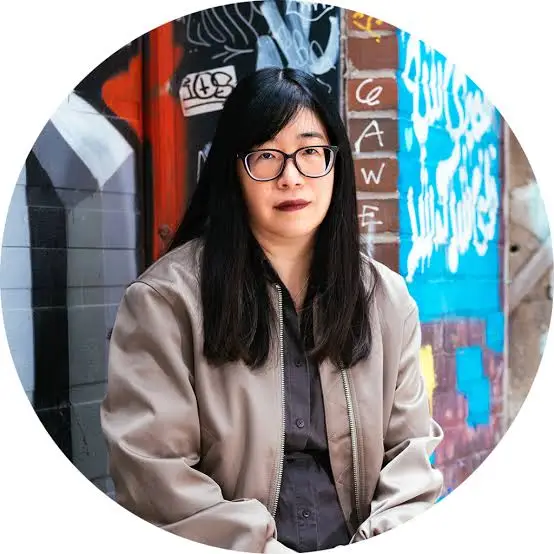
- The Past Wears a Mask: A Conversation with E. L. Chen
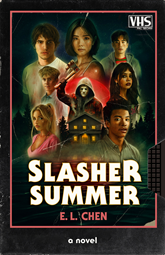
Cedar Lake sells its own murders back to tourists. In E. L. Chen’s Slasher Summer, the sleepy town is famous for one thing, a campy ’80s flick called Slasher that was shot at a cabin in its woods, and Chen sends seven former high-school friends back to that cabin to find out how little they have outrun. Each arrives carrying the archetype they played at midnight showings years ago, preppy Patrick, jock Jason, virginal Carrie cast forever as the Final Girl, and a masked figure in red buffalo plaid is there to hold them to it.
Chen is having a remarkable 2026. Sweetside Motel landed in March, Slasher Summer arrives from Crown in June, and One of Us Is Already Dead is still to come, the second time this year she has marched a former Final Girl back onto a film set. The author once longlisted for the Sunburst with a YA fantasy now writes some of the sharpest slasher fiction going. Her book argues you cannot escape who you were. Let’s start there.
The Past Wears a Mask: A Conversation with E. L. Chen
Your seven friends are named Carrie, Jason, Freddy, Jennifer, Tiffany, Mikey, and they spend high school dressing up as the cast of a movie called Slasher at midnight showings. Those names are not accidents; they are the patron saints of the slashers your book is bowing to. When did the conceit arrive, the idea that a group of real kids would name themselves after the icons and then get forced to live out the roles?
When I initially thought about writing a slasher, I wanted to put in everything that I’d want to see in a slasher film. My favourite slashers are ones that are humourous and self-aware, like Scream and The Blackening, so I wanted to sprinkle in references to other movies. (Tiffany, by the way, is the only one that isn’t an intentional movie reference; it’s a very ‘80s cheerleader name.
Although it’s been pointed out to me that Chucky’s girlfriend is named Tiffany, so that’s a nice coincidence.) Though I decided that the characters wouldn’t be like, Hey, isn’t it funny how we’re all named after movie killers, because it would be very unbelievable as well as throw readers out of the story.
As for their roles, that comes out of my initial idea of having the killer dress like a slasher from an iconic movie. The first question I asked myself when planning the book was if this fictional cult movie was going to be a stand-in for Friday the 13th. Does Friday the 13th exist in the world of the book? I decided that yes, it does. The next question was, what makes this fictional movie famous if it has to compete with big franchises like Friday the 13th, Nightmare on Elm Street, and Halloween?
Why does it have a cult following? That’s when I hit on the idea of Rocky Horror-like interactive screenings, with a shadow cast miming the movie as it plays on screen. Each character would get actively stereotyped as they performed as the audience yells, “Nerd” or “Slut” etc.
The cover is built to look like a VHS tape, and the reviews keep calling the book a slasher movie in print. But film is a visual grammar, the slow push toward a closed door, the music cue, the cut. On the page you have only sentences. What was the hardest piece of cinematic slasher language to rebuild in prose, and how did you rebuild it?
A good friend of mine pointed out that slashers lean heavily on empathy. Even if it’s an unlikeable character, we still feel their fear as they’re being chased by the killer. Cinema achieves this with camera angles and music, and the actor’s performance of fear. On page, however, we achieve empathy by really getting to know the characters. I have to credit Brian McCauley’s Candy Cain Kills for this lesson. Every character in that book, no matter how minor, has wants and goals, and so we find ourselves rooting for them when they find themselves in a life-or-death situation.
The most challenging thing for me to translate from film to page, however, was a good jumpscare. On screen, a slasher film tends to set up a jumpscare with prolonged tension. Either the character is completely oblivious to the danger, or they’re creeping around trying to avoid it. But we know something is going to happen. We just don’t know when and what it will be. So you’re on the edge of your seat, anticipating a release to the tension.
In a book, you have to similarly play with those expectations, knowing the reader expects something to happen at any moment—and then try to catch them off-guard. I don’t know how successful I was, though. I have a scene in which a character undergoes a number of clichéd pratfalls, but I guess I won’t find out if I made anyone startle until more reviews come in.
The synopsis ends on a promise that lands like a threat: before the night is over, each of them will have to take on the role they thought they’d left behind. That is a structural engine as much as a theme, because it dictates who acts when and who is allowed to survive. How did you let the archetypes drive the plot mechanics without letting the reader feel the gears turning?
The promise applies most to Carrie, who had played the Final Girl in the movie’s shadow cast, and embodies the Final Girl stereotype of the nice, quiet girl-next-door. It’s a stereotype she resents because her crush never saw her as girlfriend material. Many of the others chafe against their roles too, which leads to them making bad decisions. Mikey wants to prove that he’s no longer a scrawny nerd and tries to play the hero. Jason, who had been the popular football hero in high school, is reluctant to be the leader and decision-maker. I hope that by subverting the tropes, the story doesn’t play into readers’ expectations as to what will happen and how people will act.
Classic slashers had a body-count order, and queer characters and characters of color tended to die early so the virginal white girl could live. You put a gay man in the cast, a queer Latina, and a Chinese Final Girl named Carrie, which is also, not for nothing, your own background. What was the specific problem you set out to solve about who these movies kill, and in what order?
I confess that the diversity of the cast wasn’t a conscious statement on my part, although a Chinese Final Girl was definitely intentional as that’s my own identity. (I don’t explicitly dwell on it in the book, but I meant for Carrie’s ethnicity to play into the Final Girl stereotype, since in my experience Asian girls are often painted as being quiet and reserved.) I’m from Toronto, Canada, which is a very large, very multicultural city. I’m friends with folks of various identities, so I populated the book with the kind of people I’m surrounded by.
As a second-generation Chinese Canadian, I want to see characters whose identities have little to do with the story and who don’t fit the expected narratives. But at the same time, one still has to be aware of the optics. Having a diverse slasher cast posed a challenge because, as you point out, slashers have a history of killing off the minorities first.
At one point I switched the order of deaths in Slasher Summer because I imagined readers throwing the book across the room in rage at the first on-page kill. I don’t know if I was entirely successful, but I think the key is to not have minorities as the “token”. There is more than one Asian in this book! More than one queer person! And so if one of them dies you’re not crossing names off a list until only the white girl is left.
Cedar Lake interests me as much as the cabin. It is a town whose entire identity is a fictional massacre it now monetizes, a place that turned its worst imaginary night into a brand. That feels like a quiet argument about nostalgia itself. What did you want the town, as opposed to the killer, to be saying?
In my initial draft, “Slasher Summer” the festival was more of a horror convention. It was my American editor who drew my attention to small-town festivals like Blobfest, which celebrates the movie The Blob. I did more research and discovered Forks, Washington still successfully attracts Twilight fans, and Seneca Falls is devoted to It’s a Wonderful Life. It’s really fascinating how these movies are being kept alive. Part of it is nostalgia, but for small towns it’s also a matter of economy.
The best definition of nostalgia I’ve seen was from a random online post: we associate an IP with a time when we didn’t have to pay bills. Nostalgia is a powerful—and lucrative—force, as we can see from the countless TV and movie reboots and rock band reunion tours. But the past wasn’t necessarily a good time for everyone. We see it now whenever folks long for the “good ol’ days” and it’s like that goose chase meme. Good for who? Good for who? Maybe sometimes glorifying the past can be harmful.
Your masked figure seems to be working from a script, restaging the original Slasher so the reunion becomes as authentic as possible. That makes the antagonist less a monster than a devoted fan, maybe even a director. Without giving away the turn, how did you think about building a killer whose weapon is fidelity to a text?
Modern-day antagonists tend to be given a backstory instead of being monstrous for no reason other than their inherent nature. I feel like Psycho was a turning point. Norman Bates had mommy issues. Jason, Michael Myers, and Freddy Krueger are out for revenge. So I think it’s very believable that someone would take a text or IP extremely seriously, especially when you look at current fandoms. Canon becomes sacred, but individuals will also develop their own deep, personal relationships with media that are very meaningful to them.
In Slasher Summer, the original Slasher movie lore has little Timmy Thompson growing up to avenge his mother by misguidedly attacking the inhabitants of the place where she died. It’s not much of a stretch to imagine that a fan might be so fixated on the Slasher cabin that they’d want to get rid of everyone staying there, and that’s what the characters are afraid of.
(Fun fact: I’d originally come up with a backstory for the cabin itself. The family who’d owned it had to sell because it was attracting too many gawkers after the movie was filmed. And then a descendant of the original owner would be a suspect, as life imitated art. But these additional details would have interfered with the book’s pacing.)
You have now sent a former Final Girl back to a film location twice in one year, here and in One of Us Is Already Dead, where the cast of a found-footage movie returns decades later. That is not a coincidence; that is an obsession. What keeps pulling you toward the movie-within-the-book and the woman who survived the camera?
It wasn’t so much the horror film subgenres that pulled me in, but the tension between your identity and others’ perception of who you are. Movies are just a handy vehicle for exploring that, using character tropes, or the fact that characters are simply actors filling a role, or the difference between real life and what’s been edited for film.
But first I need to rewind a little and give you some background: I’m a recent convert to slashers. I actually don’t like graphic gore—onscreen, anyway—and avoided them for the longest time. I only started watching more of them about 8-9 years ago when I decided to broaden my horror education. I grew to love slashers when the formula and the tropes became evident.
My brain runs on pattern recognition; I was very much into Joseph Campbell as a teen, because The Power of Myth and The Hero With a Thousand Faces validated what I’d already noticed about the fairy tales and world mythology I read. And so while watching slashers, I found myself drawn to the Final Girl archetype, as she’s a variation of the hero: an ordinary innocent who’s transformed by violence and finds the agency to survive/battle the bad guy.
(I’d also recently gotten divorced, and it’s probably not a coincidence I found this trope appealing after surviving challenging times. Though it may be a correlation rather than causation, as I was suddenly able to watch what I wanted on TV.)
Slasher Summer is my ode to slashers, but One of Us Is Already Dead’s inspiration was more specific. The Blair Witch Project was obviously an influence, though not just the movie itself. I’d been fascinated that actress Heather Donahue had quit acting shortly afterward—although not surprised, looking at how Hollywood treats women, especially back in the ‘00s. Survival and self-preservation in a hostile environment is something that anyone can identify with, especially if you’re part of a minority. But at the same time, it’s unfair that you have to make concessions in order to get by in a world that’s not designed for you, or has specific expectations as to how you should behave.
Before the slashers there was Sweetside Motel, where Sarah Ng breaks down in a country town and has to quarantine inside a decaying inn the locals call the Suicide Motel. That book builds dread out of confinement and politeness rather than blades. What did writing that kind of slow, mannered menace teach you that you carried straight into the noise and speed of Slasher Summer?
Working on those two books actually informed each other. Although I’d sold Sweetside Motel first, I ended up making final revisions around the time I was doing the same for Slasher Summer. Working on Slasher Summer (as well as One of Us Is Already Dead) had greatly improved my sense of pacing, and so I brought some of that back to Sweetside Motel in the final draft. Even though the threats in that novella are less physical, the story still had to move at a similar clip, even if a lot of it is psychological.
On the flipside, Sweetside Motel was good practice for rooting a story deeply in setting. It’s the remote location that characters find themselves up against as much as the antagonists. But whereas Slasher Summer is my take on slasher movies, Sweetside Motel is my take on the gothic. Both use established genres as their foundation, which then allowed me to play with reader expectations.
You started somewhere very different. Summerwood/Winterwood was a YA fantasy, a Narnia gone wrong, and it got you onto the Sunburst longlist. Somewhere between that book and the killer in buffalo plaid, you committed fully to adult horror. What was the decision, or the moment, that changed how you approached the work?
There wasn’t an “aha” moment during which I decided to flip a switch and devote myself to adult horror. I’d been drifting toward it for a while. I started off writing fantasy because I loved it as a teen. Like most horror writers and readers, I discovered Stephen King when I was around 12, but otherwise as a voracious young reader in the ‘90s, there was nothing else available to me. YA wasn’t the powerhouse category it is today. My mother disapproved of romance novels and she and my sister wouldn’t let me read books like Flowers in the Attic, which all my friends were into, or a lot of other adult novels.
I therefore fell into secondary-world fantasy like Robert Jordan, David Eddings, Guy Gavriel Kay, and Mercedes Lackey, and naturally wanted to write books like theirs. However, I’m lazy at worldbuilding and don’t have the deep knowledge of history it takes to create believable worlds and cultures and conflicts. (Every fantasy writer I know seems to have a history PhD and/or can geek out about specific historical periods.) I found myself writing novels in contemporary settings, with creepy elements.
The Good Brother has ghosts; Summerwood/Winterwood is a dark take on Narnia that’s a bit bloody and has spiders. A lot of spiders. And so I began to suspect I might actually be a horror writer. (None of my writer friends are surprised I’ve gone in this direction, by the way.)
However, it did take me a while to find my stride. I tried to write horror short stories for a few years and was unsuccessful. It wasn’t until I took a course with Canadian horror author Gemma Files that I managed to “crack the code”. Before, I had been trying to write what I thought others would find scary, instead of tapping into what I personally find scary. That was the turning point for me. I wrote Sweetside Motel, and ditched the YA fantasy novel I’d started in favour of what would become One of Us Is Already Dead. From there ,my fascination with Final Girls snowballed into Slasher Summer.
The literary slasher has had a real run lately, from Stephen Graham Jones taking the form apart in My Heart Is a Chainsaw to Grady Hendrix turning Final Girls into a support group. Deconstruction has almost become the new convention. When everyone is already winking at the rules, where do you think the smart slasher novel goes next?
This is difficult to answer because there’s where I think it might go next and where I would like it to go next. I feel like both romance and horror had a resurgence around the same time, and were both refreshed due to new and diverse voices. Now in romance we’re seeing more high-concept, genre mashups and cozy stories, and I wonder if horror is going to follow.
There are already books like The Ending Writes Itself, which is kind of a slasher/mystery, and How to Kill a Guy in Ten Dates, a slasher/romcom. Horrormance is becoming a thing, as is cozy horror, although I’d be hard-pressed to define both at this time. I suspect we’ll start seeing slashers in unconventional settings, due to readers seeking stories outside the classic formula. (Scream meets Game of Thrones? Evil Dead meets Andor? Nightmare on Elm Street meets Bridgerton? I would totally read the heck out of all of those.)
However, I’d like to see more slashers from diverse authors, because I think there’s still more we can say about the Final Girl trope. I think what makes the archetype appealing and easy to identify with is that she gets to show vulnerability, as opposed to the traditional male action movie hero who’s expected to man up and fight back right away. I’d love to see authors of other marginalized identities use the Final Girl to examine our expectations of who gets to be a hero and how.
I’d also love to see someone write a slasher with a straight white Final Boy and explore the patriarchal expectations of a male hero. (Why is Ash from Evil Dead an icon but not Jesse from Nightmare on Elm Street 2? Does Tommy Jarvis only work as a Final Boy because his flavour of vulnerability is acceptable i.e. he survived Jason as a child? I have many questions that I’m not equipped to answer.)
Set your own books aside for a second. I want the one that got under your skin as a reader, the horror novel that genuinely unsettled or moved you, the kind you finished and then sat with in the dark for a while. What was it, and what did it do to you?
Paul Tremblay’s The Pallbearers Club got under my skin in a way I don’t understand. I found it so unsettling yet compelling—all without falling into the beats of a conventional three- or four-act story structure, or any familiar rhythm I could discern. It’s a low-key coming-of-age story, the supernatural threat is not even explicit and never explained, and yet it kept me turning pages and filled me with constant dread. Horror Movie was like this too, and try as I might, my writer brain can’t figure out how he achieved it.
On a pure craft level, an ensemble slasher is a logistics nightmare. You have to make a reader love seven people fast enough to mourn them, then pick them off without the survivors blurring together. What was the hardest technical problem the seven-hander gave you, and how did you actually solve it on the page?
I mentioned before that I learned from Candy Cain Kills that the key to making the reader sympathize with a character is to show their wants and goals. It has you feeling for them even if they’re unlikable, or only on the page for a short time. So I tried to make sure each character in Slasher Summer has something they want, whether it’s a short-term or long-term goal, and this affects the choices they make throughout the book.
This means we have to get inside everyone’s head, so the technical challenge for me was that I had never written a book with multiple POVs before. I approached it in a very practical way: a spreadsheet! I’m an outliner, so I had my scenes along the x-axis and the characters along the y-axis, and then I could see which character would be best to narrate which scene. I could also plot what each character was doing and feeling at any given time, even if they were off-page.
Half your readers know exactly how a slasher works; they can call the kills before you write them. Sustaining fear for an audience that is genre-literate is a different job than scaring a newcomer. At the sentence level, how do you keep dread alive for a reader who is in on the joke?
It’s an interesting genre in that the seasoned fan knows when a death is coming—and even expects it to be telegraphed in advance—yet will still keep watching. The thrill is in the anticipation. When and how will the killer finally catch up to their victim? Or will there be a reversal that leaves the audience laughing nervously in relief? It’s the tension and release that keeps slasher fans coming back, I think.
A lot of fans say they find horror movies cathartic, and I imagine their experience is like doing cardio. Again, it all comes down to character. In a book, greater care has to be put into crafting a character so we can feel what they feel when the killer has them in their sights, and experience those highs and lows with them.
Here is one I doubt you get asked. You clearly love this genre, and yet the slasher canon you grew up on spent decades treating people who looked like you as the first to fall, the ones who exist to raise the count before the white girl runs. What is it actually like to give your whole creative life to a tradition that, for most of its history, was not built to let you survive?
To be honest, I’ve never seen an Asian in a Hollywood horror movie before the ‘00s, even the ‘10s. (I think there might be one in Jason Takes Manhattan? I’m afraid I found that movie pretty forgettable.) Growing up in the ‘80s and ‘90s, I barely saw any Asians at all in Hollywood movies except for Lucy Liu, the actresses in The Joy Luck Club, and action star imports like Jackie Chan and Jet Li. Asian American actresses tended to play the exotic love interest or otherwise had very minor roles, so I didn’t see myself in anyone.
I like to tell myself—and I bring this up in One of Us Is Already Dead—that there are no Asians in classic slashers because no Asian would vacation in a remote cabin in a small redneck town, or move to an all-white suburban neighborhood, or get invited to join the exclusive sorority. So this is me writing myself and others like me into those hoary old situations and hopefully providing some new insight.
Your books keep insisting that no one escapes who they were; the cabin always calls everyone back, the Final Girl always returns to the set. So this is the last thing I’ll ask. If no one in your fiction ever truly gets out, do you believe people genuinely change in life, or do we just get better at playing the part until the credits roll?
Maybe I’m old and jaded, but I don’t believe people can fundamentally change. The needle might shift a bit on some of their traits, but ultimately no one ever does a 180-degree turn. Your narcissist ex still only thinks of himself. Your insecure friend still needs constant validation from their parents. That A-type you knew in high school is still ambitious, although maybe she’s learned to let some things go. I do think we get better at playing the part—especially if it allows us to move in the world—but few of us are very happy about it. Or we learn to play it so well we forget who we really are.
Slasher Summer by E.L. Chen
Back in high school, seven unlikely students were drawn together over one shared love: all things horror.
Years later they come back to their hometown of Cedar Lake Falls to reunite. The town happens to be the setting of a cult classic 80’s slasher film and so what better place to stay than in the very lodge the movie was filmed in.
But then ominous figures are spotted across the lake, members of the group are pulled underwater and a masked killer is unleashed.
Suddenly they realise they’re in the same kind of horror they love to watch, only it’s not so fun being on the other side…

Ginger Nuts of Horror: The Heart and Soul of Horror Reviews

Looking to get your horror book or film in front of the genre’s most dedicated audience? Ginger Nuts of Horror is one of Europe’s largest independent horror review websites, with over 30 contributors publishing horror book reviews and horror movie reviews almost every single day.
We offer far more than reviews. Authors, filmmakers and publishers can promote their work through in-depth horror book reviews, horror film reviews, comic and video game coverage, news features, and our popular author and director interviews like Five Minutes With. Our guest feature series, The Horror of My Life, Childhood Fears, The ? That Made Me and more, let creators tell their story while promoting their latest release.
Every feature is built to sell your work. We include backlinks to your website or Amazon author page, a full synopsis, and a universal purchasing link that sends readers straight to their local store. Add a large, engaged social following and an 18-year archive of trusted horror coverage, and you have a platform genuinely built to grow your readership.
Whether you’re an established author, an indie filmmaker, or a debut voice in indie horror, there’s a way for us to help you reach more fans. Explore our horror book reviews and horror movie reviews, then get your horror book or film featured today.


