

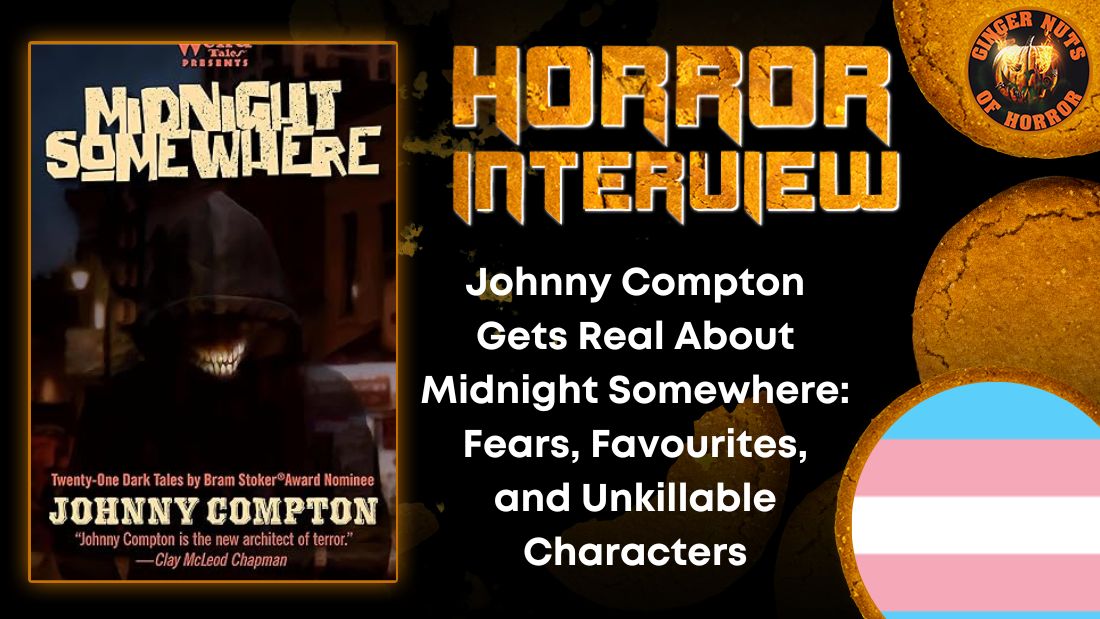

Johnny Compton Gets Real About Midnight Somewhere: Fears, Favourites, and Unkillable Characters
Johnny Compton a Stoker Award-nominated author, sure, a creator of profoundly unsettling tales like The Spite House. But get him talking ,and you quickly find the man behind the monsters is, well, wonderfully human. Loud, he admits, a little self-conscious. Absolutely fascinated by storytelling and the mechanics of fear.
We explore the chaotic inner workings of a horror craftsman. He shares which of his own characters would justifiably want to murder him upon meeting, a meta dilemma only a writer could face, and reveals where he’d host a dream Halloween party (think ancient castles).
His influences range from crime noir to chilling historical accounts of real-world disasters, which he believes shape terror more than people might think. Compton rejects easy labels and clichés with a sharp, thoughtful wit. He avoids reading reviews, grapples with overthinking tiny details, and finds pure energy in the writing itself. This is a glimpse into the creative engine, the personal fascinations and confessed imperfections that fuel the nightmares. It’s a ride.
And don’t forget to check out our review of Midnight Somewhere here!
Please tell the readers a little bit about yourself.

I’m the Stoker Award nominated author of The Spite House, Devils Kill Devils, and Dead First. I’m tall, a little self-conscious about how loud I can be, and even more self-conscious about how much I love to talk about storytelling, and scary stories in particular.
Which one of your characters would you least like to meet in real life?
Great question, and hard to say. I’m going to get a little bit meta here and say Farrah from “The Happy People” in this collection. Not just because she’s a nearly unkillable murderer, but because I don’t think I could resist telling any of my characters, “Holy shit, do you know I made you?” if I met them in real life, and she’d be able to justifiably respond with, “You’re the bastard who put me through all of this!” And any chances of talking her out of killing me would fly far, far away.
Which of your characters is your favourite?
Overall, I’d say Shyla, from my third novel coming up, Dead First. But in this collection it has to be Mabel, the matriarch in “No Hungry Generations.” She’s funny, she’s tough, she’s smart, and I naturally reward her for being all of these things by putting her beloved family through misery.
Which of your books best represents you?
I think Dead First represents me directly the most, even though I tried to avoid putting too much of myself into it. I try to do that with all of my works, but more of me seeped into Dead First than I could filter out. There’s a character based on a couple of my aunts, there’s a scene based on an old urban legend about a haunted hospital I heard about in my childhood, I get to mention the Galveston hurricane of 1900, which is one of my longtime fascinations, it goes on and on.
And it marries horror with crime noir, which is something else I’m a fan of. It’s the first book I’m dedicating directly to any member of my family, and I think the reason for that is that it feels like a part of me, despite my efforts to excise myself from it.
Other than the horror genre, what else has significantly influenced your writing?
Crime fiction for sure. I read my share of Sherlock Holmes growing up, and Devil in a Blue Dress is one of my favorite books. I also read a lot of non-fiction accounts of disasters, and I feel like getting a sense of real world fears and the suddenness with which deadly circumstances can appear influences my writing considerably.
I mentioned the Galveston hurricane in my answer to the previous question: the moment in Isaac’s Storm when Erik Larson describes the water on the already flooded island rising four feet in a matter of seconds is still one of the most chilling things I’ve ever read. “This was not a wave, this was the sea itself.” The realization that the situation has gone from awful to catastrophic—from “flooded island” to “there effectively is no island”—has had a big impact on my approach to telling stories and trying to escalate the tension.
The term horror, especially when applied to fiction, always has such heavy connotations. What’s your feeling on the term “horror”, and what do you think we can do to break past these assumptions?
So, I’m pretty fond of saying “everybody likes horror, whether they realize it or not.” I know that’s hyperbolic, it’s not literally “everybody,” but I do think that applies to a significant majority of people. Perhaps an overwhelming majority. Some form of horror shows up in just about every fictional story that has life or death stakes. There are action movies and even comedies that throw in a jump scare just to make sure they’ve got the audience’s attention.
So I think the biggest assumption we can break people from having is this notion that they don’t like horror. In a lot of cases what they don’t like is just the word itself, because, as you mentioned, it carries certain connotations. But I think it’s pushing past that and maintaining momentum in recent years.
I remember Barnes & Noble not having a horror section, and now it has one (at least ones where I live do). There are two—TWO—terrific horror bookstores within an hour or so drive of me right now, here in Central Texas, a state where attempts to ban “undesirable” literature isn’t exactly unknown, unfortunately.
Yet those stores have remained open and successful because there’s a desire and increasing respect for the genre. At the time I’m writing this, the two highest grossing original films of the year are Sinners and Weapons. A pair of horror films are at the top of the non-IP box office in 2025.
I think if we just keep telling stories that people gravitate to and appreciate, it will continue to erode the assumptions people have about the genre.
Should horror be political?
I believe in the adage that “All art is political.” Horror is inherently socio-political if it’s told well, which, for me, means that you don’t have to overdo it or try to hard to make a political statement with it. If that’s intrinsic to the work, or the primary objective, then of course it makes sense to be as deliberate with it as possible, and different people will have different approaches.
My approach is to tell a great story first, confident that politics will be part of it, because that’s the nature of the story. I take my cues from favorites, such as the film Alien, which, I’d argue, is pretty anti-corporate, anti-capitalist, and pro-worker, but it doesn’t exactly stop the show at any point to spell out these themes. They’re not the point of the story, but they’re baked into it as essential ingredients.
Why do you think so many people enjoy horror?
It’s fun! Well, it can be fun, and obviously it can be a lot of other things, but as to the question of why people enjoy horror, I think it’s because it scratches a ton of different itches we apparently have.
When we hear scary stories when we’re young, for many of us, it tugs at our curiosity, our desire to be thrilled, and our willingness to be a little bit daring. It’s the storytelling equivalent of climbing up to and / or jumping off the higher and higher branches of a tree because you and your friends find it challenging and rewarding to test where your limit is.
And if you’re someone like me, who hated heights and stayed his ass right on the ground while the other kids climbed, it was especially important, because while I didn’t have it in me to jump out of a tree from ankle-snapping heights, but I had it in me to read about every form of fictional, Fortean, or folkloric horror I could get my hands on.
I think that sensation, once it’s planted, never goes away. If anything, I think you chase it more and more the older you get.
What new and upcoming authors should we take notice of?
I always feel a little weird labeling anybody as “new” because even though you might be a debuting novelist, you might also have been writing for years prior to that, publishing short stories or self-publishing, just working and grinding, and not feeling terribly “new” at all.
So with that out of the way, Yah-Yah Scofield’s On Sundays, She Picked Flowers is terrific, and I can’t wait for more people to get their eyes on it. I’m also in the middle of Listen to Your Sister by Neena Viel and enjoying it so far.
And who would be on your Mount Rushmore of horror?
Stephen King, Edgar Allan Poe, Shirley Jackson, Ambrose Bierce
Are there any reviews of your work, positive or negative, that have stayed with you?
Not really, because I don’t read reviews. As Gabino Iglesias says, reviews are for readers, not for writers. Even positive reviews aren’t something I’m particularly interested in. If I had to pick anything, I suppose it would be an online review early on, with The Spite House, that praised me at the expense of an another author, insulting them, which a) I feel like isn’t really a compliment to me, after all, and b) obviously I’m not comfortable with another author being put down to ostensibly build me up. That has stayed with me as an additional reason to leave the reviews for readers to take in, and just keep my eyes on my writing.
What aspects of writing do you find the most difficult?
Probably getting out of my own head and not double-and-triple thinking certain things. Especially the little things. If I get stuck on trying to come up with a fitting character name it can derail me for days, which is absurd. Just plug a name in and if I think of a better one, go back and change it later! I tell myself that, but never really can follow that advice, at least not consistently. That’s just one example, but I tend to overthink the little things and get behind on the progress I plan to make, from time to time.
Does writing energise or exhaust you?
Oh it’s energizing, 100%.
What’s your best advice for new authors about social media?
Interesting question, but I’m probably among the least qualified authors to answer this correctly, because I’ve never been a big social media user, and I’m really only on any platforms now because I have a professional obligation to promote my work. So from my perspective, I’d start with saying just do what you’re comfortable with.
It can help to view what makes others successful on social media, but adapt it to whatever you feel works for you. Don’t neglect it, but don’t obsess over it, either. And, now that I say that, hell, if you can be successful by your own measure while neglecting social media, and that’s what you want to do, then by all means, go for that.
How do you balance making demands on the reader with taking care of the reader?
I try to have a lot of faith in the reader, which probably makes my initial drafts a little vague in a few areas at times. Fortunately I’ve worked with good editors who’ve pushed back when they feel I’ve taken this too far. My instinct leans heavily toward believing in the reader to figure certain things out based on clues I’ve planted in the text, or to understand that ambiguity or and unanswered question is what I’m going for. But my editors give me a different perspective on that approach, so that’s pivotal in helping me keep it somewhat balanced.
Writing is not a static process; how have you developed as a writer?
It’s been quite a journey of development for me. When I started writing in earnest, a few decades ago now, in my first year of college, I outright feared writing dialogue. It’s almost hard for me to wrap my head around that now, as I think it’s one of my strong points nowadays, and something I definitely enjoy. Back then I would avoid it altogether sometimes, even when it wasn’t best for the story for me to do so.
I like to think my similes and metaphors have gotten stronger as well, although sometimes I revisit an old unused story, find a line that I think is still really good, and repurpose it for something new I’m working on. But I think I have a certain consistency with my rhetorical device usage. I’ve also leaned more heavily into the style I’m comfortable with, and have cultivated, with regard to prose, plotting, characterization, just about everything.
What’s the most surprising thing you learned while writing your books?
While I’ve learned some fascinating things about the world, beliefs, folklore, et al while researching stories, I think what’s surprised me the most is learning what my apparent influences have been. Sometimes while writing I’ll remember something from when I was considerably younger, some book I read or story I watched from back when I was in grade school, even, and realize that it stuck with me enough that I’m trying to capture or reimagine those same moments in my stories.
Or even larger ideas, like how I approach plotting. I relatively recently came to the realization that my admittedly dense plotting, as well as my layered but shrouded view on world-building, is probably influenced by a lot of anime films I watched and enjoyed right around the same time I was starting to take writing seriously. I haven’t really tried to write anything on the scale of Ghost in the Shell, Akira, or Nausicaa and the Valley of the Wind, amongst others, but I think that approach to storytelling bled into more than I realized when I look at the way I’ve structured my novels, Devils Kill Devils in particular.
What does literary success look like to you?
Just having an opportunity to keep writing, keep putting stories out there. Being in bookstores is already a dream come true for me. When I fantasized about having a literary career in my late teenage years, it always came back to being able to visit bookstores or libraries that I loved and seeing my work on the shelves. As long as I keep getting to do that, I’ll feel like I’m successful.
What is the best piece of advice you ever received regarding your writing?
I think this was indirect—a compliment that I received as advice—but it was to actually use some of my wordplay instincts, instead of fighting against them. Once upon a time I was an aspiring rapper, trying to overload my verses with impactful “punchlines”—metaphors, similes, puns, and the like. But when I sat down to write fiction I would try to divide my creative mind, set aside the part of me that wanted to be an MC, because the author side of me needed to take over.
I can’t remember the exact line, but something I probably would have reserved for a verse on a song instead for a sentence in a story managed to slip into something I shared for feedback online, and an older writer pointed out how much he really liked that line, and I realized that maybe I should try to get these two halves of my writer brain to collaborate instead of trying to isolate them.
Do you have a favourite line or passage from your work, and would you like to share it with us?
I’m still partial to the opening of The Spite House: The Masson House of Degener, Texas, was like the corpse of an old monster, too strange and feared for most to approach it, much less attempt to bury it. After all, it might be feigning death or dormant.
The late Weston Ochse complimented me on that opening when we met at the Tucson Book Festival a few years ago. Still one of the highlights of my career.
I also like the moment in Devils Kill Devils when the vampire from the tunnel massacre taunts the few who’ve escaped to come back into the dark to rescue their friends, telling them to “Be brave.”
Can you tell us about what you are working on next?
I’m currently working on my fourth novel, with the working title of Say A Grave Maker. It’s a little bit of a serial killer story, a little bit of a revenge story, with some hints of ghostlore surrounding and influencing the primary plot.
If you could erase one horror cliché, what would be your choice?
This goes beyond horror, but any time someone picks up a gun to point it at the killer / villain but is so afraid to actually use it that it allows the killer to get up close to them and regain the upper hand. I’ll neither confirm nor deny that I’ve had a little experience with having to aim a weapon in self-defense once in my real life, and I’ll fully acknowledge that my own (alleged) experience is just that, my own, and can’t represent what everyone else’s is or would be. That said, it rings untrue to me.
What’s the one question you wish you would get asked but never do? And what would be the answer?
If you could host a Halloween party at any place in the world where would it be?
Either Glamis Castle, in Scotland, or Casa Matusita, in Peru.
Midnight Somewhere by Johnny Compton

From Bram Stoker Award–nominated author Johnny Compton, Midnight Somewhere is a frightening collection of thought-provoking stories perfect for fans of Stephen King’s Night Shift, Tananarive Due’s The Wishing Pool, and the work of Junji Ito.
A man gets into a car that can take him anywhere he can imagine—including the past, into the worst mistake of his life, a memory he does not want to relive, cannot escape, and is even more afraid to alter …
A seemingly harmless, forgettable film about “alien hand syndrome” inspires a wave of self-harm among viewers—and even stranger things among those who become obsessed with it …
A woman tries to bring her dead lover to life through a macabre ritual that requires attacking his corpse. Is it because she longs to be with him again … or because the two of them have unfinished business?
The assorted characters in this thrilling collection encounter horrors that range from mysterious to murderous, discovering that darkness can find anyone, anywhere, at any hour of the day. After all, it’s always Midnight Somewhere …

About Johnny Compton:
Johnny Compton is the author of the Bram Stoker Award–nominated The Spite House. His short stories have appeared in PseudoPod, Strange Horizons, The NoSleep Podcast, and many other outlets. He is a Horror Writers Association member and creator and host of the podcast Healthy Fears.
Interviews on Ginger Nuts of Horror
If you’re a fan of horror literature and cinema, then you absolutely need to check out the horror interview section of Ginger Nuts of Horror.
Firstly, the interviews feature a diverse range of authors, filmmakers, and horror enthusiasts, allowing readers to gain a multifaceted understanding of the genre. Each interview is an opportunity to explore the creative processes, inspirations, and personal stories behind the minds that produce some of the most chilling and thought-provoking works in horror today. From seasoned veterans to up-and-coming talents, the variety of voices ensures that readers can find something that resonates with them.
Moreover, these interviews often delve into the nuances of what makes horror such a compelling genre. Contributors share their thoughts on the psychological aspects of fear, the societal influences on horror trends, and the ways in which horror reflects cultural anxieties. This deeper exploration not only enriches one’s appreciation for horror stories but also fosters discussions about broader themes, such as identity, morality, and existential dread.
The interviews frequently touch on practical advice and industry insights. Writers and creators often share the hurdles they faced in their careers, tips for aspiring horror writers, and the realities of getting published or produced. This wealth of knowledge is invaluable for anyone looking to navigate the sometimes challenging waters of the horror genre. Readers interested in breaking into horror writing or filmmaking will find a treasure trove of wisdom that could pave their path toward success.
Lastly, the community aspect of Ginger Nuts of Horror cannot be overlooked. Engaging with these interviews allows readers to feel connected to a larger community of horror enthusiasts. Comment sections and social media interactions often follow, enabling fans to discuss their thoughts and engage with both the interviewees and fellow readers.
In conclusion, the horror interview section of Ginger Nuts of Horror is an essential resource for anyone interested in the genre. It provides rich insights, guidance, and inspiration that can deepen one’s appreciation for horror while fostering a vibrant community among fans and creators alike. Don’t miss out on the chance to delve into the minds of your favorite horror creators!


