



From the academic analysis of fear to the heart-pounding creation of it, the journey of a writer is often as compelling as the stories they tell. In this edition of Five Minutes With…, we sit down with Kendall Phillips, a scholar who has spent his career dissecting the mechanics of horror and pop culture, only to take the daring leap into writing it himself.
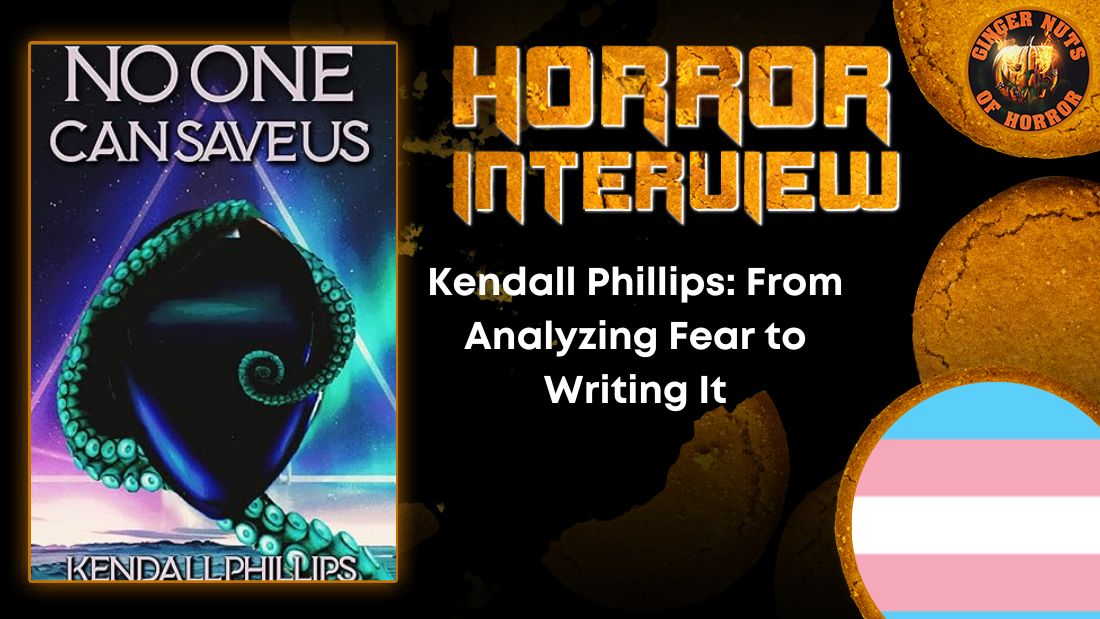
Phillips, a Bram Stoker Award-nominated nonfiction author and professor, invites us behind the scenes of his debut novel, No One Can Save Us. He shares the unique challenges of blending superhero tropes with Lovecraftian cosmic dread, the brutal realities of breaking into the fiction world, and the personal resilience required to survive a critic’s flush.
Kendall Phillips: From Analyzing Fear to Writing It

Let’s start at the very beginning. For our readers, please introduce yourself. Beyond the author bio, tell us a little about who you are when you’re not writing, what you love doing, what fascinates you, and what fuels your creativity.
I’m Kendall. I grew up in a relatively small town in Texas, and I spent way too much time with my head either in a comic book or a Stephen King novel. As I grew up, I continued to be fascinated with horror and popular culture and ended up studying communication at university. Now, I teach about all these things at Syracuse University where I write a fair amount of nonfiction works about pop culture. Really, I’ve spent so many years writing about horror that I was a bit afraid of trying to write my own horror story, but I have an amazing spouse and supportive friends who encouraged me to ‘go for it.’
The one great thing about living in upstate New York is our amazing outdoors. I love to hike around in the woods, camp, and find new ways to injure myself! I find being alone on a trail in the middle of nowhere is the perfect place to let my imagination drift. Then comes the hard part, sitting down in front of a keyboard and putting all that imagining down on paper.
In the early stages of a new project, what tends to come to you first: a compelling character voice, a central thematic question, or a vivid image/scenario? How does that initial spark then guide you in building the rest of the story?
I’m very much a premise person and also a plotter. Most of the things I’ve written, including my first novel, have begun with some slightly strange idea. Usually, it is just taking the real world and adding one little twist. If the twist keeps me interested, then I start trying to think about what kind of characters would react to this strange world and what they might do, which sometimes leads to a story. In terms of writing, I am an orthodox plot outline person! I have to see the different acts of the drama and absolutely have to see where it will end up.
Probably 70% of the time, the story never really materializes or what develops isn’t very interesting. Or sometimes I come up with a whole plotline only to realize I saw it on some TV show or read it in an old novel. But on rare occasions it comes together in interesting ways. That’s when I start putting finger to keys and see where it goes. There are definitely places where the story deviates from my initial plot structure, but I’d say most of the time the basic structure holds together all the way to the final draft.
Every book has its own unique set of problems to solve. What was the most difficult ‘puzzle’ you had to crack while writing this book? Was it a plot hole, a character’s motivation, the structure, or something else entirely?
The tricky part about No One Can Save Us is that it intentionally blends well-known genres. It is, at its core, a superhero novel that happens to be set in a Lovecraftian world of secret cults and Eldritch gods. Finding ways to use those familiar tropes but putting slightly different spins on them was tricky. I also struggled to push beyond the stereotype.
Adam, one of my main characters, is sort of like Superman, invulnerable and powerful. But what would a super person that be like in real life? Would they be all heroic and noble, or would they just be a regular person? And how would the people around such a being feel about them, what kinds of relationships would they have? Same with the Lovecraftian elements. It is easy enough to say some shambling creature ‘drove people mad,’ but what would that actually look like? I guess I wanted to keep all the fantastic elements of heroes and monsters grounded in the real world. A fun challenge, but definitely a challenge!
The journey from a finished manuscript to a book in a reader’s hands can be a surprising one. What was the most significant way your book evolved during the editing and publishing process, something you didn’t anticipate when you typed ‘The End’?
To be totally honest, I had never realized how tough the fiction world is and how demoralizing it can be. Before this novel, I had written mainly nonfiction, including a Bram Stoker finalist back in 2012. I’m used to the nonfiction and academic world where work is generally treated with some level of respect, even when it is not particularly good.
But wow – the fiction world is filled with form rejections, non-responses, and utterly vicious critiques. I went to a writer’s conference where you could share a query letter and the first few pages with an agent and met with two. Both of them essentially pulled my soul out of my body, kicked it around the room for a few minutes, and then flushed it down the toilet. I left there devastated and largely abandoned this novel for a good six months.
Fortunately, there are also a lot of supportive people in the fiction world. My wife, Catherine, is an incredible writer and she has always been supportive. I also found great allies in the local writing community with workshops and writing groups. I think the real lesson is to look for people who will try to make your writing better and avoid the people who take sadistic pleasure in gatekeeping.
We often hear about authors being influenced by other books. What are some non-literary influences on your work, such as a specific piece of music, a historical event, a scientific theory, or even a landscape, that have profoundly shaped your storytelling?
I absolutely have to listen to music when I’m writing. For some of my nonfiction books, I’ve picked a single artist or album to listen to over and over while writing. I imagine it helps me stay in the headspace. My new novel, No One Can Save Us, spooled out over several years of writing, so it didn’t have a single artist or album, but I did have a playlist of songs that ‘felt’ like the characters.
The funny thing is, not all the songs are the kind I would normally listen to, but they just seemed to resonate with my sense of the characters. AWOLNATION’s “Sail” and Fall Out Boy’s “Centuries” were the theme songs to two of my main characters (bonus points to any readers who figures out which ones!)
Who was the first person to see your early drafts, and why did you trust them with your unpolished work? What is the most valuable piece of feedback they gave you?
The first person who read through my draft was my amazing spouse, Catherine. She is a great writer, mainly literary with short stories in proper lit journals. I totally trust her as a writer and reader but, I’ll confess, I had some lingering doubts. She is married to me after all, so telling me “It stinks” might be a bit awkward. I’d say the first real feeling of confidence I had came at a writer’s conference at Colgate University.
Naomi Jackson was assigned to my group to read my whole draft and give comments. Now, Jackson is an incredible writer. She went to the Iowa Writers Workshop and her The Star Side of Bird Hill was short listed for numerous prizes. Her work is deeply literary and personal. So, in many ways she was the exact opposite of my kind of fast-paced genre blending. But she was really supportive. Her best advice to me was to control the pace of the story and know when to slow down and let the story breathe. I only interacted with her during that week, but her support of my project really meant a lot to me.
Setting in horror is often described as a character in its own right. How do you approach transforming a location, whether a house, a town, or a landscape, into a source of active dread?
A good deal of No One Can Save Us is set in Chicago. Now, I have to confess, I have never lived in Chicago, but I’ve spent a lot of time there over the years for various work events. I also felt a kinship to Chicago because of my love for the old “Kolchak: The Night Stalker” series with Darren McGavin (I even wrote a book about the series for Wayne State’s “TV Milestones” series!).
Chicago is such a great city and so absolutely down-to-earth, the idea of setting a fantastic story with superheroes and elder gods and shambling creatures in the “Windy City” just felt right. I do feel that the city is an important character, and I hope readers from Chicago feel the same way!
You have precisely two minutes in a crowded bookstore to hook a reader who is sceptical of the entire horror genre. They look at your book’s cover and ask, ‘Convince me. Why should I read this? I don’t even like being scared.’
If you enjoyed the Marvel Cinematic Universe but wish the films had a bit more depth and character development, you should read No One Can Save Us. If you loved Watchmen, either the graphic novel or the HBO series, you should read No One Can Save Us. If you’ve ever wondered what the whole “Lovecraft” thing is all about, you should read No One Can Save Us. If you like fast-paced adventure with a hint of cosmic horror, then this is the book for you!
NO ONE CAN SAVE US has been unleashed from NIGHTMARE PRESS!

Adam always keeps his powers in check. As the world’s only superpowered hero, he has to know his limits. Defeat the master criminal, repel an army, stop a natural disaster, but never let himself go too far.
Until Syangnom.
The world has grown accustomed to the feats of its only superhuman. Adam’s wife, Sara, a celebrated journalist and periodic hostage, regularly reports his exploits, and all the legal issues are handled by the agents of Extra-Judicial Affairs. But when Adam becomes enraged in the reclusive regime of Syangnom, he leaves 14 million people dead and the world recoiling from the destruction he has wrought.
Now Adam’s wife Sara and EJA Agent Pia Mercado must track down the conspiracy behind Adam’s breakdown and discover the otherworldly source of his powers. Their search will bring them face to face with supervillains, eldritch gods, and the mysterious armored figure who defends Chicago from the shadows.
A mix of superheroes, horror, and science fiction – think WATCHMEN X LOVECRAFT! I hope you like it!
Book site: https://a.co/d/4foDVjZ
Kendall Phillips

Author Bio: Kendall Phillips is a Bram Stoker nominated author who lives and works in upstate New York. His debut novel, No One Can Save Us, was released in October 2025 by Nightmare Press.
Author site: https://www.kendallrphillips.com
Interviews on Ginger Nuts of Horror
If you’re a fan of horror literature and cinema, then you absolutely need to check out the horror interview section of Ginger Nuts of Horror.
Firstly, the interviews feature a diverse range of authors, filmmakers, and horror enthusiasts, allowing readers to gain a multifaceted understanding of the genre. Each interview is an opportunity to explore the creative processes, inspirations, and personal stories behind the minds that produce some of the most chilling and thought-provoking works in horror today. From seasoned veterans to up-and-coming talents, the variety of voices ensures that readers can find something that resonates with them.
Moreover, these interviews often delve into the nuances of what makes horror such a compelling genre. Contributors share their thoughts on the psychological aspects of fear, the societal influences on horror trends, and the ways in which horror reflects cultural anxieties. This deeper exploration not only enriches one’s appreciation for horror stories but also fosters discussions about broader themes, such as identity, morality, and existential dread.
The interviews frequently touch on practical advice and industry insights. Writers and creators often share the hurdles they faced in their careers, tips for aspiring horror writers, and the realities of getting published or produced. This wealth of knowledge is invaluable for anyone looking to navigate the sometimes challenging waters of the horror genre. Readers interested in breaking into horror writing or filmmaking will find a treasure trove of wisdom that could pave their path toward success.
Lastly, the community aspect of Ginger Nuts of Horror cannot be overlooked. Engaging with these interviews allows readers to feel connected to a larger community of horror enthusiasts. Comment sections and social media interactions often follow, enabling fans to discuss their thoughts and engage with both the interviewees and fellow readers.
In conclusion, the horror interview section of Ginger Nuts of Horror is an essential resource for anyone interested in the genre. It provides rich insights, guidance, and inspiration that can deepen one’s appreciation for horror while fostering a vibrant community among fans and creators alike. Don’t miss out on the chance to delve into the minds of your favourite horror creators!


