
- Sara Hinkley on The Red Sacrament: Vampires Who Microwave Fish
- The Red Sacrament by Sara Hinkley: A Vampire Coven in 1869 Paris
Sarah Hinkley has spent a career dressing other people’s characters — on the sets of Law and Order: SVU, Monsterland, and the opera house. The Red Sacrament is the first story she’s driven herself, and it shows: a debut vampire novel set in a besieged, starving 1870 Paris, where the undead drink black-market blood, bicker like an orchestra trapped together for thirty-five years, and fail to meet revolution with anything like grace. Owing a clear debt to Interview with the Vampire but treading darker, more class-conscious waters, this is queer vampire fiction with dirt under its rhinestones. We talked craft, costume, and venality.
Sara Hinkley | The Red Sacrament | Titan | June 2026 |
The novel explores two forms of suspense: Arnault’s personal tension with Victor and the larger dread of starvation and revolution. How did you structure the pacing to keep both narratives active? Did you create specific thresholds, page counts, or transitions for the reader to switch between these two levels?
When I set out to write The Red Sacrament I knew I wanted to explore the spectacle of revolution, the relationship between political turmoil and the stage—how in some moments the glamour that mystifies our social relations can fall away and reveal the true workings of the world. So like a theatrical performance, I wanted to create a sense of creeping dread that builds and builds to an explosive, spectacular conclusion.
How I did this is another question. I tried everything under the sun to try to get a handle on pacing: Scrivener organization tools, spreadsheets, big pieces of butcher paper taped to the wall. At one point I had a fat stack of index cards held together with a rubber band, and I kept it on my nightstand. Do I recommend any of this? I don’t know! It was the hardest part by far. I’m sure I left blood on the page.
The phrase ‘constant bickering of his immortal friends’ signals that this isn’t your typical solemn vampire coven. How did you use this bickering, the petty conflicts of immortality, to subvert the idea of a ‘coven as sacred family’? Was there a scene where you allowed trivial arguments to overshadow a potentially grand, gothic moment?
When creating the social world of the Théâtre Saint-Siméon I took inspiration from my own working life in show business, but also from industry tea, specifically stories about the orchestra of The Phantom of the Opera. The show ran for 35 years on Broadway, and most of the musicians stayed for the whole run, which meant they were playing the same music together, eight shows a week, for decades. You would not believe the social dynamic that emerged there. One guy reportedly used to eat his lunch staring at the wall, he was so tired of looking at his colleagues.
So yes, there’s plenty of bickering. One scene takes place during the Siege of Paris. (Spoilers for late-19th century history: there is a Siege of Paris.) The city is encircled and starving, its people reduced to eating rats, pets, and zoo animals; everyone’s blood is thin and tastes horrible, and the vampires are having a pretty bad time. I’ll say only that the characters don’t rise to meet these hard times, or the world-historical events causing them, with a lot of grace or solemnity.
While Arnault’s clan kills to survive with a ‘just enough’ mentality, where do we see the limits of his empathy? Is there a kill or near-kill that forces him to confront his self-deception about moral responsibility?
Arnault’s aversion to violence doesn’t really have a moral basis. It has more to do with taste, sensibility; just as he doesn’t like vulgarity, he doesn’t like cruelty or mess. And like all managers he is very risk-averse. Violence increases risk, so he doesn’t like it.
Still, he has a significant body count, and isn’t all reluctant to kill; he is pragmatic about the need for blood, and more than once we see him end a person’s life very casually, the way you or I might reach for a half a sandwich while reading emails. And his track record isn’t perfect. He has made what he thinks of as mistakes. One kill in particular, centuries before the book takes place, casts a long shadow for him.
But Arnault can tell himself he isn’t violent, and it’s mostly true. Certain events in the book, though, will push him toward true violence, which for him is vanishingly rare.
Victor’s background suggests he embodies a different moral philosophy. How does his approach to immortality challenge Arnault’s rules? Does Victor represent a reckless honesty or a more humane possibility that Arnault hasn’t considered?
As they become closer, Victor shares with Arnault his feelings of guilt and distress around the fact of killing, and we get the sense he takes this to heart more than other vampires do. This makes a big impression on Arnault. It sets Victor apart, shows that he is special; it flatters Arnault’s desire to instruct and advise.
But Victor and his sister Françoise are products of a specific time and place. They are from the colonial periphery, Haiti before the revolution, a slave aristocracy in which they enjoyed the highest possible status. So even before they become vampires these are people who don’t work, who are not troubled by consequence, who have the human beings around them at their total disposal. With Francoise this manifests in violence and sadism, where Victor is inclined towards mercy, but both were raised in a position of privilege so extreme as to be utterly grotesque. This adds dimension to why Victor prefers travel to the realities of home. He’s running from something. What is it?
Even beyond this upbringing, and the significant class difference between sugar heirs and a crew of actors, Victor and Françoise behave very differently from the vampires of the Théâtre Saint-Siméon. The circumstances of their turning have separated them from vampiric culture and tradition. They mix socially with the living, don’t wear black, they might not even sleep in coffins. They aren’t confined to one city and its demimonde; they travel the world and move in elevated circles with ease.
Arnault admires this ease in Victor; really, he envies it. Victor has an effortlessness to him, and he isn’t saddled with the midlife hangups and vampiric responsibilities Arnault has to deal with, the job, the kids, the aging sire. He doesn’t have those constraints. Of course there is one big constraint which is Françoise, but take her out of the picture and Victor’s a remarkably free agent…
Béatrice, a witch, exists outside Arnault’s framework. What specific need does Arnault have that only she can fulfill, reflecting a vulnerability he wouldn’t admit to his coven?
Victor is enterprising, forward-looking, optimistic. He’s coming into his own, blossoming in front of Arnault’s eyes; he sees many opportunities in the industrializing world and the approach of modernity and is poised to take advantage of them.
Where Victor represents the lure of the future, Béatrice represents the draw of the past. She is pessimistic, almost poisoned by bitterness, old-fashioned, provincial; she’s from a region very close to where Arnault grew up. So she’s like him in some ways. Probably she’s a lot like the hypothetical woman he might have married, if his life had taken a more ordinary path.
This isn’t a romantic draw exactly, more of a domestic one. One way to seduce a vampire is to present them with the everyday things they are denied. Living in a house, sleeping in a bed, a hot meal. I thought of the question that often lurks in the back of the artist’s mind: what if you left the biz? What if you gave up and moved back to your hometown?
This is something Arnault can’t admit to the troupe or even to himself: that his existence in the arts and show business, in the city, in immortality–it all may have been a mistake. He might be just some guy. No winning talent, no bright future. This is a deeply shameful possibility, but for Arnault shame and attraction are not easily separated.
Françoise acts as a ‘Claudia’ figure that Victor wants to leave behind. How does her presence constrain Victor’s choices? Is there a scene where he prioritizes her in a way that harms Arnault, and how did you handle reader sympathy in that moment?
The Red Sacrament is treading in very different thematic waters from its inspiration, Interview With the Vampire, and the character of Claudia is the heart of that story and not at all replicable. Still, I found myself very interested in one aspect of her position in the narrative, which is obstacle. Claudia begins to get in the way of what other characters want, with devastating results.
I wanted to dig into and explore this position and its difficulty, which seemed to me to have a lot of dramatic potential. This is a little meta, but I also thought of how fandom often behaves around certain women characters. To explore romantic connection between two men, it will demonize, sideline, even outright murder the woman in the way. What tempts about this dynamic? The character of Françoise then began to emerge as an embodiment of the trope. Obstacle and problem. Victor’s troublesome mirror image, the heel to his face.
From these beginnings, Françoise was a lot of fun to build. One major ingredient is Countess Addhema from Paul Féval’s 1856 La Vampire, and I also stole shamelessly from the sexually manic female shoplifters in Èmile Zola’s 1883 Au Bonheur des Dames. The result is extravagantly awful. I sort of offer her to the reader in this way: here she is, here’s the problem.
As for Victor, he’s been with Françoise his whole long life, and he is used to operating around her. Even with Arnault he’s always gauging, modulating, appeasing; he is a very careful listener. The reader can infer Victor is often in trouble with Françoise, that he has to walk on eggshells around her.
There’s a scene where Arnault and Victor are having an evening together, kind of a date; they’re going to go cruising, essentially, go out and be flâneurs in the city. And Françoise crashes this evening completely. She shows up as if in an Audi convertible, saying, get in losers, we’re going shopping (Regina George: another Françoise ingredient). And Victor folds immediately, he goes along with this without a moment’s hesitation; it’s easier than opposing her in the moment, which feels impossible.
Most people have met someone whose personality is so dominant and difficult that conversations, interactions, even whole relationships tend to warp around them. My hope is they will empathize with Victor in moments like this, and identify Françoise as the problem.
You have an extensive background as a costume designer for film, television, theatre, and opera. How does that visual and tactile discipline shape the way you build a world and characters on the page?
I am very close to my work in costume design, and I think everything about the way I write is shaped by it! Costume designers break down and analyze scripts, do extensive research, work closely with directors and cast, devise ways to express character and theme; we also manage budgets from hundreds of dollars to millions, conceal pregnancies, place rhinestones, soothe actors, and paint fake dirt onto old boots. It’s a varied skillset, and all of it helped.
I think where I felt strongest writing the book was in its characters. What is the material basis of someone’s life? What is their their social context? What do they have access to, and how do they want to present themselves? What do they wish for? What do they hate? These are questions costume designers ask every day as part of our work.
In costuming, every fabric, color, and silhouette tells a story about a character’s status, secrets, or state of mind. Can you share an example of how you used a detail of dress or appearance to reveal something essential about a character in The Red Sacrament?
There are plenty of costume moments in the book. I try not to linger too long on them, or catalogue what anyone is wearing head to toe; a person’s clothes are most often perceived in a few quick seconds of impression, and I wanted to stay true to that.
One favorite garment in the book is the opulent and beat-up dressing gown worn by the character Léopold. This is a reference to a costume designed by the great Sandy Powell for Neil Jordan’s 1994 Interview With the Vampire film adaptation, worn by Antonio Banderas as Armand. These robes are not identical and are making different character gestures, but they share a certain spirit.
Léopold’s robe tells us a lot about him: he is artistic, grandfatherly, louche, he lives a soft life and isn’t working. He doesn’t leave the house much, or ever. Like him it is precious and magnificent, very old, and not in good shape.
You’ve worked behind the scenes on major sets like Law and Order: SVU and The Off weeks and Monsterland. How has witnessing the “closed door” drama and intense collaboration of a production set influenced your writing about groups, hierarchies, and hidden conflicts?
Intense is the right word for it! Workdays in TV and film production are long: 12 hours as a rule, often more, and if you like horror, google ‘Fraturday’. Like the orchestra of Phantom of the Opera, we spend a tremendous amount of time with each other.
You learn a lot about someone by working closely with them under pressure over time. You build a whole volume on them in your mind: what they like, how they operate, how to work with them or past them, or even against them. The strength of these connections makes for good drama. People grow to love or resent one another; often it’s both, which has a lot of storytelling potential.
We are in a notable resurgence of vampire stories across books and film. As a new voice in this space, what do you think is driving this renewed hunger for stories about the undead?
Vampires are maybe our most durable monster, and can be relied on to re-appear in times of heightened class antagonism or instability. A perfect metaphor for extraction, avatars of the ruling class, they speak to our anxiety that something in a human shape is living off us and draining us dry. This was true in Marx’s time and it’s true now. I began writing this book in January 2021, and it really felt like something was stirring in the crypt.
But there are other, newer dimensions to the creature. The post-Rice vampire has become a way to explore the alienation and loneliness of life in the modern era, especially queer life. Dracula and Salem’s Lot don’t concern themselves much with relationships between vampires or their exclusion from society, but lots of today’s vampire stories do. They help us explore social rejection, the exploitation seeded in our relationships, our attempts at connection which are flawed or even doomed; are we monsters to each other? Is something wrong with us?
Recent vampire narratives are incredibly diverse, exploring everything from corporate conspiracies and social justice to deeply personal horror and queer romance. Where do you see The Red Sacrament fitting into this new landscape? What classic tropes did you want to honor, and which did you aim to reinvent?
My vampires are classic creatures in many ways. They drink blood, sleep in coffins, wear black; they must be invited into buildings before they can enter, and are destroyed by sunlight. I didn’t want to reinvent the wheel, or creep into science fiction.
One thing I wanted to do differently: vampiric characters are often larger-than-life, more substantial and profound than mortals. I knew from the beginning I wasn’t interested in the aristocratic or superheroic, in making my vampires ‘people, but better’. I’m deeply curious about the lives and jobs of ordinary people: the dancer, the painter, the vegetable-seller, the bureaucrat. I’m a sucker for a supporting character, or an ensemble.
So I knew I would need vampires with some smallness and venality to them, who felt true to life, not larger-than. The kind of people who microwave fish in the green room or pitch fits in rehearsal, who you catch crying in the bathroom at work. It’s my hope The Red Sacrament offers a sense of social realism along with its opulence and violence, its nasty twists and turns: a class-conscious look at the movement of history, and how people make their way in it or don’t.
What’s one thing you learned from the process of writing this book that you will definitely take with you to your next project?
The Red Sacrament isn’t just my first novel, it’s my first foray into writing fiction, period. I’ve always been a huge reader, and I used to analyze and over-analyze media and get all bent out of shape at what I perceived as missed opportunities. I thought that was as far as it went. Well, turns out I was wrong, and that analytical habit was a big clue!
So really, what I learned is simply that I can do it. My main line of work is in supporting other writers’ scripts and stories, but I don’t have to stop there. I can get into the mix myself. A thrilling use of free will! And now I’m hooked.
From designing costumes that bring other people’s stories to life on stage and screen, to now stepping fully into the spotlight with your own novel, The Red Sacrament, what has been the most unexpected part of this creative journey for you, and what do you hope readers carry with them long after they read your book.
I’ve really enjoyed the sense of agency that comes from writing my own story, from making decisions that aren’t limited to providing context. I’m not just turning the dials, I’m driving, and it has been way more rewarding than I expected.
What comes along with that, though, is a sense of responsibility. The buck literally stops here; when readers receive The Red Sacrament it’s my work, not someone else’s work wearing my clothes. I’m a little nervous about this, and the spotlight in general, which has never been my place.
But more than I’m nervous, I’m plain old excited. I can’t wait for the book to find its readers. I hope they have as much fun reading it as I did writing it, and fall in love with my horrible little characters just as I did. At heart I’m an entertainer, a creature of showbiz, so I hope the book leaves people thrilled and scared, titillated and grossed out; I hope they feel they were immersed, and the door of the book slammed behind them, that they were plunged into history and went through the wringer there. In short, I want people to feel they got plenty of book for the money.
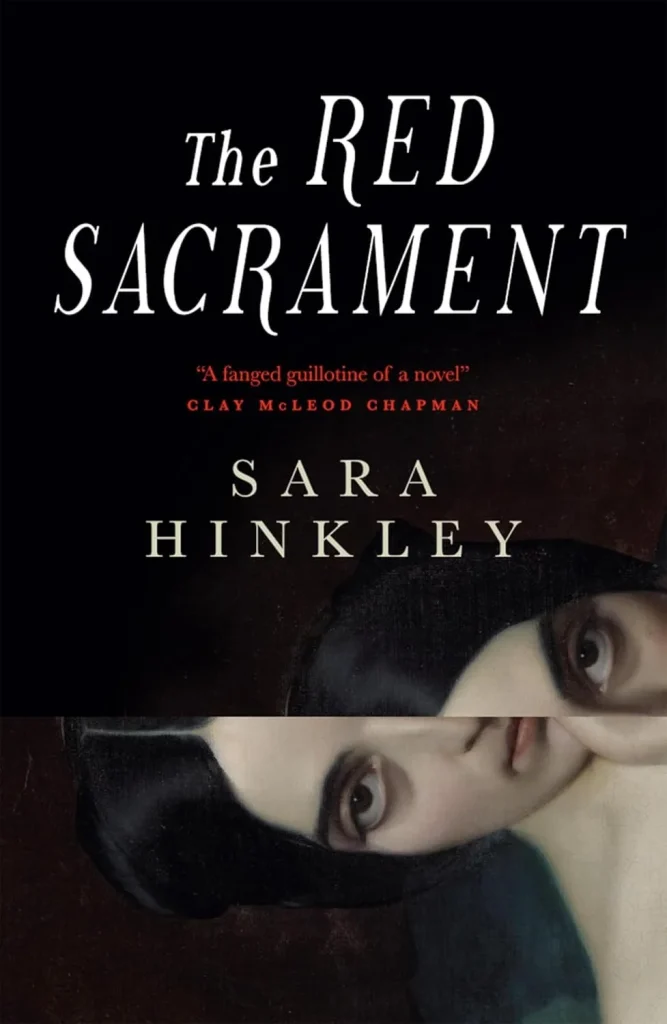
The Red Sacrament by Sara Hinkley
A savage, hypnotic dive into the lives and deaths of a coven of vampires living in 19th Century Paris on the cusp of revolt and revolution, perfect for fans of Silvia Moreno-Garcia, Laura Purcell and Elizabeth Kostova
Paris, 1869. The Théâtre Saint-Siméon is the place to be, if you can get in. The black slips of paper that guarantee entry are rare and highly desired, and given only to certain persons. The actors on stage are magnetic and ageless, performing only at midnight and never seen during the day…
Arnault and his clan of vampires have survived for as long as they have by observing a rigid set of rules. At night, they perform on stage at the Théâtre Saint-Siméon, picking off just enough people in the audience to survive. But they understand the city, and how to live in it without being noticed.
Their peace is shattered first with a visit from Béatrice, a witch who forms a strange connection to Arnault; then with the arrival of Victor de Rouvray and his sister Françoise, vampires from a very different world. And, as Arnault grows closer and closer to the beautiful, enigmatic Victor, he risks becoming distracted from the constant bickering of his immortal friends, from the daily running of the theatre, and worse, from the premonitions of blood, death and starvation that he receives at night.
For a terrible change is on the horizon, revolt and revolution are brewing in the streets and soon, the city, and Arnault will never be the same again.

Ginger Nuts of Horror: The Heart and Soul of Horror Reviews

Looking to get your horror book or film in front of the genre’s most dedicated audience? Ginger Nuts of Horror is one of Europe’s largest independent horror review websites, with over 30 contributors publishing horror book reviews and horror movie reviews almost every single day.
We offer far more than reviews. Authors, filmmakers and publishers can promote their work through in-depth horror book reviews, horror film reviews, comic and video game coverage, news features, and our popular author and director interviews like Five Minutes With. Our guest feature series, The Horror of My Life, Childhood Fears, The ? That Made Me and more, let creators tell their story while promoting their latest release.
Every feature is built to sell your work. We include backlinks to your website or Amazon author page, a full synopsis, and a universal purchasing link that sends readers straight to their local store. Add a large, engaged social following and an 18-year archive of trusted horror coverage, and you have a platform genuinely built to grow your readership.
Whether you’re an established author, an indie filmmaker, or a debut voice in indie horror, there’s a way for us to help you reach more fans. Explore our horror book reviews and horror movie reviews, then get your horror book or film featured today.