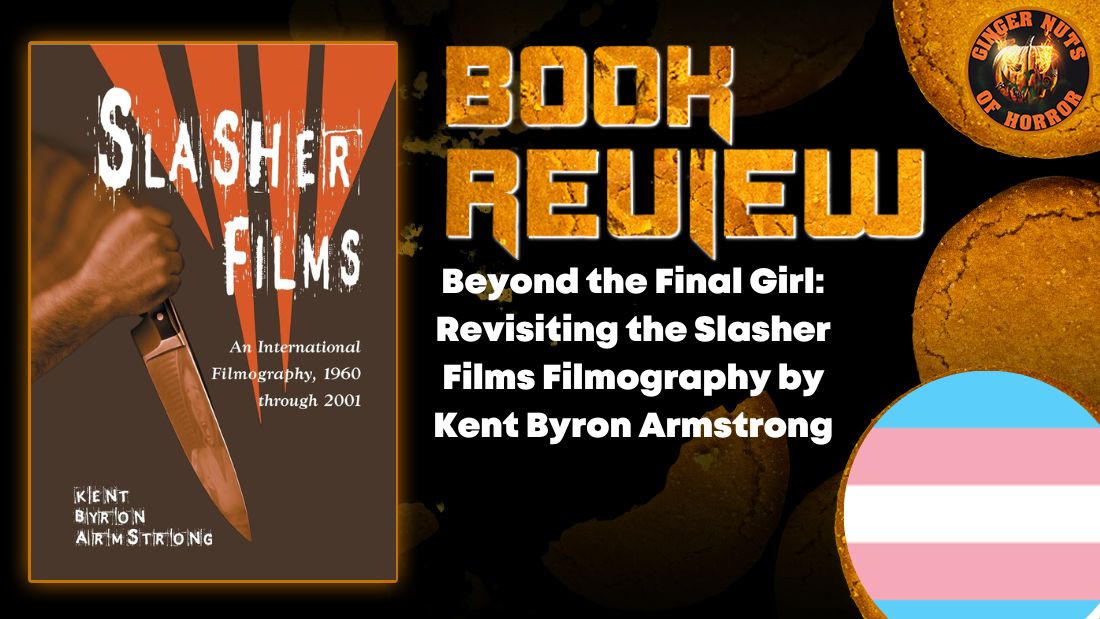

Slasher films An International Filmography 1960 through 2001 – Kent Byron Armstrong – reprint (2003 McFarland)
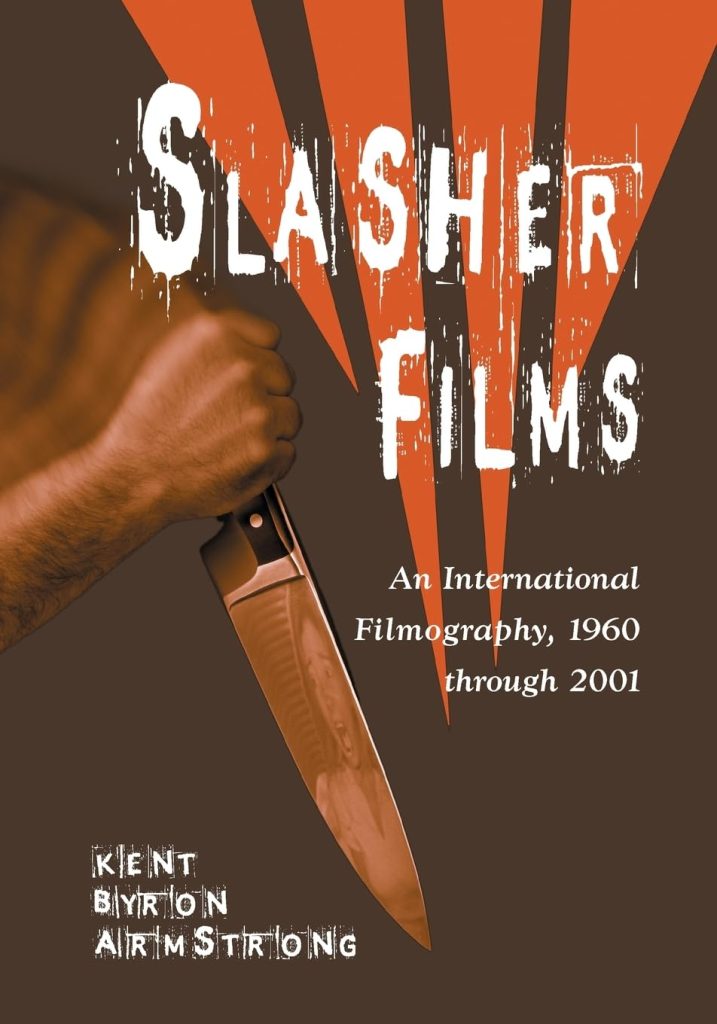
Encyclopaedic table books, especially those dedicated to film, are so special. Novels might risk having sexier covers than insides, but titles like Slasher Films, An International Filmography 1960 through 2001 are going to give me what they’re selling on the tin. A reprint following the 2003 publication, Armstrong’s compendium gives a rigorous snapshot of every film he considers a Slasher up to the year 2001. Before opening the front cover the viewpoint is made clear and stands in contrast to so much popular understanding of the topic.
Though infinite US-centric lenses have backdated the slasher’s invention to Halloween and the Texas Chainsaw Massacre, increasingly now also crediting Bob Clarke’s Canadian masterpiece Black Christmas; Armstrong shines a determined light on countless titles from the sixties and early seventies too often relegated to the “proto-slasher” label.
Slashers, according to Carol J. Clover, whose work in Men, Women and Chainsaws is taken as the contemporary criticism on the genre, include a killer who is ‘the psychotic product of a sick family but still recognisably human; the victim is a beautiful, sexually active woman; the location is not-home, at a Terrible Place; the weapon is something other than a gun; the attack is registered from the victim’s P.O.V. and comes with…suddenness.’[1] That emphasis on the victim has shaped discourse around the genre for years and defined how critics search for its first example.
In a 2017 article, Bart Bishop called Jess Bradford of Black Christmas the first Final Girl, which was solidified in Halloween and codified in Scream, where Randy “defines the so-called rules[…] no sex, no drinking or drugs, and never say “I’ll be right back.””[2] In a post Scream landscape, into the 2000s and beyond which Armstrong’s text does not cover, this has become the popular opinion, especially by the genre itself which has skewed increasingly more meta to the point of fairy tale logic.
In modern entries, such as 2015’s The Final Girls, and by writers such as Stephen Graham Jones, this knowledge of supposedly iron clad genre tropes is even used to the advantage of the potential victims.
But Armstrong defines the genre as ‘exhibit[ing] a combination of the following: (1) an introductory murder; (2) a setting that does not inspire terror, but which may be combined; (3) visualised killings and killers; (4) a human or human-like killer; (5) the systemic killing of characters; (6) a theme that connects the murders; and (7) an unhappy, often unresolved, ending.’[3] None of these are criteria which limit the genesis of the genre to the early seventies and so Armstrong doesn’t.
The earliest films here are from 1960; primarily international titles unrestrained by the Hays Code which wouldn’t come to a real end for another eight years. At least in the United States the ‘visualised killings and killers’ Armstrong lists as ‘similar to spotlighting the main performer on stage’ wouldn’t be permitted to appear. [4]
The reasons for the killings are, for Armstrong, less likely to be linked by sexual violence and repression than they are class. ‘A surprising number of slasher films feature victims that are students and/or yuppies’, he notes.[5] However he then uses a girl’s death in Prom Night to state that ‘a character’s background and current situation are often of no consequence in a slasher film’[6] For Clover and most literature following her these texts are inextricably about gender.
‘The Final Girl has not just manned herself; she specifically unmans an oppressor whose masculinity was in question to begin with’.[7] Gender is the hidden reason behind the violence just as superseding it becomes the key to escaping it, and the portal through which audience enjoyment is inextricably filtered.
But for Armstrong, ‘sexuality is present because humans are sexual; it does not present itself through the murders. This is why killers are both male and female, and it explains why sexuality is present throughout, both preceding the killings and afterwards. Furthermore, it is why, despite the misconceptions, the murders are not restricted to the sexuality liberated.’[8]
To explain this gap in the shaping of scholarship, Tonato Dotaro wrote in 2002 that ‘Clover and other feminists deprive themselves of great potential material with their near exclusive dependence on American horror… [in which] women are usually murdered because of their having had sex, or desiring sex. In the Euro horror film women murder because of their carnality.’[9]
He goes on to mention that Isobel Cristina Pineda only cites 3/120 non-English language films in her own work.[10] Though Armstrong could undoubtedly broaden the international net he casts, he is not left with anything like the same issue. Giallo for instance is extensively referenced; a controversial inclusion to many scholars who prefer to separate the two undeniably linked genres.
He also considers other films often excluded from the Slasher canon. De Palma’s neo-noir Body Double (which, spoilers, only contains one real murder) is also written about extensively.[11] Though it may not technically meet the criteria of having multiple on screen murders Armstrong’s rules are ones he’s happy to play with, which becomes just as interesting in looking to what he chooses to exclude.
To many, Bart Bishop among them, though Black Christmas, Halloween, and Friday the 13th all come close to producing what will become Clover’s inimitable figure of the final girl, it’s not until A Nightmare on Elm Street’s Nancy, who doesn’t do drugs or have sex and who savvily learns to turn the villains own weapons against them without needing outside help, that we see the first true Final Girl.[12]. But Armstrong isn’t so interested in the figure of Clover’s monster.
After all, he also includes Bay of Blood, which has no clear victim or sole killer. So Nancy and her franchise are not lauded here as they are in other slasher investigations. There is no supernatural slasher subgenre that interests Armstrong.
He excludes Alien and Predator for their non-human elements despite structure, same with the Church; Demons and Dusk til Dawn.[13] For my part, I agree wholeheartedly with these latter examples, but I do believe supernatural slashers have their place in the genre. To me, something like Pumpkinhead is most interesting as a slasher hybrid with folk horror elements.
The first publication came prior to the rigid canonisation of Clover’s theories, and so it stands against rules we now take for granted. To me Scream and other meta properties like Bride of Chucky (included, despite the entire franchise following a magically possessed doll[14]) functionally embed those rules and icons into the cultural consciousness. Freddy might not have been a traditional slasher villain but he is referenced enough as one in the undeniable slasher films that followed him. It feels clear however that Armstrong is no Craven fan, mentioning with distaste in the Scream entry that, Craven ‘ostentatiously’ references his own work in Elm Street.[15]
Along with killer dolls, telekinesis is also included through Friday the 13th, Part VII: the New Blood. I remain curious if Jason X’s trip to space would have been enough to shake his franchise from the book (Jason X being released the same year as Slasher Films).[16] To me, telekinesis feels almost worse than dream powers in terms of rendering characters less human in power. It also draws attention to Carrie’s exclusion (I promise I don’t actually have an interest in labelling Carrie a slasher).
Though it goes unmentioned here, Hellraiser is obviously more complicated. Pinhead has often been culturally pushed into the slasher role in the same way as Freddie, even later by the series itself, as a marketing inclusion which never suited his brand of torture/perverse sexual awakening. Julia however does function as a slasher villain in the first film, luring her victims one by one and becoming hooked on the power of it.
The compendium itself is wonderfully extensive. Each entry is alphabetically organised with a full glossary to assist in navigation. Every film description displays all alternate titles, essential for so many of these multi-titled non-English films difficult to dependably track down on Letterboxd. It goes on to cite all major crew members involved before launching into a comprehensive Wikipedia style plot summary. Each summary ends with a review note and more on performance/other projects.
These summaries are both informative and often witty; occasionally end with pairing advice. Following the film arrangement the book ends with appendixes for stars, writers and composers. The way each entry devotes a portion to the main crew involved in each film is also wonderful. It was not only stars and directors that found a home in shaping this corner of horror and Anderson showcases that.
‘There is no set formula,’ Anderson writes. ‘…the determination must be made on a film by film basis.”[17] There is also, it seems, no set way of categorising and writing about slasher films. This is all to the positive and speaks to the exciting discourse a supposedly less vital genre still has the power to generate discourse and criticism. What would a book like this now look like; would recent violent films like No Other Choice require inclusion? What would it think of modern meta-genre takes like the Final Girls?
In an age where both the internet and the slasher genre feel past their prime, it’s wonderful to have such an essential resource and point of view to consult, or to use as a recommendation tool. The conversation about these films stagnates if everyone becomes certain about what counts among them. Criticism remains all about how we categorise these films, and the way Anderson done so for this book is both bold and infinitely logical. His views entrench the Slasher genre outside of traditional definitions of horror or thriller. I would highly recommend to any fans of slashers and horror at large.
Slasher Films by Kent Byron Armstrong
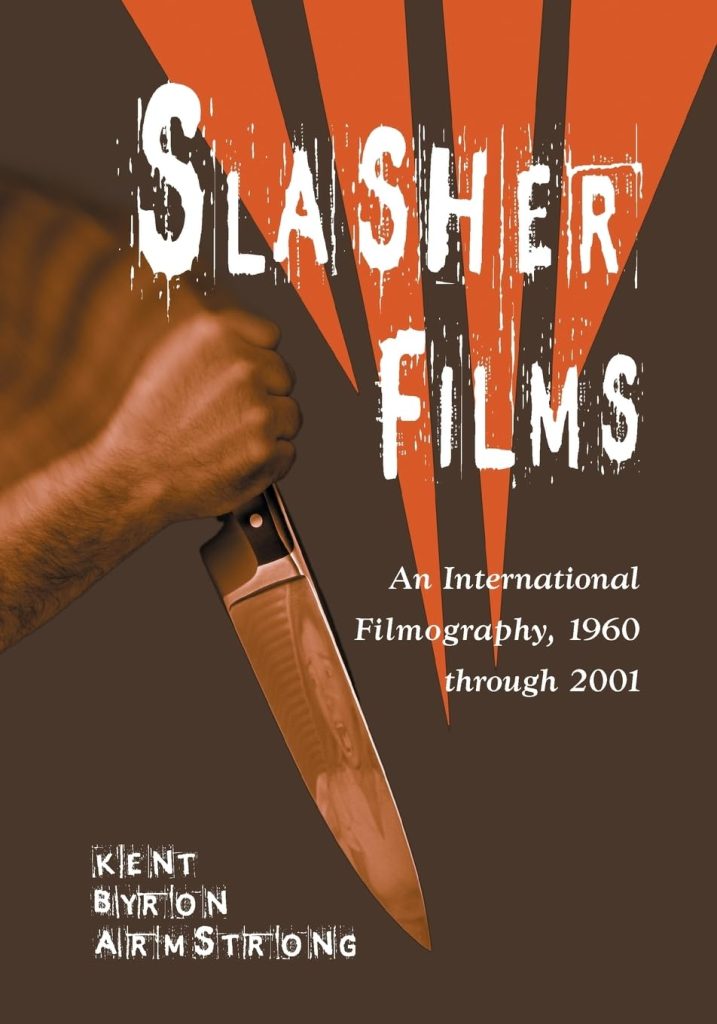
The slasher film genre got its start in the early 1960s with filmmakers such as Alfred Hitchcock Psycho and Michael Powell Peeping Tom making provocative mainstream films, but it is most associated with the late 1970s and the releases of Halloween and Friday the 13th. They have been frightening and thrilling audiences ever since with their bloody scenes and crazed killers.
Over 250 slasher films are presented in this work, each with major cast and production credits, a plot synopsis, and a short critique; interesting production notes are often provided. Some of the films covered include Alice, Sweet Alice, American Psycho, The Burning, Cherry Falls, Curtains, Deep Red, Frenzy, Hide and Go Shriek, Maniac, Prom Night, Scream, Sleepaway Camp, Slumber Party Massacre, and The Texas Chain Saw Massacre.
Filmographies are provided for slasher directors, actors, writers, and composers.
Horror Book Reviews: Ginger Nuts of Horror, Your Premier Horror Website for 17 Years
For every horror enthusiast searching for authoritative horror book reviews and a definitive horror website, your journey ends at Ginger Nuts of Horror. As a trusted pillar of the dark fiction community, we have spent over 17 years building a reputation for the most passionate, insightful, and credible coverage in the genre.
Our dedicated team of reviewers lives and breathes horror. Our collective expertise, forged over nearly two decades, ensures every review is a deep, critical analysis. We don’t just summarise plots; we dissect the terror, explore the thematic depths, and connect you with the very emotional core that makes horror books so compelling.
Why Ginger Nuts of Horror is the #1 Resource for Horror Fans
Unmatched Depth & Legacy in Horror Book
Reviews: With 17 years of reviewing horror, we offer an unparalleled perspective. Our reviews expertly guide you from mainstream bestsellers to under-the-radar indie gems, helping you find your perfect, terrifying read.
Exclusive Access to Horror Authors: Go behind the scenes with in-depth interviews that reveal the minds behind the madness. We connect you with both legendary and emerging horror authors, exploring their inspirations and creative processes.
Award-Nominated Authority & Community: Founded by Jim McLeod, Ginger Nuts of Horror has evolved from a passion project into an award-nominated, essential horror website. We are a global hub for readers who celebrate horror literature in all its forms, from classic ghost stories to the most cutting-edge dark fiction.
Experience the Difference of a Genre-Dedicated Team
What truly sets us apart is our dedicated team of reviewers. Their combined knowledge and authentic enthusiasm ensure that our coverage is both intelligent and infectious. We are committed to pushing the genre forward, consistently highlighting innovative and boundary-pushing work that defines the future of horror.
Ready to dive deeper?
For horror book reviews you can trust, a horror website that champions the genre, and a community that shares your passion, Ginger Nuts of Horror is your ultimate destination. Explore our vast archive today and discover why we’ve been the top choice for horror fans for over 17 years.
[1] Carol J. Clover, Men, Women and Chainsaws, 1992, (New Jersey, Princeton University Press, 2015, pp23-4
[2] Bart Bishop, “The Rare Occurrence of the ‘Final Boy’ in Horror”, 23/10/17, litreactor.com
[3]Slasher Films An International Filmography 1960 through 2001 – Kent Byron Armstrong – reprint (2003 McFarland), P1
[4]Slasher Films, P4
[5]Slasher Films, P11
[6]Slasher Films, P13
[7] Carol J. Clover, Men, Women, P49
[8]Slasher Films, P12
[9] Donato Totaro, “The Final Girl: A few thoughts on feminism and horror”, Offscreen, Vol. 6, Issue 1, Jan 2002
[10] Donato Totaro, “The Final Girl”; Isobel Cristina Pineda, Recreational Terror: Women and the Pleasures of Horror Film viewing, 1977
[11]Slasher films, P14
[12] Bart Bishop, “The Rare”
[13]Slasher Films, P8
[14]Slasher Films, P60
[15]Slasher Films, P256
[16]Slasher Films, P133
[17]Slasher Films, P19