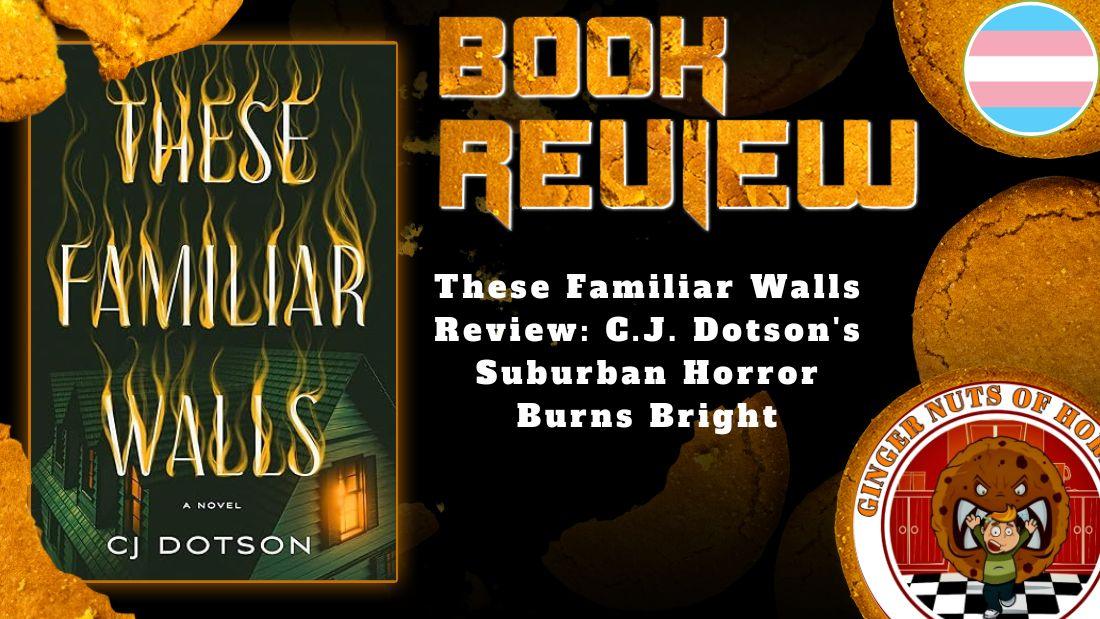
C.J. Dotson torches the haunted house blueprint and builds something fiercer from the ashes. In These Familiar Walls, the past is not content to whisper from the attic; it kicks the door in, demanding an accounting for every buried secret. A suburban horror novel that understands the true terror is not what rattles the mirrors but what refuses to look back.
These Familiar Walls Review: C.J. Dotson’s Suburban Horror Burns Bright
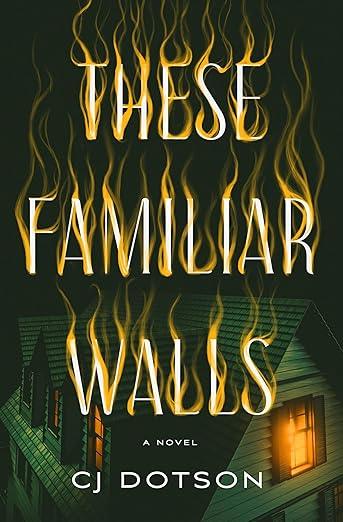
Some books about haunted houses spend their first fifty pages trying to convince you the house is actually haunted. C.J. Dotson’s These Familiar Walls does not bother with that. The house is haunted.
The question is whether it is more haunted than the woman living in it. The opening pages drop you straight into a double murder, masked intruders, a crime scene that will, within months, become a family home again because Amber Walker has nowhere else to go and no money to get there. That hard economic fact, the grinding pragmatism of moving your husband and two kids into the rooms where your parents were killed, is the engine that drives everything that follows. It is not gothic atmosphere that traps this family. It is debt.
This is suburban horror, a sub-genre I have learned to approach with a specific kind of wariness. Too many novels in this corner of the genre treat the cul-de-sac as an ironic backdrop, a place where the lawn is green but the secrets are dark, as if that tension has not been thoroughly mapped since the mid-twentieth century. Dotson does something sharper. She understands that the real horror of suburbia is not what it hides but what it demands: the performance of normalcy, the maintenance of surfaces, the absolute prohibition on discussing what is actually happening. Amber’s motto, delivered early and enforced throughout, is simple. Don’t discuss what’s happening. Ever.
That refusal to name the thing, to look directly at it, becomes the book’s central dread mechanism. Amber avoids mirrors because her reflection will not meet her gaze. She and her husband, Ben, slip into fugue states during which they do things they cannot remember. A menacing voice whispers from the gathering shadows.
The children, Xander and Marigold, begin acting strangely. And through all of this, Amber insists that everything is fine, that stress explains everything, that the family just needs to settle in. The gap between what the reader can see bearing down on this family and what Amber permits herself to acknowledge is where the novel builds its most excruciating tension. I found myself wanting to grab her by the shoulders. That is not a criticism. That is precisely the response Dotson intends.
The structure is a dual timeline, alternating between 1998 and 2020. In 1998, Amber is a desperately lonely preteen who befriends the troubled new boy in the neighbourhood, Nathan Teldegardo, despite every warning sign her family can wave. Nathan has dead eyes, a fascination with fire, and no remorse. He torments mice.
He sets things ablaze. Amber’s younger sister, Hannah, sees through him immediately and tries to warn her. Amber, hungry for any companionship, ignores everything. Their turbulent friendship is brief but creates consequences that reach twenty-two years forward and crash into the present timeline with the force of a fist through drywall. In 2020, Nathan resurfaces to kill Amber’s parents, and is in turn betrayed by his accomplice and killed in the same house.
Dotson has cited Mike Flanagan’s 2013 film Oculus as the biggest influence on this book’s structure, and you can feel that DNA in the way the two timelines begin to bleed into each other. In Oculus, a cursed mirror causes characters to lose track of whether they are in the present or the past. In These Familiar Walls, the house itself performs a similar function. The 1998 chapters are not mere flashbacks providing exposition.
They are an active infection in the 2020 narrative. As the haunting escalates, the boundary between memory and present experience dissolves. Amber’s childhood choices are not backstory. They are co-conspirators in the horror unfolding in real time. The dual-timeline structure has become common enough in horror fiction to risk feeling like a default setting, but here it earns its keep because the novel’s central argument is that the past is never past, that childhood is a room you never actually leave.
C.J. Dotson torches the haunted house blueprint and builds something fiercer from the ashes. In These Familiar Walls, the past is not content to whisper from the attic; it kicks the door in, demanding an accounting for every buried secret. A suburban horror novel that understands the true terror is not what rattles the mirrors but what refuses to look back.
The prose is modern, smooth, and surprisingly tactile. Dotson has aphantasia, a condition she has discussed openly in interviews; she cannot see images in her imagination. This might explain something about how her descriptive language works. She does not paint pictures so much as build sensations. When she writes about mirrors, she is not describing what they show but what they refuse to show, which is a more unsettling approach. The mirror scenes in this book, and there are many, operate through negation. The reflection will not blink. The reflection will not meet Amber’s gaze. The reflection is disturbingly eyeless. These are not images. They are absences. And absence, in horror, is almost always more frightening than presence.
The dialogue is functional rather than flashy, doing its real work in what characters decline to say. Amber’s conversations with Ben are littered with pivots and deflections, the verbal equivalent of not looking at the thing in the corner of the room. The child characters, Xander and Marigold, speak with an authenticity that suggests an author who has spent serious time around elementary schoolers. Dotson has said that their behaviors were drawn from her own two children, and it shows in the small details: the way they interact, the way they notice what adults pretend not to, the way they become barometers for the house’s escalating wrongness.
The chapter construction favours short, propulsive sections that pull you through both timelines at a steady, accumulating pace. Dotson is not afraid to end a chapter on an image that makes you want to put the book down and check the locks, then immediately start the next chapter because you need to know what happens. The 1998 sections build a slow, sick dread rooted in the helplessness of watching a child make terrible choices for comprehensible reasons. The 2020 sections operate more like a pressure cooker, the haunting manifestations growing more aggressive, the family’s denial more brittle, the secrets Amber has buried pushing up through the soil of the narrative like something that refuses to stay dead.
What is this book actually about beneath the plot? It is about the stories families tell themselves to keep functioning. It is about the way childhood loneliness can make you vulnerable to people who recognise that hunger and know exactly how to exploit it. It is about the specific horror of becoming a parent and realising that your own parents were just as lost as you are now, just as capable of catastrophic mistakes.
It is about the terror of inheriting not just a house but everything that happened inside it. Amber moves back into her childhood home because she cannot afford not to. The house, in this reading, is not merely a setting. It is a physical manifestation of generational trauma, a structure whose walls are saturated with every argument, every betrayal, every fire that was set and every fire that was covered up.
The pandemic setting is handled with a light but deliberate touch. Dotson has been clear in interviews that this is not a pandemic novel. No one catches COVID. The virus is hardly mentioned. What the lockdown provides is something more useful to horror: a plausible, contemporary reason for a family to be trapped together in a house they cannot leave, isolated from neighbours, from normalcy, from any outside perspective that might puncture their denial.
There is also something quietly audacious about setting a novel in 2020 without making it about 2020. Dotson has said she wanted to preserve “what it felt like to actually experience that year” because “while the recording of history preserves the facts, it’s fiction that often does the better job of providing the emotional context for the era.” That is a serious ambition for a horror novel, and the book carries it without ever feeling like a period piece or a polemic. The lockdown is simply the weather in which this particular haunting occurs, and the weather, as anyone who lived through that year knows, was strange.
To understand what Dotson is doing in this book, you need to look at her debut. The Cut, published in April 2025 by the same publisher, followed a young widow named Sadie Miles as she fled an abusive relationship and took a housekeeping job at a decrepit Lake Erie hotel. That book was praised for its atmospheric rendering of setting and its nuanced, lived-in portrait of a mother protecting her child under impossible circumstances.
It was also, by multiple accounts, structurally uneven; the supernatural elements felt sketchy, the pacing wobbled in the back half. What struck me reading about that debut was how clearly the talent was visible even when the execution faltered. The atmospheric writing, the interest in economic precarity as a horror condition, the fierce commitment to female protagonists navigating trauma: all of it was there, waiting for the craft to catch up.
These Familiar Walls is the craft catching up. The dual-timeline structure, which might have been unwieldy in less confident hands, is tight and purposeful. The supernatural logic, which reviews of The Cut cited as inconsistent, here feels carefully calibrated; the haunting escalates according to an internal rhythm that holds together. The character work is deeper, particularly in the 1998 timeline, where young Amber’s loneliness is rendered with a specificity that suggests either sharp memory or sharp observation or both.
The prose has not fundamentally changed, it was already good, but it has learned to trust itself. Dotson seems to have figured out that her instincts, for claustrophobic domestic spaces, for the menace in the mundane, for women making terrible decisions for reasons that are entirely legible, are what distinguish her work. She has leaned into those instincts rather than trying to outrun them toward more conventional horror set pieces.
The thematic continuity across both books is instructive. Both feature women trapped by economic circumstance in places that want to consume them. Both use supernatural horror as a language for talking about abuse, survival, and the impossible demands of motherhood under duress. Both are set in Ohio, Dotson’s native territory, and both treat that landscape with the unsentimental clarity of someone who knows it from the inside. These Familiar Walls does not repeat The Cut. It deepens it. The haunted house becomes the logical next location for an author whose subject is the way domestic spaces can turn predatory.
In the current horror landscape, this book sits comfortably alongside the work of writers like T. Kingfisher, Cassandra Khaw, and Catriona Ward, all of whom are name-checked in the publisher’s marketing and all of whom share Dotson’s interest in the uncanny within the ordinary, the domestic as a site of dread. But where Kingfisher often leavens horror with wry humour, and Khaw brings a baroque, almost decadent prose sensibility, and Ward constructs elaborate narrative puzzles, Dotson’s register is something else: direct, emotionally grounded, committed to the reality of her characters’ economic and psychological circumstances even as the supernatural encroaches.
She writes horror the way some writers write literary fiction about difficult families, which is to say she treats the genre machinery as a means of access to emotional truth rather than an end in itself. The haunted house is not the point. The house is a method for examining what people do to each other and what they cannot forgive themselves for having done.
One of the blurbs for this book, from Clay McLeod Chapman, describes it as “further burning testament that the past won’t only just haunt you, it’ll come crashing like a blazing boomerang.” The fire imagery is apt. Fire runs through this novel the way water runs through The Cut. Nathan’s fascination with fire in 1998. The mysterious house fire that killed Amber’s sister Hannah. The “pyrotechnic finale” Publishers Weekly noted in its review.
Fire as destruction. Fire as cleansing. Fire as the one thing that refuses to stay contained. Amber has been running from fires her whole life, literal and metaphorical, and the novel’s final act makes it clear that you cannot outrun a thing you are carrying inside you.
Which brings me back to where I started. The house is haunted. The question is whether it is more haunted than the woman living in it. These Familiar Walls earns its place in the haunted house tradition by understanding that the most terrifying thing about a haunted house is not the ghost. It is the possibility that you deserve to be haunted. That the walls are familiar because the worst thing in them has always been you.
These Familiar Walls by C.J. Dotson
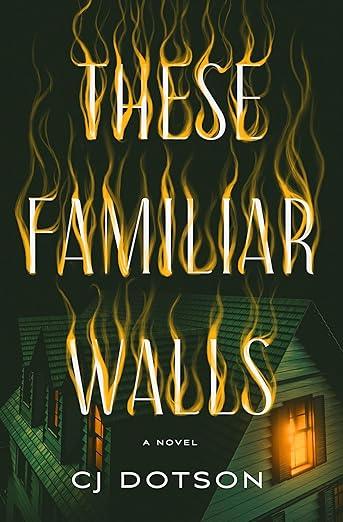
A spine-chilling, heart-pounding suburban horror novel at the heart of the genre, perfect for fans of T. Kingfisher, Cassandra Khaw, and Catriona Ward.
In 1998, desperate loneliness pushes preteen Amber to ignore the misgivings of her family, particularly her younger sister, when she befriends the troubled new kid in the neighborhood–a boy with dead eyes, a fascination with fire, and no remorse.
Their turbulent relationship is brief but creates lasting consequences.Twenty-two years later, in 2020, he resurfaces to kill Amber’s parents, and is in turn betrayed by his accomplice and killed in Amber’s childhood home.After the deaths, Amber inherits the house and, in an effort to save money, moves in with her husband and two children, hoping to reclaim some sense of stability in the grief and chaos surrounding her.
Instead, she finds that the familiar walls are haunted by more than just bitter memories and lockdown stress. She shifts in and out of dreamlike trances, her reflection won’t blink, and a menacing voice whispers to her from the gathering shadows. Although she tried to brush off the strange happenings as stress-fueled hallucinations, Amber is soon forced to admit that something much more real–and more dangerous–haunts her family. But Amber has deadly secrets of her own, and she must resolve these long-buried truths or lose the life she’s contrived for herself.