





“Threads is a rare, rare species of work I admire enormously both in terms of its technical accomplishment and ideological positions, but that I would be happy never to see again, and cannot recommend to others without the most earnest and sincere of caveats.”

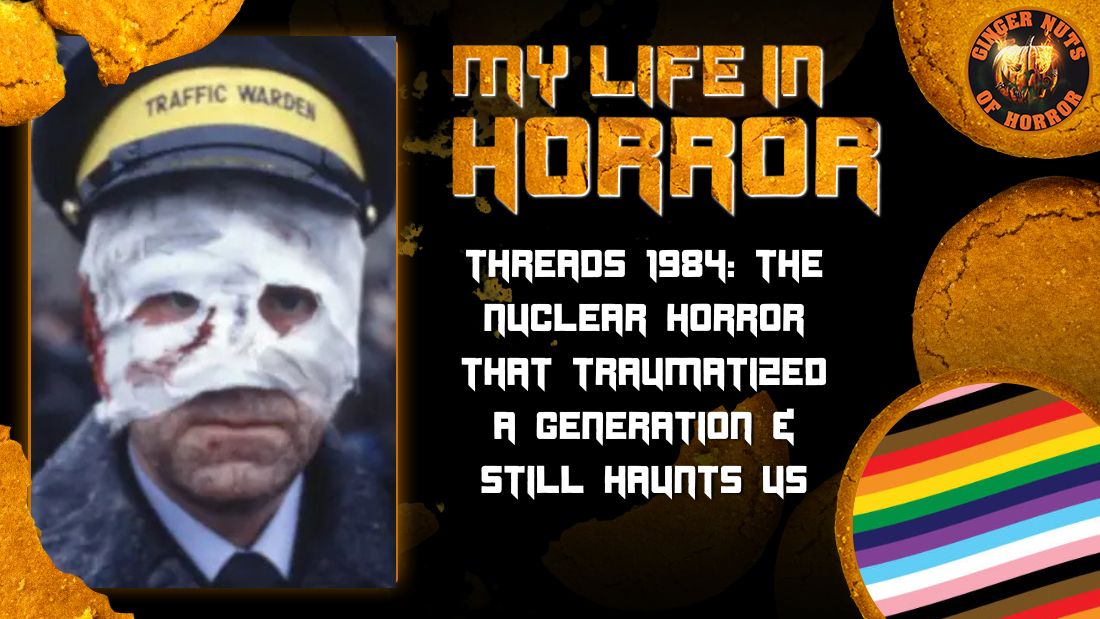
My Life In Horror: Threads 1984: The Nuclear Horror Film That Traumatized a Generation & Still Haunts Us

For the most part, my inclinations run to the fantastical. Owing to the stuff on which I was raised (the formative input discussed elsewhere in this series), I’ve always been engaged and profoundly aroused by subjects regarded as outré, dream-like, uncanny. And, for the most part, that’s the species of subject matter I seek out and create: My tastes, my imagination, are such that they naturally incline in that direction.
However, some of the most profoundly moving, traumatic and impactful work I’ve ever encountered revolves around the opposite: Subjects of such stark realism and rationality, their reflection of the actual becomes a source of horror in and of itself.
Supernatural or fantastical horror serves, by its nature, as a waking nightmare for our cultures; our collective consciousness. It allows for the processing -via metaphor and allegory- of situations and subjects we’re loath to approach in a more direct fashion.
The realist, by contrast, is more of a blunt instrument: A means by which concerns can be directly -and forcibly- expressed, resulting in work of the most incredible -and indelible- power.
1984’s Threads is legendary in this regard: An attempt to explore, via a one-shot TV drama, Cold War concerns of “mutually assured destruction,” the genuine consequences of a nuclear strike against the UK, both in the immediate aftermath and future decades.
The film is infamous in certain circles for the -deliberate- trauma it inflicted on its audience: Viewers of the era were left stunned by its stark desolation, the nihilistic despair with which it depicted the truth of what would become of them, the degradation they’d suffer, should the looming spectre of nuclear annihilation descend. Children of the era recall being shown the film at school and emerging utterly traumatised, politically aware in ways they never could be before. It became a cultural artefact, an example of how bleakly brilliant British film making can be.
Being born in 1984, I wasn’t aware of the film in any meaningful way; my first exposure to it came much, much later in film magazine articles and oblique mentions by other creators (always referencing it in hushed and revenant tones of quiet horror, as something esoteric and forbidden).
That said, I -like many of my generation- was keenly aware of Cold War concerns and paranoia from a young age: Much of our media was saturated with it, either overtly or in terms of subtext. Our toys, our cartoons; almost every aspect of our lives was informed by that fundamental fear to some degree or other. Threats of various types and degrees of apocalypse were commonplace, as were exhortations to us, as children, to somehow solve them.
My first overt and direct engagement with the threat of nuclear annihilation would have undoubtedly been Raymond Briggs’s masterpiece, When The Wind Blows. A work explicitly designed as a plea for nuclear disarmament, the animated adaptation of the original book aired on British TV when I was very young, and was seen by many of us who were arguably, far too young for its subject matter.

Threads is similar both in terms of theme and ethos; it seeks to shock and traumatise its audience in a similar fashion (as a means of rousing action against our looming self-destruction). But, whereas Briggs’s work makes the horror intimate and highly personal, Threads takes a broader, systemic view:
The title of the film itself is somewhat oblique; a metaphor pertaining to the delicate balance of interrelated systems that allow our societies and ecologies to function (represented in the film’s opening by a delicate garden spider’s web). It takes very little to disturb or destabilise those systems, and, according to the film’s thesis, damage to even one thread has potentially disastrous repercussions for the entire structure. Therefore, something as wholly destructive as a nuclear explosion is catastrophic: An event from which said systems cannot recover.
For my part, I knew of Threads by reputation long before I encountered the material myself: Many critics and academics made reference to it as a uniquely traumatic event in British culture, and one that spurred mass anti-nuclear and anti-war sentiment across the country. Those who experienced it directly spoke obliquely -almost reluctantly- of how profoundly it disturbed them.
Yet, for the longest time, it remained an almost-mythic artefact, extremely difficult to view before the advent of streaming services and the wider Internet, a morbid spectre haunting British culture and collective memory.
When I did finally come to view the film for myself, I was prepared to be disappointed. How could anything live up to that profound air of the bleakly forbidden?
To say that it more than lived up to its reputation would be the profoundest understatement. Threads, I discovered, is that rarest species of work: One that is 150% successful, that achieves every intention and criteria it was created in mind with, and then goes even further. And, by that same token, becomes a victim of its own unambiguous success.
Threads is a rare, rare species of work I admire enormously both in terms of its technical accomplishment and ideological positions, but that I would be happy never to see again, and cannot recommend to others without the most earnest and sincere of caveats:
The film has one aim and one aim only: To put up on-screen the consequences of a nuclear attack on the UK; what that would mean on a domestic level, for people and families etc, but also systemically: How the event would impact our weather, our food, our supply chains, our culture, our technology, our ecosystems. Every element is taken into consideration, researched without compunction and rendered without ambiguity.
The film is an exercise in a species of existential terror the like of which largely doesn’t exist anywhere else. This isn’t some fiction in which the threat can be dissipated by some appeal or incantation; some mythic contest or morality play. It is a relentless and unwavering dissection of the self-destructive, idiot, extinctionist evils of our history, of the perpetual and abiding threats whose shadows we’re all born into.
With an unflinching realism that approaches the documentary at times, Threads very simply says: Either we learn from those hereditary evils and stupidities or we destroy ourselves in the cruellest, most pointless and disgraceful ways imaginable. There is no ambiguity here; the film doesn’t do its audience the disservice of providing some contrived solution or potential salvation. It simply puts the consequences of our historical trajectories up on-screen and demands that we see.
Threads stands as among those rare, rare works I would describe as sincerely -and deliberately- traumatic. Trauma is part and parcel of its intention: It has no compunction about being aggressive -arguably violent- towards its audience, as a means of demonstrating the innate horror and violence of the systems they operate in. The point is not to shock or sicken for the sake of it, out of some prurient desire to evoke ephemeral reaction. The point is to forcibly shunt the audience out of complacency and into action (even if it has to actively harm them to do so).
In the film’s thesis, the stakes are simply too high for ambiguity or prevarication: This is humanity rendered down to survivalist essentialism, spurred by the very real and palpable threat of Cold War extinction. It’s difficult to express from a 2025 perspective (or perhaps not so much, given the escalating crises we currently face) just how pervasive and immediate the feeling was that we had reached the end of human history, that any moment we might see that flash on the horizon, hear those sirens signalling the end.

Whilst I came to sentience on the outer-edge of that era, when the threat of nuclear Armageddon had begun to subside in favour of fresh impending apocalypses (climate change, environmental and/or economic collapse, pandemics etc), echoes of that burning spectre still lingered, so ingrained in culture as to have become mythic; part of our collective consciousness. So, while I and my generation might’ve avoided the more immediate culture of impending destruction that preceded us, we still grew up in a world seemingly teetering on the brink, apt to collapse any day into one or more innumerable abysses.
Even as a young child, I recall being so aware of that fragility; the flimsiness of systems and status quos that endlessly insisted on their absolutism. It baffled my -admittedly morbid and depressive- mind that no one else seemed to see what I saw outside of the fiction I devoured, or at least pretended not to. I retain vivid memories of talks with adults -family teachers etc- in which the reaction was to divert or shut down the conversation when it lurched towards the existential.
Later, I would find friends who operated in similar states of morbid obsession, but even now, I look back on that strange, insular child and wonder at how he perceived the world and how clear and conscious his ruminations on it were.
For the most part, outside of my own head, matters disastrous, apocalyptic etc were only ever broached or explored in fiction: The metaphysical fantasy I’d loved since first learning to read often contained mythological catastrophes that upended or unravelled the world -The Chronicles of Narnia, The Silmarillion, The Lord of The Rings– or that at least threatened to. Even the comics, cartoons and toys I enjoyed as a child were narratively and aesthetically informed by those pervasive concerns (The Transformers, for example, involved an alien civil war that migrated to Earth because the mechanical planet, Cybertron, had been so ravaged by war and depleted of natural resources, it stood on the brink of collapse).

It’s little wonder, therefore, that I, along with so many children of my generation, grew up with a fear and fascination for such subjects. Just as we operated in states of near-perpetual dread, many of us also found ourselves perversely fascinated by that imagery and subject matter: Images and phenomena of collapse and decay have always held a strange, macabre romance for me:
In many British towns and cities, old and abandoned districts still exist: Victorian hotels, homes and factories left to moulder, industrial sites that are closed and imperfectly fenced off from the outside world. Many train stations boast approaches surrounded by architectural decay; spaces that look post-apocalyptic, and in their own peculiar ways sincerely are, as markers of by-gone eras and forgotten worlds.
I’ve always found the bleak romance of such sites irresistible: My imagination can’t help but stray into those shadows and make myths or stories out of them. What manner of lost creatures or echoes still inhabit them? What ghosts might be spied or heard wandering their dilapidated halls? There’s a certain hauntological quality to such settings, an unspoken and ill-defined resonance bred in the substance of ruin, as though the lives and events they once hosted linger still, recorded in brick, wood and metal. Not only do they serve, by their very natures, as markers of the past; they also somehow resonate and radiate with it, a quality that certain imaginations are attuned to and which kindles morbid inspiration.
It’s little wonder, then, that the likes of Threads exercises such enduring power and consistent fascination: Beyond its near-documentary qualities (a degree of verisimilitude that is unequalled in its horror), the film indulges a certain perverse tick in its audience, a sublimated and unspoken yearning for the collapse we all secretly anticipate to finally descend and put us out of our collective dread.
That perverse yearning becomes so acutely manifested here, it takes on almost Faustian dimensions: Be careful of what you’re afraid to even admit wishing for. The film speaks to something deeply reluctant within us, maybe even taboo. It touches sublimated depths of apocalyptic desire that find themselves mythologised within our oral and folkloric traditions.
The difference is the nature of that apocalypse: There’s no metaphysics here, no promise or potential of grander conditions or spiritual transcendence. If anything, events within the film put paid to even the idea of such, presenting a squalid, pointless, self-mutilating affair in which humanity and its lunatic systems become the authors of an almost arbitrary self-extinction. The film takes enormous pains to demonstrate there are -and can be- no “winners” here; just a sad, sorry degeneration of all we hold highest and most dear in ourselves, and a condition where life itself is the most arbitrary, fruitless torture.
My original exposure to Threads came in my early twenties, during a rapacious period of media consumption in which all was welcome, and nothing rejected. To say that it made its mark is the most sublime understatement: From all the work I devoured during that period -media ranging from Stephen Volks’s seminal Ghostwatch to Nabakov’s incendiary Lolita-, Threads may be the most powerful and affecting; a rare example of media that’s traumatic to experience (and deliberately so).
Its peculiar activism doesn’t come in the form of deep ideological discussion or exposition; any commentary that occurs within the story itself is pedestrian at best, deriving from casual conversations at family dinner tables or at pub bars. What’s made despairingly clear in these interactions is the distance most ordinary people feel from the event, their fear tempered by an unspoken faith in the same sick and sorry systems that made it inevitable.
The sense of arbitrary abandonment is tangible from the first frame; an abiding sense that we down here, in the dirt, don’t particularly matter. Our deaths, our suffering, are statistical; not matters for detailed consideration or factors in the overall calculations (other than as potential impediments to the safety of our apparent betters).
I recall coming away from the film breathless, heartsick and shaken to my core. All of those sublimated cultural dreads I’d been conditioned with as a child of the 1980s were dredged up, put on gruesome and lurid display. Not the stuff of nightmares; nothing so fanciful or imaginative, so fruitful or inspired. The images and ideas Threads relentlessly bombards its audience with are materialist, cruel, and degraded in a way that defies narrativisation; the brutalities of self-destructive human stupidity at its most bleak and final.

While the early chapters concern themselves with the minutiae of basic existence, providing sketches of family and domestic life, even these demonstrate a particular distance, an almost-documentary level of reality, such that the audience is placed in an unpleasant voyeuristic position that, in itself, feels faintly taboo. We are invited to peek through grimy windows at scraps of “real life” as they occur before us, whatever emotional connection we draw due to their familiarity:
Here are the politics of families and households, of Mothers and daughters, Fathers and Mothers-In-Law laid strikingly bare, rendered without sentiment or distortion.
Meanwhile, a backdrop of grander events unfurls through overheard radio broadcasts, TV news reports and political discussions. Part of the sublime shock and horror of Threads is its balance between awful inevitability and the defensive assumption that nothing so cataclysmic, so utterly without sense or reason, could ever happen.
As such, when it does, when those sirens sound and the radio warnings come, the first reaction is of utter incredulity. In itself, the event is too big, too calamitous to apprehend. We aren’t so made as to understand the ramifications of such profound, idiot evil: We naturally retreat from it, concealing ourselves in narratives woven from denialism and futile attempts to rationalise.
Threads allows for none of that: Even among the annals of similarly apocalyptic projects, it is singularly bereft of pity or any desire to short-change its audience by allowing for delusions of hope, sentiment or potential solutions. No one and nothing is spared the pitiless gaze of its documentary eye: It portrays in lurid detail both the immediate effects of the bomb and all that comes after.
From architectural devastation to people set alight by burning winds, from starvation to the gradual regression of culture and society to pre-feudal states of survivalism, the film demands that its audience see and understand. It is remorseless and unambiguous in that project: The full scale of human-wrought horror, from the personal to the historical, is drawn here without reluctance or consideration for delicate sensibilities (what do such things matter in the face of imminent annihilation?).
When the horror starts, it doesn’t relent. The feverish heights and depths of despair escalate and escalate to a point of abjection that makes a mockery of all human history, any hope or notion of better tomorrows, any Utopian project or vision. We not only destroy ourselves; we destroy and poison goodly portions of the world in the process. Even the meanest existence becomes nearly impossible, given what the explosions do to the land, the air, the climate (and aren’t worth enduring anyway).
Alongside horror and abject despair, the other key emotion the film arouses is fury. Utter, inconsolable fury at the systems that brought us to this brink, into which we were born at the heights of their sickness and over which we’ve never had the slightest power or influence (regardless of what other examples of our media might prescribe).
I recall the taste of that anger very well; the bilious, existential fury at prior generations for allowing this to come to pass, and thinking they had any right whatsoever to bring children into a world so masochistic, a species so unfathomably self-destructive.

I have no doubt that, upon original airing, much of the anger this film deliberately generated was misplaced; directed against the film itself. Given the pervasive, censorious conservatism of the 1980s -manifested most notably in Mary Whitehouse’s crusades and the related “Video Nasty” scare-, media literacy and the ability to parse one’s own emotional reaction to work weren’t exactly at their heights.
I have no doubt Threads earned itself powerful backlash from certain quarters for what it dares to portray and has the temerity to make its audience feel. Misplaced and misdirected anger was undoubtedly a common response, resulting in the work being disowned and largely buried up until recent years, when the BBC finally featured it on the iplayer platform for the first time.
My own immediate reaction was complex and profound, breathless, intense and powerful. I hugely admired the work for daring to go to the places it did, for making statements that little other media of its era had the courage or conviction to. It is profoundly unconcerned with any criticism it might suffer for evoking negative emotions. Such is the purpose of its project; it wants us to feel bad, demands that we engage on the most intimate, traumatic level, feelingevery inch of its pain and degradation as our own (after all, whether we like it or not, it belongs to us; this is the legacy we’ve been handed, the dubious circumstances we’ve been born into).
In that effort, it becomes profoundly activist without breathing a word of standard disarmament rhetoric or directly engaging in direct debate: It simply puts the brute facts of nuclear Armageddon up on-screen and silently begs the question: What are you going to do with this?
Any answers we give will likely prove inadequate defence against the looming spectre that haunts every moment of the film, and every moment of our lives. What are we supposed to say? What words, what abjurations or incantations can move something so sublimely, moronically without purpose, poetry or even a semblance of reason?
Threads isn’t interested in providing pat answers or the illusion of solutions to these factors: It’s intelligent enough to realise that any effort to do so can only dilute its fundamental message. It merely provides its audience with demonstrations of its theoretical scenario. Its ruthlessness in this regard is as close to documentary as fiction can come. It is, for all the world, as though we have opened a window onto that -barely- alternative history and looked out upon the hell-scape that might yet still become our own.
Nor does the film allow us to wallow in standard superstitions: Innocence is no defence here. Animals, children. . .no one and nothing is spared the horror. In point of fact, the only glimmer of bleak hope it provides is the possibility that we may be among the first to die: Those who perish quickly rather than scrabbling for some mean, pointless existence in the ashes after.
And that really is the point: Threads understands that, in the aftermath of nuclear holocaust, there is no after. No world worth maintaining; it is the final, hideous, hollow full-stop at the end of history, the death of every ideology, vision, dream or delusion of humanity. Whatever rude, survivalist waste of life follows will be ineffably tainted, corrupt and degraded, hardly worth the impotent effort to sustain. And Threads has no issues portraying that, either:
In its latter chapters, it leaps forwards a number of years after the event. It shows us how desolate, cruel, degraded and pointless humanity has become; the utter collapse of civilisation, anything but the most rude and impotent attempts at societal project. It thereby underscores how close we were, at the time of broadcast, to destroying history itself; making a mockery of every advancement, evolution and renaissance, every revelation and discovery and fresh understanding.
The despair of that portrayal is tangible, etched into the cells of the film, its nihilistic soul. There is nothing in the years that follow to make continued existence worthwhile; no hope of humanity emerging from the ashes of its own failed experiment, its perverse self-destruction. There is only abasement and abjection, suffering and disgrace, until the point that the last starving, sickly specimen gasps its grateful last.
Among all the various pieces of media I’ve experienced in my life; the stories, documentaries, films and video games, Threads stands starkly apart. It is unique in its unambiguous success; barely anything in existence comes close to its sincerity, its power and its steadfast resolution to not condescend or short-change its audience. In terms of the emotions it evokes, it leaves the viewer feeling as desolate and empty as the radioactive wasteland of its latter chapters. While it doesn’t actively pose the question, it asks by dint of what it dares to portray:
Is this what you want? Is this the fate you want to bring humanity to? Is this the world you want for your children and grandchildren? Because, without action and intervention, it’s the world that will be, and a sad, sorry end to a species that may be unique in all of creation.
More than anything, the film seethes with a cold, subtextual fury at the impotent stupidity of it all: That we could so easily erase all meaning from the world, any trace of ourselves, and do so almost arbitrarily; for no other reason than the systems and trajectories of our diseased histories demand it.
The death of meaning is, in itself, a primary concern of the film; an overt blasphemy to its creators (as it should be to us all). The self-destruction of humanity, our self-reduction to pointless survivalism, undoes our ability to look out at creation, our own existence, and wonder. Meaning dies under such conditions, and may not be found anywhere else in all existence (certainly not in the same state). To murder that, after so many centuries of evolution, human history, is as stark a desecration as any that might be conceived, and should be treated with the same horror that a believer might treat possibilities such as damnation.
From a 2025 perspective, the film operates metaphorically, less immediately than it did in the 1980s, but that robs it of none of its bleak profundity or immense power. If anything, the benefit of hindsight and understanding of how history has developed since makes it all the more stark:
When we look at escalating crises such as climate change, for example, and our societal system’s impotent response to it, we come to understand that the same self-destructive myopia and inclinations still hold sway; that said systems and those who most immediately benefit from them still favour short-sighted personal reward over long-term survival (that we may, in fact, as a species, be unable to keep from annihilating ourselves owing to our inability to comprehend forces of such historical weight).
This is certainly Threads thesis: Our everyday existence, everything we consider banal, humdrum or assume to be absolute, is a fragile miracle dependant on the tenuous integrity of interrelated systems. All it requires is for one seemingly inconsequential thread to fail, and the entire structure faces irrevocable cataclysm. We operate blithely unaware of how close we are to dissolution at any given moment, how close we’ve come to utter annihilation in our own lifetimes.
Threads is a resolute effort to disabuse us of that blindness, a forcible ripping away of blinkered denialism; any narrative that masks, diverts or insists otherwise. Sublimely shorn of sentiment, nostalgia or any and all delusion of hope, it demands that its audience sees, suffers and assimilates all that it has to convey.
In that, it is a rare and precious beast, of a kind that barely occurs once in a generation: Fiction that cares not one wit about its popularity or fiscal success, that has no interest in establishing franchises or sequel-baiting or even becoming the cult classic that it ostensibly has. Rather, it is preoccupied with a single agenda: To elucidate the critical juncture in history humanity stood poised upon at the point of its creation, to provide every-day humanity a window into arguably the worst of all possible futures.
And, in that intention, it is more successful than perhaps any other piece of media I’ve ever encountered. The only thing that eclipses its nihilistic horror is the blinding, nuclear light of its unambiguous brilliance. In the interests of verisimilitude, the film-makers poured research into the project, seeking education on how a nuclear explosion would effect infrastructure, architecture, ecosystems, materials, animal life, vegetation, the human body and more.
Perhaps one of the most starkly horrific elements of the film lies in its lack of dramatics or hyperbole: Little here is exaggerated; the film-makers apply documentarian eyes to the project, its myriad horrors all grounded in bleak reality, research and observation. That, in itself, is a species of message (no horror film in existence comes close to the sheer human abjection and disgrace this portrays, yet there’s nothing here remotely fantastical; everything occurs as it legitimately would in the midst of such an event. Reality thereby becomes the sincerest nightmare, a vision of Hell to shame any that Lucifer might conceive).
Threads is horror of an entirely other species. It is not entertainment, it is not casual, it is not enjoyable or diverting or cathartic. It actively defies all of those qualities in the interests of whetting its message to the keenest, most ruthless edge. This is not a good film to watch. It is despairing, it is disturbing, it is nihilistic and profoundly upsetting. But it’s precisely this that makes it essential. In an age where film has largely been reduced to jangling keys, distraction and pacification, Threads stands as something other; something that promises nothing, that provides no diversion or escape, that actively grinds the ashes of inevitability into its audience’s eyes.

It is as cruel, as pitiless as the world it portrays and passes quiet judgement on. The only spark of redemption the project might be said to boast can be inferred by exactly what it doesn’t say, in its screaming absences (i.e. that we in the waking world, outside of the TV screen, still have time to avert this ultimate catastrophe, that humanity, for all its self-destructive sins, is still a phenomena worth fighting to preserve). Humanity, in the film’s implied purview, may be entirely without precedent or analogue in all creation. We are rare and strange and beautiful, we create meaning and apply it to the universe. In that, we are worth preserving.
Beauty stands in the fragility of all we are and represent, as both the title and the opening image of the spider web imply. Everything we conceive and create, everything we are, is so strange and fragile, it can only be regarded as uniquely and incalculably precious.
That we may have brought ourselves to the point of our own gruelling extinction is a perversity the film can’t abide, that it regards with a contemptuous sorrow, as from the eyes of a disappointed divinity watching events unfold. All that is beautiful is within us, within our stars, our imagined tomorrows, but also all that is base, servile and surrendering. It is that latter which leads us to our collective ruin, the inclination to bow our heads and “just get on with things,” in the British vein.
It’s only by portraying the most execrable depths of our potential ugliness that the film emphasises our beauty and nobility by contrast: The radioactive wasteland of endless want and disgrace it conjures is not inevitable. The film is not a prophecy, nor does it indulge in such fancies; it exists in a world where the ultimate disgrace we might visit on ourselves has yet to occur. Yes, in 1984, we might’ve been poised on the brink of it, but there was still a chance, still opportunity to claw our way back to some stability, maybe even transcend the sins of our history and learn from the last mistake we were about to make.
There’s no rallying cry within the film itself; whilst it does include nuclear disarmament movements in its early chapters, it depicts them with the same despairing distance as those going about their domestic lives. It has little faith in the efficacy of such movements, and ultimately consigns them to the same ash-pile as everyone else.
The evils it identifies are vast, systemic and profound. They require revolutionary transformation, shifts in political assumption and zeitgeist so fundamental, most can’t begin to conceive of them. And yet, by measure of its existence, the film does not surrender to its own despair, nor does it allow its audience that indulgence: It seeks to move by necessity, by presenting the stark choices history has left us with as honestly as possible:
Either we save ourselves or we destroy ourselves. It is that simple.
From a 2025 perspective, that choice is, if anything, even more pronounced (closer as we are to myriad species of catastrophe and/or collapse).
Were the film entirely nihilistic, if it saw no hope for tomorrow, then it wouldn’t exist, nor would it trouble itself to be so powerfully traumatic. It quietly entreats its audience for better; for humanity and our various confections of politics, culture etc to realise the glory in our stars before the despair in them swallows us utterly.
I’m not sure I’ll ever watch Threads again. It is simultaneously one of the most brilliant works of fiction I’ve ever encountered and the most alienating. It doesn’t care if you watch it again, doesn’t care if you take pleasure in it; that is not its intention nor its project.
All it is concerned with is evoking the appropriate responses. Once it has done that, it simply doesn’t care for anything further. It is not attempting to garner viewing figures or box-office success. It doesn’t care if you love it or enthuse over it; it is a singularly purposeful work of art, so enviably clear in its direction, it makes an absolute mockery of practically any other politically active project you might name.
For my part, I find its brilliance uniquely blinding, the emotions it evokes so powerful as to be almost unendurable. It doesn’t just move me; it drags me up by my hair and throat, forcibly turns my eyes to the mushroom cloud on the horizon and demands I play witness.
It’s rare to come across a piece of work like this, something so powerful, so sincere that it wounds, becoming painful to engage with. Even so, it’s an experience I’d never be without; an example of how art and storytelling can, in fact, change the world (even if it does so by traumatising everyone it touches).
George Lea 03-12-2025
Discover the Hidden Depths of Horror with George Daniel Lea
If you’re looking for horror analysis that goes beyond simple scares, George Daniel Lea’s “My Life in Horror” column on Nuts of Horror is essential reading. This isn’t just a review series; it’s a deeply personal and intellectual exploration of how horror shapes our fears, identities, and understanding of the world.
Lea masterfully blends memoir with sharp critique, using classic and contemporary works—from the existential dread of Silent Hill 2 to the cosmic despair of Stephen King’s The Mist—as a lens to examine universal human experiences like grief, love, and societal anxiety. His writing treats horror with the seriousness it deserves, uncovering the profound truths hidden within the genre’s darkest corners.
For any fan seeking to understand not just what terrifies us, but why it matters, “My Life in Horror” offers a uniquely thoughtful and compelling journey. It transforms your appreciation of horror from mere entertainment into a deeper conversation about life itself.


