
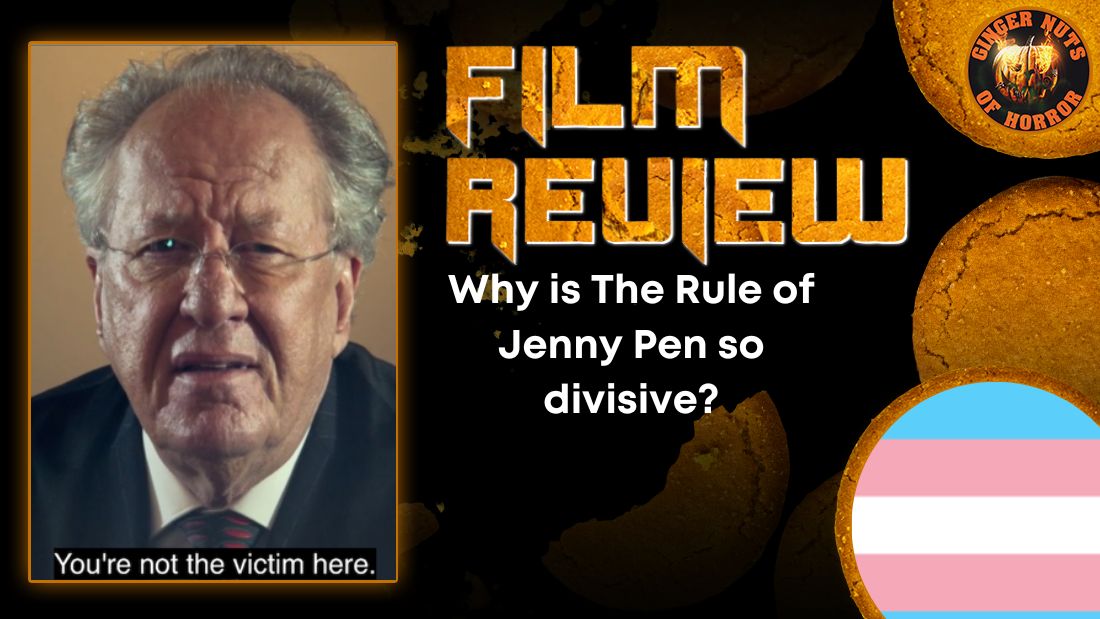

Why is The Rule of Jenny Pen so divisive?
Want to find an interesting watch by looking at review scores? There are two ways. One is to find one of the five-star movies, something that’s either a brilliant masterpiece or at least so much fun that nobody can resist saying nice things about it.
The other is to find a three-star movie, and then look at how its score was calculated.
If everyone gave it three stars, it’s probably one to avoid; that’s a movie so mediocre nobody could even be bothered to get mad at it. But what really puts a sparkle in the film-lover’s eyes is one of those movies where three stars is an average, because almost everyone who watched it either loved it or hated it. One star reviews and five star reviews boiled down to a mid-level score: that’s the ticket.
James Ashcroft’s 2024 chiller The Rule of Jenny Pen shakes out like this on Google:

Rotten Tomatoes shows something even more notable: there’s a split between audiences and critics. It’s one of those movies where the critics like it way more than the average viewer:

Such splits usually mean a film with a very distinctive style, something where fans can accuse haters of ‘not getting it’. But The Rule of Jenny Pen isn’t one of those: it’s a clear story with a beginning, middle and end, and the reasons it’ll grab your attention are not subtle. You can see this if you look at Reddit threads: a lot of ‘I loved it!’ and a lot of ‘I hated it!’, but nobody disagreeing what the film was in any way ‘about.’ So what gives?
Let’s begin with the story.
To go into the real reasons I think it’s so divisive I’m going to have to spoil, but I’ll give a warning once we get there. I’ll also warn now that, from physical to sexual assault, this film does not pull its punches.
We’ll start with the basics: The Rule of Jenny Pen tackles one of those common horrors we prefer not to think about.
To wit, what happens to you when you get old and weak.
Stefan Mortensen (Geoffrey Rush) is an English judge in New Zealand. He’s confident, authoritative, absolutely sure of his opinion – or you could put it another way and say he’s a bit of a prick. We see him begin the story handing down sixteen years to a child molester, and when the children’s mother tearfully thanks him he rounds on her. He doesn’t want her thanks, he tells her coldly: she’s culpable, because she knew what was happening to her children and she didn’t stop it.

Stefan’s doddering a bit as he tells her how ‘deplorable’ she is. He doesn’t seem very well. But he’s confident to the point of didactic.
‘Where there are no lions,’ he says, ‘hyenas rule.’
And he’s quite happy to take on the role of lion. That’s who he is, right?
Then he has a stroke mid-sentence, collapses, and is carted off to a low-end care home because a life of bad investments has left him unable to afford anywhere upscale.
The care home is depressing. All its residents are frail, and most of them are in some degree of cognitive decline. Its staff are what you’d expect in such a place: not actively abusive, and they’ll make sure you’re clean and fed, but they haven’t the time or the interest to treat you the way you’re used to being treated. Whoever you were, you’re here now, which means you’re basically a child as far as they’re concerned.

It isn’t even malice on their part. It’s routine. This is just how the world works for them, and they’re the ones in charge of your world now.
Stefan is encountering, for the first time in his life perhaps, people who don’t really listen to what he has to say, and scold him as a troublemaker if he reacts by saying it louder.
That’s the first horror of the film, and we spend a while with it before getting to anything more dramatic.
Stefan has been a powerful man: he’s educated, a successful professional, white, male. All of a sudden his body did what bodies do, which is fail, and it landed him in his first ever underclass. He’s disabled. He depends on an electric wheelchair to get around, and on the care of people who don’t have to listen to him if they don’t feel like it.
He doesn’t intend to stay like this. He’s going to get better and go home. He’s not like the rest of the people in this place: they’re all senile or silent. Submissive.
Beaten.

Enter the second dramatic powerhouse of the movie.
Geoffrey Rush’s performance is as good as you’d expect, but if you know anything about John Lithgow, your heart will sink for Stefan knowing he’s in this film too. From Raising Cain to Dexter, Lithgow is an actor with a speciality – not his whole range, but an archetype he made his own, and it’s the last man you want to be trapped in a care home with.
Lithgow is the reigning champion of playing the quiet, harmless-seeming nerd who’s a terrifying monster underneath.

If you ask the staff they’ll say that Dave Crealy’s in cognitive decline and doesn’t know what’s going on. He uses a therapeutic puppet he calls Jenny Pen, waving her hand at them like he’s a child.
That’s not what the residents would say. But nobody listens to the residents.

Crealy’s malice is subtle at first. He eats disgustingly, putting Stefan off his food. He roars with laughter at the TV, distracting Stefan from his physical therapy.
Then we see what else he does to people.
We don’t think much about elder abuse if it isn’t under our noses, happening to us or to someone we love. Violence seems to belong to the young, the impulsive, those with a whole life of fighting still before them.
But here’s the thing about aged bodies: they’re terribly easy to hurt.
Crealy isn’t the man he once was, no doubt about it. But he’s more able than his victims. He can walk unassisted; his mind is unimpaired. That’s all that matters. You don’t have to be very strong to hurt someone with arthritis. Or a catheter. You don’t have to be all that virile to sexually assault an immobile woman.
Yeah, once this movie gets going it’s really hard to watch.

‘Who rules?’ Crealy demands of Stefan’s roommate. Tony Garfield (George Henare) used to be a star rugby player; he was strong, famous, manly.
‘Jenny Pen,’ Tony quavers. And then Crealy turns his wrist to Tony’s mouth so that Tony can lick Jenny’s arse.
Look, I’m sorry to tell you that, but if you can’t stomach that kind of happening, then A. I don’t blame you, and B. This is not the movie for you. Be warned. This is not Netflix’s Man On The Inside with a horror twist. It’s not a dark comedy. It’s just dark.
What is Jenny Pen?
There’s an answer I’ll give later, after we get to the spoilers. But here’s what we can see right away: she serves a dual function. To the staff, she’s cover; Crealy carries around this cute little puppet and acts as harmless as a toddler. Who could believe such a man was a bully? Abusers need an acceptable public face, and Jenny Pen gives him a literal one.
And to his victims? Well, she’s like a wheelchair or a grabber stick. He’s not physically up to climbing on top of you and getting in your face – but he can still make Jenny Pen do it. The puppet isn’t real, but the humiliation is.
Jenny Pen is a disability aid for abuse.

Without Crealy, this would be life at a crappy care home. But with Crealy, it becomes obvious what’s really happened to all these poor people.
They’re in a prison.
Once it became apparent where this movie was going I had a private conviction: my only purpose was to watch Dave Crealy get all the way killed. Absolutely murdered to death. There was no other way to make what I was seeing tolerable.
Does he? Well . . . spoilers past this point.
This is a film that teases us with genre. Stefan’s roommate Tony makes an early attempt at friendship by chatting about how his daughter gave him a Tom Clancy book for Father’s Day. We can see how happy this gesture of love makes him; his deepest reason for not reporting the abuse, in fact, is that his grandchildren look up to him and he can’t bear the thought of their pity. So he chats a bit about how he’s not much of a reader but he enjoyed what a ‘real ripper of a yarn’ it was.
Stefan doesn’t have children or grandchildren. He dismisses the conversation: ‘All those books,’ he says, ‘are about the same thing.’

And you might think that was setting up for a yarn in this film. We have the makings of a kind of Tom Clancy morality. There’s a purely evil bad guy, for starters. There’s also Stefan’s conviction that there are lions and there are hyenas – that good people must exert power to stop the bad people hurting the weak people. That’s very Clancy.
If this was an American film, that’s what it would be. There’s a clear way for the story to go: the tale of a man who by his own account is ‘prideful’, with all the good and bad qualities that go with that. In his old age his ferocity gets a last hurrah, pitted against someone who truly deserves his contempt, and then, having vanquished this hyena, he lives out his last few years having discovered to love those he saved, softened by time and compassion and finally taking the last chance to be the best version of himself. Never too late to make things right. There’s always hope.
But we’re in New Zealand, bitches.
Honestly I’m fairly ignorant about Kiwi culture and my attempts on social media didn’t get me much information. But I know there’s no Hollywood endings here in this care home.
Stefan lambasts his fellow-prisoners for their cowardice the way he lambasted the ‘culpable’ mother of the children whose abuser he sentenced: he sees himself as a lion, and the others as . . . well, he doesn’t have an animal term for them. His natural history isn’t very strong.
Much later in the story, we see him sat before a nature documentary. ‘Contra to their reputation as lowly scavengers,’ murmurs the narrator, ‘hyenas are in fact consummate predators.’

In the real world lions don’t rule hyenas. Stefan didn’t want to be treated like a child, but his understanding of predation hadn’t progressed much beyond The Lion King. And he’s nobody’s king any more.
Stefan thought he could stand his ground. But now he can’t stand.
The stroke he suffered was only the first of many. Stefan didn’t have a little turn that he’s going to shake off and get back to work. Stefan is dying. And he’s going to die here.
Crealy, meanwhile, knows this place inside out. He used to work here; he has a secret pass key that lets him creep around. His whole life has been fairly menial; by his own account he lacked ‘the will, the brains . . . the luck’ to get much out of it. He even tells a little anecdote about how once, decades ago, he was mopping floors and saw Stefan holding the crowd from a podium at an award ceremony. Once, in Stefan’s glory days, Crealy was nobody in particular.
But now he has power over people. Not many, and not strong opponents, but he doesn’t care about that. We make what we can of our lives, and he’s going to finish his indulging his bitterness and sadism for all he’s worth.

And the sheer hard fact of old age isn’t to be vanquished just because it’s not fair. It’s doing at least as much to Stefan as Crealy can.
Two-thirds in, we see a possible Hollywood ending.
Stefan’s physically weaker than Crealy, but he’s smart and driven, right? There must be a way to outwit the bastard. Hoist him with his own petard, even.
Well, there is. For a moment.
Remember when I asked what Jenny Pen is? Well, among other things she’s named after a music-hall singer called Jenny Pencarrow. Don’t worry if you missed it, she’s fictional; the credits identify the voice as Janet Roddick. But she sings a famous old pub song, ‘Knees Up Mother Brown’, which Crealy puts on and dances to in front of his victims.

Jenny Pencarrow’s song is another of his mental tortures. Any staff would assume he’s just a nostalgic old buffer cutting a caper. To his victims, though, Crealy’s dance is a threat display: You’re all stuck in wheelchairs, but look how strong I still am. Just think what I can do to you.
He’s mobile. He’s compos mentis. He only has one weakness: asthma.
When he has an attack while dancing he isn’t worried – until he finds that Stefan has deliberately emptied out every canister in every inhaler he has.
If this was a comforting movie that’d be the climax.
It’s very neat: brain defeats brawn, good defeats evil. And for just a brief moment it looks like that might be the story we’re in.

We see the common room: it’s full, and there’s no fear. Sure, many of the people in there are a bit confused, but they’re relaxed, cheerful, there’s the sounds of quiet laughter from all directions. Stefan sits contentedly next to his roommate Tony; at first he resented having to share with him, assuming that a former rugby player must be a tiresome meathead.
For certain Tony’s no intellectual like him. But they’ve gone through some shit together, and they’ve won out. Stefan’s at peace with himself, and maybe he and his lovely new mate can enjoy a few years of quiet comfort together before a final, gentle end. Maybe there’s worse things than just being with people treating each other well.
But the monster returns. Crealy survived.
What did you expect? This isn’t a slasher villain rising from the ground; it’s just sheer dumb chance. We began this film watching a man survive a stroke; why shouldn’t another man survive asthma?
Death comes at nobody’s convenience.
And worse is to come. Just as Crealy makes his next attack, a truly horrible one, Stefan has another stroke. This one paralyses half of his body.
And after that he doesn’t have the fight any more. He used to scorn the weaklings who didn’t challenge the hyenas, but now he’s as weak as they are.

All Tom Clancy stories may be about the same thing, but this isn’t a Tom Clancy story. It isn’t The Lion King. This is what happens when your body can no longer second your will.
Which is where the division comes in. Essentially it’s one of genre.
There are two stories happening at the same time, and they’re stories for different kinds of viewer. There’s the tale of the monstrous Dave Crealy who needs to get what’s coming to him for the balance of the universe to be restored. It’s a genre story, a story for horrorheads and thriller lovers. The movie really makes you want it.
Then there’s the literary story.

The Rule of Jenny Pen is based on a short story by Owen Marshall, winner of the New Zealand Order of Merit and a Prime Minister’s Award for Literary Achievement. The story that inspired the film isn’t available online but you can read some other samples of his work here: http://www.owenmarshall.net.nz/bookshelf/sample_stories/. In an interview Marshall observed:
Life is precarious, happiness is fragile, triumph and disaster are only a random incident apart . . . I’m interested in the clash of expectation with reality, the manner in which people cope with disappointment and diminished opportunity. For a writer, failure is often more fascinating than success.
https://www.anzliterature.com/feature/interview-owen-marshall
Marshall gives this as a reason to ‘savour what is fine and good’, but he also notes in the same interview that he’s a supporter of voluntary euthanasia. He’s highly aware that there may be a time when the fragility is all that’s left.
Does Stefan conquer Crealy in the end?
Well, yes. But it’s not a satisfying clash. He and Tony have to work together, and there’s no point trying to be clever about it: they drag Crealy into a side room and smother him to death, and as they fight they gasp and sob and struggle as much against their own bodies as Crealy’s.
It was a desperate act that had to be done. But there’s no triumph afterwards; they’re just tearful and spent and utterly exhausted.

Make no mistake, this is a movie of themes.
You don’t throw in meta-textual references and name puppets after singers and keep referring back to lions without having a story to tell in the subtext as well as the text. So where does the theme take us?
Final scene. The surviving inmates are in the common room. With Crealy gone it’s once again a kindly, peaceful place; Stefan is playing backgammon with another man we haven’t seen before, and the two of them quietly enjoy each others’ company.
Then this happens.

Soon after his arrival another inmate warned Stefan to watch out for the house pet, a beautiful little tortoiseshell cat. It knows, he’s told, who’ll be next to die; that’s who it goes up to.
Stefan sits playing backgammon, and the harbinger comes and sits at his feet. He may have won, but he can’t beat his body. He won’t have long to enjoy the peace he fought for.
An announcement rings out. A blind inmate has a watch that announces the time; others have even joked that it’s a bit pointless to know the time in a place like this. So here’s what we hear:
A mechanical voice recites, ‘The time is . . .’
‘MISERY!’
Boom. Smash-cut to credits, and the soundtrack turns up what was the background song in the care home: ‘Misery Misery Misery’ by Jimmy Gilmer.
This is an aggressive ending if ever there was one. After all that: the time is misery. That’s what it’s always been here.
Who is Jenny Pen?
Do you know the lyrics of ‘Knees Up Mother Brown’? The fictional Jenny Pencarrow sings them as Crealy dances:
I’ve just been to a dingdong down dear old Brixton way
Old Mother Brown the Pearly Queen’s a hundred years today
Oh what a celebration, a proper la-di-da
Until they rolled the carpet up and shouted, ‘Now then Ma!
Knees up Mother Brown, knees up Mother Brown . . .
But the voice that sings is young.
Jenny Pencarrow didn’t know what Jenny Pen does: that by the time you’re a hundred years old – far sooner than that – you can no longer get your knees up.
And that means that someone who can might do anything to you – and even if you survive them, you won’t survive for ever.

There are two monsters in this film. There’s Dave Crealy, and there’s reality. One or other of them will get you in the end.
It’s easy really to see why this film gets such a mixed response.
From one angle, it’s one of the meanest tricks I’ve ever seen a horror movie pull. It puts you through so much, using the kind of grim nastiness that usually only this genre even attempts to get away with – and at the end it smacks you with this bleak conclusion. I respect it as a film, but I’m never going to re-watch it.
‘What a rotten song!’ the chorus of ‘Knees Up Mother Brown’ goes. And yeah; it’s a rotten song. It’s a rotten trick to play on the viewer.
But it’s not a dirty trick. You can’t say anything in it was a surprise. The final monster, the death the cat foretells, may come in to upstage Dave Crealy – but it wasn’t as if we weren’t told right from the beginning that Stefan Mortensen was an elderly man in failing health.
More than that – did the film have to tell us that we all die in the end?
That was knowledge we brought in with us . . . but generally it’s knowledge we prefer to ignore. One of the reasons we enjoy horror films is that that many of them are an escape from death; it brushes us close and then passes us by. The film simply refuses, right up in our face, to let a dramatic storyline lead us away from the thought that one day it won’t. That would be a genre trick; literary fiction likes to meditate on uncomfortable subjects.
It’s a horror story and it’s a literary story. It’s both separately. This isn’t ‘elevated horror’, it’s two kinds of tale at war with each other, and whichever wins we’re all going to lose in the end.
How much you like it may have a lot to do with your genre preferences; I certainly can’t recommend it to anyone who wants to come out of the movie with a smile on their face.
But that said, would it have been so memorable if it had been comforting?
I don’t think so. And by making the ending so miserable – literally blaring ‘Misery!’ right at us – it reminds us of what it’s been saying all along, which is that over a certain age, people become vulnerable, painful, easy to hurt. The Rule of Jenny Pen is fictional, but elder abuse certainly isn’t. Nor are shitty care homes.

It’s like a slap in the face: don’t be at ease with what’s done to people just because they’re older than you. Things can be ‘fine and good’ even if you’re dying; even just a quiet game of backgammon with a man who doesn’t hurt you matters. We don’t want to see these things taken from Stefan.
Which means we care about him, haughty old prick that he was, and we care about every last moment he’s going to get. And if it took a ‘ripper of a yarn’ to get our attention on that point, and then a cruel ending that makes us hurt alongside him – well, it’s a point that needed making whether we like it or not. It’s a rotten song, but it doesn’t ring false.
Horror Movie Reviews on Ginger Nuts of Horror
Horror movie fans looking to deepen their appreciation for the genre should definitely check out the Horror Movie Review section of Ginger Nuts of Horror. This platform is a treasure trove of insights, critiques, and discussions that resonate with both casual viewers and dedicated aficionados alike.
Firstly, the reviews are penned by passionate writers who understand the intricacies of horror filmmaking. They delve deep into the elements that make each film unique, from unsettling visuals to compelling sound design, offering a comprehensive analysis that goes beyond superficial impressions. Such in-depth reviews can enhance viewers’ understanding and appreciation of the genre, revealing layers of meaning and intention that may go unnoticed during a first watch.
Lastly, with its focus on both mainstream and indie films, the Horror Movie Review section is an excellent resource to stay updated on upcoming releases and trends in the horror landscape. For any horror buff, exploring The Ginger Nuts of Horror Review Website is an essential step toward a deeper connection with the genre.