
Robert Rankin called it a trilogy. He wrote nine books. He was right to do both

Robert Rankin’s Brentford is a strange place. On the surface, it’s a quiet West London suburb. Below that surface, it’s a cosmic battlefield where aliens land, popes return from the dead, and the end of the world is just another inconvenience for the locals. For over forty years, Rankin has chronicled this chaos in a series of books known collectively as The Brentford Trilogy.
The joke, of course, is that there are nine of them. This is a fact. Well known to those who know it well.
This humorous science fiction series, a cornerstone of British comedy fantasy, and, if Rankin himself is to be believed, the cornerstone of an entirely new literary genre called Far-Fetched Fiction, which he invented in the hope that WH Smith would give him his own shelf¹ , follows the “heroic” layabouts Jim Pooley and John Omally. Their adventures, fueled by copious amounts of beer at The Flying Swan, form the backbone of a body of work that defies easy categorisation. It’s time to pull up a stool and re-read the whole glorious, messy, far-fetched lot.
You have to admire a writer who looks at a perfectly good numeric concept like a trilogy and just laughs in its face. A trilogy, by the laws of both God and man, is three. It’s in the name. Tri. Three. Even a child knows this, and most children are not particularly clever, as any parent will tell you, especially in Penge, where they understand these things differently.
But Robert Rankin, the self-styled Father of Far-Fetched Fiction, took one look at that rule and decided to build a lovely, sprawling council estate of books right on top of it. The Brentford Trilogy isn’t three books. It’s nine. And counting. And even then, the characters keep popping up in other novels like annoying neighbours who’ve run out of sugar and have developed a theory about crop circles.
I’ve just spent a frankly concerning amount of time re-reading the whole lot, due to the transperambulation of pseudocosmic antimatter, or else because of a tradition, or an old charter, or something, and my grip on reality feels a little looser. Which, I suspect, is entirely the point.
Plonking yourself down to read these books is a specific kind of commitment. It’s like agreeing to listen to a brilliant, slightly sozzled old bloke in the corner of a pub. He’s going to go off on tangents. He’s going to repeat himself. He’s going to repeat himself. Some of his jokes will be the funniest things you’ve ever heard. A couple might make you wince and check the date. But you stay, because the story he’s telling, about a Borgia pope, alien golfers, a sentient bicycle, and the very fabric of reality unravelling because of a dodgy bar code, is unlike anything you’ll hear anywhere else. Certainly not in Penge. Although I understand it’s a very nice place.
The Brentford Trilogy (All 9 of Them): A Resplendent Robert Rankin Retrospective
If you fancy reading any of these books, which you really should, then just click on the book covers
1. The Antipope (1981)
Proof that the best defence against the forces of darkness is a full pint glass and no fixed employment.
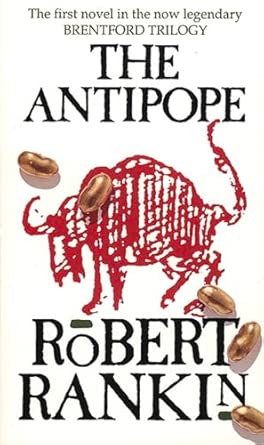
Robert Rankin’s debut novel, The Antipope, launched the Brentford Trilogy in 1981 with a spectacularly unhinged bang. Set in the real West London suburb of Brentford, this comic fantasy novel follows two magnificently workshy layabouts, Jim Pooley and John Omally, as they stumble into a battle against the resurrected Pope Alexander VI, the last of the Borgias. Part occult thriller, part pub crawl, the book blends Far Fetched Fiction with a uniquely British sensibility. For readers of Douglas Adams or Terry Pratchett who want something rougher around the edges and considerably more interested in pints of Large, this is your starting point.
The one where it all starts. And where it starts is in The Flying Swan, with Jim Pooley, a man so spectacularly unemployed that he views finding a job as a personal failure of imagination. He’s sitting with his Irish partner in crime, John Omally, a man who combines a philosophical bent with a genius for never paying for his own pint. Omally is, it should be said, a master of Dimac, the deadliest martial art known to man. He’s never used it. He lives in hope.²
They are the heart of Brentford. They are also, apparently, the only ones who can stop the resurrection of the rather unpleasant Pope Alexander VI, the last of the Borgias, who has set up shop in a local chair factory. This is not, all things considered, an obvious choice of premises for a returned pontiff. But then, none of this was going to be obvious. If it were obvious, someone else would have written it. And they didn’t. They were probably in Penge.
Reading this first one now is like watching a band play their early gigs before they figured out how to properly use a synthesiser. It’s raw. It’s got all the pieces. The ghost of Edgar Allan Poe floats about in a manner that the ghost of Edgar Allan Poe would almost certainly not approve of. Professor Slocombe, the ancient magician who looks uncannily like Peter Cushing and dispenses cryptic wisdom in a way that suggests he has a great deal more of it and is rationing carefully, holds court.
Norman Hartnell, the shopkeeper-inventor (not that Norman Hartnell, obviously; that Norman Hartnell was a dress designer to the Queen and presumably had less cause to build a bicycle-powered dimensional gateway), builds bizarre gadgets in the back of his shop for reasons that are never entirely satisfactorily explained, which is, in fairness, also true of most gadgets.
The prose is like a comfortable old armchair. Not flashy. But you know exactly how it’s going to hold you, and you sink into it willingly. Rankin plants his flag firmly in the soil of suburban surrealism. A small flag. But a very good one.
2. The Brentford Triangle (1982)
The fifth planet exploded. Its survivors want ours. Pooley and Omally are on it, once they have finished their pints.
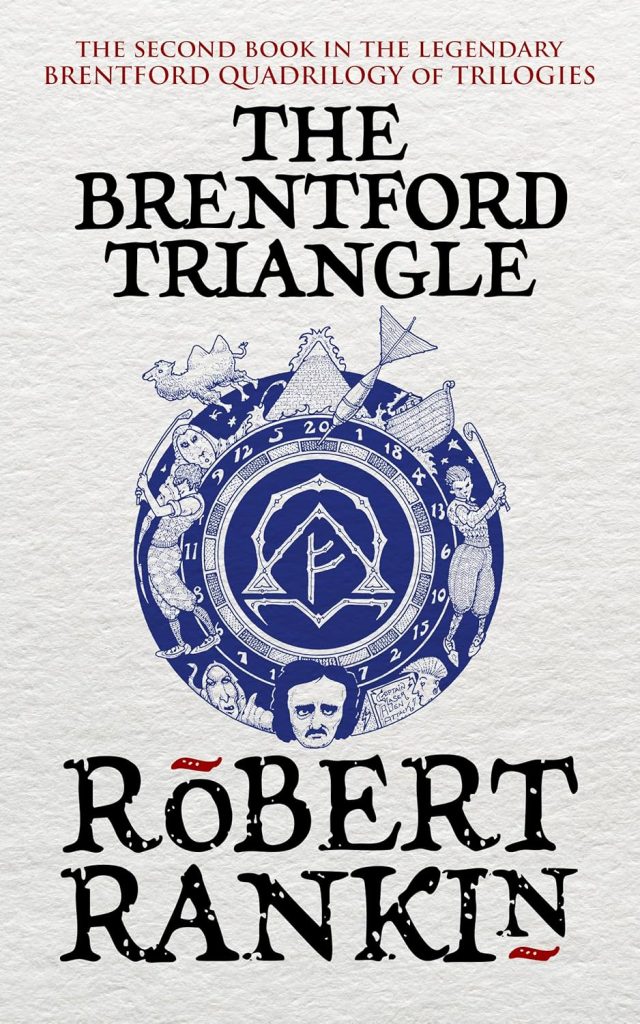
The Brentford Triangle, Robert Rankin’s 1982 follow-up to The Antipope, escalates the stakes considerably. Where the debut involved a resurrected Borgia pope, book two delivers a full alien invasion, courtesy of the former inhabitants of Ceres, the planet that once occupied the fifth position in our solar system before it inconveniently exploded into the asteroid belt. Jim Pooley and John Omally, still magnificently unemployed, are once again Brentford’s best and only line of defence. The comedy is sharper here, the mythology more fully realised, and Rankin’s distinctive voice considerably more confident. This is where the Brentford Trilogy truly locks in.
Right. We’ve dealt with an undead pope. Time for aliens.
The natives of the exploded planet Ceres are looking for a new home, and wouldn’t you know it, they’ve set their sights on Brentford. The title is a gift. It sounds like a paranoid cold-war thriller, but instead of missile silos, the three points of the triangle are the allotments, the gasworks, and the library. This is, if you think about it, probably a more accurate map of genuine local power than the cold-war version, and I think we should all sit with that for a moment.³
This book sees Rankin stretching his legs considerably. The plot is sillier, the stakes are technically higher (the whole planet, not just one pub, though you sense the pub is the real concern), and the humour is more confident. The image of alien spacecraft deploying laser-operated gravitational beams to play a cosmic game of golf on Pooley’s allotment is peak Rankin. The man takes the mundane and inflates it to universal proportions without ever losing sight of the fact that his heroes would rather be watching the darts. It’s this anchoring in the gloriously parochial that sells the cosmic insanity. That and the beer.
Rankin’s prose in The Brentford Triangle has the quality of a perfectly calibrated clockwork toy: you can see the mechanisms, you understand in a general sense what is going to happen, and you watch it happen with delight anyway. Where Adams was interested in the existential vertigo of an indifferent universe, Rankin is interested in the specific human, or specifically Brentfordian, refusal to be particularly impressed by that universe. His heroes are not inspired by the scale of what confronts them. They are mildly put out.
The Brentford Triangle is the book where Rankin stops being promising and becomes himself. Read it immediately, preferably with a pint on the table.
3. East of Ealing (1984)
Corporate evil is just regular evil with better stationery. Fortunately, Sherlock Holmes drinks.
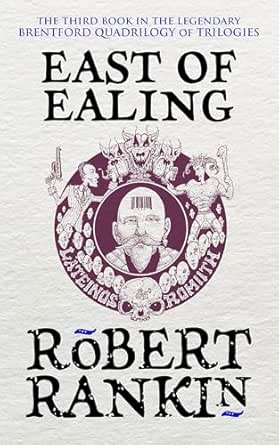
East of Ealing, the third book in Robert Rankin’s Brentford Trilogy published in 1984, delivers what might be the series’ most prescient premise: a satanic corporate entity planning world domination through barcoding the entire human population. The prophecies of the Book of Revelation are being fulfilled, and they appear to be happening in a gleaming office building that has risen ominously over Brentford’s bombsite land. Jim Pooley and John Omally receive assistance from a temporally displaced Sherlock Holmes, and Professor Slocombe provides his usual combination of ancient wisdom and unsettling calm. This is Far Fetched Fiction firing on all cylinders.
Satan. Via barcodes. And time-travelling Sherlock Holmes.
If the first book was the setup and the second was the expansion, this is the full-blown psychedelic episode where someone has clearly left the back door of metaphysics unlocked. The Great Omnibus of All Knowledge, a sinister supercomputer with ambitions well above its station, plans to enslave humanity by tagging everyone with a barcode. It’s 1984, and Rankin looks at creeping consumerism and the beep of the checkout and thinks: yep, that’s the devil’s work. He is, as events in any supermarket queue will confirm, not entirely wrong.
This is where Rankin’s particular brand of paranoia really takes hold the feeling that everything is connected, that nothing is as it seems, that the council is definitely in on it, and that the bloke at the end of the bar knows far more than he’s letting on. He’s been to Penge. He’s seen things.
The plot is a beautiful mess. It doesn’t always make perfect sense, but it barrels along with such manic energy that you don’t care. You’re just along for the ride, clinging to the roof of the car as it careens through metaphysical dimensions and ends with humanity apparently getting destroyed. A small detail. I’m sure it’ll be fine.
As Rankin grows from his debut, East of Ealing shows the most significant structural improvement of the first three books. The plotting is tighter, the comedy more precisely calibrated, the running gags arriving with the confidence of things that know they have earned their place. The jokes about Norman Hartnell not being the fashion designer have reached their mature form. Old Pete’s absolute immobility at the bar has become a philosophical position.
The Book of Revelation as plot structure is not original. But Rankin’s version makes the apocalypse feel like something that could happen on a Tuesday in West London, inconveniencing bus routes and requiring Neville to put a sign on the door. The mundanity is the joke and also, somehow, the reassurance.
East of Ealing proves that the end of civilisation, properly handled, is less terrifying than the end of the pint. Rankin handles both with equal gravity.
4. The Sprouts of Wrath (1988)
The Olympics came to Brentford. The forces of darkness came with them. Pooley got a job. Everyone suffered.
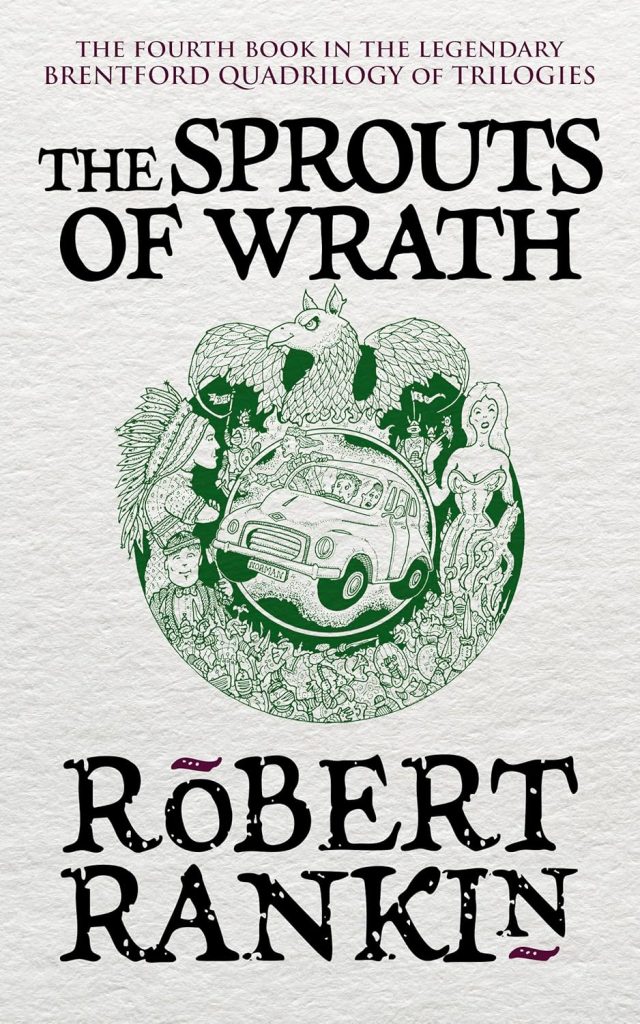
The Sprouts of Wrath, fourth entry in Robert Rankin’s Brentford Trilogy published in 1988, brings the Olympic Games to the most improbable borough in West London. Following Birmingham’s last-minute cancellation, a mysterious benefactor arranges for Brentford to host the world’s greatest sporting spectacle, complete with a pentagram-shaped stadium of anti-gravitational material suspended above the town’s rooftops. Jim Pooley and John Omally face their most terrifying challenge yet: regular employment. The comedy remains sharp and the mythology deepens, even if this fourth outing shows the first signs of formula settling comfortably around the series’ edges.
After a four-year break, Rankin returns and he’s brought sprouts.
The Olympic Committee, in a fit of madness only possible in this or possibly one other universe, decides to hold the next Games in Brentford. Cue stadium construction, land development, and, of course, an ancient evil entity called Kaleton that plans to use the new stadium to transform into a giant monster and destroy humanity. Again. Kaleton should really consider diversifying.
This feels like the first true sequel in the sense that the world is now fully formed and Rankin knows exactly where all the furniture is, even the furniture that shouldn’t, by any physical law, be where it is. The characters are all present and correct: Old Pete and his dog Chips, Soap Distant (who has been down in the Hollow Earth and has opinions about it), and the magnificently unpleasant vindictive dwarf postman, Small Dave, a man so committed to the wrong side of every argument that he could start a fight with his own reflection and win.
The humour is broader, more confident. The running gags are now fully embedded in the series’ DNA. You’re no longer reading a book about Brentford; you’re visiting an old haunt. One that will, statistically, shortly be destroyed by something cosmic and unprecedented.
There is genuine invention here that the previous books had not managed: the reincarnated American Indian chiefs on the town council are an inspired addition, town councillors deploying indigenous wisdom in planning committee meetings being exactly the sort of cosmic joke Rankin relishes. Norman’s kit design for the home team achieves a particular comic majesty. And the book’s rewritten ending in the Corgi edition, altered because Rankin disliked leaving Brentford in sadness, tells you something about the man’s fundamental generosity towards his world and its people.
Reading The Sprouts of Wrath after East of Ealing is like returning to a favourite pub and finding it slightly redecorated. The beer is the same quality. The company is just as good. But you notice the new wallpaper. You adjust. You order a pint of Large. You settle in. And by the time the pentagram stadium begins its slow, ominous anti-gravitational rotation above the rooftops of Brentford, you are exactly where you want to be.
The Sprouts of Wrath is the series settling into a very comfortable stride. The stride is faster than most writers’ sprints.
5. The Brentford Chainstore Massacre (1997)
You can clone Jesus from the Turin Shroud. What you cannot guarantee is which one you will get.
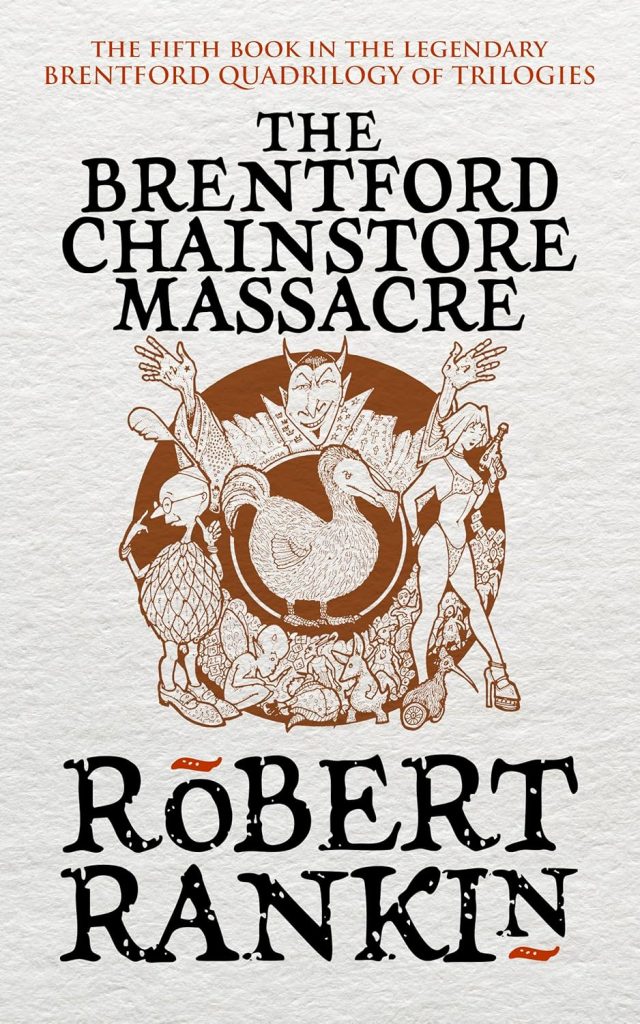
The Brentford Chainstore Massacre, Robert Rankin’s 1997 return to Brentford after a nine-year gap, takes on the millennium with characteristic disregard for calendrical accuracy. Brentford is celebrating two years early. A geneticist named Dr Steven Malone has cloned Jesus from the Turin Shroud and, because this is Rankin, there are two of them and one is evil. The millennium committee’s chief executive Fred has sold his soul to the devil for ultimate power. Jim Pooley is being blackmailed into sabotaging the ceremony. The Flying Swan faces its most serious existential threat to date. This is the series at full, glorious throttle.
Nine years. Nine years, and the world has changed. The millennium is approaching, and Rankin tackles it with his usual precision instrument of a blunt instrument: by having a scientist clone Jesus Christ from the Turin Shroud. A man named Fred, who has sold his soul to the devil in what even the devil privately considers a somewhat one-sided deal, wants to use this clone in a ceremony that will grant ultimate power to his master. Oh, and a massive supermarket chain wants to build a store in Brentford. Of these two threats, the locals are considerably more exercised about the second one.
The title is a pun on The Texas Chain Saw Massacre, and it’s a perfect summary of the book’s tone: brutal on consumerism, deeply silly about theology, and ultimately quite fond of its characters in the way that you’re fond of people you’ve known long enough to stop expecting them to make sensible decisions.
This is often cited by fans as a high point, and you can see why. It is a fact, well known to those who know it well. The writing is tighter, the jokes land with more precision, and the central idea is so gloriously daft it circles back around to inspired. The prose here has evolved into a constant, low-level assault of wordplay, non-sequiturs, and asides to the reader that feel less like literary technique and more like Rankin leaning around the page and winking directly into your face. In a good way.
Reading The Brentford Chainstore Massacre after the first four books is like hearing a familiar tune played by a much better band. All the elements you love are present, but the arrangement is richer, the timing more precise, the ambition more honestly displayed. Rankin in 1997 is writing with the confidence of a man who knows his audience, trusts his world, and has thought hard about how to surprise both.
The evil Jesus twin is handled with such structural nonchalance that you might miss how technically difficult a joke that is to sustain across an entire novel without either becoming offensive or defusing the comedy through excessive apology. Rankin does neither. He commits to the bit entirely, and it works because the book’s theological universe is so consistently and lovingly constructed that the appearance of a malevolent clone feels, within its own logic, almost inevitable.
If you read only one book in this series, make it this one. Then read the others, because Brentford deserves the company.
6. Sex and Drugs and Sausage Rolls (1999)
God’s Power Meets Rock and Roll Ambition. Brentford Provides the Sausage Rolls.
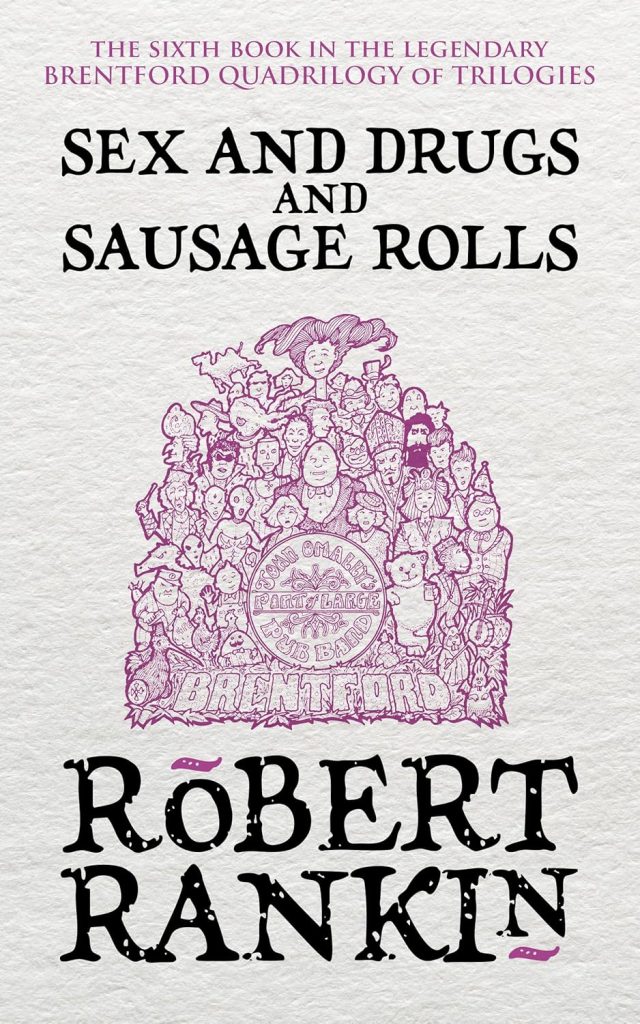
Sex and Drugs and Sausage Rolls, Robert Rankin’s sixth Brentford novel published in 2000, takes the series into the music industry with predictable consequences for everyone involved. John Omally manages a local rock band called Gandhi’s Hairdryer, whose lead singer carries a miraculous ability to heal the sick. The combination of divine healing, rock and roll ambition, and the proximity of forces that are never happy when miracles occur freely means that Brentford is once again at the centre of something considerably larger than itself. Pooley dies in this book. Temporarily. Quite brutally. He gets better.
The title alone tells you where Rankin’s priorities lie, and frankly, they are correctly ordered.
Omally, ever the schemer, decides to manage a rock band. The twist? The lead singer can heal the sick. This being Brentford, this miracle worker is quickly embroiled in a plot that brings back Soap Distant and Small Dave. It also features the death of Jim Pooley. This is fine. It’s not permanent. In Rankin’s universe, death is best understood as a temporary administrative inconvenience, like a parking ticket you can argue your way out of if you know the right people, or, indeed, the right ancient mystical forces.⁴
This book feels like a hangout session, which is perhaps its greatest achievement and also, depending on your taste, its most notable liability. The plot is almost secondary to the joy of spending time in this company again. Rankin is now a bestseller, and his prose has the easy confidence of a man who knows his audience trusts him. The jokes about the music industry are sharp. The sausage rolls are plentiful. The whole thing has a warmth that was sometimes missing in the earlier, more frantic books, when the author was still working out how many apocalypses he could fit into a narrative before the structural integrity gave way.
The rock music backdrop allows Rankin to exercise his ear for period detail, his facility with the specific absurdities of the music business, and his longstanding interest in the intersection of popular culture and genuine mysticism. The contrast between the petty vanities of the music industry, record deals, tour riders, inter-band politics, and the genuine supernatural stakes playing out behind the scenes is precisely the kind of double vision that the series does best.
As Rankin’s sixth outing in Brentford, Sex and Drugs and Sausage Rolls demonstrates a writer completely at home in his created world but still finding new angles on it. The music industry provides fresh absurdity to set against the established absurdity of Brentford’s cosmic status. Rankin’s prose here has the fluency of a long-distance runner finding a comfortable pace. The jokes arrive with practiced ease. The mythology deepens without becoming laboured.
Sex and Drugs and Sausage Rolls is Rankin in full command of his world, deploying it with the confidence of a man who knows exactly where the laughs are buried and exactly how deep to dig.
7. Knees Up Mother Earth (2004)
Developers want the land. The serpent wants out. Brentford wants neither of those things.
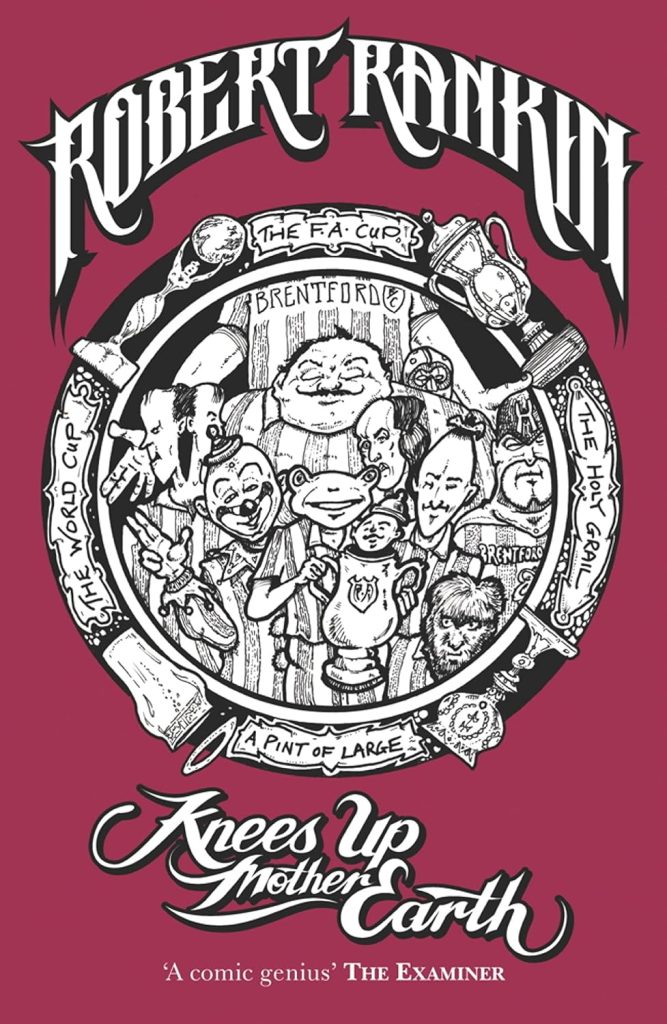
Knees Up Mother Earth, the seventh Brentford Trilogy novel published in 2004, combines football, property development, and the literal serpent from the Garden of Eden in a single plot with Rankin’s customary disregard for the boundaries between genres. Developers plan to demolish Griffin Park, Brentford’s beloved football ground, unaware that the serpent that tempted Eve lies buried beneath the pitch. The seventh book in the increasingly inaccurately titled trilogy also functions as the second volume in Rankin’s Witches of Chiswick trilogy, a crossover that deepens both series’ mythology considerably and rewards the patient reader at every turn.
Rankin throws a new ball into play. Property developers want to tear down Griffin Park, Brentford’s beloved football ground, which, in a detail that would be outrageous if it happened in real life (and therefore almost certainly will), is built directly above the serpent that tempted Eve in the Garden of Eden and is the source of all original sin. You mess with their pub, you mess with their football ground, you mess with the fundamental nature of human sin. It’s the Brentford way. It is, in fact, the only way.
This is also the second book in The Witches of Chiswick trilogy, which is itself part of Rankin’s broader multiverse of interlocking trilogies, a literary structure so complicated that I spent twenty minutes drawing a diagram of it on a napkin before realising I’d just drawn a map of the London Underground with added apocalypses.⁵ The scope is widening. The lens stays fixed on West London. The writing is slick. The concepts are, in the technical literary sense, completely bananapants.
Serving simultaneously as the seventh entry in the series and the second book in the Witches of Chiswick trilogy, a crossover that rewards readers of both while remaining accessible to those approaching from either direction. The mythological depth accumulated across six previous Brentford books is deployed here with the assurance of someone who has spent decades building a world and now knows exactly which walls are load-bearing.
The prose has the authority of late Rankin, not experimental but deeply assured, the running gags arriving with the weight of old friends, the setpiece moments constructed with a craftsman’s confidence. It is like reading a building that has been lived in for twenty years: the architecture is fully bedded in, the rooms all serve their purpose, and the occasional draught through the wainscoting only adds to the charm.
Knees Up Mother Earth is Rankin proving that the seventh book in a series can be as good as the first. It is possibly better. Do not tell the first book.
8. The Brightonomicon (2005)
Hugo Rune is the most amazing man who ever lived. He taught Sherlock Holmes everything Holmes knew. He needs an amnesiac assistant. The acolyte is always called Rizla.
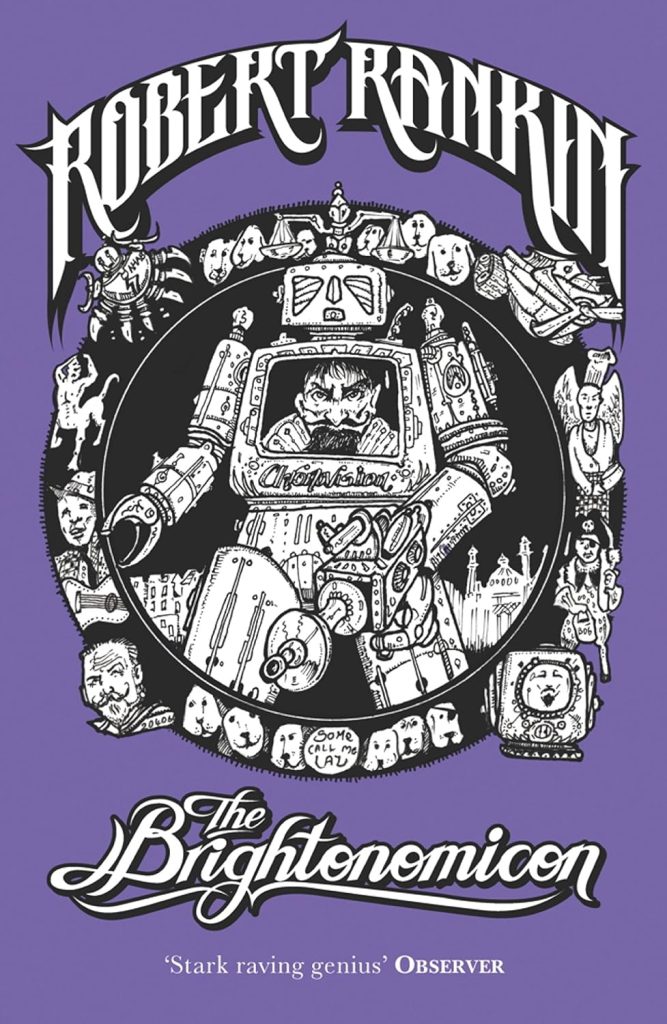
The Brightonomicon, eighth entry in the Brentford Trilogy published by Rankin in 2005, departs from West London for Brighton without ever truly leaving Brentford behind. Hugo Rune, the self-styled Logos of the Aeon and Guru’s Guru, takes on an amnesiac young man called Rizla as his acolyte, and together they must solve twelve mysteries based on the Brightonomicon, a new zodiac formed by the alignment of Brighton’s streets. Count Otto Black, the most evil man alive (apart from Nixon), wants the Chronovision. The revelation that Rizla is actually a young Jim Pooley lands like a bell being struck.
A bold move. Pooley is young again, he is now an amnesiac acolyte called Rizla, working for the mystical con-man Hugo Rune — and the action moves almost entirely to Brighton. John Omally is reduced to a cameo in the final chapter, where he appears to be fine about this, which seems suspicious.
On paper, it shouldn’t work. It feels like removing the coffee shop from Friends and replacing it with a flamboyant celestial charlatan who refuses to pay for anything on the grounds that his genius alone constitutes adequate compensation for all goods and services rendered. And yet.
Hugo Rune, the self-declared Most Amazing Man Who Ever Lived, is a magnificent creation: a know-it-all, a charlatan, a glutton, and possibly a genuine magician, which in Rankin’s universe is a category considerably more useful than it sounds. He has the moral compass of a compass that someone has left near a very large magnet.
He also has Dimac. He has mentioned it. The book is structured around twelve constellations of Brighton, The Hangleton Hound, The Bevendean Bat, and so on, in a picaresque, detective-flavoured, origin-story shape that shows Rankin’s world is larger than two blokes in a pub, while strongly implying that two blokes in a pub remains the Platonic ideal to which all human endeavour should aspire.
Count Otto Black, described as the most evil man alive, apart from Nixon, provides the antagonist with theatrical menace that suits the Brighton backdrop. He wants the Chronovision, a device that allows its user to witness any event in history, and in the wrong hands would provide leverage over the timeline that makes world domination look like a hobby project. His confrontations with Rune have the quality of two extremely dangerous people who have been matching wits across centuries and have developed a mutual respect neither would ever acknowledge.
Twelve mysteries, each corresponding to a zodiacal sign, each building toward a final confrontation, the whole operating simultaneously as comedy, adventure, mystery, and covert autobiography. The prose is Rankin at his most precise and playful, the jokes landing with the confidence of a practitioner at the height of his powers. Reading it is like watching a master watchmaker assemble something too small for ordinary eyes, each part clicking into place with quiet, satisfying precision.
The Brightonomicon is Robert Rankin writing about his father and himself without knowing it, which makes it both his funniest book and, quietly, his most personal. Read it and find out why Rizla always remembers the Ocarina.
9. Retromancer (2009)
If the sausages are wrong, the entire timeline is wrong. Hugo Rune understands this. He is the only one who does.
The circle is now, if not completely complete, at least substantially circular.
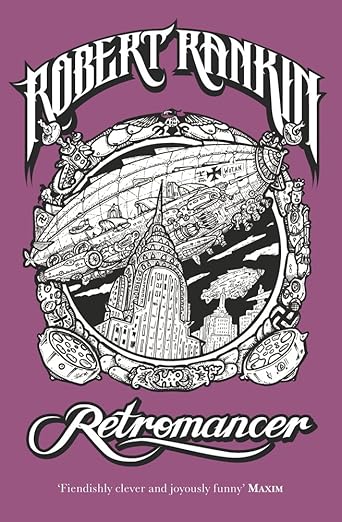
Young Pooley and Hugo Rune return for a final (for now, and for now is doing considerable heavy lifting in that sentence) adventure. History has gone wrong. Germany won World War II. America is a wasteland. The breakfast menu at The Wife’s Legs Café features Bratwurst, which Pooley considers a greater atrocity than the geopolitical ones.
It’s a full-on alternate history romp, a sequel to The Brightonomicon, and a prequel to the very first book, The Antipope, which means that the series ends by beginning, or begins by ending, or possibly both, due to the transperambulation of pseudocosmic antimatter. This is not a running gag. I hope it’s not a running gag. If it is a running gag, it peaked quite early.⁶
It has everything: time travel, derring-do, cosmic significance, and a deep, abiding love for the ordinary. The humour is darker, the plot more urgent, but the soul of the book is still Brentford. It’s about wanting to go home, to get things right, to save your mates and your local. For all its talk of retromancy and alternate dimensions, it is, at bottom, a story about belonging. About the terrifying possibility that nowhere else in time or space will have quite the same darts board.
The alternate history London is handled with genuine imaginative rigour. Bratwurst aside, the details of a Nazi-won Britain are drawn with the specificity of someone who has thought about what occupation actually means for daily life: the small compromises, the adjusted signage, the breakfast menus. In a Rankin novel, this is where the darkness lives: not in the grand historical sweep but in the minor domestic adjustments. The texture of wrongness is personal.
Hugo Rune is at his most magnificent here, operating against a backdrop that confirms everything he has always claimed about himself: that he exists outside normal historical constraint, that his genius is genuinely trans-temporal, that he is, despite all available evidence to the contrary, exactly as important as he says he is. The confrontation with advanced alien technology, killer robots, death rays and an ancient god reads like a man fulfilling a destiny he wrote himself, which is probably what happened.
As the ninth book in the series and the conclusion of what might be considered the original Brentford sequence before the later trilogy, Retromancer has the quality of a final movement that collects all its themes and resolves them in a key both surprising and inevitable. Rankin spent the years between the first trilogy and this book becoming one of the most technically accomplished writers in British comic fantasy. The vocabulary, the timing, the structural confidence, the willingness to let genuine emotion coexist with genuine absurdity: all of it is present at its highest level.
Retromancer ends nine books in the correct way: with history restored, the breakfast reasserted as properly British, and the sense that Brentford, through all its cosmic adventures, has always known exactly what it was doing. So, as it turns out, has Robert Rankin.
The Verdict
So. Nine books. One trilogy.
Is it worth it? Yes. Unequivocally, yes. Rankin’s writing is a specific taste. It’s not for everyone. If you prefer your fiction to proceed in a logical, linear fashion toward a satisfying, fully-resolved conclusion, then Brentford is going to be something of a challenge, in the same way that a tornado is something of a challenge to a carefully arranged hat. But if you like your humour dry, your plots wet with beer, and your heroes more interested in a game of darts than saving the world — a world which, in any case, they’ve saved at least four times already and which has the nerve to need saving again — then Brentford is your spiritual home.
Some of the earlier jokes might creak a little under the weight of the years. The portrayal of certain characters reflects the era they were written in, and you notice it more now. This is, in the Rankin tradition, a fact well known to those who know it well, and need not detain us here.
But you read Rankin for the gags, the puns, the glorious digressions into whether Penge is nice (it is, apparently), and the feeling that someone, somewhere, has thought about the utter madness of existence and decided the best thing to do is have a pint and a laugh about it. That someone is Robert Rankin. He is, in our line of work, a tradition. Or an old charter. Or something.
Reading Robert Rankin is like sitting at a bar with the meaning of life, and realising it’s just ordered another round. On Pooley’s tab.
¹ He ended up in anorak corner with the Terry Pratchetts and the Douglas Adamses, which is where the good stuff is anyway.
² He has, however, on three separate occasions, threatened to use it on Small Dave the postman, which Small Dave considers an empty threat, and which Omally considers optimistic.
³ If this becomes a running gag, it is a pretty poor one. — Ed.
⁴ Readers wishing to contest this analysis are referred to Books 1 through 8, in which it is repeatedly demonstrated.
⁵ Penge was not on the napkin. Penge is never on the map. And yet I understand it’s a very nice place.
⁶ It has peaked. — Ed.