

The Lighthouse at the End of the World Review: Philip A. Suggars Builds a London You’ve Never Seen Before
“Philip A. Suggars arrives with one of the most inventive urban fantasy debuts of 2026. The Lighthouse at the End of the World plants a working-class South London criminal into a parallel city built from humanity’s wreckage, and somehow makes the surreal feel urgent. Sharp prose, an unforgettable cast, and a world that carries genuine weight. This is British speculative fiction doing something new.”
If you love urban fantasy set in London, Philip A. Suggars’ debut novel The Lighthouse at the End of the World belongs at the top of your 2026 reading list. Published by Titan Books and opening the Cities of the Drift series, this alternate-London fantasy follows Oyster McLellen, a South London petty criminal pulled into a parallel city built from humanity’s discarded technology. With sharp dialogue, inventive world-building, and a cast of genuinely original characters, Suggars announces himself as a major new voice in British speculative fiction. Here’s why this book is generating serious buzz ahead of its April 7 release.
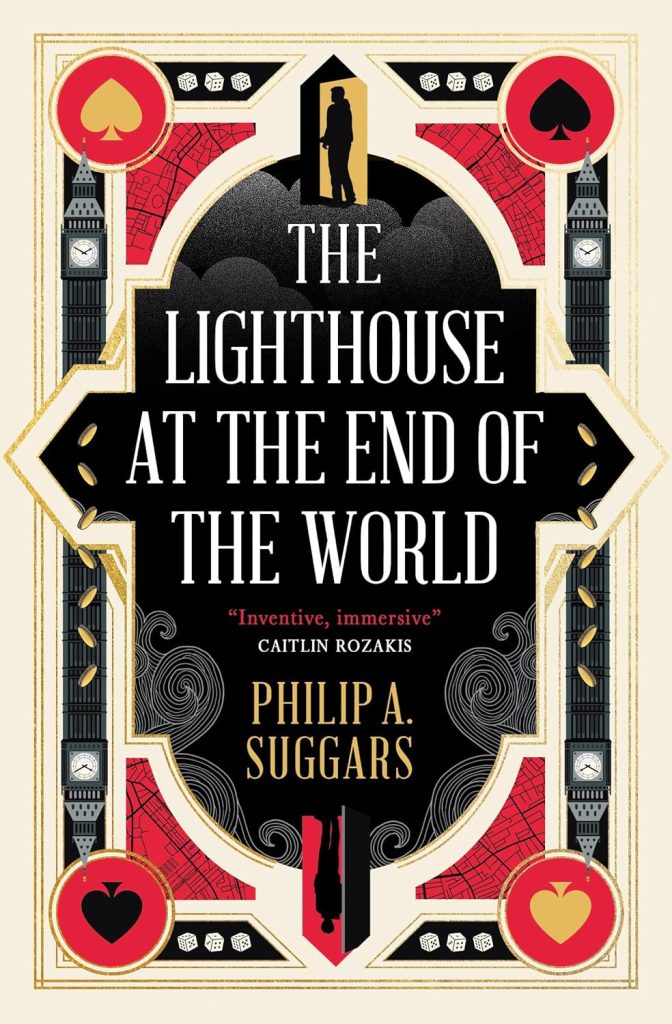
There’s something particular about South London that resists romanticisation. It doesn’t want you to make it pretty. The streets between Brixton and Tooting don’t offer the photogenic skyline that makes North London so cinematically convenient; they offer something messier, grittier, and considerably more alive. Philip A. Suggars knows this. He was born there. And that knowledge sits at the very heart of his debut novel with a confidence that most writers spend three or four books trying to earn.
Oyster McLellen is not your typical fantasy hero. He’s a petty criminal running card-sharp cons on tourists in Hyde Park, working for his boss, Big Mickey, and keeping his struggling family afloat in the long shadow of his absent father, Lucas, who vanished years ago without explanation.
When a money drop goes badly wrong, Oyster chases the thieves across South London and ends up, rather abruptly, washed up on a beach surrounded by broken phones and shattered office furniture. Welcome to Greater London. A parallel city built from the wreckage of ours, where leviathans assembled from the shells of broken skyscrapers roam the seas, where ink beetles nest beneath residents’ skin, and where the air carries the faint, dreadful possibility that Lucas might be somewhere in this impossibly strange place.
The novel operates across two registers, and Suggars handles both with real skill. The South London sections are sharp and grounded, alive with the territorial logic of gang culture; its unwritten rules, its hierarchies enforced by casual violence, its language dense with slang that feels earned rather than performed. Then Greater London arrives, and the register shifts completely. The cityscape there is genuinely disorienting, a place where living buildings stalk the land, where factions and ancient forces collide in the ruins of a world built from humanity’s discarded technology. Suggars earns the weirdness. He doesn’t apologise for it.
Reading Suggars’ prose is like receiving a radio signal from two different frequencies at once; the familiar crackle of street-level realism overlaid with something stranger and more distant, and somehow the two transmissions resolve into one coherent, urgent broadcast.
Oyster sits at the centre of all of this as a refreshingly fallible protagonist. He’s not chosen. He’s not special. He’s a young man who made a small mistake that spiralled outward, and he spends much of the novel simply trying to keep up. That vulnerability works. It gives the reader a point of entry. Some may find him harder to warm to in the early chapters, but his characterisation grows with the stakes, and by the time the novel’s bigger ideas crystallise, his journey feels genuinely earned.
The supporting cast is where Suggars really stretches his imagination. Marya Petrovna, chain-smoking and preposition-dropping and relentlessly acerbic, is an unlikely ally who earns every one of her scenes. She belongs to a long tradition of older female characters who cut through nonsense with surgical efficiency, and she’s all the more welcome for it, given how many fantasy novels reserve that energy exclusively for teenagers. Then there’s Nonesuch, a Gebel character who glows with an inner light and carries herself like the anarchic, six-foot cousin of Tinkerbell, all corsair instinct and sharp edges.
Her manner of speaking is distinct, idiosyncratic, and immediately her own. She could not exist in any other book. And Mr Primrose, the novel’s chief menace, is genuinely unsettling in a way that owes nothing to conventional horror. His face seems to hold itself together only through the force of his own will, each feature pulling slowly away from the others. That’s the kind of villain who stays with you.
Thematically, the novel covers a lot of ground, perhaps too much at times, but the core threads hold. Familial trauma sits at the book’s emotional centre; the entire plot springs from a son trying to understand why his father walked away. Around that, Suggars builds questions about loyalty, class, and the way ordinary people get caught between forces much larger than themselves.
There are also quieter, more philosophical currents running through the Greater London sections, particularly in a speech Marya delivers about perception and constructed reality: the idea that the brain dreams the world into existence from available inputs, that materiality is assembled from concepts in the mind rather than any direct connection to external truth. It sounds like it belongs in a philosophy seminar. Somehow it fits perfectly.
Underneath it all runs a current of climate fiction. Ancient god-like forces perform rituals to determine which imperative, technology or nature, will drive humanity’s next epoch, with the implicit understanding that the current epoch has not gone especially well. Suggars doesn’t press this theme hard. He lets it breathe beneath the surface, which is the right call. Press it too hard and the book tips into polemic. Let it breathe, and it adds genuine weight.
Comparisons to Neil Gaiman’s Neverwhere are inevitable, and not entirely unfair. Both books give London a shadow twin, a hidden city where the rules are different and the stakes are existential. But Suggars is doing something tonally distinct. Gaiman’s London Below has a dreamlike, fairy-tale quality to it; Suggars’ Greater London feels more industrial, more salvaged, more hostile.
As debuts go, this is a striking one. Suggars arrives with a significant body of short fiction behind him; work published in Strange Horizons, The Guardian and Interzone, a win at the Ilkley short story prize, a BSFA long-list, and appearances in the Best of British Science Fiction anthology series. You feel that training in the precision of his prose, the care with dialogue, and the economy of his world-building descriptions. He knows how to make a sentence work. The ambition is evident throughout, and the ending, without giving anything away, delivers on its promise in a way that makes you actively want to know what happens next in this series.
Genre-wise, the novel occupies an interesting position. Urban fantasy has long claimed London as its territory, from Ben Aaronovitch’s procedural approach in the Rivers of London series to Philip Reeve’s mobile city logic in Mortal Engines. Suggars doesn’t operate quite like either. His book is less a fantasy novel set in London and more a novel about the idea of London: what it means to belong to a place, what it means to lose someone inside it, what happens when the city you grew up in turns out to be haunted by a version of itself constructed from everything it ever threw away.
That’s a genuine contribution to the genre, not just an iteration of something that already exists. The working-class protagonist angle alone sets it apart from much of the current urban fantasy landscape, where chosen-one narratives and upper-middle-class bildungsromans still dominate.
The Lighthouse at the End of the World is book one of the Cities of the Drift series, and it reads like the opening chapter of something considerably larger. Suggars is playing a long game. The pieces he’s assembled suggest he knows exactly what kind of game it is.
Read it now. Say you got there first.
The Lighthouse at the End of the World by Philip A. Suggars
Enter a London like no other in this fast-paced, captivating fantasy novel, perfect for fans of V.E. Schwab and Genevieve Cogman.
Oyster McLellen has spent his life causing mischief. Running with a small-time gang and fleecing money from tourists in Hyde Park to support his struggling family in the absence of his father, who abandoned them years ago.
When a simple money drop for his boss, Big Mickey, goes wrong, Oyster’s future looks bleak. His only chance to redeem himself in the eyes of Mickey is to get the money back, but as he pursues the thieves across South London he suddenly finds himself washed up on a beach, surrounded by broken phones and shattered office furniture.
His new world: Greater London. A city built on the detritus of our own, where leviathans crafted from broken skyscrapers roam the seas, where ink beetles nestle beneath the skin of its residents and where Oyster’s father, Lucas, may well have escaped to all those years ago.
But there are bigger things at stake. Oyster’s allegiances are torn between the enigmatic Nonesuch, the eccentric escapist Marya Petrovna, and the terrifying Mr Primrose – and he will have to choose who to align himself with quickly. Because plans are afoot: something ancient is brewing, and a choice needs to be made, the consequences of which will determine the fate of Londons, and life, everywhere.


