

The most dangerous thing in this book is how safe it makes you feel.
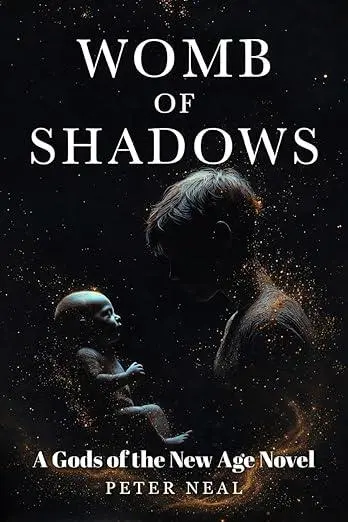
Peter Neal’s debut novel Womb of Shadows arrives as something the biological horror genre has been building toward without knowing it: a book that understands the body not as a site of invasion but as a site of longing. The first entry in the Gods of the New Age series, it follows Dr. Evelyn Hart, a geneticist who injects her infant daughter with an unauthorised gene therapy, and the catastrophic chain of events that connects her family to a classified military project and a boy whose skin produces a compound that rewrites human attachment at the cellular level. This is literary horror with teeth, and the teeth are warm.
Womb of Shadows: Peter Neal’s Biological Horror Debut
Peter Neal’s debut opens with a finger growing in real time, and the horror of that moment is not what you’d expect.
It isn’t the physical event itself that disturbs, though Neal renders Nunnally’s first digit emerging through split skin with a precision that largely earns its place.
The disturbance lives somewhere else: in the mother’s face as she watches, in the word “triumph” fighting “terror” in the same chest at the same moment, in the clear, documented choice Dr. Evelyn Hart makes to let the science win and pick the syringe back up. By the time she whispers “I don’t care what it costs” into her daughter’s hair, the book has already installed its central question deep in the reader’s nervous system. Not “what will happen?” but “how much is love allowed to cost someone else?”
Womb of Shadows is biological horror. It occupies the space where an mRNA sequence meets a classified military programme meets a family that is quietly, consistently failing to see what it has let inside the house. The dread here does not arrive in a rush. It accretes. A sweet smell in the air that could be anything. A papercut that heals in twelve hours. A vibration in the copper pipes at 18.3 hertz.
The pacing is deliberate, and the deliberateness is mostly the point. This is not a book that jolts. It conditions. By chapter five, the reader has absorbed the same compound the characters have, the same subtle chemical instruction to stay close, to keep reading, to remain in the orbit of these people even as the evidence mounts that remaining costs something. The horror builds the way an attachment builds: slowly, then completely. But that deliberateness also comes at a cost. In the middle sections, the accumulation of detail can feel less like atmospheric pressure and more like a holding pattern, the narrative tension occasionally slackening under the weight of its own patience.
Neal structures the novel through two alternating modes. The chapters are intimate, close-third-person, shifting between Evelyn, Colonel Marcus Hart, and sixteen-year-old Elara Voss, each of them seeing only their portion of the larger organism that is assembling itself around them. Between the chapters, the “Synapse” sections arrive: classified transcripts, security audio logs, research journal entries, incident reviews. These shift the register entirely. Where the chapters heat up, the Synapses cool down, presenting catastrophe in the flat institutional voice of a bureaucracy that files everything, including the end of a person, under the correct subcategory.
The contrast is effective, though not always seamless. A security audio transcript from Gestation Bay 4, logged at 3 a.m., follows a technician named Arnaud talking to the boy through glass about his sister’s birthday Lego problem and his cat Copernicus’s dignity on a windowsill. The transcript records resin output spikes alongside the pauses between sentences with clinical precision: “4.1 sec pause.”
Every clinical measurement makes the conversation behind it more poignant, because the instruments are cataloguing exactly what the institution cannot protect from ending. But the found-document formalism occasionally creates distance at the wrong moments, pulling the reader out of the family’s immediate emotional register just when the domestic horror needs to land most intimately. The technique is impressive, but its repetition can blunt the impact it’s clearly designed to deliver.
Neal’s prose at the sentence level rewards attention. He writes with the discipline of someone who has thought hard about what imagery earns its place. In the early chapters, descriptions of Nunnally’s developing anatomy carry much of the book’s moral argument. Her nubs are described as “completion, refused,” a phrase that in two words locates the whole horror of a body interrupted and a mother who refuses to leave that interruption unanswered. When the boy eventually presses his palm to glass, his handprint compared to a lighthouse watching a ship from a distance it cannot close, the metaphor is not ornamental. It defines the character’s existence and earns its keep.
The dialogue is sparse and precise. Characters here speak the way people speak under pressure: in deflections, in abbreviated exchanges, in the particular shorthand of a relationship that has stopped asking full questions because the full answers require disclosures nobody is ready to make.
At its deepest, Womb of Shadows is a novel about what we are willing to do to the people we love in order to help them, and the biological argument it makes is that there is no clean separation between love and the chemistry that produces it. Evelyn injects Nunnally with an untested gene therapy, well above the safe dosing ceiling she herself established, because she is a mother and because she is a scientist and because the book will not let those two identities operate in separate rooms.
The act is simultaneously the most human thing she could do and the most catastrophic. Neal holds both truths without resolving them, and the refusal to resolve is where the real ethical weight sits.
Marcus is a different kind of horror. He steals his daughter’s blood to save a classified project that was always going to destroy something, and the destruction arrives exactly where he expected and nowhere he was prepared for. His gradual transformation, the compound rewriting his muscle memory until his hand literally refuses to execute an order his own mind has given, reframes the question of agency in ways that horror rarely manages this cleanly. He is not possessed. He is colonised.
The compound does not invent new desires in him; it amplifies the ones already there and removes the inhibitions that kept them in check. By the end of his arc, the question of whether Marcus is making choices or whether the compound is making them for him has no clean answer, and the book’s refusal to provide one constitutes one of its most unsettling arguments—even if Marcus’s interiority can, in the back half, feel slightly drowned out by the thematic machinery driving him forward.
Elara Voss gives the novel its conscience. She has been carrying the compound’s frequency in her bones since a laboratory accident she barely survived at age eleven, the silver scars on her wrists a record of that exposure. She sees what the adults cannot or will not, building an evidence archive out of small observations the way teenagers build understanding of dangerous adult spaces: carefully, from the edges, because the centre is not safe to stand in.
She is also the book’s most radical argument about loneliness. She has been listening to the compound’s static her whole life and never knew what it was trying to tell her. When she finally understands, it does not relieve her. It enlarges her in ways she is not sure she wanted to be enlarged.
And then there is Arnaud. The night-shift technician who sits in a folding chair and talks to a biological weapon through glass about his cat’s dignity. Who measures his coffee wrong every time. Who asked what snow feels like and listened to the answer with the specific, undramatic care of a person choosing decency in a facility designed to make it inconvenient.
What the book eventually reveals about Arnaud’s fate is one of the most morally complex moves Neal makes, and it lands not as body horror but as something older and worse: a meditation on what happens when kindness becomes infrastructure, when warmth outlives the person who produced it, when the most compassionate person in the building becomes the trap.
The military-industrial element, Project Forge with its biological weapon programme and its purge protocols and its language of “assets” and “catalysts” and “viable enhancers,” functions less as a plot mechanism than as a structure of ethical abdication. The facility does not create evil men. It creates institutional distance: the distance between the order and the hand that executes it, the distance between the file and the person inside it.
Marcus closes this distance one catastrophic decision at a time, and the horror is that every step felt, in the moment, like the only available move. At times, though, the institutional critique leans heavily on a register that genre readers will recognise, and some of the Synapse documents retread conceptual ground already well established by the domestic chapters.
The distributed consciousness the book names “the Anomaly” in its final sections is clearly a beginning, not a resolution, and some readers may find that the ending leans a little too heavily on sequel promise rather than providing a fully satisfying stand-alone climax. Neal has built a trilogy around a single question expanding outward: from a mother’s decision, to a family’s contamination, to something that may not have a human name for what it is becoming. The architecture of the series, even at this early stage, suggests a writer who knows where he is going.
Womb of Shadows occupies a specific and underworked corner of horror: biological horror that operates at the level of attachment rather than revulsion. The body horror tradition, from Kathe Koja’s fractured anatomies through the contemporary surge of “slick” and “neo-weird” fiction, has largely focused on transformation as violation: the body doing something against the self’s wishes, the flesh becoming hostile territory. Neal’s contribution is to ask what happens when the transformation is welcome, when the body runs toward the change because the change feels like finally being held by something that knows you.
The closest contemporary comparison in tone and ambition is Jeff VanderMeer’s Southern Reach trilogy, specifically Annihilation, in its handling of an entity that rewrites biology without malice, that has no goal recognisable as human intention, that spreads according to its own logic and produces in those it touches something between awe and terror. But where VanderMeer pursues the alien and the unknowable, Neal stays close. His compound is not alien. It is love, chemically expressed. The horror is not incomprehension. It is recognition.
Ramsey Campbell’s intimate domestic horrors share Neal’s patience and precision, the slow contamination of ordinary spaces. Carmen Maria Machado’s architectural dread in In the Dream House offers a comparable deployment of found-document formalism to reveal what linear narrative would obscure. Tananarive Due‘s biological horror, with its deep engagement with what bodies carry and transmit, provides a thematic neighbour.
But none of these comparisons fully captures what Neal is doing with the biological register: the body as both the site of the horror and the site of home, the compound that does not trap people but makes the trap feel like home. Neal’s reach is genuinely exciting, even when his grasp occasionally exceeds the pacing and emotional immediacy required to sustain it.
Neal’s real achievement here is not the horror of the compound but the horror of realising you would probably let it in too. The book’s final frequency still sounds, like honey, like rot, like a man talking to a boy through glass about what snow feels like, and the sound does not stop when you close the cover. A remarkable, imperfect debut, that heralds a writer of immense promise, still calibrating the balance between literary ambition and horror’s primal need to unrelentingly pull you under.
Womb of Shadows: Gods of the New Age, Book One by Peter Neal
The baby did not cry.
That was the first thing Dr. Evelyn Hart noticed — and the last thing she would ever forgive.
When her daughter is born blind, limbless, and silent, geneticist Evelyn Hart breaks every rule she swore she’d never break again. The unauthorized therapy works. But it is not working the way she designed it.
Thirty-seven miles south, in a classified military facility, a teenage boy sits in permanent containment. His skin produces a compound that rewrites human biology through proximity. Through touch. Through love. Everyone who gets close becomes dependent. Everyone who leaves begins to die. And Evelyn’s husband, who stole three drops of their daughter’s blood to keep the boy alive, is already too deep to pull free.
When sixteen-year-old Elara Voss arrives carrying compound in her own scars from a tragedy she barely survived, the line between weapon and victim dissolves. The boy is not a monster. He is lonely. And the compound spreading through the Hart family does not trap them — it makes the trap feel like home.
WOMB OF SHADOWS is dark literary sci-fi horror — biological dread with the prose of literary fiction and the gut-punch of body horror. A 97,000-word debut and Book One of the GOTNA trilogy.
For readers of Jeff VanderMeer’s Annihilation, Agustina Bazterrica’s Tender Is the Flesh, Caitlin Starling’s The Luminous Dead, and Nick Cutter’s The Troop.