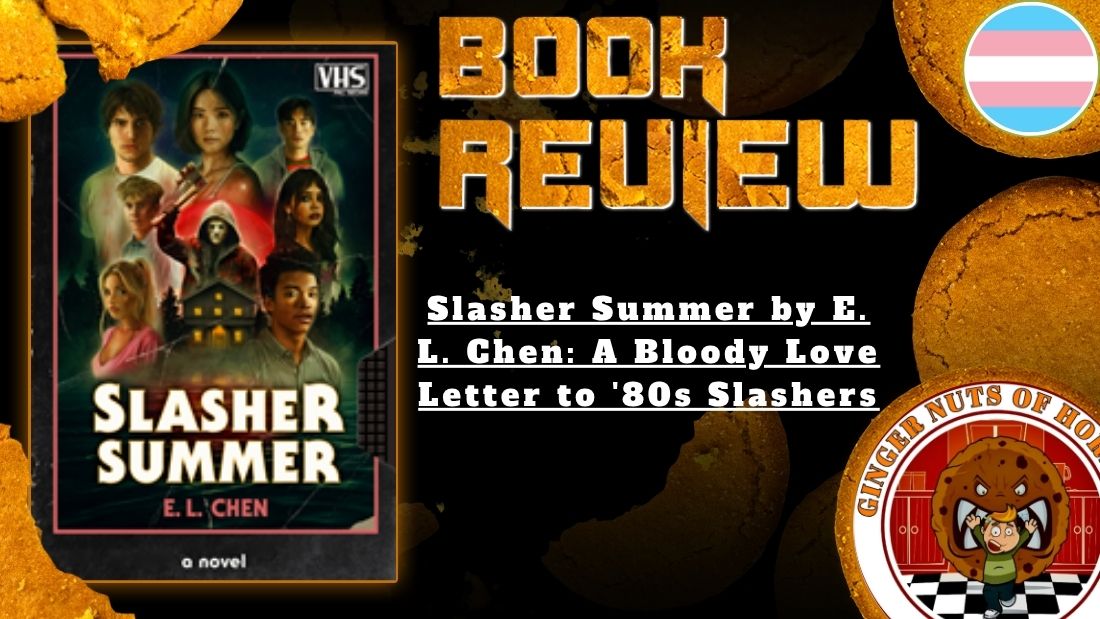
- Slasher Summer by E. L. Chen: A Bloody Love Letter to ’80s Slashers
- The Past Wears a Mask: A Conversation with E. L. Chen
A throwback slasher that hands back your yearbook photo and dares you to leave.
Cedar Lake exists for one reason: a cheap 1980s slasher got filmed there, and the town never lived it down. E. L. Chen builds Slasher Summer out of that single fact, sending seven friends back to the cabin where the movie was shot for a reunion that turns deadly the moment the masked killer appears. This slasher horror novel is a campy 1980s homage with real teeth, a meta-slasher built on a wicked Final Girl twist and one upsetting idea: you cannot outrun who you were at seventeen. Here is my full horror book review of why it cuts deeper than nostalgia.
Slasher Summer | E. L. Chen | Crown| June 23, 2026 |
Chen takes the ordinary dread of a bad reunion and gives it a blade. Slasher Summer is a bright, funny, blood-soaked love letter to the slashers we grew up renting, and underneath the kills it asks the upsetting question none of us escape: what if you are still the type they typecast you as at seventeen?
Slasher Summer by E. L. Chen: A Bloody Love Letter to ’80s Slashers
Cedar Lake has exactly one claim to fame, and it wears a hoodie, a red plaid jacket, and an axe.
That town sits at the dead centre of E. L. Chen’s Slasher Summer, and the town’s whole identity comes from a cheap, beloved horror flick called Slasher that got shot there back in the 1980s. From that one fact Chen builds a reunion, a body count, and a sharp little argument about the people we used to be. The book is having a blast. It also means every word of it.
Here is the wind-up, and Chen sets it spinning fast. Seven friends grew up loving Slasher. In high school they went to the midnight showings and acted out the cast: preppy Patrick, jock Jason, cheerleader Tiffany, stoner Freddy, goth Jennifer, nerdy Mikey, and virginal Carrie as the Final Girl, of course. Years go by. They drive back to the remote cabin where the movie was filmed, hoping for a weekend to catch up. Then night falls, a masked figure shows up, the tires go flat, the phone line goes dead, and the old game stops being a game. Somebody, it seems, wants their Slasher experience to feel authentic.
The dread here is a slow squeeze, not a jump scare.
Chen knows the difference, and she works it. The opening stretch is warm and a little goofy. You get old friends ribbing each other, in-jokes that have curdled slightly with time, the specific ache of seeing someone you used to know by heart. And the whole time, you already know the shape of the thing. You have seen this movie. You have seen this movie inside this book, since the characters keep narrating their own doom by quoting the film they are trapped inside. That gap between what they remember and what is coming is where the real pressure builds.
So the experience splits in two. Part of you is grinning at the references. Part of you is bracing. The book moves like a cassette you cannot eject; once it starts rolling, it drags you frame by frame toward the part you already dread.
When the violence lands, it lands hard. Chen does not get coy about the kills. They are loud, physical, and staged with real affection for the form. But what got under my skin was not the blood. It was the quieter horror baked into the premise, the one the cover copy flags right up front. The real terror is not being able to escape who you were in high school. That line could have been a throwaway. Chen treats it as the engine.
By the back half I was reading with my shoulders up around my ears. The pacing tightens like a tripwire. The cabin shrinks around these people, until the only roles left to play are the ones they swore they had outgrown.
The prose does not get in the way. It is bright. It is funny when it wants to be. It never slows down to admire itself, which is right for a book that runs on speed. She trusts a short sentence to do damage. Then she lets a longer one breathe, circle a memory, and tuck a small dread inside a joke before the joke is even finished landing. The rhythm does a lot of the scaring.
The smartest build here is the cast. Seven friends is a lot of plates to spin. Chen spins them by leaning into the types instead of fighting them. Patrick, Jason, Tiffany, Freddy, Jennifer, Mikey, and Carrie each carry a label from the old movie, and the book keeps asking how much of a person is just the label other people stuck on them at seventeen. That is a clever piece of engineering. The slasher form already sorts its cast into types and kills them in order. Chen takes that machinery and points it at something tender.
The winking never tips into smugness, either. A book this aware of its own genre could spend the whole runtime winking. This one mostly plays it straight. The characters know the rules of a slasher because they grew up on this one, and that knowledge does not save them, which is the joke and the knife at the same time. High school is the mask none of them ever fully took off, and the killer simply makes them put it back on.
Strip the mask off and Slasher Summer is a book about the grip of the role.
We all get cast young. The jock, the nerd, the slut, the good girl, the stoner. Most of us spend our twenties and thirties quietly trying to escape the part, and then one bad reunion drops us right back into it. Chen takes that ordinary social dread and makes it lethal. The friends have grown and changed in real ways. Patrick came out. Mikey got strong. Carrie built a life with somebody. And the night insists, with a blade, that none of that counts, that you are still the type they typecast you as. There is something truly upsetting in that, worse than any single kill.
It connects outward, too. The book lands in a moment when a whole generation is busy re-watching its own childhood, mainlining 1980s nostalgia, streaming the slashers it grew up renting. Chen clearly loves that culture. She also gives it a small, pointed shove. Nostalgia, the book suggests, is not free. Going back to the thing you loved at sixteen means going back to who you were at sixteen, and that person may not have anywhere safe to put you.
There is a thread about queerness and self-definition running under it as well, quiet but real, since one of the deepest changes any of these friends made was the freedom to stop performing a part. The story understands what it costs to be forced back into a role you fought to leave. That gives the carnage a weight that a straight homage would never reach.
Chen has been circling this exact obsession for a while now.
Her YA fantasy Summerwood/Winterwood was longlisted for the Sunburst Award and flagged by the Canadian Children’s Book Centre, so she came up writing about thresholds and doubled worlds. Her 2026 horror novella Sweetside Motel sharpened the knife: a woman named Sarah Ng on the run from an abusive partner, her car dead in a lonely town. Already you can see the signature. Chen likes a trapped protagonist, a remote place with bad history, and the past closing in from behind.
Slasher Summer takes those instincts and throws a party with them. The isolation is now a cabin full of friends. The trap is now nostalgia. The thing chasing you is now, quite literally, your own teenage self in a mask. And for anyone tracking the arc, her next novel One of Us Is Already Dead keeps the obsession burning, with a former Final Girl pulled back to the site of a cult horror shoot. The Final Girl, the cursed location, the reunion that reopens an old wound. Chen has found her territory and she is staking it out with confidence. This book reads like an author who finally got to make the exact thing she always wanted to make.
We are living through a wave of horror novels that treat the slasher itself as a text worth taking apart.
Grady Hendrix did it from the survivors’ side in The Final Girl Support Group. Stephen Graham Jones did it from inside the head of a slasher-obsessed teen in My Heart Is a Chainsaw. Justine Pucella Winans went meta-survival with How to Survive a Slasher. Slasher Summer belongs on that shelf, no question. What sets it apart is the group. Most of these books anchor on a single Final Girl and her private mythology. Chen spreads the weight across seven, turns the whole friend group into a living cast list, and asks her central question: who gets to stop being a type, of all of them at once.
That cast-wide move is where horror keeps heading. More and more, these stories use the old machinery to talk about identity, memory, and the parts other people pin on us. Chen plants her flag there and brings the blood besides.
Cedar Lake will not soon forget the night these seven came home. Neither will you, because the book hands you back your own yearbook photo and dares you to prove you ever really left.
Slasher Summer by E.L. Chen
Back in high school, seven unlikely students were drawn together over one shared love: all things horror.
Years later they come back to their hometown of Cedar Lake Falls to reunite. The town happens to be the setting of a cult classic 80’s slasher film and so what better place to stay than in the very lodge the movie was filmed in.
But then ominous figures are spotted across the lake, members of the group are pulled underwater and a masked killer is unleashed.
Suddenly they realise they’re in the same kind of horror they love to watch, only it’s not so fun being on the other side…