The Devil’s Banquet builds its dread like fog gathering in a London street at dusk, patient, suffocating, and inescapable by the time you notice it. Lecomber’s 1933 Soho is a city of competing corruptions and genuine historical horror, and George Harley stands at the centre of it all: a working-class conscience in a world that has already decided he doesn’t matter.
The Devil’s Banquet | Phil Lecomber | Titan Books | 23 June 2026 |
Phil Lecomber’s The Devil’s Banquet arrives as the second entry in his Piccadilly Noir series, published by Titan Books, and it confirms that historical noir doesn’t get more atmospheric than this. Set in 1933 London, where Cockney private detective George Harley operates from a new office on Frith Street in the heart of Soho, the novel throws its protagonist against Glaswegian gangsters, aristo occultists, and undercover SS agents, all circling a missing girl last seen with the notorious “Queen of Depravity” Ilse Blau. Dark, morally serious, and rooted in genuine interwar dread, this is crime fiction built for horror readers.
The Devil’s Banquet by Phil Lecomber: Dark, Occult, and Unmissable
George Harley gets an unsigned postcard written in ancient Greek just when he’s starting to believe the past has finally let him go.
The Devil’s Banquet is set in 1933, four years on from the Nursery Butcher case that defined George Harley’s first outing in Midnight Streets, and it opens with a detective who looks like a man returning to business but feels like a man still counting his wounds. The new office on Frith Street in the heart of Soho suggests fresh starts. The postcard in dead language, and the figures who look disturbingly like Osbert Morkens, the murderous history professor from the previous book, whose sympathisers murdered Harley’s fiancée, suggest something else entirely.
This is a book that understands how grief and trauma actually work. Not as events that conclude but as presences that simply find new shapes.
Lecomber constructs his dread with deliberate patience. The surface narrative is clean enough: a distressed father hires Harley and his new assistant Bunty to locate his daughter Louise, who has run away from home to join a cabaret troupe led by Ilse Blau, the notorious “Queen of Depravity,” lately expelled from Weimar Berlin by the ascending Nazis. Straightforward missing-person work, almost. Except in Soho, nothing is ever as it first appears.
What Lecomber does with that premise is build pressure in every direction at once. The Glaswegian gangsters who orbit this particular corner of London’s underworld carry a specific, unhurried menace, the sort that doesn’t need to threaten you explicitly, because it assumes you already know.
The aristo occultists who emerge deeper in the book belong to a tradition of English decadence that runs from the Victorian Black Mass panic through Aleister Crowley to the interwar tabloid terror of high-society devil worship; these are men who use ritual and power interchangeably, who have decided their appetites constitute a philosophy. And the undercover SS agents watching London from its margins bring a particular kind of dread that is neither supernatural nor comfortable, because the reader knows the shape of the history that is about to happen even if Harley cannot.
The atmosphere Lecomber builds is specific in the way only genuine research produces. Gold Flake cigarettes, all-night cafes, the grubby particularity of Soho as a place where bohemian aspiration and street-level brutality share the same narrow pavements. This is not the prettified 1930s of other genre fiction, not the silver-spoon country house and the eccentric detective solving puzzles over sherry. Harley’s city runs on grime and desperation and the cold logic of the deal. It’s a world where morality gets ground down to pragmatism and almost everyone is running some kind of angle.
The pacing builds through accumulation rather than sudden shock. The threats don’t arrive separately; they arrive on top of each other, layered and entangled, until Harley, and the reader with him, has to concentrate hard just to keep track of who wants what from whom. This is intentional. It mirrors the actual experience of operating in the underworld, where information is currency and nobody tells you the whole story.
His handling of the point of view is worth examining. Harley is not a self-reflective man; he doesn’t go in for interiority in the conventional literary sense. What Lecomber does instead is reveal character through attention, through what Harley notices and what he doesn’t, through the specific texture of his perceptions. A less damaged man wouldn’t see Morkens’ ghost in strangers on the street. A man less shaped by violent betrayal wouldn’t read an anonymous postcard as a warning. The technique trusts the reader to do the interpretive work, and that trust is part of what makes the reading feel active rather than passive.
The construction of Ilse Blau is the book’s most impressive piece of characterisation. The femme fatale is one of noir’s most exhausted archetypes, flattened by decades of use into a shorthand: beautiful, duplicitous, the detective’s undoing. Lecomber works against that reflex. Blau arrives carrying the specific weight of a real historical catastrophe the destruction of Weimar Berlin’s extraordinary culture of transgressive cabaret and artistic freedom, crushed by the same forces now sending agents to watch London’s streets.
She is not simply dangerous because she is a woman with secrets; she is dangerous because she comes from a world that was destroyed for being what it was, and she has learned survival strategies from that destruction. When Harley finds himself ensnared in her mind games, as the synopsis puts it, the word “ensnared” carries more than the usual genre weight. This is a collision between a Cockney detective who has never believed in the city’s official story and a woman who has lived through the definitive proof that civilisation’s official story is a lie.
The structural choice to balance Harley’s new case against the unfinished threads from Midnight Streets shows a maturing confidence. Two pulls at once forward into the Louise investigation, backwards into the Morkens aftermath, and Lecomber keeps both under tension without ever letting either go slack. That kind of construction, the thriller’s equivalent of plate-spinning, is harder than the finished product makes it look.
The Devil’s Banquet is about what happens when the systems that are supposed to contain the worst of human nature stop functioning. The Weimar Republic has collapsed; the Nazis are in power; Berlin’s culture of transgression, of art and excess and the refusal to bow to respectability, has been physically destroyed. Ilse Blau arrives in London carrying that collapse as lived experience, and the novel uses her presence to ask a quiet, persistent question: what can London’s own structures withstand?
Harley operates in the cracks between legitimate and illegitimate power, trusted by neither, needed by both. His working-class roots give him access to a city that the official story ignores. The aristo occultists represent a different kind of rot, a rot that hides behind respectability, behind breeding and education and the assumption that certain people are simply not subject to the moral order they impose on everyone else.
The Glaswegian gangsters are transactional; they operate outside the law but they’re honest about it. It’s the respectable rot that Lecomber circles most carefully the men who read ancient Greek in their private clubs and fund rituals in their townhouses and believe their elevated tastes exempt them from consequence.
The SS agents give this theme its sharpest edge. They aren’t simply foreign villains, a convenient external menace. They are a reminder that fascism doesn’t need formal invitations, that it finds its fellow travellers among the ideologically flexible, the bored, and the ambitious. Their presence in London in 1933 is historically plausible and frightening, and Lecomber is smart enough not to editorialise about it. He lets the context do its work.
The horror in this book, and there is genuine horror here, is not supernatural. It’s the horror of recognising how thin the membrane is between civilised society and its discontents, and how many powerful people are perfectly willing to punch through that membrane so long as they believe themselves protected on the other side. Lecomber has been interested in this territory since his first book, but The Devil’s Banquet gives it a canvas large enough to breathe on.
Midnight Streets published in 2025, Lecomber’s debut with Titan Books and the formal launch of the Piccadilly Noir brand. That novel delivered a tightly plotted thriller built around the Nursery Butcher case, a working-class detective in Shoreditch navigating the competing claims of honest police and corrupt power, and it earned considerable critical attention. The craft was sharper than the first book, the period detail even more meticulously assembled, the ending genuinely brutal in the best possible sense. What it was doing, in retrospect, was laying foundations.
The Devil’s Banquet is what those foundations were for. Where Midnight Streets proved the world, this book opens the world up to forces beyond its initial borders, reaches into the European catastrophe that is already underway in 1933, and asks what it means for a grubby Soho detective agency to be operating in the shadow of history’s worst decade. Lecomber is also developing his range of characters: Bunty, Harley’s new assistant, alters the texture of scenes that previously might have been solo, adding a dynamic that the series needed.
For horror readers specifically, the Piccadilly Noir series occupies a genuinely interesting position: crime fiction with a horror sensibility, rooted in real historical darkness rather than the supernatural, but no less disturbing for that. Lecomber himself describes his series as featuring dismembered corpses, occult sacrifices, and iniquitous conspiracies, and this isn’t marketing hyperbole. The darkness in these books is earned and specific and it sits in the stomach.
Some truths about power and appetite and who gets consumed don’t change with the decade. Lecomber knows this. He just needed a Cockney detective, a murdered Weimar cabaret, and the right year to make you feel it in your bones.
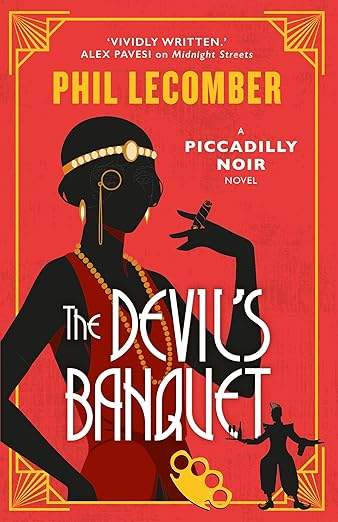
The Devil’s Banquet by Phil Lecomber
The second novel in the Piccadilly Noir series, this dark historical thriller sees Cockney private eye George Harley return to the streets of London’s Soho, populated by gangsters, wide-boys and lowlifes, to investigate a missing cabaret dancer. For fans of Dominic Nolan and Laura Shepherd Robinson.
Four years after bringing the infamous child-killer known as the ‘Nursery Butcher’ to justice – and still haunted by the brutal vengeance exacted by the psychopath’s ruthless allies – Cockney private eye George Harley is finally back in business, operating a new detective agency in the heart of London’s Soho. Harley and his new assistant Bunty are presented with their first case when a distressed father engages them to investigate the disappearance of his daughter, who has run away from home to join a cabaret troupe led by the notorious ‘Queen of Depravity’ Ilse Blau, now in London after being driven out by the Nazis from Weimar-era Berlin.
But in Harley’s liminal world, things are never straightforward, and the detective soon finds himself embroiled in another pitch-dark scenario, with London’s decadent, thrill-seeking gentry on one side and West End mobsters and wide-boys in search of easy cash on the other. When he discovers that a six-year-old has been kidnapped from an orphanage, Harley is convinced his old nemesis has somehow broken out of the lunatic asylum and is back on the streets of London, up to his old tricks.
Set in 1933 and following on from the events of Midnight Streets, this second instalment in the Piccadilly Noir series sees George Harley return to the frowzy alleyways and sleazy nightclubs of the UK capital in search of answers – no matter how uncomfortable they might turn out to be. But when he becomes ensnared in the mind games of a wily femme fatale, and finds himself up against ruthless Glaswegian gangsters, well-connected occultists, and undercover SS agents, those answers become increasingly hard to find.