Folk horror leaves the fields and moves into the city, and it’s worse there.
Folk horror usually means fields, standing stones and a village that wants you on the bonfire by harvest. Blood in the Bricks has other ideas. Neil Williamson’s anthology drags the whole sub-genre kicking into the city, where the isolation, buried customs and strange secrets curdle just as nastily under concrete and strip lighting. You can be lonely in a crowded room and terrified in a familiar place, and these urban folk horror stories know it. From James Bennett’s masked mob on the underground to Ray Cluley’s lyrical closer, this is a bleak, brilliant collection that finds dread in the everyday.
Neil Williamson’s anthology takes folk horror and asks how the isolation, strange secrets, and long lost customs manifest in the urban heart of our world. Because you can be lonely in a crowded room and terrified in a familiar place.
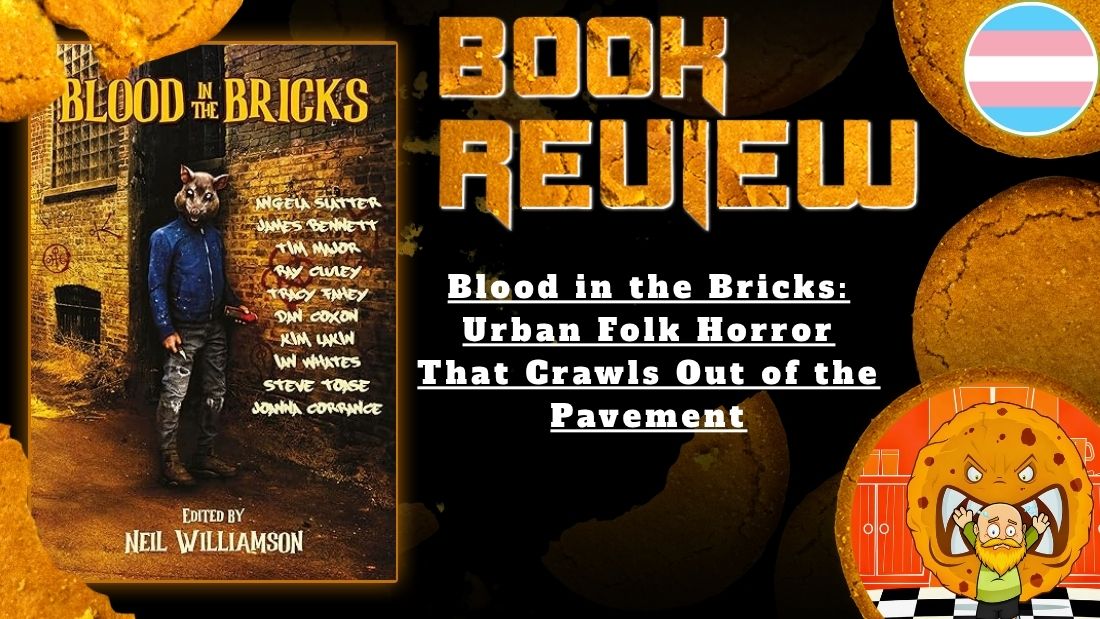
Blood in the Bricks | edited by Neil Williamson | NewCon Press | Nov 2025 |
The countryside has its fair share of horrors. There’s a reason so many horror films and books involve weird villagers and the “all look at the interloper” trope. Having lived in the countryside myself for a number of years, I can also confirm that these stereotypes aren’t as far-fetched as you may think.
The flip side of this then is that my ventures into “big cities” are a living hell. The monolithic structures, the nightmarishly grotty alleys, and spatially unaware hordes are all horrors waiting to strike me down. Who would voluntarily like in these hellscapes? I’m evidently not alone in wondering this, as it’s a sensation which ‘Blood in the Bricks’ tackles acutely. And seedily. Neil Williamson’s anthology takes folk horror and asks how the isolation, strange secrets, and long lost customs manifest in the urban heart of our world. Because you can be lonely in a crowded room and terrified in a familiar place.
These were some of my favourites.
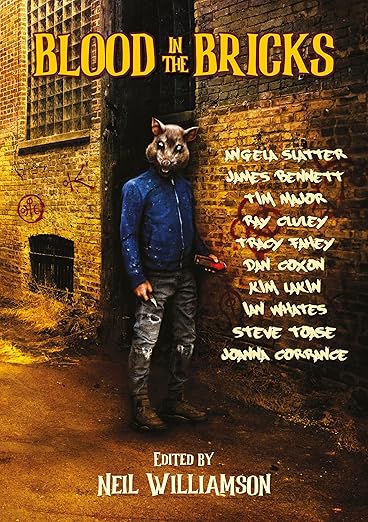
Opening the anthology is James Bennett’s ‘Down Street’. While I’m unsure it disconcerted me as profoundly as many other stories here, and the tale’s slight simplicity prevents Bennett’s story from reaching individual greatness, it’s a fabulous ‘gateway’ into the anthology. Set on the underground, where a late-night commute goes drastically awry due to a vicious mob of kidnappers clad in animal masks, the imagery of ‘Down Street’ is what sells it best.
Not only does it find its way onto Vincent Chong’s wonderful cover art, but it also lends the story a danger as weird as exuberant and which somehow dovetails the grim setting well. Bennett evidently loves his splatter here, and the nameless fugue of characters has a charm; the greater love is for images that don’t belong though, or rather worlds that shouldn’t mix. Perhaps most telling of all then is that it left me with simultaneous urges to watch DEATH LINE and THE WICKER MAN, two films at very different ends of the tonal scale, but which somehow find common ground here. If nothing else, it’ll remind you why public transport is a fate worse than death.
Ian Whates’s ‘Inverse Nurse’ is a short and direct tale and it takes a surgical route into urban folk horror, more specifically via a found-footage (at least in vibe) look at the recollections of someone’s recovery from surgery. Suffice to say though, by the end it’s found a far darker place to reside. Inevitable it doubles as a critique of the NHS, which gives it an extra kick.
There’s then Tim Major’s ‘Escape Notice’, which is delicate and invasive in the best possible ways. The narrative, about being isolated in familiar landscapes, has twinges of anxiety-plagued dialogue familiar to any reader of Ramsey Campbell fiction. As though Lovecraft wrote urban decay. It’s a comedy of errors in some regards, but where every error is more tragic than anything else and pushes the main character further over a precipice. Of all here, it probably is the one to linger in your head the longest and you’ll start to see traps in your own life, however quiet it may be.
Lyndsey Croal’s ‘When the Blood Runs Dry’ takes the anthology into the realm of urban exploration (UrbEx) and in the same breath worms in a sense of claustrophobia and general repulsion that serves the story well. You get the feeling that you should feel dirty just for reading something like this. It’s a shorter entry but one where the brevity really works.
One where the brevity doesn’t work quite as powerfully is Dan Coxon’s ‘Our Sister of Blackthorn’, as you want the tension to be drawn out for longer, however Coxon more than makes up for it with intimate character work, a nicely disorientating mix of podcast reports and scenes, and a mystery which has many uneasy layers for you to unpeel. Also, of all the anthology’s story this is the one where the final image will likely stay with you longest.
Matthew Hopkins then provides ‘One of the Rotten Ones’, which is best described as a sensory overload in an excruciatingly misophonic way. This is probably quite marmite, and will take on a special piquancy for anyone further along the neurodivergent spectrum, however if it doesn’t have you squirming then go back and re-read it. While the plot gets rather indistinct at times, overall there’s a nice mystery at the core as opposed to a lack of clarity and it returns you to the bleaker direction most of these stories go in.
Joanna Corrance’s ‘A Pinch of Salt’ is a delightfully wrong-footing story, beginning with someone who appears to be gritting the roads, running headlong through bizarre revelations and fairy myths, and then finding a conclusion which wouldn’t go amiss in a Jacques Tourneur/Val Lewton film.
You could almost call this a magical slasher. Corrance nicely inspects xenophobia, buying into the tropes of strange old biddies and dialogue which isn’t comedic but is enjoyable in how misleading or double-edged it is. On the surface, it appears a quiet and dark tale, with a lot of ‘mundane’ action like bus rides providing the locations; however, it oozes uncanniness and the injects of drama are subtle but powerful, making it a page turner despite the lack of outright action or monsters.
Ray Cluley’s ‘Flip’ is entasked with bringing the anthology home and he does so via a narrative that reads like he is himself trying to recover memories of childhood – whether his own or someone else’s, I don’t know! From the off then, it lends the whole story a slightly delirious ambience.
While the plot explores skating and the people who do it, Cluley can’t resist hinting at the two sides of nostalgia: the dourness of looking back and also the unique joy of fond memories. As this is another which likely requires more than one read to get truly to grips with it, it won’t be for everyone, but not because of any plot flaws. Rather, the prose is almost lyrical and it feels like it’s playing with you even when it isn’t.
Ultimately, there’s an even split in the style of storytelling – the gist of some, for instance Phil Sloman’s ‘Larking’, is more trying to say that folk horror and the natural world is far nearer than we thought, while the gist of others is to transpose folk horror onto urban objects and city’s inevitable decay and technology.
Yet no author ever actually ‘cheats’ the premise. At times the anthology becomes hard to stomach as the majority of these stories are so bleak – grunge is okay, but there aren’t the notes of comedy, black or otherwise, you’d expect from this story of anthology – but it’s a small quibble, and the unity of unique voices is a greater benefit than detriment. A standout anthology of recent times.
Blood in the Bricks by Neil Williamson
Tales of the city redolent with ritual and drenched in dread.
Folk Horror is primarily associated with isolated settings and weird beliefs. Traditionally the isolated setting is rural, but our cities have been around for a long time too, their histories constructed layer upon layer, their secrets long kept and buried deep. And there are other types of isolation than geographical remoteness: housing schemes and suburbs, gilded business districts and gated communities, industrial wastelands and crumbling tower blocks…
Who knows what our old bricks were made of or what lies beneath our brightly lit pavements? Who knows what superstitions have been passed down the generations and who knows what goes on behind the locked doors of the community centre?
Editor Neil Williamson has assembled a cadre of gifted writers to explore these chilling issues and much much more.

Ginger Nuts of Horror: The Heart and Soul of Horror Reviews

Looking to get your horror book or film in front of the genre’s most dedicated audience? Ginger Nuts of Horror is one of Europe’s largest independent horror review websites, with over 30 contributors publishing horror book reviews and horror movie reviews almost every single day.
We offer far more than reviews. Authors, filmmakers and publishers can promote their work through in-depth horror book reviews, horror film reviews, comic and video game coverage, news features, and our popular author and director interviews like Five Minutes With. Our guest feature series, The Horror of My Life, Childhood Fears, The ? That Made Me and more, let creators tell their story while promoting their latest release.
Every feature is built to sell your work. We include backlinks to your website or Amazon author page, a full synopsis, and a universal purchasing link that sends readers straight to their local store. Add a large, engaged social following and an 18-year archive of trusted horror coverage, and you have a platform genuinely built to grow your readership.
Whether you’re an established author, an indie filmmaker, or a debut voice in indie horror, there’s a way for us to help you reach more fans. Explore our horror book reviews and horror movie reviews, then get your horror book or film featured today.

Jim "The Don" McLeod has been reading horror for over 35 years and reviewing it for more than 16. He's the editor of Ginger Nuts of Horror, Europe's largest independent horror review and culture site, and a British Fantasy Award nominee for his work in the genre. When he's not busy inflicting his opinions on the horror community, he can be found annoying his family or getting thoroughly outwitted by his two dogs, Casper and Molly.