The most famous dead blonde in horror gets up and takes the knife.
Most people meet Marion Crane only long enough to watch her die. Leah Rowan had a better idea. Her debut, Marion, takes the most famous murder in horror and hands the knife to the woman who was supposed to be the victim. This Psycho retelling is feminist horror with teeth, fast and funny and furious, built around a stolen bag of cash, an abusive marriage, and two sisters who only have each other. My review covers the dual-POV craft, the black comedy, and the female rage and slasher reclamation that make this one of the year’s sharpest horror debuts.
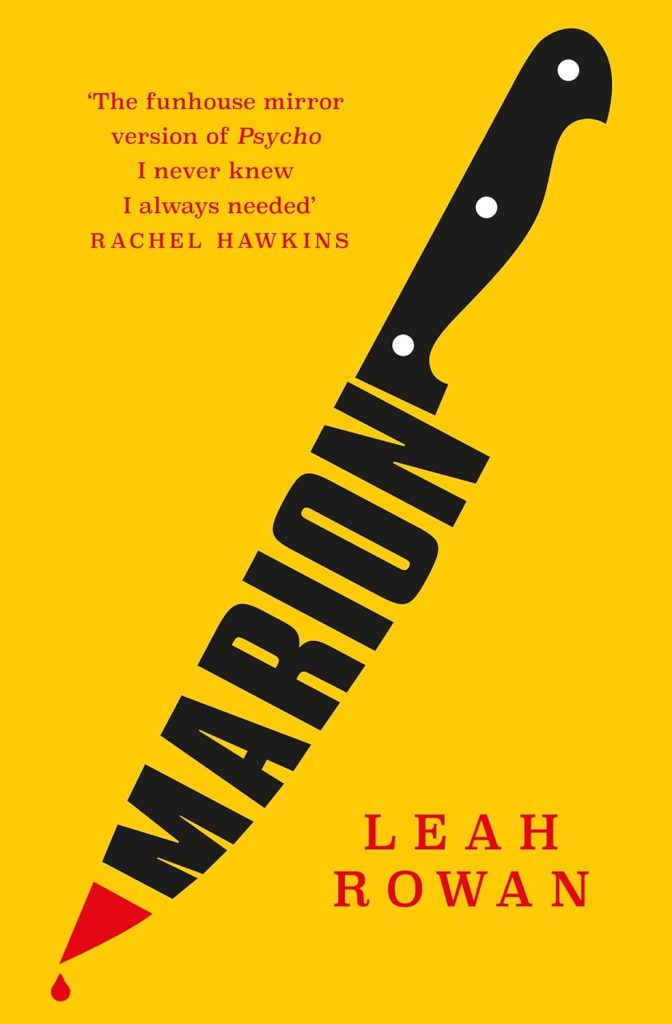
Marion | Leah Rowan | Titan Books | June 2, 2026 |
The most famous dead blonde in movie history gets up off the bathroom floor and takes the knife with her. Leah Rowan climbs inside the single most famous murder in horror and reverses it at the source, building dread like a cook builds heat, low and patient, until the air hums. A debut with the confidence of a writer who has been doing this for years.
The shower curtain rips back, and this time the blonde wins. She knees the man with the knife, takes the blade off him, and ends him on the wet tile while the late-summer heat still clings to her skin. That single swap of fortune is the spark for the whole book, and Leah Rowan lights it early. She does not make us wait for the famous moment. She rewrites it in front of us, then asks the question Hitchcock never let Marion Crane answer. What happens to a woman after she survives the thing that was built to kill her?
Marion is a feminist horror novel that wears the bones of Psycho like a borrowed coat, then tailors them into something sharper. Norm Billings runs a set of run-down cabins on the edge of town. Marion only stops there because her bus dies before it can reach Saratoga Springs. She is already in trouble. She has taken cash from the Manhattan ad agency where she works, all of it meant to get her sister Lauren out of a marriage that is grinding Lauren down. Marion is not a thief by nature. She is a sister keeping a promise. By the time she steps out of that shower, she is a killer too, and she is on the run.
This book moves. It hits like cold water, then keeps the pressure on.
The first kill is loud and fast. Everything after it tightens. Marion has a body, a stolen bag of money, and a sister still trapped a state away. Every choice she makes shrinks the space she has to move in.
What surprised me is how funny it is. The humour runs black and dry, and it never breaks the tension. It does the opposite. A sharp joke lands, I laugh, and then I remember what Marion is standing over while she thinks it. That gap between the wit and the blood is where the book does its best work on the nerves.
The pacing is brisk without feeling thin. Short chapters. Hard cuts. A clock that never quite stops. Rowan trusts speed, and she earns it, because under the speed there is a real person making frightened, furious, human decisions. I read late into the night and resented sleep for interrupting.
Rowan runs two points of view and lets them circle each other like two trains sent down the same track from opposite ends.
One track is Marion, close and raw, a woman improvising her survival in real time. The other is Hannah, a young private detective hunting for a missing girl last seen near that same motel. We know, long before they do, that these two lines have to meet. Rowan uses that knowledge against us. The dread is not only “what will happen to Marion,” it is “what happens when Hannah gets close.” That is a clever piece of architecture, and it pays off.
The voice is the other triumph. Rowan hooks you on the first page and keeps the grip. Marion narrates with a flat, wry steadiness that makes the violence land harder, because she rarely flinches and so the reader has to flinch for her. The prose is lean. Rowan does not crowd a sentence. She picks the one detail that matters, the cash counted twice, the blood on the curtain rings, the mother’s voice in Norm’s house, and lets it do its quiet damage without help.
And the ending rewards your attention. The pieces Rowan plants early, including the truth of Norm’s family and the shape of what Hannah is really chasing, lock together with a satisfying click. I went back and found the seeds. They were all there.
Strip away the motel and the knife, and this is a book about rage. Specifically, the rage women are taught to swallow.
Hitchcock’s Marion Crane existed to be punished and watched. Rowan takes that famous victim and hands her the agency she was denied. The result reads as an argument as much as a thriller. It says the woman on the bathroom floor was never just a body. She was a person with a history, a sister, a reason to run, and a capacity for violence that the original never imagined giving her.
Sisterhood is the beating heart underneath the blood. Marion does everything for Lauren. Their parents are gone, and a promise to their dying mother binds Marion to the role of protector. That promise is the moral spine of the book. Every terrible thing Marion does, she does out of love for someone the world failed to protect. Rowan refuses to let us look away from the cost of that love.
The book also speaks plainly to domestic abuse, and it does so without lecturing. Lauren cannot simply leave. She cannot afford to, not for a year, and Rowan understands that this trap is the real horror, quieter and more common than any motel killer. Marion’s crime spree is monstrous and illegal and, on the page, completely understandable. That tension is the point. The book asks how much a woman is allowed to do to save another woman, and it does not offer a comfortable answer.
There is a cultural nerve here too. The “icy blonde” was a Hitchcock fixation, the cool, controlled woman built to be undone. Rowan takes that figure and gives her a pulse, a temper, and a knife. Read in 2026, with the long argument about who gets to be the survivor in a horror story still going strong, Marion feels less like a gimmick and more like a reckoning.
The obvious touchstone is the source itself, which people forget began as a book. Robert Bloch’s 1959 novel Psycho gave Hitchcock his Norman Bates. Rowan goes back to that well and pulls something new from it, which is a bolder act than adapting the film. The natural shelf-neighbours are books, not movies. I would set Marion beside Grady Hendrix’s The Final Girl Support Group and Stephen Graham Jones’s My Heart Is a Chainsaw, both of which take the slasher’s treatment of women and turn it inside out. I would put it next to Rachel Harrison’s brand of funny, angry horror, and beside the sharp domestic menace of a Gillian Flynn, where female fury drives the plot rather than decorating it.
What sets Marion apart from that company is the specific audacity of the premise. Hendrix and Jones interrogate the slasher from the outside, through fans and survivors. Rowan climbs inside the single most famous murder in the genre and reverses it at the source. She does not comment on the trope. She overwrites it. That is a riskier and, to my mind, more thrilling proposition, and it points to where horror seems to be heading, toward stories that do not just feature women but hand them the narrative knife and let them carve.
There is a black comedy running through it that keeps the whole thing from curdling into misery, and that balance of dread and delight is hard to pull off. Rowan does it like she has been doing it for years. The most famous dead blonde in movie history gets up off the bathroom floor, and the genre she was killed to serve will not look quite the same once she has.
Marion by Leah Rowan
A bloody and wickedly funny twist on Hitchcock’s iconic classic Psycho. Trapped in a world full of sexism, abusive men and glass ceilings, Marion is on the run. Then one fateful night at a rundown motel, she turns the knife on Norm, kicking off a murder spree – and with the knife in her hands, she’ll prove she’s no victim.
NORMAN WAS HER FIRST.
Marion is in deep. She’s stolen money from the Manhattan ad agency where she works in a desperate bid to help her sister escape an abusive marriage, but the bus breaks down before she can make it to Saratoga Springs. It’s late at night, and the only place with vacancies is an old set of cabins on the outskirts of town. She pays for a room in cash, and ends up chatting with Norm, the young innkeeper who’s handsome, charming and a touch hung-up on his elderly mother. Back in her room, she steps into the shower, scrubbing off the late-summer heat, when the curtain is pulled back…
Norm Billings is there with a knife. He raises his arm to strike, but before he does, Marion knees him in the balls, grabs the knife, and stabs the life out of him. Now, she’s covered in blood, and she’s a woman on the run—not just a thief, but a killer, too. Where will she go? How will she save both herself and her sister? And what mysteries will she uncover as she does?
In Psycho, Hitchcock shocked audiences when he killed off his protagonist. But what if the leading lady had fought back? Marion offers an alternate history of the most famous dead blonde to ever grace the silver screen. Only this time, the knife is in her hands—and she’s no victim.