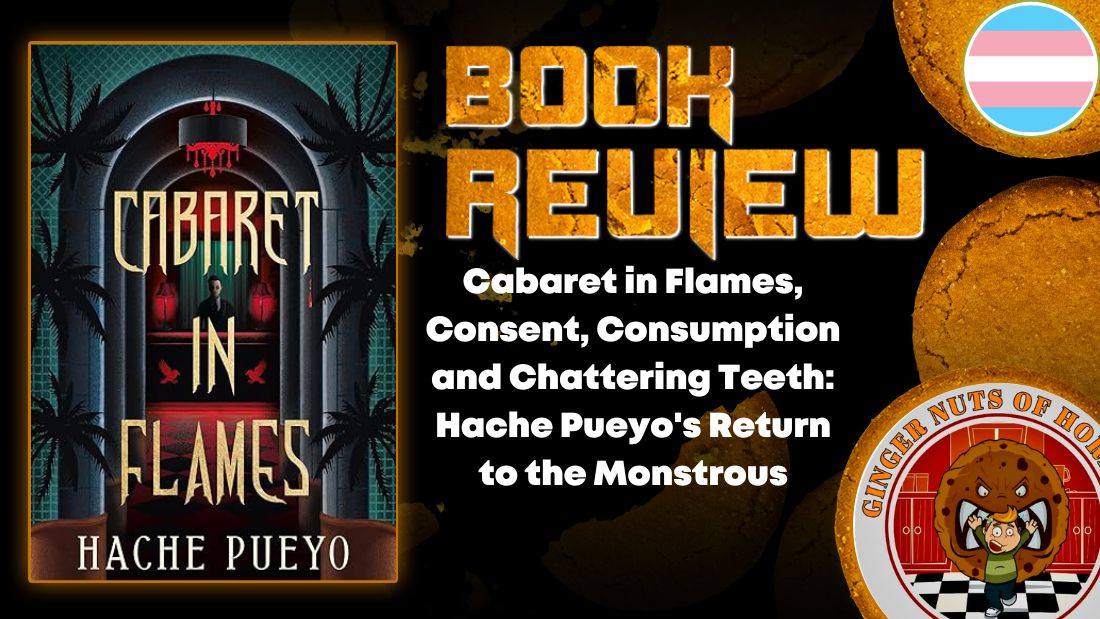
Some monsters wear sequins. Some wear scalpels. Hache Pueyo writes about both.
We carry our childhood horrors in the strangest places. In the hitch of a prosthetic limb. In the way we flinch when someone touches us too fast. In the quiet acceptance that the monsters who broke us might also be the only ones who understand.
Ariadne, the protagonist of Hache Pueyo’s new novella Cabaret in Flames, carries hers in a clinic. She treats Guls, flesh-eating predators who stalk the night streets of an alternate Brazil, with the same steady hands that once rebuilt her own body after they ate half of it. This is the central tension Pueyo wants us to sit with. Not the obvious horror of monster consumption. The quieter one. The one where the victim grows up to care for her attackers because the man who saved her taught her that healing and harm sometimes share the same address.
Pueyo returns after her 2022 debut, But Not Too Bold, with something leaner and meaner. That first novella played with gothic conventions in a Portuguese convent, all repressed desire and religious iconography. It was good. This is better. The author has shed any hesitations that might have lingered from that debut and committed fully to the viscera.
Cabaret in Flames, Consent, Consumption and Chattering Teeth: Hache Pueyo’s Return to the Monstrous
Erik Yurkov disappeared five years ago. He’s the man who pulled Ariadne from a pit of mutilated children—she was the only survivor, and built her prostheses with his own hands. He trained her in medicine, gave her purpose, and then vanished without explanation. She’s spent half a decade running his clinic, treating Guls for everything from infected wounds to complications from their particular diet, asking no questions, expecting no gratitude.
Then Quaint shows up.
Quaint is a Gul. Tattooed, charming, possessed of ten sets of teeth that can shred bone. He claims to be Erik’s oldest friend. He suspects foul play. He wants Ariadne’s help. And he looks at her like she might be more than just a useful human with steady hands and a dead-end routine.
What follows is part mystery, part reluctant partnership, part exploration of whether someone who eats people can also love them. The investigation takes them to Cabaré, an infamous Rio club where Gul elites gather to scheme and feed. The government, it turns out, might be more entangled with the predator class than anyone wants to admit. Erik might have known too much. Ariadne might have inherited more than just his clinic.
If But Not Too Bold was Pueyo learning to walk the gothic tightrope, Cabaret in Flames is her sprinting across it.
That first book had atmosphere in spades. The convent setting dripped with suppressed longing and the particular cruelty of women who have nowhere else to turn. But it sometimes felt like the prose was holding its breath, waiting for permission to really let go. The restraint was effective.
Not here.
Pueyo writes now with the confidence of someone who has spent the intervening years publishing short stories in Clarkesworld and Strange Horizons, honing her voice in smaller spaces before unleashing it on a novella. The sentences are sharper. The imagery lands harder. She trusts her reader to keep up, so she doesn’t slow down to explain. When Ariadne flashes back to the pit, to the children who didn’t survive, to the hands that reached for her in the dark, the transitions come without warning. They hit like memory actually hits. Disorienting. Brutal. Over before you’ve fully registered what happened.
Consider how she describes Ariadne’s body. The prostheses aren’t magical. They don’t grant her superhuman abilities. They ache. They chafe. They require maintenance, cause phantom pain, and occasionally fail at the worst possible moments. This is disability writing without inspiration porn, without tragedy narrative. Just the lived reality of a woman who lost half herself and built the rest anyway.
The Guls themselves get similar treatment. They’re not romanticised vampires in the Anne Rice tradition. They’re not political allegories standing in for oppressed minorities, as certain lesser writers would do with this material. They’re predators. They eat people. Some of them feel bad about this. Most don’t. Pueyo refuses to let us off the hook with easy moral frameworks.
One metaphor kept surfacing as I read: this prose is like watching a surgeon operate on someone she loves. Steady hands. Deep investment. No room for error. The clinical precision coexists with genuine emotion, and somehow both survive the encounter.
Look. We need to talk about the ending.
The romance between Ariadne and Quaint develops with that particular intensity that only happens when two damaged people recognise each other’s damage and decide to stay anyway. And then the resolution comes fast. Maybe too fast.
I read the final pages twice. The first time, I wanted more. The second time, I understood why I wasn’t getting it.
SPOILER
Pueyo isn’t writing a thriller. She’s writing a character study wearing a thriller’s skin. The question was never really what happened to Erik. The question was what happens to Ariadne once she stops treating the monsters and starts asking why they exist in the first place. The ending serves that arc. It serves the mystery less generously.
Some readers will find this frustrating. I found it honest.
Here’s where I digress for a moment.
Brazilian speculative fiction doesn’t get enough attention in English-language markets. We read so much from the UK and America. We translate less from Latin America than we should. Pueyo, writing in English while drawing on Brazilian culture and politics, occupies an interesting middle ground.
The Brazil of Cabaret in Flames isn’t just a backdrop. It’s character. The political chaos mirrors real instability. The class dynamics between humans and Guls reflect actual tensions around wealth and power. Cabaré, the club where Gul elites gather, exists in the same psychic space as the country clubs and gated communities where actual power concentrates. The monsters aren’t hiding in the shadows. They’re hosting galas. They’re funding campaigns. They’re eating whoever gets in their way.
This grounds the horror in something recognisable. We’ve all felt, at some level, that the people running things might not see us as fully human. Pueyo just makes that feeling literal.
If you’re looking for comparisons, Cabaret in Flames sits somewhere between Silvia Moreno-Garcia’s Certain Dark Things and the messy, complicated legacy of Anne Rice. It has the political specificity of the former and the obsessive relational focus of the latter. It also shares DNA with Cassandra Khaw’s work, the bodily horror, the lush prose, the refusal to look away from ugliness. Khaw herself blurbed the book, calling it something that “eats up every scrap of your attention and demands you hang on by the tendon.” That’s accurate.
The book also engages with questions of consent in ways that feel particularly urgent. Ariadne’s childhood trauma involved adults who treated children as food in every sense. Her adult life involves choosing, again and again, to enter spaces where she could be consumed. This isn’t presented as pathology. It’s presented as survival. When you’ve already been eaten once, you stop fearing teeth as much.
Cabaret in Flames won’t hold your hand. It won’t explain itself. It won’t give you the satisfying resolution where the good guys win and the bad guys lose and everyone goes home with their moral clarity intact. What it gives you is Ariadne. Steady-handed. Scarred. Rebuilt. Walking into the dark because the dark is where her people are.
Some monsters wear sequins. Some wear scalpels. Hache Pueyo writes about both.
And she trusts you to know the difference.
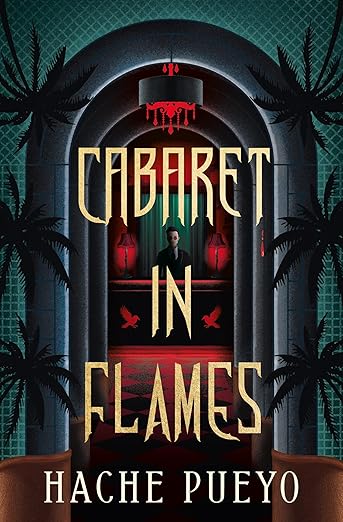
Cabaret in Flames by Hache Pueyo
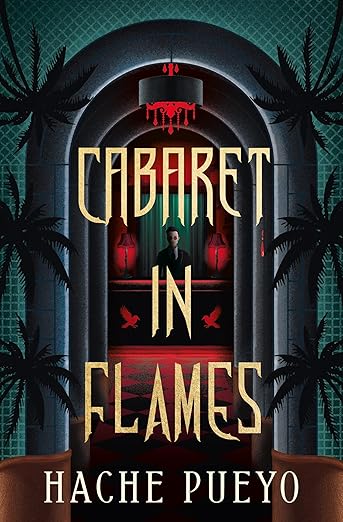
A riveting Latin American dark horror-fantasy about two survivors finding one another amidst monstrous creatures and a brutal political regime, perfect for fans of Silvia Moreno-Garcia and T. Kingfisher
Guls can be brutal. Few people know this better than Ariadne, who lost half her body to their appetites, but she finds their brutality a predictable constant amid the political chaos of Brazil. Now she treats them in the specialized clinic she inherited from Erik Yurkov—the mentor who rescued her from captivity as a child, trained her in medicine, built her prostheses, and then disappeared without a trace.
Ariadne’s routine is disturbed when a dapper gul covered in tattoos knocks on her door, introducing himself as Quaint and claiming to be Erik’s oldest friend. As unsettling as the presence of a healthy adult gul can be, there is something familiar—almost intimate—about him. Quaint suspects foul play in Erik’s disappearance, and his suspicion proves real when they discover Erik sought asylum at Cabaré, an infamous club in Rio de Janeiro frequented by the gul elite.
Together, Ariadne and Quaint will unravel the conspiracy behind their friend’s disappearance, navigate the labyrinthine world of Ariadne’s memories, and discover what Erik means to them—and what they are starting to mean to each other.
Horror Book Reviews: Ginger Nuts of Horror, Your Premier Horror Website for 17 Years
For every horror enthusiast searching for authoritative horror book reviews and a definitive horror website, your journey ends at Ginger Nuts of Horror. As a trusted pillar of the dark fiction community, we have spent over 17 years building a reputation for the most passionate, insightful, and credible coverage in the genre.
Our dedicated team of reviewers lives and breathes horror. Our collective expertise, forged over nearly two decades, ensures every review is a deep, critical analysis. We don’t just summarise plots; we dissect the terror, explore the thematic depths, and connect you with the very emotional core that makes horror books so compelling.
Why Ginger Nuts of Horror is the #1 Resource for Horror Fans
Unmatched Depth & Legacy in Horror Book
Reviews: With 17 years of reviewing horror, we offer an unparalleled perspective. Our reviews expertly guide you from mainstream bestsellers to under-the-radar indie gems, helping you find your perfect, terrifying read.
Exclusive Access to Horror Authors: Go behind the scenes with in-depth interviews that reveal the minds behind the madness. We connect you with both legendary and emerging horror authors, exploring their inspirations and creative processes.
Award-Nominated Authority & Community: Founded by Jim McLeod, Ginger Nuts of Horror has evolved from a passion project into an award-nominated, essential horror website. We are a global hub for readers who celebrate horror literature in all its forms, from classic ghost stories to the most cutting-edge dark fiction.
Experience the Difference of a Genre-Dedicated Team
What truly sets us apart is our dedicated team of reviewers. Their combined knowledge and authentic enthusiasm ensure that our coverage is both intelligent and infectious. We are committed to pushing the genre forward, consistently highlighting innovative and boundary-pushing work that defines the future of horror.
Ready to dive deeper?
For horror book reviews you can trust, a horror website that champions the genre, and a community that shares your passion, Ginger Nuts of Horror is your ultimate destination. Explore our vast archive today and discover why we’ve been the top choice for horror fans for over 17 years.