

- Carlyn Greenwald on Her Queer Slasher What Happened to Those Girls
- What Happened to Those Girls: Review of Carlyn Greenwald’s Chilling Thriller
The friend group doesn’t fall apart when the killer arrives; it’s the reason they die.
Carlyn Greenwald | What Happened to Those Girls | Sourcebooks Fire | June 2026 |
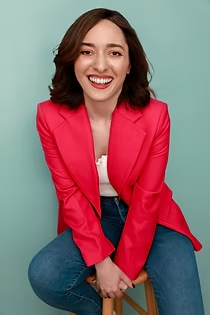
Carlyn Greenwald started with a podcast about The Blair Witch Project and one nagging question: why do horror stories build these knotty group dynamics, then drop them the second the monster shows up? What Happened to Those Girls refuses to drop them. Her new sapphic YA thriller follows Emma, bisexual, Jewish, autistic, the outcast left behind when her toxic friend group is slaughtered in the woods, as a whodunnit forces her to grieve people who were rarely kind. Greenwald, also the author of Murder Land, talks about survivor’s guilt, body horror she’s almost too squeamish to write, and the Yellowjackets spark behind it all.
Carlyn Greenwald on Her Queer Slasher What Happened to Those Girls
Your new YA thriller, What Happened to Those Girls, is being pitched as “Queer Mean Girls meets The Blair Witch Project.” That’s such a compelling and specific combination. Can you tell us how that unique blend came together in your mind? Which elements from each of those touchstones did you most want to explore?
The Blair Witch of it all came first. I was listening to a podcast where they were doing a retrospective on Blair Witch, which I had never seen. They were specifically talking about how part of the stress of the film comes from these three young people put together with an already strenuous dynamic that only gets worse as the hours wear on.
They must’ve then made some joke about other people who didn’t get to join the project and it got me thinking: isn’t it interesting how so many horror stories set up these complicated dynamics that tend to just fall away when the monster shows up? I then wanted to write a story where complicated group dynamics don’t go away, and in fact lead to characters’ downfalls. So, naturally, what’s more complicated and brutal than teenage girls in a toxic friend group? So, the Mean Girls comp came through.
The inspiration for the book reportedly came from you asking yourself, “Would I have survived a slasher in high school?” and concluding, “I wouldn’t have been invited to the party where the slasher took place.” That’s a brilliant and painfully relatable starting point. How did that initial, slightly funny thought evolve into the full-blown, intense thriller you’ve written?
So, going along with the answer to the first question: I had my complicated friend group go through a slasher story thing. But when I thought about my protagonist, I was also thinking about what happens to a community if a whole group of teens just die brutally one night via a slasher story? Then, I thought about how there were probably friends who were left behind. And thus, Emma. I really wanted to play with survivor’s guilt and honestly, a friend dynamic I’ve been a part of through various degrees in my life.
I will never forget this Dane Cook sketch about “the friend that no one likes” and how when you’re young, if you happen to not be that friend, you can be talked into staying quiet about horrendous treatment of a so-called friend all because what? They’re more awkward than everyone else? Easier to make fun of? It’s a horror story in and of itself and felt like the perfect in to this “aftermath of a slasher” novel I wanted to tell.
Your previous thriller, Murder Land, was also well-received. In what ways did writing that book prepare you for the challenges and scope of What Happened to Those Girls, and how did you actively push yourself to go further this time, especially with the horror elements?
The funniest thing about Murder Land was that I probably read 1-5 bad reviews that had me completely convinced that I had to write WHTTG differently than ML. That’s more the bad impulse, but the good one was that I love stretching my craft beyond what I’ve done before. Murder Land is an ensemble cast, darkly funny at times, and deals with a very manmade setting.
So, I wanted WHTTG to be very different: we primarily follow two characters, it’s a very moody book, and the main setting is the woods. The only thing that really connected them was a bisexual Jewish protagonist and the theme of grief, which I loved. It set me free in a lot of ways to draw from inspiration I’d taken in in the couple years since I drafted Murder Land.
And in that time, I’d watched a lot more horror movies and really wanted to play up what I could do with spooky atmosphere and gore/body horror. I’m squeamish by nature, so when my brain thought up the image of the broken off fingernails, I was delighted to see that all my media consumption was paying off. It’s a muscle I continue to hone into my future projects and I’m so happy with where the horror elements ended up in Girls. It’s brutal, but precisely the right amount for the story I’m telling here.
Emma is described as a bisexual, Jewish, autistic teen. You’ve mentioned that her neurodivergence, with special interests manifesting in a “fangirl”-ish way around media, is similar to your own experience. Why was it important for you to create a character like this for the YA thriller space, and what was your process for ensuring her inner world felt so authentic?

I think part of the important work in writing – but especially writing for young people – is being able to show a mirror to those readers. Each book, I will often take from a small part of myself that made me feel small or weird or unlikeable as a teen and show it with grace and love. I’ve never been formally diagnosed as autistic, and really didn’t even see myself beyond “weird” until my mid-20s, but the hyperfixations have always been a part of my life.
I was Emma when I was a teen. Luckily, I had a group of nerdy friends who never minded when I wanted to talk about whatever that fixation was, but I didn’t fully find people like me until college and beyond. There may be another teen out there who won’t meet another person who has the same hyperfixations and social awkwardness and whatever else until they’re older. So Emma may be their first mirror and that’s an incredible thing.
As for crafting her inner world, oh, that was one of the most fun parts. So my hyperfixations always form around actresses – I’ll watch one movie that my brain latches onto and then I’ll watch all their interviews, other films/TV, and often will “cast” them in whatever novel I’m writing to form a deep connection between this dopamine soaked part of my brain and my creative work.
Emma isn’t me, though, so I didn’t want her to have any of my fixations (and she does visual art whereas I do writing). I also didn’t want her obsession to be someone who was relevant now. So, I took a leap and gave her a sort of icon of horror for a hyperfixation: Winona Ryder.
As a sapphic, I don’t think it’s unusual to look up to older women and Emma’s a bit of a dreamer who likes to be out of space and time. Once I picked Winona, I got to do my usual process: watch her older interviews, her movies, really pick out what someone like Emma would’ve loved about her. So, long story short, I created Emma’s inner world by using my own as a template but filling it in differently.
One reviewer praised Emma’s “interior world,” calling her a “believable as a somewhat awkward, autistic teen girl who struggles interpersonally, but is tougher than she appears and has deep integrity.” How do you balance showing her vulnerabilities with her inner strength, especially when she’s under the extreme pressure of a murder investigation?
I think that in storytelling, we will often have characters stuck at a statis in their lives and it would truly take something huge happening for them to face their fears and grow. Emma is that kind of person: she wants so deeply to stand up to her friends, but is too scared of the social rejection; she has crushes, but can’t talk to them, preferring to keep her sexuality and crushes limited to admiring a celebrity she can never date for many reasons.
So, for Emma, I loved creating a situation so unique and intense that she had to grow. She had to face her friends and the way they treated her, she had to spend time with Beck and be vulnerable, and she’s stronger for it. I also love a character who bares it all emotionally in their inner world who slowly starts to say these things out loud, and writing that journey for both Emma and Beck was such a joy.
And as for balancing inner strength and vulnerabilities, I see all my characters as human and from there, I’ll allow them to react to the situation as they naturally would, knowing that I’m writing a character with an arc where she hopefully comes out of the book having learned something.
Emma’s status as the “outcast” of her friend group is the inciting incident for the entire story. Can you talk about writing the dynamics of that friend group? What did you want to convey about friendship, exclusion, and the complexity of grief when the people you’ve lost were not always kind to you?
To some extent, I started out with each of the girls representing a different reaction to there being an outcast within a friend group: Paisley is the leader, the one who set up this toxic dynamic and places her friends against each other like puppets; Harlow is deeply insecure and sees Emma as “competition” for Paisley’s love, so she leans into Emma being the weaker link to seem cooler herself; Opal is the one who knows this is a bad thing to be doing, but is too scared to break the mold and call anyone out; Emma is the outcast who can’t stand up for herself.
From there, I ask who are each of these girls as fully formed people; how did they get to falling into these more simplified roles?
As for inspiration, I touched on this a bit earlier, but the idea of “the friend no one likes” has always been a source of pain, shame, and fascination for me. I’ve been in friend groups where I’ve felt like the weird one, the one who talks about subjects no one cares about where I’m unsure what we’re doing together as friends. I’ve been in friend groups where group chats have been full of snide remarks about the person deemed “the friend no one likes” and kept my mouth shut. I’ve tried to befriend the friend no one likes.
I think, ultimately, the message of this book is don’t be friends with someone you don’t like – but also acknowledging that if you ever were a friend participating in making fun of that person that it’s okay to say that was a mistake and be a better person. The one thing I wanted to say with Paisley, Harlow, and Opal was that every girl could’ve become a better person, but their deaths cut that growth short and that’s tragic.
And I think that plays into Emma’s (and Beck’s) grief: that it can still be horrible to lose someone who was mean to you because humans all have the capacity to change and cutting that change off at 17 is awful. But I was also happy to create a space where Emma and Beck could both acknowledge the pain caused by them as well as that truth about tragedy. Basically, everything is nuanced.
You’ve mentioned your protagonists are often “total disasters.” How does Emma fit into that tradition, and in what specific ways is she a “disaster” that readers will still root for?
Funny enough, I’m not sure how much of a disaster Emma is! I actually think she’s one of the most “together” of my protagonists, bar perhaps the moment where she loses it and drives out to the campsite and slashes some tires. So, I guess she’s one of those “bottle everything up and then explode” disasters. And I think that trait is really relatable to folks, especially those of us who are scared of confrontation and then have to deal with these emotions growing and becoming utterly unwieldy.
Plus, Emma is an underdog: she starts off being the butt of everyone’s jokes despite not doing anything to warrant that, so I think we (or at least I) want her to find some inner strength and abandon her bad situation. And yes, she does have her toxic friend group taken from her, but she also kind of chooses to leave it at the end, which I love. Plus, she loves horror movies and if you’re reading this horror-thriller, I assume you do too. She’s got kind of meek, nerdy final girl energy.
The book is described as having “interstitial chapters that depict videos that take place on the night of the murders.” This is a fantastic device to build tension and give the reader crucial information. How did you approach writing these sections to make them feel distinct and more “horror”-focused than the rest of the narrative? What effect were you hoping to achieve?
My writing, especially in first person, leans toward conversational. So, interstitials where I get to move to a close third are my absolute favorite because I can manipulate the prose to do more heavy lifting. In the case of the interstitials, I focused on fear: atmosphere of a creepy forest, each character’s personal fears, the feeling of paranoia closing in as the girls’ relationship deteriorating creates an unsafe space to really say “let’s go back.”
The rest of the book is more mystery/thriller than straight up horror, but I wanted these interstitial chapters to feel like they’re out of a classic horror novel. Because Paisley, Harlow, and Opal are going through a slasher, so I wanted it to feel that way.
You’ve mentioned this book contains more intense body horror and gore than Murder Land, mentioning things like teeth and fingernails. As a writer, how do you approach writing graphic content for a YA audience? Where do you draw the line between creating genuine, unsettling horror and being gratuitous?
To be honest, I hope that my own history of being too squeamish for gore keeps me in check. But otherwise with YA, I think there’s a responsibility to never venture into a sort of sick enjoyment of the gore, or “torture porn” with teenage characters. I never want to show them suffering without it relating to the themes or being extremely important to have that horrific act of violence put against them.
I was especially careful as we get to actually revealing the murders – in an adult book, perhaps I would’ve shown more of it on the page, but with YA, we get the basic actions done (ie. rock to the head, strangulation, fingernail ripping) but what matters showing any of those moments on the page is the emotion. It’s actually the same principle I use writing sex and sexuality in YA.
You’ve spoken about your background in film and screenwriting. How did that visual storytelling background influence the pacing, the suspenseful set pieces, and the overall atmospheric dread in What Happened to Those Girls?
Every book I write starts off with Joseph Campbell’s Hero’s Journey beats, something everyone learns in screenwriting classes. It allows me to have tentpoles to keep the plot moving. This is all the more important in a thriller, so I can’t imagine not using this method.
I also follow a lot of the advice filmmakers have given when it comes to suspense. Hitchcock and the bomb is one of my favorites, about the idea of surprise versus suspense based on what information is given to the audience/reader when. From there, I always see my books as movies and have even gone so far as to write a scene I’m stuck on as a screenplay scene; it allows me to peel a scene down to what has to happen and what’s the most efficient way to get that information across?
Then, with the dread, I think knowing visual language helps, but it’s also a very novel-specific skill, being able to pull from the five senses to create a feeling. I’ve been trying to hone the skill with my YA thrillers and I’m so delighted to develop a new atmosphere for each book.
A key part of the story is the “trauma-bonded sapphic romance subplot” between Emma and Beck, the sister of one of the victims. In a story filled with so much suspense and fear, how did you approach building a believable and heartfelt romantic connection between them?
I think joy shines brightest in stories that are otherwise about sadness and fear. So, in a story that is so much about social rejection, I wanted Emma to have a positive relationship build out of this trauma she’s experiencing. I’m a sucker for a couple who find joy and support through a shared hardship; I think it adds a certain weight to the romance that’s always appealed to me as a lover of angst in a romantic pairing. It makes the romance about discovery, firsts, and mutual healing, which is so lovely to me.
Beyond that, the Emma/Beck pairing actually comes from a wayward thought I had watching Yellowjackets, how Natalie and Misty were essentially two sides of the same coin. One was an outcast for being too sexual, too edgy, too mean, and the other an outcast for being too meek, too geeky, too weird. Polar opposites, but still suffering from not fitting the mold of their larger team. I thought it would be so fun to have two opposites like that be able to see that common thread of being an outcast and the power in each other’s views of the social norms they reject/that reject them.
And above all else, I wanted Emma to have a relationship that really valued her neurodiversity and Beck felt like the perfect character to do that. In turn, Emma provides Beck with a soft space to land when her world is so largely populated by pressure and expectation.
How does the romance with Beck complicate Emma’s journey? Does finding this connection help her process the trauma of her friends’ deaths, or does it create new conflicts and vulnerabilities for her while she’s trying to solve a mystery?
To me, there’s a surface level of complication in that she thinks her growing relationship with Beck can fold like a house of cards if she finds out she went to the campsite that night, but ultimately, Beck is a net positive for Emma (and Emma a net positive for Beck).
I think Emma’s in a unique situation in that she was the only person who really knew all the girls intimately and therefore knew what she was losing. Beck is the next closest person, someone who had a deep relationship with her sister and knew of all her friends given how close they were in age. It’s so difficult to grieve alone and I wanted Emma to have someone who understood what she was going through – and moreover understood that her friends were not kind people and that that grief would therefore be complicated.
I love when a romance provides both a source of stress and a source of comfort among a mystery plot. The stakes are high and I believe that that makes people crave human connection more. The scenes of Emma and Beck bonding in the tent and holding onto each other when things get scary and, yes, the kiss they share in the watchtower all felt very natural to me.
The one thing I keep in mind as a writer is that those moments need to follow an emotional logic. For instance, they won’t be kissing if they’re immediately worried about being killed by someone in the woods. Once that threat is in the vicinity, kissing stops. But before then, when they’re still wondering if they are being stalked? Fair game.
Grief, betrayal, and guilt seem to be central themes. Emma is also worried about being the prime suspect. How does the external mystery of “whodunnit” serve as a vehicle for Emma to process her own internal feelings of guilt and grief over being left behind and the angry voicemail she left?
The book would – and could’ve been – an entirely different book if it didn’t have the whodunnit. In some alternate universe, this book could’ve been about an outcast whose friends die and she has to deal with grieving while processing that she didn’t like them as people/they hurt her. In some ways, before we get to the woods, that is the story. But I think that story would’ve been too heavy for me to write.
I want to touch on the topic of grief and survivor’s guilt, but I needed a, shall we say chaser to help those themes get woven in. So, the whodunnit comes into play – it picks up the pace, makes the book more fun, and if I crafted my mystery correct, should complement the guilt and grief themes. Each element should anchor the other; the whodunnit keeps the book from becoming too heady and the themes add a layer of substance beyond the suspense. Ultimately, Emma’s journey needed both.
You’ve successfully written adult romcoms and YA thrillers. Do you find that you have a different “writing muscle” or mindset for each genre and age category, and how does switching between them keep your creativity flowing?
Between romance and thriller, oh, absolutely. Tone is different, the kinds of anecdotes characters tell to develop themselves and their worlds are different, figurative language is different, and pacing is different. There’s more room for character development tangents in romance, more space for exploration of sex and sexual feelings, and love interests, even the most realistic, will have an air of escapism/idealism in them.
In my YA thrillers, the romance can be more messy/realistic in an undesirable way; the focus will always be on the murder aspect a little over character (although not by much; I love character), and it can be a little more…shall we say, gross. But I have gotten the chance to write my first adult thriller and that’s a whole other ballgame. In that world, everything goes – the sex can be graphic, a book can explore really, really heavy themes with a bit less hand holding, the violence can be brutal, and, well, characters can have expertise in a way that they can’t in YA.
I do try to separate all these different genres and age categories, but I’ll admit I rely on the expertise of my editors so much to get it right. Sometimes my YA editor has to tell me to cut something that’s too violent or too crass. Sometimes my adult editor has to get me to make my protagonist more of confident to match their age or to not pull a punch. And one time, my adult thriller editor had to tell me that I wrote my sex scenes more graphically than the murder scenes, so sometimes the romance writer brain seeps into my thriller novels.
In a world where readers have infinite choices and limited time, why this book?
If you’re a thriller/horror reader, inherently you should be seeking out new voices, right? You’ll never read a book quite like how I do a thriller, so why not experience that? Plus, I think it’s a unique combination of urban legend horror, fraught friendship dynamics, and murder mystery with a fangirl protagonist.
If you could whisper one thing in a potential reader’s ear at the bookstore, something that captures what this story holds, what would it be?
Misty and Nat from Yellowjackets solve a triple homicide (and it’s gay).
What can readers who fall in love with What Happened to Those Girls look forward to from you next? Are you staying in the YA thriller space, or are you itching to tackle a new genre or format?
I am both staying and venturing out! My next release after What Happened to Those Girls is called Killing Time, out with Scout Press/Gallery Books in Summer 2027. It’s an adult speculative thriller about the daughter of an executed serial killer convinced her mother was innocent who is sent back to 1994 right before the murders and becomes hellbent on discovering the true killer.
We’ve been pitching it as MY SISTER THE SERIAL KILLER meets BACK TO THE FUTURE and that pretty much captures it. Think “good for her” (while not knowing if the mother is a serial killer or just a traumatized weirdo), the hijinks of George and Marty McFly, but they’re roommates and George thinks Marty is trying to Single White Female him, a little romance with a hot grunge Blockbuster worker, the vibes of the Double R Diner in Twin Peaks but set in a dusty Central California city in 1994, and a whole lot of blood.
As for YA, I’m not sure what’ll be announced, but let’s just say there is a YA4, I’ve pitched it as “Elle Woods (and Bruiser) vs clowns,” and I cannot wait to say more about it!
What Happened to Those Girls by Carlyn Greenwald

Pretty Little Liars meets The Blair Witch Project in this harrowing thriller from the author of Murder Land, brimming with betrayal, unsettling town secrets, and a killer lurking in the woods.
Emma knows her friends all lie to her. And everyone knows Emma is the outcast of their group. She’s usually fine with that, until her friends go on a camping trip that she planned…without her. The next morning, she wakes up to the news that all three of them died at the campsite.
When Emma starts receiving unnerving videos of the girls the night they died from an anonymous source, it becomes clear their deaths weren’t an accident. And if this becomes a murder case, Emma will be suspect number one. Because while everyone knows she had been excluded from the plans, what they don’t know is that she went to the campsite that night after all, and someone has proof.
Emma teams up with Beck, one of the victims’ sisters, to return to the woods and figure out what really happened the night her friends died, uncover who is behind the mysterious videos she is receiving, and make sure that nobody can pin their murders on her. But stranded in an eerie town that doesn’t welcome outsiders with a murderer on their heels, Emma and Beck just might be next…