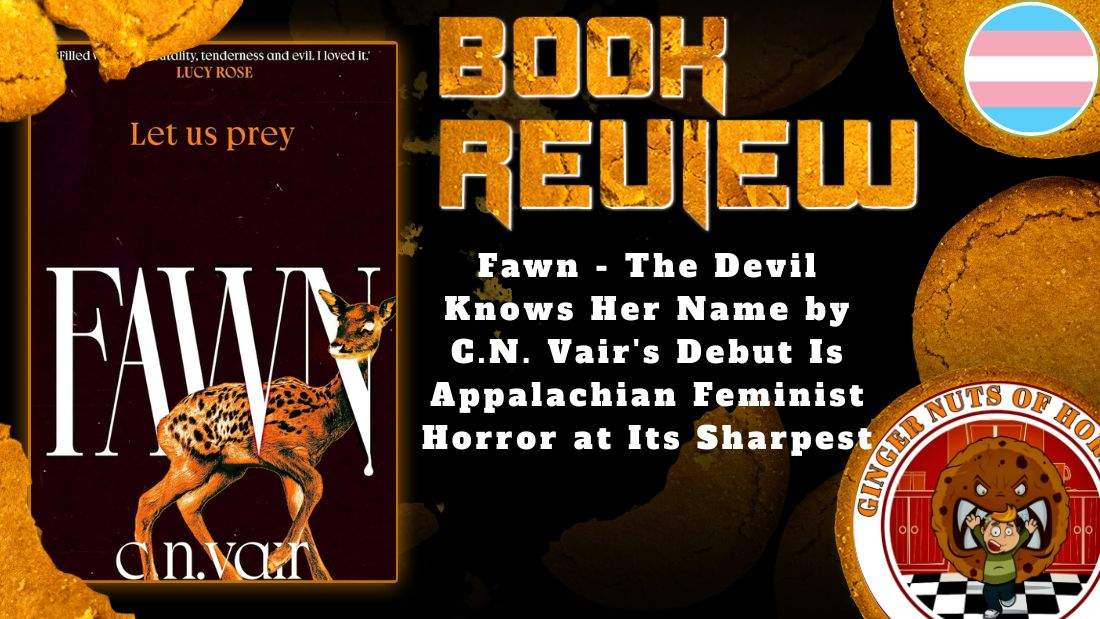
- Fawn – The Devil Knows Her Name by C.N. Vair’s Debut Is Appalachian Feminist Horror at Its Sharpest
- C.N. Vair Interview: Magic, Malice & Appalachian Horror
C.N. Vair arrives with Fawn, otherwise known as The Devil Knows Her Name, and Appalachian folk horror gains a writer who understands exactly what the sub-genre can carry. Set in the isolated town of Burrsville, this debut follows Tess Wynne, a century-old witch bound to her land by a bargain she made to survive, who tends a wildlife sanctuary and turns the devil away each autumn. Vair brings a former journalist’s precision to the prose and a genuine ecological intelligence to the horror. Sharp, slow-burning, and rooted in feminist argument, this is one of the most fully-realised folk horror novels of 2026.
The devil may have gone down to Georgia, but C.N. Vair knows he belongs in Appalachia. Her debut is folk horror with genuine ecological intelligence, a feminist argument sharp as new teeth, and a vision of witchcraft that is raw, costly, and nothing like what the internet sold you. The Devil Knows Her Name is assured, specific, and entirely its own.
Fawn – The Devil Knows Her Name by C.N. Vair’s Debut Is Appalachian Feminist Horror at Its Sharpest
Tess Wynne has been dying for a hundred years, and she is very good at it.
That is the unsettling mathematics at the centre of C.N. Vair’s debut folk horror novel The Devil Knows Her Name: a woman who bargained her way out of death and has been paying the interest ever since, bound to a patch of Appalachian land, tending her wildlife sanctuary, turning the devil away each autumn with the kind of deliberate refusal that only someone who has rehearsed it for a century could manage. That’s a premise with weight behind it. Vair doesn’t squander a gram of it.
This is slow-dread horror. Not the kind that jolts you with sudden violence, though there is violence, and it is earned, but the kind that makes the back of your neck tight on page forty and keeps it that way until the final line. The atmosphere builds the way fog builds, not with a single dramatic moment but through accumulation: a sanctuary that feels too quiet, a fawn that feeds wrong, a new pastor whose smile sits just slightly off his face. Burrsville is a town that watches. Vair’s prose captures this communal surveillance with precision, so that the horror is social and ecological and supernatural all at once, layered so that pulling at one thread tightens the others.
Vair is a former journalist, and it shows in the discipline of her sentences. Nothing sits on the page without earning its place. Her chapter construction is deliberately unhurried in the first half; scenes breathe, the natural world is rendered with specific and tactile attention, the land around Burrsville becomes a character with its own logic and appetite. Then, at a point that feels simultaneously unexpected and inevitable, the pacing shifts. Urgency enters the prose without the prose changing register. It’s not acceleration through spectacle but through compression: shorter scenes, tighter dialogue, Tess’s interiority growing sharper as the external pressure increases.
The POV choice is first person, close and retrospective in tone, which suits the material precisely. Tess has had a hundred years to make sense of her bargain; she narrates with the wry, careful authority of someone who has considered every sentence at length. At the same time, Vair keeps genuine uncertainty inside the voice. Tess’s self-possession coexists with real vulnerability. She knows what the devil wants. She doesn’t always know what she wants. That tension, maintained across the whole book without resolving it artificially early, is a significant achievement.
The dialogue is sparse and well-aimed. Vair doesn’t over-explain her characters through conversation. The new pastor, whose name I won’t give since his arrival, is something to discover, says very little that should alarm anyone, and that is exactly the point. The horror of polite, institutional menace is that it arrives in complete sentences with correct grammar and a reasonable face. Vair understands this and uses dialogue to show us the gap between what is said and what is meant.
Her prose is like a field that looks flat until you walk it: each step reveals a slight incline, a hidden root, a drop in the land that wasn’t visible from any distance. You don’t notice how much you’ve climbed until you turn around.
The fawn itself, the creature Tess rescues despite every instinct telling the town it should be killed, is one of the more quietly disturbing presences in recent horror fiction. Vair never makes it cute. It is red-mouthed, full-toothed, wrong in its appetites, and Tess’s refusal to put it down despite knowing better is the novel’s central act of defiance, which is also its central act of self-recognition.
The witchcraft in this novel deserves particular attention because Vair refuses to make it pretty. This is not the kind of magic that photographs well. It is raw, dangerous, and costly, rooted in the land and in the body, demanding something real from the person who works it. Vair makes a point early that lands like a slap and stays with you: the women burned during the witch trials weren’t witches.
They were healers, midwives, housewives, women who knew too much about herbs or kept to themselves or simply annoyed the wrong man. Real witches, the novel implies with cheerful menace, would have been a rather different problem for the people holding the torches. It’s a small observation, almost offhand in its delivery, but it reframes everything. Tess is what those women were accused of being. And look at what she can do.
There is also, woven through the novel’s treatment of magic, a quiet and well-aimed contempt for the aestheticisation of witchcraft, the Instagram altar, the TikTok ritual, the carefully curated image of power without the cost that power actually demands. Vair never names this target directly, but she doesn’t need to. Every scene in which Tess works her craft makes the point by contrast. This is not a photogenic practice. The magic in The Devil Knows Her Name is structural, specific, and deeply embedded in landscape and community: what grows in the soil, who has stood on this ground, what the seasons demand, what debts the land carries.
People and place become entwined in it, each drawing on and adding to the other’s power, so that by the novel’s latter half, to threaten the sanctuary is to threaten the magic, and to threaten the magic is to threaten every relationship Tess has built over a century. The system is thought through with the kind of rigour that makes fictional magic feel like it could actually work, and that rigour makes every escalation land harder.
Strip away the folklore and what The Devil Knows Her Name is arguing is this: women who survive violence are not supposed to thrive. They are permitted grief, permitted endurance, permitted a small and quiet life. What they are not permitted is full, uncompromised possession of themselves and their land.
The original attack on Tess, the act that drove her to bargain, belongs to a recognisable catalogue. A man she trusted. An act of violence she was not supposed to survive, let alone transform into something like power. The novel doesn’t dwell on this backstory but it doesn’t have to. The whole structure of the book is built on its logic. A hundred years of holding land, holding community, holding off a devil who visits annually and makes his offer with devastating courtesy: this is what survival looks like when survival is treated as defiance.
The environmental dimension is not incidental. Tess’s sanctuary is both literal and figurative. She protects small creatures. She works the land rather than extracting from it. The new pastor’s threat is not only to her personally but to the ecosystem she has spent a century cultivating. Vair draws a clear, sharp line between the pastor’s vision of land as resource, to be used, managed, consumed, and Tess’s vision of land as relationship, reciprocal and demanding and alive. With the irony of the Christian faith being the ones wanting to destroy the only real Eden left on earth.
The way the novel explores the fragile dynamics of friendship and loyalty is another fascinating element of the book. Tess, once beloved by some and mistrusted by others, mainly the men in power of the town, rapidly descends into fear, hatred, and a willingness to destroy her life. This happens with a whiplash so powerful I’m surprised some of her friends didn’t break their necks.
And yet this is so real; these days, there is such a strong need to be seen as in the right crowd that the speed at which she is abandoned, despite her protective magic, is heartbreakingly real.
In this she situates The Devil Knows Her Name within a tradition of eco-horror that treats environmental destruction not as backdrop but as moral argument. The land in this novel has memory. It knows who has tended it and who has taken from it.
The fawn, then, is not just an animal. It is inheritance made flesh, feral and sharp-toothed and deeply inconvenient, the thing that must be kept alive even when keeping it alive is dangerous. What a woman must become to hold what is hers. What the land demands in return. Vair’s novel asks this question and offers a complicated, costly, and deeply satisfying answer.
The Appalachian setting carries its own freight. This is a region that American literature has long used as shorthand for backwardness, superstition, and danger. Vair neither romanticises it nor condescends to it. Burrsville is specific, detailed, and socially textured. The folk traditions Tess practises feel like research married to genuine care. The witchcraft here is not theatrical. It is domestic, botanical, cyclical, embedded in how you plant and when you harvest and what you burn. This is Old World folklore given American roots without losing the Old World’s understanding of what bargains cost.
When the sentence that is being used as a publishing tag line, “Stupid, stupid man. You don’t turn your back on a predator” appears in the novel, sit down and take a breath before reading the next sentence, I was on the bus to work at that point in my reading. And I let out a “fucking hell”. Such was the brilliance of the tonal shift at that point. Any sense of whimsy and cosiness, for want of better terms, are boiled in fire and spat out.
The Devil Knows Her Name is C.N. Vair’s first novel. This matters because first novels so often show their seams, the places where confidence fails, where backstory clogs the middle, where the ending doesn’t quite trust itself. None of that is present here. There is a composure to this book that reads less like a debut than like a second or third novel from someone who had been quietly figuring out exactly what they wanted to say for a long time.
Vair’s journalism background explains some of this. Years spent writing to specific word counts, to deadline, with precision as a professional requirement, leave traces. Her sentences don’t waste your time. Her scenes move because she knows when a scene has done its job.
What this debut unmistakably establishes is a set of preoccupations that feel like the beginning of a significant body of work. The haunted corners of small towns. The magic and malice of the natural world, a phrase she uses to describe her own interests, and the accuracy of it show throughout this novel. Power in all its forms: who holds it, who is denied it, what people sacrifice to claim it, what claiming it costs. These are not superficial themes dressed in genre clothing. They are deep concerns, and Vair has the craft to hold them at depth without losing the story.
Folk horror has had an extended revival, driven partly by cinema and partly by a cultural appetite for horror that is about something, horror that connects fear to place and to history and to the ways communities police their own. Within that revival, Appalachian horror has become a distinct and energetic strand, drawing on a specific mythology, a specific relationship to land, a specific history of isolation and resistance.
The Devil Knows Her Name occupies this territory with complete authority and then does something more interesting than simply occupying it. Vair’s devil is not the folk tradition’s trickster, not quite. He is courteous, ancient, and perilously reasonable. His offers are always fair, technically. He never lies. The horror of him is not supernatural malevolence but something far harder to argue with: an entity that understands the terms of a contract better than the person who signed it and is willing to wait a century for the balance to tip his way.
Comparisons are inevitable with a debut this assured. T. Kingfisher‘s work shares Vair’s precision with natural horror and her instinct for dread that accrues rather than arrives. Alexis Henderson’s The Year of the Witching explores a similar territory of women using forbidden power against patriarchal structures, though Henderson’s setting is deliberately contained and allegorical, whereas Vair’s Burrsville is grittily specific. What distinguishes Vair is the ecological argument running through her horror, the way the natural world is not simply a setting but a participant, and the particular quality of her tension, which is intimate and social before it is supernatural.
Horror is currently in a moment that values exactly what this novel delivers: smart, specific, emotionally grounded, unwilling to trade depth for jump scares. The Devil Knows Her Name doesn’t just fit that moment; it helps define it.
Some books make you afraid of the dark. This one makes you afraid of the daylight, of polite men with reasonable arguments, of all the small, beautiful, sharp-toothed things you have been told to put down.
Fawn – The Devil Knows Her Name by C.N. Vair
Published by 3 A.M. Books
Enter the sanctuary at your own risk. The primal and unsettling tale of just how far a woman must go to protect nature and its inhabitants, perfect for fans of Francine Toon and Andrew Michael Hurley.
🍎 ‘Unflinching… I loved it’ Lucy Rose, Sunday Times bestselling author of The Lamb
🦌 ‘Beware, this book is pretty but it has sharp teeth’ Rachel Harrison, New York Times bestselling author of Play Nice
🍁 ‘Do whatever you have to do to get your hands on this book’ Clay McLeod Chapman, author of Ghost Eaters
‘The devil came on the autumn equinox, as he always did.’
Tess Wynne keeps mostly to herself in the hills of Appalachia. Her wildlife sanctuary is a refuge for the wounded and unwanted – and the only home she has left. She has built it carefully, with old rituals and even older bargains with the ominous visitor that comes every year.
Then she finds a doe split open on the road.
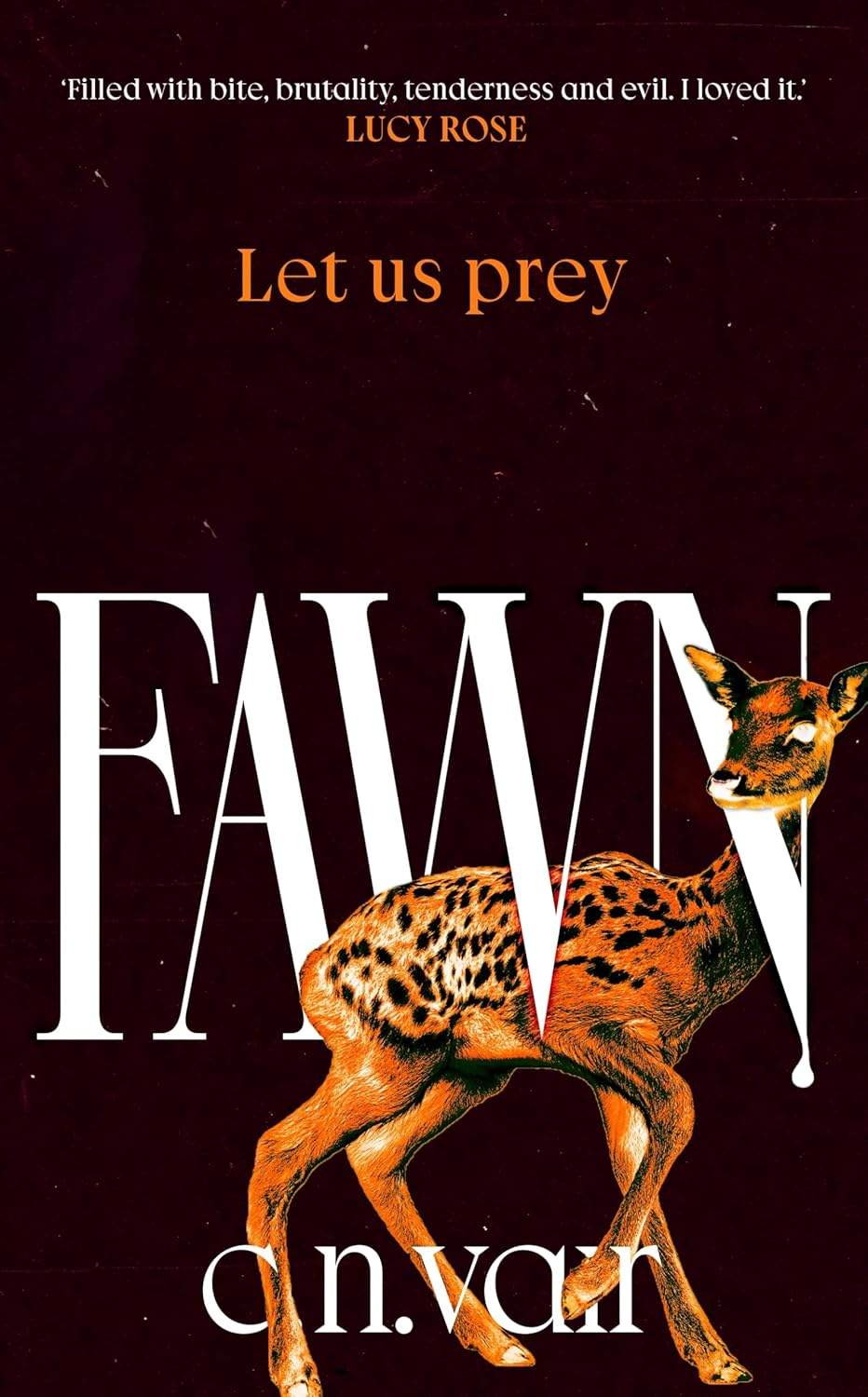
Beside it is the fawn who survived. Red-mouthed. Full set of teeth. Hungry.
From the moment Tess brings it home, whispers gather in town. A new pastor starts asking questions. And inside Tess, something primal begins to wake: anger, appetite, the slow understanding that prey is only prey for so long.
Dark, tender and eerie, Fawn is a slow-burning folk horror of nature, ritual and feverish femininity – a story about what a woman must become to protect what is hers.
🦌Readers are feral for FAWN 🦌
🦌 ‘One of my top books of the year!’
🦌 ‘This book had me reacting OUT LOUD’
🦌 ‘Not one to be missed!!!’
🦌 ‘Gets under your skin without really trying’
🦌 ‘A feminist woodland horror-fest with so much bite’

Ginger Nuts of Horror: The Heart and Soul of Horror Reviews

Looking to get your horror book or film in front of the genre’s most dedicated audience? Ginger Nuts of Horror is one of Europe’s largest independent horror review websites, with over 30 contributors publishing horror book reviews and horror movie reviews almost every single day.
We offer far more than reviews. Authors, filmmakers and publishers can promote their work through in-depth horror book reviews, horror film reviews, comic and video game coverage, news features, and our popular author and director interviews like Five Minutes With. Our guest feature series, The Horror of My Life, Childhood Fears, The ? That Made Me and more, let creators tell their story while promoting their latest release.
Every feature is built to sell your work. We include backlinks to your website or Amazon author page, a full synopsis, and a universal purchasing link that sends readers straight to their local store. Add a large, engaged social following and an 18-year archive of trusted horror coverage, and you have a platform genuinely built to grow your readership.
Whether you’re an established author, an indie filmmaker, or a debut voice in indie horror, there’s a way for us to help you reach more fans. Explore our horror book reviews and horror movie reviews, then get your horror book or film featured today.