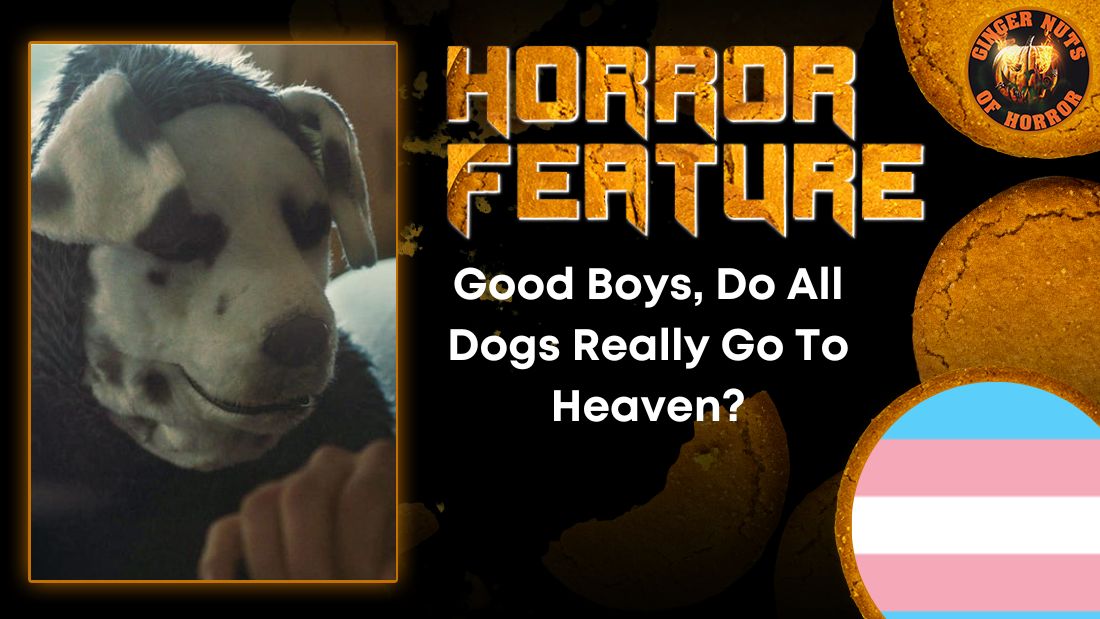

Do All Dogs Really Go To Heaven?
Good Boy (Ben Leonberg, 2025), Good Boy (Viljar Bøe, 2022), and the existential horror of dogs
Yes, Good Boy has finally made it to Shudder UK!
But we’re not stopping there. Oh no. No, today we’re looking at movies, we’re looking at ourselves, and we’re going to think long and hard about the scary movie history of good and bad boys.
So all right, first things first: the dog doesn’t die.
That’s something a lot of reviewers have brought up, and for good reason: when the film was released and began getting famous, internet searches about it spiked on the question ‘does the dog die?’
What’s up with that? In an interview with GQ, director Ben Leonberg blamed the movies:
I think it proves just how well horror films have trained audiences to worry. Whether you watch many [horror movies] or not, I feel like you’re still aware of this trope—the family buys a house, the deal is too good to be true, the dog won’t go into the basement or he’s barking at the creepy neighbor. And usually in most films, that dog doesn’t make it out of the first act.
Source: https://www.gq.com/story/good-boy-writer-director-ben-leonberg-answers-all-our-burning-questions
And he’s not wrong; killing a sweet animal for easy emotion is a well-worn trick. It works – and so, therefore, does not killing it. I’ve got new novel coming out in early 2027 which you can expect to hear more about nearer the time, and the fact that it features ‘a beloved pet that does not die’ is literally part of my elevator pitch – and it’s often the point at which people laugh and say, ‘Yeah, sold.’ If you’re genre-savvy at all, you know that what you do to the cute pet can be a make-or-break thing.
But that’s not all there is to it. And in particular not if the pet is a pupper, a doggo, a goodest boy: that species we love so much it’s a kind of anti-bear. Did you know that the proto-Germanic word for ‘bear’ was ‘arkto’, and got edged out by either ‘bera’ meaning ‘brown one’ or ‘gwer’ meaning ‘wild animal’ because the creature was terrifying to the point of taboo and people felt uncomfortable naming it directly? Dogs are the opposite of that. How we talk about them, very often, is a kind of verbal cuddle, hugging them to ourselves in our very language.
And yet.
And yet there’s something horrifying about dogs.
Either that or there’s something horrifying about people that dogs are exempt from.
It might even be both. Because there’s no emotion older than fear, and there’s no animal deeper in our past than dogs.
Here’s a bit of natural history: dogs were the first animal we domesticated.
We probably wouldn’t have conquered and annexed all the others if we hadn’t had dogs to help, in fact – but more than that, saying that we domesticated them isn’t 100% true. They participated.
To some extent at least, they came to us.
We know this because it’s happening again.
Sit down, pals, I’m going to talk to you about wolves. I promise it’s relevant to dogs in horror movies.
Did you know that as we speak, wolves are forging a new alliance? This time it’s with ravens, so everybody salute, because ravens are serious business. All the corvids are exceptionally intelligent, and ravens have communication, planning, tool-use and teamwork skills that mean if humans blinked out of existence tomorrow, the odds of the new dominant species being those great birds are . . . well, let’s say they’re far from nevermore.

And they’re making friends with wolves. They track prey over distances the wolves can’t see, hovering above so the wolves can follow the bird until they catch up to a quarry the ravens couldn’t fell alone, and then they share the kill. They even play together; ravens swoop and play tug-the-tail, and it even looks like particular individuals may have become friends with a one-on-one cross-species bond.
Wolves putting their stamina and ferocity alongside the planning skills of a weaker, smarter animal. It sounds familiar, doesn’t it? There’s a certain kind of ally they choose – and it’s one that can, to some extent, do the thinking for them.
So if dogs exist, it’s at least partly by their own choice.
Their surviving cousins prove that. But I don’t think you can say they chose to have this done to them:

People love dogs, but they also do things to them. Breed them till they can’t breathe. Work them too hard, or let them go mad with boredom. Abuse or neglect them.
And generally speaking, the dogs – bred and bred and bred to be domestic, loyal and trusting – don’t quite have it in them to get mad about it. That’s not really how they think.
There’s something horrifying about dogs. And it’s being a dog.
Okay look, don’t dox me; if you have a dog and you treat him or her kindly, I’m not talking about you. But if you’re the sort of person who treats your dog kindly, you won’t disagree that taking on the moral responsibility of an animal that really struggles to get its head around the idea of not needing you is pretty staggering.
There’s a reason why, outside of parenting, I confine my stewardship of living things to pot plants. I don’t feel able to take on more – and what it must be like to be a dog in bad hands is about as fearsome as it gets.

And when we think fearsome, we make horror movies. Such as, for instance, Ben Leonberg’s low-budget hit Good Boy.
Let’s talk about how.
A nice thought to start with: the experience of Good Boy star Indy was not horrifying. As far as he was concerned, he was just hanging out with his people and sometimes they wanted him to do things. In once scene*, for instance, he had to walk along an outdoor path; to get him motivated, the crew had to rub food into the ground.
Some of what he does in the film was just him going about his daily doggery, some of it he was tempted into, but either way Indy seems to have been fine throughout. If anything he was probably better off than many apartment pets: dogs are working animals and are happier if they have something to do.
* https://www.cinemablend.com/interviews/good-boy-director-talks-challenges-filming-horror-movie-completely-from-indy-the-dog-perspective
Leonberg and his team, however, had to spend three years on this. It took a lot of patience to gather and edit all the footage into a neat horror where there’s something scary in the ‘cursed family house’, but only the dog can see it.
It’s a restrained and thoughtful little movie, in fact, cleverly done and well-judged. But it’s also a giant flex, because the method of making it is perhaps the most spectacular use of the Kuleshov effect ever put to film.
Let’s get technical, because this film is a marvel of technique.
The Kuleshov effect, for those unfamiliar, is one of those fundamental rules of film editing, named for the Soviet filmmaker Lev Kuleshov who first described and demonstrated it. Kuleshov made a tiny film you can watch here – https://www.youtube.com/watch?v=_gGl3LJ7vHc – in which he cast matinee idol Ivan Mosjoukine to do one simple thing: for three seconds, he made this face.

Mosjoukine’s neutral expression was then edited in to follow three different shots: one of a bowl of soup, one of a child in a coffin, and one of a beautiful young woman. And even when you know the trick, it works: in succession, your eyes read the exact same shot as a man full of hungry anticipation, a man appalled with grief, and a man quietly hot and bothered.
Good Boy actually tips its hand in the credits, showing you how it was done. As the names go by, we see a shot of wee Indy sticking his head out of a moving car, just doing what dogs do and enjoying the wind and the view.

But having watched a whole movie about him, we can suddenly see what Leonberg and his team must have baked their brains for three years to notice.
Indy’s look is constantly changing. Just in subtle ways, but he’s an expressive-looking dog with mobile ears and eyebrows, and you could take any flicker of his face and, with a bit of Kuleshov, make it look like he was reacting to something. A beloved owner. A puzzling stranger. A terrible danger. Anything more than just the smell of the woods and the wind in his face.
It’s exhausting just to think about how much work must have gone into it, so full credit to them.
It’s not the first time anyone’s filmed an animal and overlaid a story, of course.
What is a feat, though, is to manage it without any kind of human commentary to help us interpret what they’re doing.
Kids’ TV used to do it quite a lot back in the day, for instance. The BBC had an old show called Animal Magic in which presenter Johnny Morris did the voices for zoo animals (https://www.bbc.com/historyofthebbc/anniversaries/april/animal-magic/), for instance, providing commentary on what the animals were doing, comedy-style.
I’m apparently almost alone in this but I also vividly remember the 80s TV show A Day In The Life in which we watched episodes of, say, a male weasel called Niva trying to cosy up to an in-season female called Mus, an otter named Vydra arguing with a dog voiced by Spike Milligan, or a field mouse declaring, ‘No matter how much grass I eat, it still tastes wonderful.’ Lost media now, I think, though if anyone has a copy I’d love to see it. Either way, kids shows were considered a natural place to tell animal stories. Harmless, right?
There’s also a history of less specifically kiddy stuff, though it still trended wholesome. Here’s a fun ruin-your-childhood fact: Disney’s The Fox And The Hound (1981) was nominally based on a 1967 book by Daniel P. Mannix . . . which ends with the fox old, alone and hunted till he dies of exhaustion, the dog’s owner succumbing to age and alcoholism, and the hound, just before his owner finally leaves for a nursing home, trustingly licking the hand of his beloved master – the one that doesn’t hold the shotgun that’ll put him down.
There’s a horror movie in that all right, but the film Disney’s storyline hews much closer to is The Belstone Fox (1973), which does involve a hunting dog befriending a tame fox – and which depends a great deal on human narration over the animal segments to make sure you have no doubt what’s happening in the story.

Keep foxes in mind. They’re relevant to Good Boy.
But what’s so impressive about Good Boy 2025 is that nobody narrates the animal. Leonberg understood that dogs naturally communicate with humans: we look at their little faces and they’re pretty good at using them to show us what they feel. Wolves have less mobile eyebrows than dogs; this is a species with a direct line of descent towards giving humans . . . well, puppy-dog eyes.
You can film that.
But hang on. Is there another Good Boy in the room?
By golly there is. In 2022 another film of that name came out of Norway, and wouldn’t you know, it’s also on Shudder? And it’s also . . . sort of . . . like, upsettingly sort-of . . . about the relationship between people and dogs?
Well, I have to do it. There’s a lot of good things to say about Good Boy 2025, but they’re hard to miss and have been said by a lot of reviewers already, and while I think I have some points of my own to make, I also think there’s an intriguing question we can get into if we compare the two.
Guys, we are going to have a Good-Boy-off.
To start, we need to ask another question:
What is a movie dog?
Because it isn’t exactly a dog, not an ordinary individual animal. It’s a curated image, an archetype. It tends to say less about this dog than it does about Dog, capital D, the Platonic idea of Man’s Best Friend and whether or not it stays that way.
People have been making dog movies for a long time. The first proper one, apparently, was the 1905 silent Rescued by Rover, in which a very good boy saves a baby. You can watch it on its Wikipedia page here: https://en.wikipedia.org/wiki/Rescued_by_Rover.

He saves her from a Romani kidnapper, by the way. It’s tempting to be off-handedly snide about this – wasn’t the past racist? – but aside from the fact that racism against Romani people is not at all a thing of the past, unfortunately, there’s also something to be said about horror here. Rescued by Rover is not horror, it’s what passed for uplifting and wholesome . . . but it required the dog’s virtue to have human vice to offset it.
This wasn’t Lassie reporting little Timmy down the well. This was a dog specifically being better, morally speaking, than a human.
And this is another of the things a lot of us seem to feel about dogs. There are people who literally boast that they don’t like humans but they do like dogs, and they say it as if this was a virtue.
For some of us, dogs are less animals than angels.
And that’s unusual. Look, I’m not a dog person, so I may get cancelled for calling this an interesting psychological phenomenon rather than an objective fact – but it is, if nothing else, something people feel very passionately.
And passion is good for horror.

We make movies about dogs and how we feel about them. But if you look at the Palm Dog awards – yes, there are awards for dogs in movies, here you go: https://en.wikipedia.org/wiki/Palm_Dog_Award – you’ll see that in a quarter century of them, only a handful – Antichrist, Sightseers, White God, The Lobster, Lamb – are even horror adjacent.
Mostly they skew comedy and/or drama. And even in this handful, dogs as plot-carriers are uncommon: in Sightseers it’s just somebody’s dog and the horror’s all human, in The Lobster and Lamb the horror lies in blurring the lines between human and animal, and in Antichrist it’s not even a dog at all: they bent the rules to allow for a different kind of canine.
Notably, once again, a fox.
Hm.
So the only dog standing really is White God, which I’m stretching to include because Wikipedia calls it a drama – but it certainly has dogs acting in terrifying ways. The mistreated mutts of a city rise up to wage bloody revenge against the men who oppress them and children with equal callousness.
Dog and child, another natural pairing. Innocent. Dependent. Vulnerable. Owed.
And of course we have to acknowledge Cujo.
The 1981 book and the 1983 film that followed it touched upon a very simple and very primal fear: what if the ordinary world suddenly declined to work the way it’s supposed to?
One day everyone is comfortably possessed of the symbols of small-town 20th-century American normality. Marriage. Cars. Dogs. These are all the things you’re supposed to have to make your life good, right?
But then a marriage fails, and the mother is by herself with the little boy as she tries to drive him home. And the car breaks down and won’t move.
And there’s something wrong with the dog.
Cujo, the story makes it clear, was a Good Boy. He was a calm gentle giant of a thing, a big old sweetheart who wouldn’t hurt anyone. But cars wear out, and dogs get rabies.
Suddenly the things that kept you safe are all broken.

There you are, shipwrecked in the ordinary American landscape. And because you don’t have the last traditional American item, a gun, you’re suddenly in the middle of a micro-apocalypse.
So that’s the famous dog horror up until Good Boy. It’s archetypal and brutal and while King himself swears he barely remembers writing it because he was deep in addiction at the time, it does stand as proof that even sick, the man was really very clever at putting his finger on the nerve.
But it’s interesting that Cujo is, essentially, the story of a failed dog.
Did you know that when Louis Pasteur created the rabies vaccine, he and his team had to hand-collect saliva from live rabid animals? These guys were not fooling around:
‘At the beginning of each session a loaded revolver was placed within their reach,’ recalled Mary Cressac, the niece of Pasteur’s collaborator Emile Roux. ‘If a terrible accident was to happen to one of them, the more courageous of the two others would put a bullet in his head.’
From Rabid: A Cultural History of the World’s Most Diabolical Virus by Bill Wasik and Monica Murphy
Those were the stakes: if I get bitten, shoot me, because I’ve seen what rabies does and I am not dying like that. This was the same Louis Pasteur who created pasteurisation; serious great minds put on gloves and grappled mad dogs because that was what it took. And they knew that once the virus was in your system, you were an anguished corpse walking. There would soon be nothing left of you but pain, and better to die than become that.

Fortunately nobody was bitten, but let’s take a moment to remove our hats, because seriously.
But it matters in horror because rabies isn’t dog-like. One of its great terrors is that it doesn’t respect the boundaries between species.
Cujo is terrifying because he’s no longer a dog. He has become a monster: rage and strength and contamination.
He isn’t a dog. He’s rabies.
Seriously, rabies is a badass subject for horror and I can’t wait till Shudder pops up a movie that gives me the chance to get into it more. But its essential shock is this: as long as you’re a mammal, you are one bite away from being a fast zombie. The fact that something was once a dog is only a poignant piece of tragedy to spice the much more urgent fear.
It makes it sad that the rabies carrier is a dog – but it doesn’t really make it relevant.
You can see this if you ever watch the 1981 BBC mini-series The Mad Death, which is all about a rabies outbreak in Britain. It’s more action thriller than horror, and one aspect is that the virus moves from animal to animal without regard. Though again, one of the most important carriers is a fox.
Can’t seem to get away from those little guys.

But Cujo is, among many other things, a demonstration that to make a dog scary to a non-phobic audience, you have to undermine the Platonic ideal of Dog.
Cujo is anti-Dog. He is unDog in the way a zombie is undead. That’s the whole nexus of the horror.
Because we really, really want dogs to be a certain way.
Which brings us, in the Norwegian corner, to Good Boy Number One, the 2022 edition!
No, the dog doesn’t die in this one either.
Because there is no dog.
Here’s the story: Sigrid (Katrine Lovise Øpstad Fredriksen), a free-spirited and somewhat directionless young woman, meets the very polite Christian (Gard Løkke) on a dating app.

Sigrid is nice. She’s fun. She’s disorganised and not really on top of her life plans. She’s open-minded, though, which means that it’s fine with her if Christian, her date, is by his own account rather antisocial, tightly controlled, and likes to keep his life carefully structured. Each to their own, right?
Christian is pleasant, after all. Also he’s extremely handsome, which doesn’t hurt, and he clearly likes her.

So they go to bed on the first date, and that’s fun too, and all seems great.
Until Sigrid discovers in the morning what we were aware of from the opening shots: there’s someone living in his house.
Christian calls him Frank. He also calls him his dog.
This is Frank.

Now, Christian thinks she’d understand if he explained, but Sigrid does what most of us would do, which is get out as fast as she can and resolve never to go back.
Then her best friend points something out about Christian: he’s a multimillionaire. We know his parents are dead; his dad left him a lot of inheritance. He’s so rich her friend recognises his photo like he’s a celebrity.

And after this, Sigrid starts to listen to the little voice in her head asking whether she’d been too quick to judge. I mean, mightn’t you?
I should be clear if I’m talking about this movie: I’m not about to take a swing at furries.
The movie isn’t either, nor at kink. Sigrid considers the possibilities of fetish and puppy play as innocent explanations. I definitely watched the movie mentally shouting at Sigrid not to give Christian another chance, but it wasn’t because I assume anyone who wears a dog costume or tolerates someone else wearing one must be some kind of degenerate freak. It’s not for me, but if it makes other people happy I’m all for whatever sparks joy – which is more or less the place Sigrid comes from.
But there are definite alarm bells to any guy who brings you home, gets you into bed, and doesn’t mention the guy living in his house as a dog until you spot him the following morning. Christian insists there are good and harmless reasons – but not until he has to come up with an explanation. Prior to that, he was hiding something.

So what else is he hiding?
So to give you my Thesis Of Scary Dog Movies I’m going to have to spoil Good Boy 2022. The drama of the second act rests on wondering exactly what the deal is with Frank, and the shenangians of the third act are what happens once we find out.
There could have been a number of explanations. One I wondered about was whether Christian was some kind of hostage to Frank. After all, we see them alone together, and Christian sleeps in the house with no more apparent fear of Frank than a man would have of his actual dog. Frank gets up in Sigrid’s body space in a way that’s pretty uncomfortable. And in particular, there’s the dog-suit itself: Christian has more money than anyone can spend, but the costume is this cheap, tatty object like it’s a throwaway piece for Halloween, and if anyone spends enormous amounts of money on commissioned costumes it’s furries. Anyone who knows their memes will know this joke.

If somebody isn’t up to bullshit, why doesn’t Frank have a better costume?
When Christian explains to Sigrid that they’re childhood friends, that living as a dog is what Frank wants for reasons Christian doesn’t fully understand but doesn’t have the heart to deny, and that essentially both of them are lonely people who live in an odd arrangement out of longstanding loyalty . . . well, it’s a horror movie, so clearly one of them is a hostage. The movie leaves the door open for a while onto the possibility that it’s Christian.

Spoilers fully from here: no, the hostage is not Christian. It’s Frank. It’s exactly what it looks like, except that Christian has done a very good job of making you wonder if it might be anything else. Frank is a prisoner forced to live as a dog because this is what Christian wants, and the reason he hasn’t attacked Christian before is simply that he’s too scared to risk it without backup.
Which Sigrid only finds out after she’s agreed, on only a few dates’ worth of acquaintance, to go away for a weekend in a luxurious cabin, to let Christian take her phone, and generally to isolate herself so it’s extremely difficult to get help for either of them.

Christian isn’t an awkward innocent. He’s a classic abuser. What did he do to Sigrid if not push the relationship along too fast, isolate her from other people, cut off her lines of help and take control?

Exactly why Christian did this to Frank, and why it has to involve a dog costume, isn’t answered in detail – but it doesn’t really need to be. The film frames things to suggest it isn’t a sexual fetish, or even a furry thing (which as I understand it may be sexual but isn’t necessarily). It’s just that what Christian wants from any relationship is very simple – and it’s not something you can expect a human being to provide.
He wants unquestioning loyalty and compliance, coupled with sincere warmth and devotion. Happy obedience founded on love. He wants those around them to never even wonder if, when he suits himself, he isn’t acting for the best for everyone. And he wants these never to waver, not even for a moment.
And in the end, he wins. If you don’t like human degradation, this isn’t one for you.
He’s dialled up from ‘abuser’ to ‘dog owner’.
We love dogs. We’d hate to be one.
What’s so angelic about dogs is their innocence, right? But think of how Victorian men fetished ‘innocence’ in women when what they really meant was sexual ignorance, financial dependence and political subjection.
A dog can’t question a man. And that’s what some men want.
Domesticated dogs are wolves that have been twisted so thoroughly in the hands of their masters that they hold nothing but love for their oppressors. Dogs are an abomination on par with the undead.
Source: https://goblinpunch.blogspot.com/2014/09/7-myths-everyone-believes-about-druids.html
Consider Yorgos Lanthimos’s 2009 horror drama Dogtooth as a comparison: the tale of an abusive father who confines his three adult children to their home compound telling them the world outside is apocalyptically dangerous. Among other things, he trains them to bark like dogs – ostensibly to frighten off the murderous cats that stalk beyond the fence, but obviously that’s not the real reason. It’s the same reason as Christian’s: humans are too independent and might disobey you. Get them down on their hands and knees and make them bark.

Disney could sell a song called ‘Everybody Wants To Be A Cat’.
Nobody wants to be a dog.
If we look at dogs as dogs, we can see an intelligent animal. Not as intelligent as the animals it allies itself with, perhaps – a human can outsmart a dog for sure, and a raven probably can too – but a creature driven above all by its love of social bonds, to the point it was a smart decision to build a pack containing greater smarts than the dog’s own and trust it’d work out okay.
And if it does, well done that dog. Good decision.

Source: https://www.sciencefocus.com/nature/how-did-humans-tame-wolves
But it was an evolutionary decision – and at some point humans took over all the deciding, which is how some dogs wound up pedigreed into oblivion and some wound up mauled in fighting rings and . . . well, I won’t go on.
That’s the trouble with being a dog.
If you’re a wolf in a pack of wolves, you may get knocked around if you annoy the alphas – which is to say, your parents, because that’s how wolf packs are actually structured – but whatever another wolf does to you, you will at least understand what it’s doing and why.
But if you’re dependent on a species with a brain far more baroque than your own . . . well, at least in a world of horror, you’re stuck in a kind of perpetual confusion as things happen completely beyond your ken, and you can only trust that the boss knows best.
But maybe he doesn’t.
Which is the real horror of Good Boy 2025.
Here’s the story. Todd (Shane Jensen) is a young man with a dog called Indy, who’s absolutely his bestie and a very good boy, and Indy is devoted to Todd as only a dog can be. We begin with a lovely montage of Indy being adopted as a puppy, brought up, played with, petted, praised, and altogether living the kind of a life that works for you if you’re a dog.

Except there’s also a hospital visit.
Todd is sick. We don’t know exactly what’s wrong with him because Indy doesn’t either, but it’s bad. He coughs up blood. His sister Vera (Arielle Friedman) wants him to stay close to the hospital even when he’s discharged. If it’s not lung cancer, whatever he has isn’t any better.
But Todd is a young, active, outdoorsy guy, and the prospect of being stuck in the city and accepting the new identity of ‘patient’ isn’t something he can take. Instead he makes a decision: he’s moving out to their grandfather’s old place in the country. It’s ramshackle; there are fox traps set around by a neighbour; it’s far from medical help. It’s also, in Vera’s words, the ‘cursed family house.’
It belonged to Grandpa. He was also a dog-lover – but all of his dogs, for some reason, ran away. It’s been in the family for generations – but most of those generations tended to be short-lived.
And since the moment they set out – before they even reached the old place – Indy has been seeing things.

Vera thinks Todd’s being reckless with his health, and jokes he’s moving to a haunted house. Todd insists everything’s fine.
Indy knows something’s wrong. He sees things. But exactly what, and what do they mean? Well, he doesn’t know because he’s a dog, which means we don’t know till the end of the movie.
It’s really a brilliant way to keep the suspense going – and it’s also a brilliant way to maintain ambiguity.
I’m going to spoil in broad strokes, but the movie is well worth a watch so I won’t narrate the whole thing. It’s all in the atmosphere and framing anyway, which no amount of description will convey.
But here’s the core question of the film: what is Indy seeing?
Because there are two possible versions, and the film supports both of them.
Here’s one; let’s call it the classic explanation. There’s something haunting the house.
The family graveyard occupies the grounds, and something mysterious killed them all at an early age. Indy is seeing ghosts: the ghost of old inhabitants, particularly Bandit, Grandpa’s old Golden Retriever. (Helpfully easy to distinguish from Indy because of Indy’s distinctive white-striped face; more smart visuals from Leonberg there).
There’s a gruesome monster that’ll kill Todd eventually. The place has an ugliness to it manifested in a zombie-like figure, but also in the effect on its inhabitants. We know from seeing an old VCR that Grandpa chose to bequeath nothing to his daughter, ‘the vegan’, he notes with a vindictive chuckle, except his taxidermy collection. The house he left to grandson Todd – and evidently nothing to his granddaughter Vera, who’s every bit as nice and deserving.
The entire bequest was an act of spite. And Todd himself, a sweet guy at the outset, grows harsher and nastier to Vera as she keeps calling, worried for his health and wanting him to be okay. There’s something corrupt about this place, something that rots. Eventually, if you stay there too long, it’ll get you.
These are things, looking from Indy’s perspective, that we literally see.

Then there’s another explanation. Let’s call it the figurative reading.
As Todd pulls up to the cursed family house, he’s on the phone to Vera. Vera thinks he’s reckless to isolate himself in the country when he’s only so recently been discharged from hospital. Has Indy been sniffing around at invisible things, she asks? Because we know dogs can detect things people can’t. Bombs. Drugs.
Medical problems.

Todd is dying. Indy knows this.
But he doesn’t know what ‘dying’ is. He’s a dog. All he knows is that something very frightening is happening.
The first ‘ghost’ Indy saw was a shadowy figure through the back window of the car before they even got to the house. The back window. Whatever that haunting thing was, it wasn’t waiting for them at Grandpa’s place. It was following them.
People in this family were short-lived. Maybe they were cursed – or maybe Todd’s illness is genetic. Even on Grandpa’s VCRs, we hear the old man coughing like there’s something wrong with his lungs.
Grandpa’s dogs mostly ran away. Maybe Grandpa was just a mean guy who didn’t look after his pets.
Todd grows angrier with Vera. Maybe he’s corrupted by bad spirits – or maybe he just hates the fact that he’s sick and can’t bear to be reminded.
Indy sees things. Or does he?

Good Boy pulls a very clever trick here: we don’t see human faces very much.
Why not?
Logically there’s no reason we shouldn’t. Dogs’ eyes aren’t level with our faces, but they look up at us all the time; there’s whole scientific studies on how they read expressions. (https://pmc.ncbi.nlm.nih.gov/articles/PMC7181561/, for instance.) Indy would, as a real dog, look at Todd’s face pretty often to check in with what his man was feeling.
Which puts the film in the world of the visually symbolic. Or to put it in shorter words: what we see isn’t exactly what’s there. We see, instead, things that make us feel the way Indy feels.
But translated into human.
Here’s the thing about humans: if we’re neurotypical, we are absolutely built to look at faces. We see them even in inanimate objects; with people, our eyes search and lock.

Source: https://sites.uw.edu/libraryvoices/2024/02/03/pareidolia-the-phenomenon-of-seeing-faces-everywhere/
And what if you can’t? Try this on for size: think of the phrase, ‘a faceless man’.
Uncomfortable, right? Even threatening. The best-case scenario is some kind of bureaucrat, but even then it’s probably the kind of bureaucrat who’ll screw you over because nobody will hold him accountable. And it could be a genuine monster. In the real world the phrase could only mean someone with severe injuries or a medical condition, perfectly blameless things – but you hear ‘faceless’, and it feels like something that will harm you.
Something, at the very least, that knows something you don’t.
Because that’s Indy’s problem.
It’s not that he can’t see Todd’s face. It’s that he can’t see Todd’s intentions. He doesn’t understand what’s going on – and that’s a challenge to put on screen, because the primary things he doesn’t understand are things we do: language and implication. We hear Todd talking to Vera and we know he’s sick and defensive about it and taking some risky decisions, but all Indy knows is that he and the man are going in a car.
Leonberg can’t put us in Indy’s literal position by blurring out the dialogue. If he did, we couldn’t follow the film at all.
So instead he puts us in the same emotional position as Indy. He keeps the camera off Todd’s face, making us feel we aren’t fully clued in to what’s going on. Of course we can piece it together – but by hiding, in a visual medium, the thing our eyes most naturally seek out, we feel a little off-balanced, a little ignorant. A little confused.
We feel like Indy.
And if we extend that to the rest of the film, then the facelessness is telling us that what we’re seeing isn’t literally what Indy sees. We’re seeing what Indy experiences.

And in particular we’re seeing what Indy can smell. Which has to be done by sensory substitution.
Nothing else would work. Even if we went full Brave New World and created movies with scent-organs playing in the theatre, a human nose can never equal a dog’s, either in sensitivity or in the importance smell occupies in a dog’s brain. So to convey Indy, Leonberg has to focus less on the sensations of a dog’s nose than on its purpose. Indy and his human viewer are each experiencing the story through their main sensory organ.
Dogs lead with their noses, humans with their eyes – and Leonberg is translating.
Is there the ghost of a dog, or can Indy just smell that there used to be another dog there?
Are there actually shadowy spooks following the car, or can Indy just smell that whatever was wrong with the man back home is coming with them?
Is there really a zombie creature, or can Indy just smell that something in Todd’s chest is going bad?

And since Indy can’t explain it to Todd, and he depends on Todd to make good decisions for them both . . . there’s nothing going on but nightmare.

Indy is living two incompatible truths: the man is a wise protector, and there’s something wrong with the man that the man isn’t acknowledging. They can’t both be true, but Indy is experiencing both at once, and he isn’t built to resolve the contradiction because he’s been bred through the aeons for loyalty.
We are operating on a kind of dream logic that conveys the confusion that is being a dog.
You can go with either the classic or the figurative interpretation of the film, but goodness is it a joy to see the cleverness Leonberg put in to making the figurative version possible.
Which just leaves one little question about Good Boy 2025. It’s about eyes in the dark.
Indy sees a lot of frightening things, and most of them aren’t explained. But there’s one that has a definite resolution – and it falls into what students of the Gothic call the ‘explained supernatural’. It isn’t about a ghost. It isn’t even about illness.
It’s going to take us right back to foxes.
So, among the worrying sights Indy sees, one that recurs is the flash of eyes in the dark. Two little lights, looking back at him from the hidden places.

So if it isn’t a ghost, and it isn’t a manifestation of illness, what is it?
It’s this little fellow:

Towards the end, as things are really bad, Indy looks out into the rain and a fox walks out from behind a tree, and the light catches its eyes. They flash. One of the things that was watching him was a fox and nothing more.
Now, this isn’t a careless film. They spent three years choosing every shot. The fox isn’t there by accident.
So what’s up with it?
And while we’re asking, here’s a bigger question:
Why do so many dog films have foxes in them?
I’ve already mentioned The Fox and the Hound and The Belstone Fox, as well as The Mad Death and the honorary dog in Antichrist – a fox that, notably, takes an extremely anti-dog political stance by announcing, ‘Chaos reigns.’

Let’s consider another movie: the 1982 adaptation of Richard Adams’ The Plague Dogs. There’s a whole generation traumatised by being sat in front of Watership Down (1978) on the assumption it was a nice film about rabbits, but The Plague Dogs is even harsher – and unusually, the film ends even harsher than the book.
The tale is of two dogs that escape an experimental laboratory and go on the run; at the book’s end they’re taken in by the former owner of one of them, but in the film’s end they’re swimming, swimming, trying desperately for an island they may never reach. (And since one of them was tortured in the lab by being repeatedly near-drowned, it reads as much like a hideous return to trauma as anything else.)

The dogs in question, Rowf and Snitter, know from near-fatal experience that humanity will hurt them. But they’re dogs; surviving on their own is not what they’re built for. Rowf has only ever known suffering, but Snitter once had a kind owner and can’t lose the idea, whatever he’s been through, that men are good and they just need to find a ‘master’, a safe man, somewhere, somehow.
Richard Adams really was one of those people who preferred animals, at least in his writing, and The Plague Dogs is misery from start to finish. If Good Boy 2025 shows us the horror of being a dog who trusts his master, who’s only a fallible man, and Good Boy 2022 shows us the horror of being a dog if you have the human capacity to understand what a man requires of you, The Plague Dogs shows us the horror of being a dog with no man to protect you. It’s almost like those lines from Possum (2018):
Children, run! He’ll eat and smother
Any child without a mother.
Puppies, you will know disaster
As a dog without a master.
And in what’s starting to seem inevitable, of course there’s also a bit with a fox.
Starving and sheep-worrying out on the moors, Rowf and Snitter encounter one. He doesn’t have a name as such; he just calls himself The Tod. (Which is an old word for fox. It just means, ‘I’m the fox that lives in this territory,’ and as such carries the reminder that foxes generally live alone.)

He’s a bleak voice of realism: they can’t survive out here, and if they try, he gives them three months. But he’s also quite kind in his way; what he suggests is that they team up, combining Rowf’s physical strength with his cunning and knowledge of the outdoors, and that way they’d all survive. Of course it serves him as well, but there are worse options.
But the alliance doesn’t last. Snitter accidentally gets into what The Tod calls ‘real trouble’, and The Tod’s idea is that he and Rowf slip away while they still can. Rowf won’t do that. He’s a dog. He goes to find Snitter and sticks by him.
Foxes are solitary, but dogs are pack animals. Rowf hasn’t known good men, but he’s a good dog. Even when he’d be better off if he wasn’t.
What do foxes offer in these movies?
Because they pop up again and again. You’d think the filmic antonym of the dog was the wolf, but no, not really. It’s foxes. The same but different. Small canids, creatures that live beside humans but can’t challenge them.
Canines that haven’t been domesticated.
I mean, scientists are working on domesticating foxes, but here’s the thing about that: the more domestic they get, they less like foxes they become. The people on that experiment didn’t select for physical traits; only for the ability to tolerate humans. But spontaneously, the friendly fox pups started to change. White patches appeared like you’d see on a sheepdog. Some had upturned tails. Some had floppy ears.
They were domestic foxes, genetically speaking. But as we really use the word – no, not really. They were turning into dogs.

A domesticated fox isn’t a fox any more than a domesticated wolf is a wolf. ‘Dog’ isn’t what you’ve always been; it’s what, over generations, has happened to you.
‘Dog’ isn’t a species. It’s a condition.
And ‘dog’ is not the nature of a fox. It’s wild. It’s a shameless little opportunist that’ll knock over your bins without a second thought. I live in an area with a lot of urban foxes, and they’re bold lads who will walk past you on the street – but they won’t let you get too close. They’ll watch you thoughtfully, and if you start to close the gap too much to challenge their head-start on you, they take right off.
I love foxes. I’d feed them if there were no consequences. But the best way to love a fox is to keep it a little afraid of people – because even if I wouldn’t hurt them I can’t guarantee that nobody would, and it’s no kindness to teach them to trust us.
To a dog, a fox is a shadow. It’s what you would be if you weren’t a dog.
Outdoors. Cold. Cunning. Solitary.
Independent.
A fox is a dog that can survive without people.
And sometimes we tell stories of how this makes foxes vulnerable. In The Fox and The Hound or The Belstone Fox or even The Plague Dogs, dogs are the canids people protect and foxes are the canids they hunt.
Good Boy 2025 isn’t unaware of this. One of the first things Indy finds at the creepy old house is a taxidermied fox; one of the first things Todd is told by a neighbour is that he’s putting fox snares out around the property. Foxes are, among other things, human prey.

But if the humans stop being your protectors – what then? Then another image pads black-footed into the frame. A creature humans don’t protect – but now they aren’t protecting you either. And this creature doesn’t need them to.
What dogs are to angels, foxes are to fairies.
To quote ‘The Changeling’, a favourite poem of mine by Charlotte Mew, fairies are ‘not quite bad and not quite good’. (A poem I like so much, in fact, I lifted a line from it to title my book In The Heart Of Hidden Things. Go on, it’s a good book: tinyurl.com/nvvetupj. It does, at least, mean I know what I’m talking about when I talk about fairies.) Pre-Victorian fey are unconcerned with human morals, capricious and unpredictable and dangerously free.
One of the ideas people had of them was that they were fallen angels. Not fallen quite all the way; they didn’t side with Lucifer against God. They just didn’t side with God against Lucifer either, so they fell only as far as Earth. And there they remain, on nobody’s side but their own.
Not predators. Not protectors. Just wild.
Let’s talk about Indy as a handsome boy.
Leonberg has stated* that he ‘didn’t get Indy thinking he was going to be my star.’ He already had Indy, did some test shots with him to try out ideas, and then just kept going. I haven’t found an interview where anyone asked him about the fox thing, so I can’t speak to his intentions as a director, but I can say this: Indy is certainly an interesting coat colour for the role.
*https://www.gq.com/story/good-boy-writer-director-ben-leonberg-answers-all-our-burning-questions

Maybe it’s coincidence or maybe Leonberg noticed it and decided to up the fox theme, but either way: Indy is an unusually fox-coloured dog. He’s a beautiful reddish shade; his tail is long and fluffy with a distinctive white tip. He’s definitely a dog – but of all the shades of dog he could be, he could hardly be foxier.
There’s just a hint of a life he could have. Or else a life that threatens him: unprotected by people, as vulnerable to neglect as he is to the fox traps that surround the property – one of which does, indeed, snare him at a certain point.
People love dogs to be innocent guardians, angels on furry pads. But if you have the virtue of an angel and no flaming sword and your lord and ruler isn’t ruling wisely, what then?
Could you fall? Could you survive on your own?
Good Boy 2025 doesn’t recommend it. No, the dog doesn’t fall.
What happens at the end depends on whether you’re interpreting it in the classic or the figurative sense. It is interesting that after something comes for him, that’s when Indy becomes less confused – and we know this because that’s when we start seeing normal shots of Todd’s face.

Death come for Todd, in whatever form. And then he is, literally, in the picture. It’s an intriguing thing for a film to do: for Indy, the fact that we’re seeing some kind of ghost is manifested not in its obscurity, but the very fact that we can see his face at all.
The happy ending for Indy is ultimately very simple: he needs to be released from his obligation to stay loyal to a single man who’s making bad decisions.
The dog doesn’t die. The man does. Then someone comes for the dog.

So Indy leaps into the light, into a life where he will once again be under the care of humans who reward his utter, unquestioning dependence with kindness and sense.
But that’s the true horror of dogdom. A dog can never be free. It can only be spared.
What if no one came for Indy? What if something goes wrong with Vera, who’s presumably taking the leash now?
Indy just needs to hope that won’t happen. Which he can’t, because that would involve anticipating the future.
I’ll admit it: during the writing of all this I went for a walk in the park and there were dogs everywhere. They looked pretty cheerful. None of them seemed to be in a state of existential anguish. When there’s nothing wrong, and when the people who have charge of them are reliable, dogs are happy.
But no human is infallible or immortal – and dogs need them to be. If they didn’t, they wouldn’t be dogs. They’d be foxes.
And sometimes, it really is a dog’s life.
Further Reading
Kit Whitfield’s “What’s On Shudder” articles are a must-read for any horror enthusiast looking to enhance their streaming experience. These articles offer a comprehensive guide to the latest and most exciting horror films available on Shudder TV, diving deep into the genre’s rich tapestry. One of the standout features of Whitfield’s work is her unwavering passion for horror, which resonates throughout her writing. She not only highlights key films but also provides insightful commentary on themes, directors, and the evolution of horror as a genre.
Additionally, her articles often include hidden gems and lesser-known films that might be overlooked in the crowded streaming landscape. This can lead to discovering unique stories and innovative filmmaking that challenge conventional horror tropes. Whitfield’s expertise ensures that readers gain a better understanding of the films’ cultural significance and artistic merits.
For both die-hard horror fans and newcomers alike, checking out “What’s On Shudder” is an invaluable resource for finding thought-provoking content that goes beyond mere scares. Her engaging style and knowledgeable perspectives make the horror genre accessible to everyone. Whether you’re in search of a terrifying thrill or a deeper exploration of cinematic horror, Whitfield’s articles are the perfect companion for your Shudder journey.