- Harmed and Dangerous Review: Jasper Bark’s Bark Bites Horror Shines
- Jasper Bark Interview Part 2: Harmed and Dangerous, Bark Bites Horror, and the Stories That Can Kill
- Harmed and Dangerous: Is This the Real Life? Is This Just Fantasy?
Harmed and Dangerous Review: Jasper Bark’s Bark Bites Horror Shines
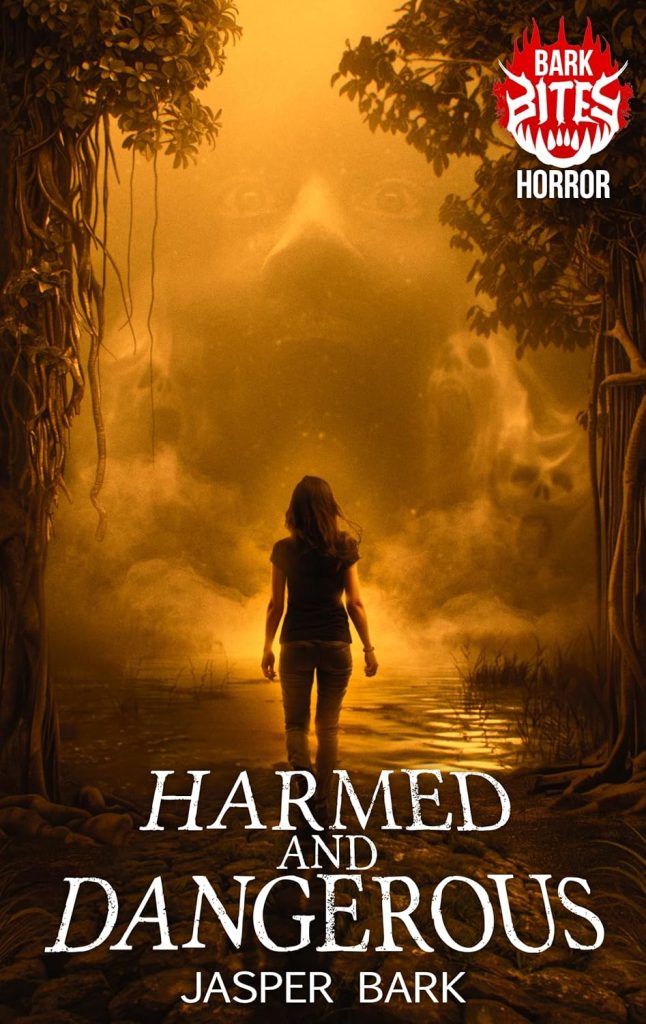
Harmed and Dangerous (Bark Bites Horror, 2026) by Jasper Bark follows Kyra, a seventeen-year-old runaway who discovers her dead mother was a serial killer’s last victim. What she finds in Yeuxville, Louisiana, is worse than any headline. Bark writes psychological horror with teeth, blending Southern Gothic atmosphere, visceral body horror, and a protagonist who can’t trust her own eyes. Fans of Grady Hendrix’s small-town dread or Stephen Graham Jones’s literary carnage will find familiar pleasures here. But Bark carves his own path.
Anger has a geography. It has a smell, stale cigarette smoke, humid asphalt, the metallic tang of your own blood. In Jasper Bark’s Harmed and Dangerous (2026), the eighth entry in his Bark Bites Horror series, anger lives in Yeuxville, Louisiana. A town where the heat sticks to your skin like a second layer, where the locals keep “the old ways” and won’t explain what that means, and where seventeen-year-old Kyra Hughes arrives looking for her birth mother. She finds something else. She finds the eyes of a dead serial killer staring back at her.
On the surface, this is a paranormal thriller. Kyra, a Chicago runaway with a stolen ten grand in her backpack, discovers that Caitlin Robichaud, her mother, was the final victim of Billy-Ray Johnson, a local mechanic turned murderer. Bark lays out the case with true-crime precision, complete with blog excerpts, forensic details, and a town still picking at old wounds. But Harmed and Dangerous isn’t content to retread familiar slasher ground. It’s a novel about seeing. About the violence of looking.
Let’s start with Kyra. She’s not your standard horror protagonist. She’s angry, prickly, and self-destructive. She wears all black, hides behind her bangs, and has a habit of pressing lit cigarettes into her inner thigh when the pressure gets too much. Bark doesn’t romanticise this. He shows it as a symptom, not a statement. Kyra’s self-harm is a learned behaviour, a grim inheritance from a mother she can barely remember. That’s the novel’s real horror: the way trauma passes through bloodlines like a curse.
The supernatural element kicks in when Kyra starts “seeing through the eyes” of Billy-Ray Johnson. Fifteen years dead, executed by lethal injection, Johnson still stalks his victims. And Kyra, his daughter, is along for the ride. Bark handles this conceit with impressive control. The episodes arrive like migraines: vision whites out, patterns form, and suddenly Kyra is walking the streets of Yeuxville in 2009, trailing a woman who doesn’t know she has two days to live. The prose here is disorienting in the best way. Bark writes like someone painting with a dry brush, the texture is rough, the strokes deliberate, and the colour bleeds through anyway.
The supporting cast adds depth. Delilah, Kyra’s online friend who turns out to be a trans woman living in the closet, provides warmth and wit. Béatrice, the ocularist (she paints prosthetic eyes), offers a kind of maternal care that Kyra desperately needs and doesn’t know how to accept. Even Sheriff Hawkins, the novel’s antagonist, has dimensions. He’s a bully and a killer, but Bark gives him a daughter he loves, a community he protects, and a sense of honour that makes his corruption hurt more.
Bark sits in interesting company. He’s been compared to Grady Hendrix and Stephen Graham Jones, and you can see why. Like Hendrix, he writes horror that’s grounded in mundane details, bus stations, motel rooms, the smell of a rental car. Like Jones, he’s unafraid to get literary. The novel’s structure, which alternates between Kyra’s present-tense narration and her blog posts (annotated by Delilah), creates a layered effect. You’re reading a murder investigation, a family drama, and a ghost story all at once.
But Bark is his own creature. His earlier work in the Bark Bites series, Run to Ground, Dead Scalp, tended toward the extreme. Splatterpunk stuff. Ruptured anuses and stomach-churning descriptions. Harmed and Dangerous shows growth. The violence is still there, but it’s earned. When a character loses an eye (and someone always loses an eye in a Jasper Bark novel), it hurts. Bark has learned restraint. He knows that the most terrifying thing isn’t the blood. It’s the silence afterwards.
“Harmed and Dangerous is like a therapy session with a serial killer, uncomfortable, oddly enlightening, and you’ll definitely need a shower afterwards,” Jasper Bark’s horror sticks with you. Mostly in your nightmares.
Bark taps into a rich vein of Southern Gothic tradition. Yeuxville is a cousin to Faulkner’s Yoknapatawpha County, a place where the past isn’t past, where family secrets rot in the bayou, and where the living share space with the dead. The novel’s treatment of Voodoo and “the old ways” is respectful without being touristy. Bark doesn’t exoticise. He shows these practices as part of daily life: altars in kitchens, prayers to Saint Expedite before a car ride, offerings of rum and cigars left at crossroads.
The central theme, though, is guilt. Kyra believes she killed her mother. Not Billy-Ray. Not Sheriff Hawkins. Her. At age two, during a moment of terror, her foot kicked a knife into Caitlin’s eye. Bark doesn’t let her off the hook. He makes her sit with that knowledge, revisit it, and eventually find a way to live with it. That’s harder than any exorcism.
His prose is muscular, direct, and refreshingly unfussy, at times strikingly brutal in its honesty. He employs sentence fragments like sharp, impactful punches that catch the reader off guard. Sentences often slide effortlessly into a breathless, frantic panic, mirroring a character’s rising tension. He varies sentence lengths with the keen ear of a skilled musician, creating a rhythm that pulls the reader along. A long, winding description of the oppressive Louisiana heat will suddenly give way to a stark, one-word paragraph. No.
If you strip away the plot, you’re left with a meditation on seeing. Kyra sees through Billy-Ray’s eyes. Béatrice sees through the eyes of her mother’s killers. The novel asks: What happens when you witness your own origin story? Do you become the observer or the observed? Bark’s answer is bleak: you become both. And you don’t get to choose which version wins.
Harmed and Dangerous won’t hold your hand. It won’t offer comfort. What it offers is a mirror. Look into it. See what looks back. Then decide if you’re brave enough to close your eyes.
Harmed and Dangerous by Jasper Bark
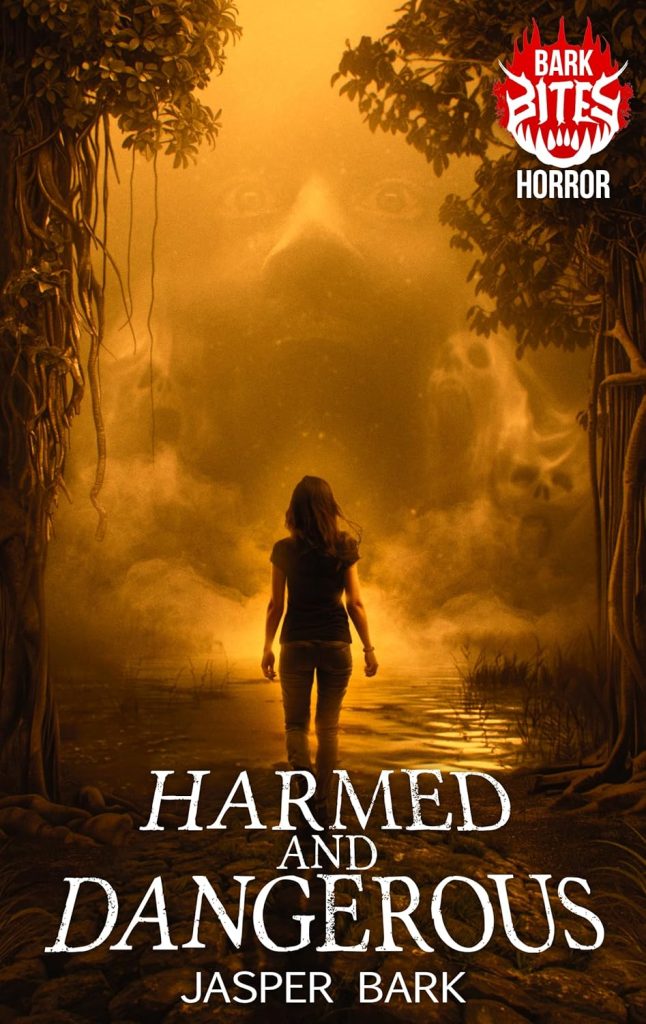
A Paranormal Thriller for readers of Stephen Graham Jones, Tananarive Due and Grady Hendrix
Put yourself in Kyra’s place.
You’re seventeen years old, lost and alone in a remote town in Louisiana. You’re searching for the birth parents you never knew. The heat is crippling. The river often floods, washing houses away and lifting corpses from the ground.
The locals treat you with suspicion. You don’t belong here. They’re hiding something. All over town, in nooks and hidden alcoves, there’s evidence of a forbidden faith. They keep the old ways here, but no one will tell you what they are.
There’s an intangible presence following you. Hiding in your peripheral vision. You can’t see, hear or touch it, but you know it’s there, waiting for its chance to claim you.
Then the episodes start.
Your vision goes and when it returns you’re seeing the world as it was fifteen years ago. Physically you’re in the present, but everything you see happened a decade and a half ago.
Suddenly you realize.
You’re seeing through the eyes of the serial killer who murdered your birth mother. He takes control of you, forcing you to watch as he stalks and brutally murders her.
And there’s nothing you can do to stop him. Because he died by lethal injection more than a decade ago.
Proudly represented by Crystal Lake Publishing—Where Stories Come Alive!