
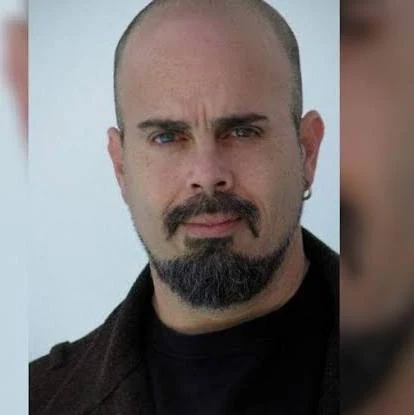
The knight finds the girl in a dead village. She speaks of angels. He has forgotten how to believe in anything but his own sword and the next meal. This is the opening of Between Two Fires, the 2012 medieval horror novel by Christopher Buehlman that refused to stay buried. Now, in 2026, Tor Nightfire has given it a deluxe reissue, complete with a foreword by Joe Hill, dragging it back into the light for a new generation raised on BookTok recommendations and a hunger for horror that actually means something.
Buehlman’s path to this moment is as unconventional as his prose. He started as a poet, moved to playwriting, and spent three decades as “Christophe the Insultor,” a verbal mercenary at Renaissance fairs. You can hear all of it in Between Two Fires. The poet’s ear for rhythm gives the landscape a haunting texture. The playwright’s instinct builds dialogue that crackles with tension and sudden, unexpected tenderness. And the comedian? He provides the dark, absurdist thread that keeps the whole thing from collapsing under its own weight.
The book follows Thomas, a disgraced, excommunicated knight, and Delphine, a young girl who might be a prophet or simply a child broken by the Black Death. Together, they traverse a 14th-century France that feels less like a historical setting and more like a Bosch painting come to life. Demons walk the roads. Angels are terrifying. And the plague is just the background noise for a second war in heaven.
We sat down with Buehlman to discuss the book’s long road to cult status, the theology of horror, and how insulting strangers made him a better writer.
Hell and Redemption: A Christopher Buehlman Interview on Between Two Fires

Your career path is unconventional, moving from poet and playwright to stand-up comedian and novelist. How do these disciplines interact in your work? Does the poet’s ear for language clash with the comedian’s instinct for punchlines?
I think they interact quite organically, and I don’t feel there’s conflict. Comedy can be lyrical and poetry can be funny. Lines invoking wonder and awe have internal rhythms just as punchlines do, and the more we write the better we get at finding them.
You won the prestigious Bridport Prize for Poetry before you started writing novels. Looking back, do you see your poetry as a kind of secret laboratory where you developed the prose style that would later define books like Between Two Fires and The Blacktongue Thief?
I do. I think I unknowingly apprenticed in many laboratories that helped shape me as a novelist. I wrote comedy material as Christophe the Insultor and for the stage shows I wrote; poetry taught me imagery and rhythm; playwriting taught me dialogue; screenwriting taught me economy. It’s all been quite lucky.
How has your experience as “Christophe the Insultor” influenced your writing of character interactions, especially the banter between Kinch and his companions or the tenderness between Thomas and Delphine?
Writing comedy for thirty years was, as I mentioned, a great workshop. One assumption people make about the insult game I played for so long is that it had something to do with meanness or viciousness. Sure, the lines I used were brutal, but also absurd. More importantly, I made sure the ‘victim’ understood that it was all in fun, and that I would only carry on with their consent. So yes, I learned to deliver funny lines, but, more importantly, I learned to read people.
I never wanted to actually upset anyone, and I got very good at telling when I was getting close to someone’s boundaries. So in a strange way, insulting people almost certainly sharpened my empathy, and empathy is intrinsic not just to moving through the world doing a minimum of harm, but it is also necessary to build characters that feel real. I never really made that connection before. Thanks for the great question.
You hold a degree in French from Florida State University. Was the decision to set your first foray into historical fiction in 14th-century France a direct result of your academic background, or was it a separate fascination that your studies made easier to research?
I’ve always been a francophile, and I blame the grade school I attended for bringing in a French woman to teach us the language when I was like six years old. She was only there for a year or so, and I didn’t learn to speak much French; but I learned how to make the sounds, which any linguist will tell you gets harder as we get older.
We can learn grammar in our sixties, but hearing and replicating the difference between tu and tout or amour and our number four, that gets tougher. But now I knew that there were other countries, and they spoke other languages, and there was a very interesting country called France and I would like to go there one day, please. All of which is to say I think it was only natural that I should both study the language and one day set a novel there.
Between Two Fires is immersive in its depiction of the Black Death. Was there a specific image, historical anecdote, or moment of inspiration that served as the initial spark for the novel? Did it begin with the character of Thomas, the setting, or the central concept of a celestial war playing out during the plague?
It all started when my editor asked me what I would like my sophomore novel to be. I had a very good time nerding out on research for Those Across the River, which was set in 1935 and featured a protagonist who had served in the First World War. I knew I wanted to write another historical novel, but when would it take place?
I had studied Elizabethan England in some detail as I used to perform a one-man show about poet, playwright, and spy Christopher ‘Kit’ Marlowe; but that time and those characters felt almost too familiar. I wanted to open up a different century on a granular level. So, remembering Barbara Tuchman’s excellent book A Distant Mirror, I decided to drill down on the 14th century, the hundred years’ war, and, most centrally, The Black Death.
The novel has been described as “The Road meets The Seventh Seal” or a medieval The Last of Us. Were you conscious of these or other touchstones while writing, or are these connections readers and critics have drawn after the fact?
I was aware of The Seventh Seal of course, but I had never played The Last of Us. I had both read and seen The Road, but I didn’t make any conscious parallels as I was writing. People have also compared it to the manga Berserk and the video game Lost Souls, both of which I was unaware of. There was one big influence, however, and that was Stephen King’s The Stand, which, as with several of his novels, I read much earlier than I probably should have. Rather than cooking up a modern plague, however, it interested me to go back to the ‘original gangster’ pandemic and explore those bleak days.
The character of Thomas is a disgraced, excommunicated knight, a man of violence seeking a fragile form of redemption. How did you approach crafting his voice? He’s cynical and world-weary, yet his actions betray a deep, perhaps buried, sense of chivalry and honour.
I never know how to answer the ‘how did you’ questions. I just animated him, let him speak, and figured out his backstory. Writing dialogue comes naturally to me. Plotting doesn’t! I’m in awe of writers who develop intricate, interlocking plots. That’s something I struggle with. Not dialogue, though. I love helping characters appear on the page and declare themselves.
Father Matthieu is such a brilliantly tragic and human figure, a priest of great learning and even greater doubt, haunted by his own sins. He provides both comic relief and profound spiritual crisis. Was he always part of the plan for the trio, or did he emerge as you were writing Thomas and Delphine’s journey?
He emerged. He just wandered out of the darkness with his lamp, looking for good people in a bad world, as Delphine did in chapter one. And, as with her, I let him speak. I think he’s the most relatable of the trio. Few of us are grizzled combat veterans like Thomas––though not few enough; we have broken a great many men and women for poor cause, and to our great shame my country is doing it again as I write this and I am outraged and heartbroken.
Okay, taking a deep breath. Few of us are like Thomas, fewer still are children with angelic visions. But Matthieu is a misfit; he’s gay in a time that isn’t particularly accepting of that, and he’s an alcoholic in a world that’s running out of wine. What’s more, he’s a deeply kind but physically and morally soft person thrown into hard times and faced with hard choices. He’s easy to love.
One of the book’s greatest strengths is its restraint. The supernatural horrors are often hinted at or appear only briefly, making them all the more terrifying. Was it a challenge to maintain that balance, to keep the demons and angels present and threatening without letting them overrun the very real human drama at the story’s core?
How much to show is always a challenge in horror. King nailed the conundrum in Danse Macabre, saying the thing outside the door is always more terrifying before you open that door. But you have to open it. I experimented with a few different approaches in this book, one of which involved only sound. ‘Sister Broom’ engages in a sort of ‘Riddles in the Dark’ moment with Delphine, and that might be the scariest scene in the book. Why? Because sound goes straight to the amygdala, where fear is processed. Seeing a snake is frightening, but hearing it slither toward you? Much worse!
The religious landscape of Between Two Fires is complex and unflinching. It’s a world where God seems absent, yet the Devil is very, very active. Were you intentionally exploring the concept of theodicy, the problem of evil, through the lens of the Black Death?
Yes, though as an agnostic I find the problem of defending both God’s goodness and omnipotence in the face of evil’s existence intractable. It was more interesting to me to juxtapose the directives of Christ, particularly non-violence and forgiveness, with the way most Christians seem to live. The Christian soldier is, for me, an oxymoron.
I do believe there are times when it is incumbent on us to fight, to defend ourselves or those we love, but that’s not what Christ calls us to do. This same problem is beautifully illuminated in the film The Mission, which I think is a masterpiece. Bad men are coming to do bad things. Do we fight them, or allow ourselves (and others) to be martyred?
The latter path is harder, which seems to me to be why Christ says the path to heaven is narrow. I can’t walk it, but I admire and respect it when people can. I think Jimmy Carter was the only US president who managed it. He lived humbly. He urged us to live within our means rather than finding more to consume. And he refused to take us to war with Iran when most Americans were eager to avenge the humiliation of the hostage crisis.
Had he bombed Teheran (and had world war three not destroyed us all because of it), there would have been statues of him in parks and he might have had a second term. But he felt called to pacifism, and was ready to sacrifice his perception in the public eye to save innumerable lives. We have a very different creature in the White House today.
Critics often praise the book for its deep religiosity without being preachy. How did you maintain that balance while authentically presenting the medieval worldview, with all its faith and fear, without imposing modern judgments?
Curses, another ‘how’ question! I don’t know, I just immersed myself in the world and treated it as though it were real. It’s what I always do when writing this stuff. I wasn’t trying to tell anyone how to live–I just showed people doing their best. But with demons. And where there are demons, there should be angels, yeah?
Delphine is a compelling conduit for the divine, embodying innocence without naivety. Her connection to God is both visceral and often frightening. In a striking passage, she reflects, “Heaven was a woman holding your head… a warm hand on your cheek and the smell of soup with garlic.” This beautiful imagery highlights the theme that, amidst apocalyptic horror, holiness resides in small acts of human kindness. Thomas embodies the journey from skepticism to belief through love and sacrifice, echoing “Doubting Thomas.” Matthieu, a priest who has lost his faith, contrasts with the cynical knight who rediscovers it by protecting a child. Was it your intention for these characters to mirror and challenge each other’s faith?
It all developed organically. I didn’t plan my way there, I found my way there. I’m not much of a planner.
The angels in your book, especially the one speaking through Delphine in the crypt, are terrifying and otherworldly, more akin to the “Fear not” angels of the Old Testament than to gentle Renaissance depictions. What inspired this interpretation, and what message did you want to convey about the divine in your story?
Medieval depictions of angels often evoke cosmic horror–think of a seraph with its sextet of wings and single blazing eye. In the New Testament; think of the annunciation to Mary that she, a young girl and a refugee, is to be the vessel for God’s incarnation. Who wouldn’t be terrified at that? Thanks for the lilies, Gabriel, but wow. And Gabriel is often depicted around lilies because their shape resembles the trumpet he is one day to blow, heralding the end of the world and waking the dead from their coffins. Hardly comforting stuff. And what are devils but fallen angels, after all?
Between Two Fires was published in 2012 but has seen a massive resurgence in popularity in recent years, leading to a new deluxe reissue from Tor Nightfire with a foreword by Joe Hill. Why do you think this particular story has resonated so strongly with a new generation of readers, especially in our current era?
I think the causes for its resurgence are threefold. First, it was slowly gaining a word-of-mouth following on Reddit, and this bled over to Tiktok. The process was accelerated when I signed with Tor to publish The Blacktongue Thief because Tor truly excels at promotion. They had everyone interested in the new book a full year before it appeared on shelves in 2021, and, in the meantime, Between Two Fires was the most fantasy-adjacent of the books I had written.
Lastly, and most unfortunately, we were visited with a real, live pandemic—though mercifully one with a 1.5 percent mortality rate rather than yersina pestis’ catastrophic 60-70 percent. Plague was very much on everyone’s mind, and here was this bright red book with a skeletal knight on the cover.
You’ve built immersive worlds in historical France, the dark fantasy of *The Blacktongue Thief*, and the vampire-filled NYC of *The Lesser Dead*. When you write, what influences your choice of setting? Do you start with a desire to write horror or fantasy, or does the character lead you to the genre?
So far I’ve always started with a specific genre in mind. With Between Two Fires I set out to write horror, but it’s fair to say it grew into something more than that. I think that’s because it presumed to wrestle with some very big questions about religion, redemption, and what we owe to each other or to our idea of God.
As far as setting goes, I’m attracted to dark places; the spaces under the subways in New York, the lonely highways of an America in social upheaval, a world where all the horses and most of the men have been killed by goblins in an existential struggle with humankind. And, of course, France undergoing a medieval apocalypse. I don’t know why, but I’ve always been more Halloween than Christmas.
Finally, with the Between Two Fires reissue on the horizon and the world eagerly awaiting more from the world of The Blacktongue Thief, can you give us a hint about what’s currently on your writing desk? Is there a new fire you’re tending to that you’re excited to share with readers?
I’ve got two books on the near horizon. One will be the final book in the Blacktongue series, now that I’ve handed in The Thrice-Bound Fool and it’s due for publication in October this year. The other will be another historical medieval horror novel, though I believe we’re going to Italy this time.
Between Two Fires by Christopher Buehlman

THE EPIC TALE OF MEDIEVAL HORROR DRIVING BOOKTOK WILD
‘A beautiful nightmare that grips you from start to finish’ VICTORIA AVEYARD
This edition includes a critical foreword from bestselling author Joe Hill
****
The year is 1348. Thomas, a disgraced knight, has found a young girl alone in a dead Norman village.
An orphan of the Black Death, and an almost unnerving picture of innocence, she tells Thomas that plague is only part of a larger cataclysm-that the fallen angels under Lucifer are rising in a second war on heaven, and that the world of men has fallen behind the lines of conflict.
Is it delirium or is it faith? She believes she has seen the angels of God. She believes the righteous dead speak to her in dreams. And now she has convinced the faithless Thomas to shepherd her across a depraved landscape to Avignon. There, she tells Thomas, she will fulfil her mission: to confront the evil that has devastated the earth, and to restore to this betrayed, murderous knight the nobility and hope of salvation he long abandoned.
As hell unleashes its wrath, and as the true nature of the girl is revealed, Thomas will find himself on a macabre battleground of angels and demons, saints, and the risen dead, and in the midst of a desperate struggle for nothing less than the soul of man.
Essential Horror Interviews on Ginger Nuts of Horror

For true devotees of the dark and macabre, Ginger Nuts of Horror stands as a premier destination for exclusive horror author interviews and in-depth horror director interviews. Our curated conversations go beyond the surface, offering unparalleled access to the visionaries shaping modern horror.
Step inside the creative minds behind your favorite nightmares. Our interviews dissect the inspiration behind iconic horror stories and films, exploring how masters of the genre conjure fear. Learn how horror authors develop chilling narratives and how horror directors translate terror to the screen.
2. Gain Unique Industry Insights & Career Advice
Navigate the horror industry with wisdom from those who’ve succeeded. Our conversations provide practical advice for aspiring horror writers and filmmakers, covering:
- Breaking into horror publishing or film
- Overcoming creative and professional hurdles
- Understanding evolving horror trends and audience expectations
3. Explore the Psychology & Culture of Fear
Delve deeper into what makes horror resonate. Our interviews examine the psychology of fear, how horror reflects societal anxieties, and the genre’s exploration of themes like morality, existential dread, and identity.
4. Connect with a Community of Horror Enthusiasts
Join a vibrant community. Each interview sparks discussion, allowing you to engage with fellow fans and sometimes the horror creators themselves through comments and social media.
Featured Insights from Horror’s Finest
Our archive includes conversations with legendary horror authors discussing craft, and visionary horror directors breaking down their filmmaking techniques. Find guidance, inspiration, and a deeper appreciation for the art of horror.
Ready to explore? Visit the Horror Interview Section on Ginger Nuts of Horror today. It’s your essential resource for connecting with the minds that define fear, perfect for fans, aspiring writers, and future horror directors alike.
Searching for the best horror author interviews or seeking wisdom from horror directors? You’ve found your source. Click here to start reading now.


