




Some stories don’t just want to be read. They want to be felt in your bones, a visceral tremor that resonates long after the last page. This is the unsettling territory of Yah Yah Scholfield’s debut, On Sundays She Picked Flowers. A Southern Gothic horror novel that’s equal parts bloody and lyrical, it carves a new space in the genre.
Forget genteel hauntings. This is a story steeped in the humid, blood-soaked soil of Georgia, wrestling with the ghosts of abuse and the violent inheritance of family trauma. It’s a sapphic horror tale about an older woman’s fight for survival and self, a narrative that is as much about the haunting of a place as it is about the haunting of a bloodline.
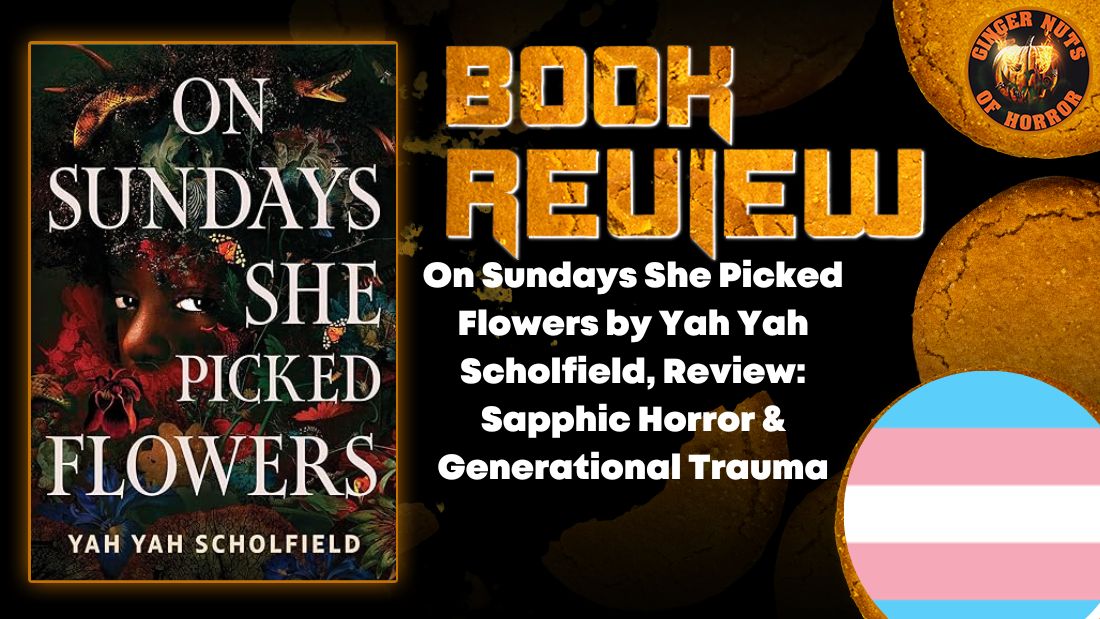
On Sundays She Picked Flowers by Yah Yah Scholfield, Review: Sapphic Horror & Generational Trauma
It starts with a crack. A skull against a wall. Not in a grand, dramatic climax, but in the brutal, casual air of a Tuesday. The violence in Yah Yah Scholfield’s On Sundays She Picked Flowers isn’t ornamental. It’s foundational. It’s the first language the protagonist, Jude, ever learns. By page one, you’re not being eased into a world; you’re being thrown headfirst into its humid, gory truth. This book doesn’t let you hide.
You think you know where this is going. Abused woman fights back, flees into the woods, finds peace. A simple redemption arc. However, Scholfield isn’t interested in simple narratives. Jude’s escape to a dilapidated house in the Georgia swamps isn’t an escape at all. It’s a trade. She exchanges the violent history of her mother for the violent history of a place called Candle, a former plantation house teeming with what the locals call haints.
Ghosts of the enslaved who lived and died there. The house is a character, mischievous and temperamental, and Jude’s relationship with it is the book’s first strange, beautiful love story. She soothes it. Honours its bloody land. For thirteen years, she builds a fragile peace, becoming a wisewoman, a healer.
But here’s the thing about trauma, the real, generational kind. You can’t outrun your own blood. It simmers. Waits.
The peace shatters with a knock. A stranger named Nemoira appears, beautiful and utterly uncanny. She is a disruption, a desire, a question mark. And with her, the old brutality in Jude’s blood begins to sing again. This is where the novel pivots from a story of survival to something more complex and terrifying: an examination of whether the violence done to us is a stain we can cleanse or a seed we inevitably nurture.
We talk about “breaking the cycle” so easily. As if it’s a conscious choice, a clear-cut moral line. Scholfield muddies that water with the skill of a poet who understands that roots grow deep in darkness. The book humanises Jude’s abuser, Ma’am, without ever excusing her. We see the abuse passed down like a twisted heirloom, from a grandfather’s lash to a mother’s rage to a daughter’s clenched fist. It makes you wonder. Is monstrosity inherited? Or is it a language, learned so early that it becomes mother tongue? Jude’s journey isn’t about becoming innocent. It’s about confronting what she is capable of, the urges that feel less like a foreign possession and more like a homecoming.
The Southern Gothic genre is a minefield of potential cliché. The decaying mansion, the oppressive heat, the ghosts of the past. Scholfield doesn’t just use these elements; she reinvigorates them with a fierce, contemporary purpose. Her expertise lies in welding the genre’s traditional atmosphere to a starkly modern exploration of inherited trauma. The haunting here isn’t merely spectral; it’s cellular. The violence of the plantation’s history and the violence of Jude’s childhood aren’t metaphors for each other, they are the same root system, feeding the same poisonous tree.
This is where the novel’s power truly coalesces: in its unflinching portrayal of generational trauma as a haunting. Ma’am is a monster, yes, but Scholfield, with brutal authoritativeness, forces us to see the chain. The abuse passed from grandfather to mother to daughter isn’t an excuse; it’s an autopsy.
The book poses the agonising question that defines so much Black horror and literary horror today: Is the trauma a stain to be cleansed, or a seed, already sprouting twisted inside you? Jude’s fight isn’t to become innocent. It’s to confront what has taken root in her own soil. Her relationship with the sentient, demanding house isn’t a quaint haunted house trope; it’s a dark mirror of her own struggle to manage a legacy of pain.
The prose itself is lush, verdant, and almost overwhelming. The way in which Scholfield describes Jude entering the woods is so powerful that you can smell the decay and the blooming flowers. Let’s talk about the reading experience, because it is intensely, deliberately visceral. Scholfield’s prose is a character in itself. It can be lush, almost overwhelmingly verdant: describing the woods as having “bark teeth and a mossy throat.” You smell the damp earth, the blooming flowers, the hint of decay.
This lyricism makes the sudden eruptions of body horror not just shocking, but feel inevitable. The grotesque isn’t grafted on; it blooms organically from the soil of the story. When violence comes, it is sharp, clinical, and profoundly disturbing. This oscillation between beauty and brutality is the novel’s central nervous system. It mimics the way trauma lives in the body, a flood of sensory memory triggered by something as simple as the scent of flowers.
And the romance. Let’s talk about that. It’s sapphic, charged, and deeply unsettling. Nemoira is less a human love interest and more a force of nature, a beast in a beautiful skin. Their relationship is a dark fairy tale, think Beauty and the Beast if the lines between beauty and beast, hunter and prey, were completely erased. Jude, in her 40s and then 50s, gets to have a passionate, complicated, hot sexual relationship, a refreshing defiance of the cultural invisibility forced upon older women. But this love doesn’t save her. If anything, it threatens to unmoor her completely, to pull her back toward the abyss she’s spent years clawing out of.
The queer horror element, central to the plot, is similarly refracted through this complex lens. The relationship between Jude and Nemoira is charged with a desperate, feral heat. It defies easy categorization. This isn’t a romance that saves or sanitises. If anything, it threatens to unravel Jude’s hard-won control. In giving a woman in her 40s and 50s a deeply passionate, physically demanding, and morally ambiguous sexual narrative, Scholfield claims space rarely afforded in fiction. It’s a raw, authentic portrayal of desire that exists outside the bounds of healing or redemption narratives.
It’s messy. It’s ambiguous. Some readers will close the book with more questions than answers. They’ll wonder about the pacing, the purpose of certain visceral turns. That’s the point, I think. Trauma isn’t a tidy three-act structure. Healing isn’t a linear path. It’s recursive. It’s two steps forward and a bloody stumble back into a memory.
Yet, within that, there is a strange, hard-won catharsis. Not the kind that comes with neat resolution, but the kind that comes from witnessing a truth told without compromise. Jude’s journey is a harrowing portrait of survival, not as a triumphant escape, but as a daily, grinding negotiation with the past. The final act doesn’t offer easy answers. It offers a stark, unforgettable image of what it might cost to truly own every fractured part of the self, the victim, the healer, the lover, and the potential monster.
What Scholfield does, with what can only be called ferocious talent, is refuse to let the reader or Jude off the hook. There is catharsis here, but it’s a raw, earned, and painful thing. It’s in the act of witnessing Jude’s full self, the victim, the healer, the lover, and the potential monster, and understanding that all these fragments must coexist for her to be whole.
This is not a book for everyone. The content warnings are a necessary map: cannibalism, extreme abuse, body horror. It will unsettle you. It should. But for those willing to walk into its dark, verdant heart, On Sundays She Picked Flowers offers a rare reading experience. It’s a Southern Gothic for a new era, one that uses the genre’s tools, hauntings, grotesquerie, a deep sense of place, to dissect the very real horrors of inherited pain and the brutal, beautiful fight to build a self from the wreckage.
Yah Yah Scholfield hasn’t just written a good debut; she has planted a flag. This is visceral horror with the soul of poetry, a story that will cut you and then ask you to admire the sharpness of the blade. You’ll finish it changed. Maybe a little bruised. Definitely seeing the shadows in the corner of the room with a bit more clarity. The house, and its flowers, stay with you.
On Sundays She Picked Flowers by Yah Yah Scholfield

Lone Women meets Sorrowland in this sinister and surreal Southern Gothic debut about a woman who escapes her family home to the uncanny woods of northern Georgia and must now contend with haints, ghosts and a literal beast in the woods.
When Judith Rice ran away from the house she grew up in, she thought she severed her abusive mother’s hold on her. Seventeen years later, she’s made a home for herself in a cottage secluded deep in the forests of northern Georgia. Jude believes she’s settled into a quiet life.
But when an enigmatic woman shows up on her doorstep, Jude’s tentative peace is threatened by the stranger’s presence. The woman is beautiful but unsettling, captivating but uncanny. Caught between her desire for this woman and the violence that seems to simmer just beneath her skin, Jude’s past and present clash as the woman stirs up memories that force her to reckon with the violence of her escape years ago.
Horror Book Reviews: Ginger Nuts of Horror, Your Premier Horror Website for 17 Years
For every horror enthusiast searching for authoritative horror book reviews and a definitive horror website, your journey ends at Ginger Nuts of Horror. As a trusted pillar of the dark fiction community, we have spent over 17 years building a reputation for the most passionate, insightful, and credible coverage in the genre.
Our dedicated team of reviewers lives and breathes horror. Our collective expertise, forged over nearly two decades, ensures every review is a deep, critical analysis. We don’t just summarise plots; we dissect the terror, explore the thematic depths, and connect you with the very emotional core that makes horror books so compelling.
Why Ginger Nuts of Horror is the #1 Resource for Horror Fans
Unmatched Depth & Legacy in Horror Book
Reviews: With 17 years of reviewing horror, we offer an unparalleled perspective. Our reviews expertly guide you from mainstream bestsellers to under-the-radar indie gems, helping you find your perfect, terrifying read.
Exclusive Access to Horror Authors: Go behind the scenes with in-depth interviews that reveal the minds behind the madness. We connect you with both legendary and emerging horror authors, exploring their inspirations and creative processes.
Award-Nominated Authority & Community: Founded by Jim McLeod, Ginger Nuts of Horror has evolved from a passion project into an award-nominated, essential horror website. We are a global hub for readers who celebrate horror literature in all its forms, from classic ghost stories to the most cutting-edge dark fiction.
Experience the Difference of a Genre-Dedicated Team
What truly sets us apart is our dedicated team of reviewers. Their combined knowledge and authentic enthusiasm ensure that our coverage is both intelligent and infectious. We are committed to pushing the genre forward, consistently highlighting innovative and boundary-pushing work that defines the future of horror.
Ready to dive deeper?
For horror book reviews you can trust, a horror website that champions the genre, and a community that shares your passion, Ginger Nuts of Horror is your ultimate destination. Explore our vast archive today and discover why we’ve been the top choice for horror fans for over 17 years.


Awesome review, Jim. You captured everything I felt about the book. It’s truly unique and special!