

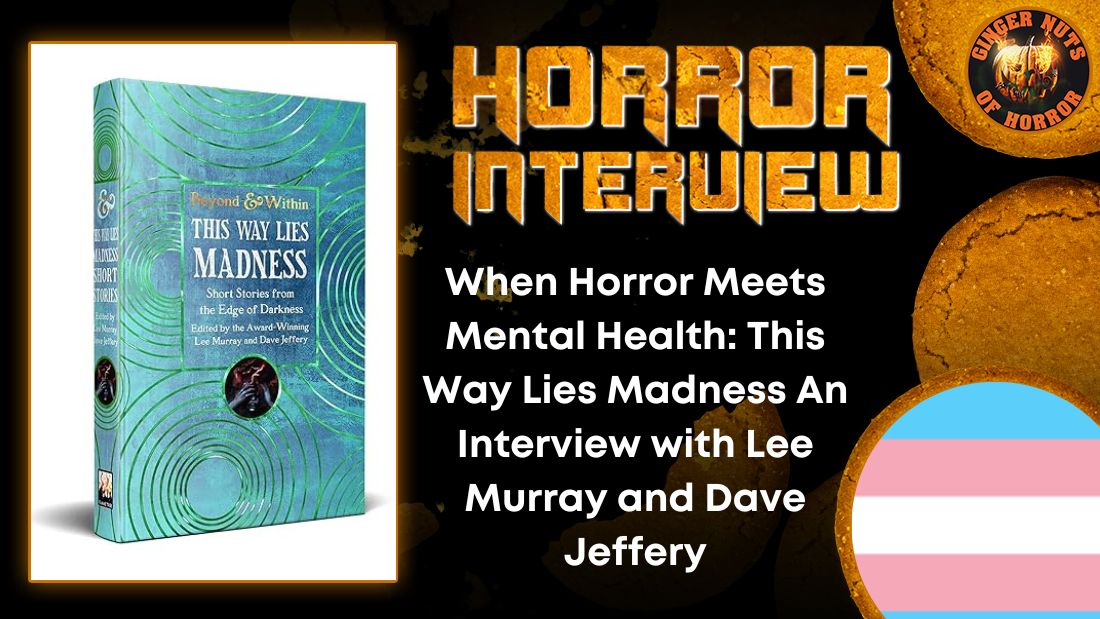

When Horror Meets Mental Health: This Way Lies Madness An Interview with Lee Murray and Dave Jeffery

Horror has long danced with themes of madness, but too often this relationship has relied on stigmatising tropes and cheap thrills at the expense of authentic representation. Enter This Way Lies Madness, a groundbreaking new anthology from Flame Tree Press that seeks to redefine this complex intersection. Edited by acclaimed authors and mental health advocates Dave Jeffery and Lee Murray, the collection brings together a robust roster of voices to explore psychological terror with sensitivity, authenticity, and a profound sense of purpose.
The critical reception has already begun to validate their five-year journey to publication. As highlighted by a stellar review on Ginger Nuts of Horror, which called the anthology “essential reading” and a “landmark release,” the book is achieving its goal of offering chills without caricature. Reviewer Ben Unsworth’s praise has not only celebrated the quality of the stories but has affirmed the editors’ core mission: to prove that horror can be a vehicle for empathy and understanding, destigmatising mental health struggles through the very power of metaphor and fear.
We sat down with the editors, Dave Jeffery and Lee Murray, to discuss the inspiration behind this vital project, the challenges of curating such a sensitive theme, and how they believe the horror genre can—and must, evolve in its portrayal of mental health.


Hello David and Lee, congratulations on the release of This Way Lies Madness. How are you feeling now that your book has been released into the wild?
‘Ecstatic’ is a word that springs to mind! The anthology has been part of our lives for over five and a half years, if you count the conception, pitch development, and publishing process. It’s also a nervous time because we believe we have conceived something special here, and gaining feedback from readers and reviewers is important to consolidate our goals. The incredible review by Ben Unsworth published on Ginger Nuts of Horror has certainly calmed those nerves to some degree!
What was the initial inspiration for creating an anthology explicitly focused on the intersection of mental health and horror?
Dave: This goes way back to 2019 where we wrote a conversational essay for the Horror Writers Association (HWA) titled Out of the Darkness. In our time as co-chairs of the HWA Wellness Committee, and architects of the associations’ Mental Health Initiative, we both felt that horror was an incredible vehicle for a considered exploration of mental illness, given the psychological impact great horror can and does illicit from its audience.
However, the genre had become lazy, using images of ‘crazed’ and ‘psychotic’ killers or deranged monsters to garner cheap thrills at the expense of those very real people who endure mental illness on a day to day basis. Part of mental health recovery is the fostering of hope, this means looking at mental illness as something positive, something that people can overcome or survive. In terms of the genre, stigmatising language was counterproductive to such an ethic. So we decided to dig deeper and find out what we could do to try and challenge that perspective.
Lee: I agree, Dave. Having this beautiful book in my hands feels like the culmination of our purpose to show that there is a different way to approach mental illness in horror —that the topic can be addressed with sensitivity and authenticity and beauty. However, despite the long road we have taken to reach this point, it also feels like a beginning, since the book is among the first of its type.
None other that I know of includes vignettes by its contributors’ revealing the rich lived experience that inspired their stories and poems and the added insight those revelations entail. I hope this book becomes a starting point for many discussions on this topic, a way of overcoming some of the stigma and shame that surrounds mental illness and means of bringing some hope to anyone who might be struggling.
The term “mental health” is broad. Did you provide contributors with a specific focus (e.g., particular illnesses, the experience of therapy, societal stigma, recovery) or was the interpretation left open?
The brief for This Way Lies Madness was kept pretty simple; we wanted stories that depicted chilling and compelling tales while remaining sensitive to the portrayal of mental illness. As a benchmark we used Poe’s The Tell-Tale Heart and Gillman’s The Yellow Wallpaper for submission guidelines; where both works used metaphor to the describe psychological horrors imparted upon their protagonists. That said, people were left to approach their tale whoever they saw fit, and we did not limit genre, which gave us access to a wide range of stories in various settings.
What do you believe horror as a genre can accomplish in destigmatising mental health struggles that other genres cannot?
The psychology of horror is, in itself, a key component of reducing stigma. For us, the genre is primarily used to explore how human beings cope with adversity, be that emotional or the visceral. If horror can do anything, it can show the trials of being human; how we battle literal emotional demons, the dark monsters of grief and loss, the terror of paranoia and dissociated realities.
Yet, from what we have discovered through our discussions with genre creatives, the genre can also be cathartic; whereby the act of creative narratives can help individuals deal with the day to day trauma of living with mental illness. Creativity is an established, integral part of mental health recovery, and using horror as a theme can give such issues focus.
Was there a conscious effort to move beyond tropes like the “insane asylum” or the “homicidal maniac,” and if so, how was that guidance given to writers?
We made clear from the outset that stigmatising phrases and stereotypical terminology would be absent from This Way Lies Madness. To do this effectively, we took time with the marketing team from Flame Tree Press to craft a carefully worded submission brief so that those answering the submission call were aware that the focus was one of representation of mental illness through metaphor, not stereotypical and insensitive portrayals of mental illness. For example, we wanted to understand how protagonists endured and understood their own sense of self, an aspect that mental illness has tendency to erode when left unchecked.
While horror has a history of tackling important subjects, it also has a troublesome past with representation. About its history, what are the biggest missteps that horror has made about mental health representation within books and film?
The German expressionist film, The Cabinet of Dr Caligari (dir: Robert Wiene, 1920) is widely accepted as the originator of the modern day affiliation between mental illness and the horror genre. But it is important to note that the history of psychiatry, and narratives from such times come with their own influences, especially when applied to arcane treatments and the pre-asylum and asylum systems of the 17/1800s. Such images of dark and dingy buildings and prescriptive treatments such as lobotomy, sensory deprivation hoods, as well as chains, manacles, and the straightjacket leave their own horrific images, yet such things are accurate.
So, we do not want people to shy away from factual representations, these have their own value in terms of learning lessons, but what do expect is that such representations are well researched and accurate, and not there for mere shock value, so to speak. So, when it comes to films and books that apply the latter aspect—too many to count, let alone name, sadly—these would be considered ‘missteps’ in our view.
And where in the horror genre did they get mental health representation correct in your opinions?
Dave: There are many positive examples. Films such as Possum (dir: Matthew Holness, 2018), Saint Maud (dir: Rose Glass, 2019), and Horse Girl (dir: Jeff Baena, 2020) are exemplars of a portrayal of the terrifying realities of mental illness on a person and those around them. For exceptional literature, especially in their ability to capture grief, depression, and the pervading affects of trauma, I often talk about Serpent’s Wake: a Tale for the Bitten by L. E. Daniels (who also has a poem in our anthology) and Whalefall by Daniel Kraus.
Lee: I thoroughly endorse all those suggestions offered by Dave above. L.E. Daniels’ Serpent’s Wake is one of the most lyrical and beautifully horrific depictions of trauma that I have ever read. Craig di Louie’s The Children of Red Peak is another great read, a powerful commentary on the collective dysfunction resulting from cultism and gaslighting. For a short story offering a strong cultural interpretation of madness, readers might want to sample “The Head” by Korean writer Bora Chung. A translation by Anton Hur can be found in a 2019 issue of Strange Horizons here:
http://samovar.strangehorizons.com/2019/09/02/the-head-%EB%A8%B8%EB%A6%AC/
“No Flesh on Our Bones” by Mariana Enriquez, a short story in which a woman obsesses about a skull she discovers on the street, is another compelling example with a unique cultural take. Don’t forget that horror poetry is a fabulous source of mental health and horror done well, and in a form that can be accessed in smaller doses, a plus given the emotional toll some of these narratives can bring. Consider picking up a copy of John Edward Lawson’s poetry collection Survivor Ritual and Stephanie Wytovich’s On the Subject of Blackberries, for two very different approaches to the otherness of depression. Stephanie also has a poem in This Way Lies Madness.
What was the most surprising or unexpected take on the theme that you encountered in the submissions?
Dave: Having a broad brief encouraged stories that were equally wide ranging in both tone and genre. This meant that we had traditional ghost stories alongside science fiction horror tales, nuanced chills alongside extreme body horror. The ultimate table of contents really does have something for everyone.
Lee: With more than 1400 story submissions, we were overwhelmed with the vast spectrum of approaches, tones, styles, and structures. Unease to extreme. Anxiety to addiction. We saw stories that concentrated on the machinations of a single mind, overarching collective madness, and everything in between. Stories which took the perspective of the person struggling or surviving mental illness, and others which examined the experience of a carer or witness.
Couched in metaphor, the stories we chose invariably lead the reader to access a particular psychosis, without forgetting that there is a person behind the narrative, reminding us that mental illness should not be reduced to labels and stereotypes. Our contributors come from different countries, cultures, and lifestyles, and draw from a range of lived experience. I think Dave is correct when he says there is something in this volume for everyone.
Was it a challenge to find authors who were comfortable and skilled at writing in both of these demanding spaces?
We had no issue with our contributors in that most agreed to be part of the book from day one, such was the excitement of the project. Ramsey Campbell submitted his story A Solitary Voice within a few days of signing up! As mentioned above, from the submission call we had over 1400 stories, and whittling these down to the remaining 10 places was an incredible challenge.
We didn’t use the usual publisher slush pile system, we read every story, in some instances three times! We wanted to make sure everyone had the chance to impress, and we certainly were, overall. The primary ethos was ‘did the submissions meet the brief’ meaning the concept of metaphor was key to progressing to the next submission phase.
Many horror authors draw on personal fears. Did any contributors share that they were drawing from personal experience with mental health, and how did that impact your editorial approach?
One of the most important elements, and something unique to This Way Lies Madness, is that each contributor provides a vignette explaining how they came to write their story, and what influenced its development. Our contributors have been bold and speak explicitly about how their stories have been shaped by their lived experience of mental illness, be that as a survivor, a carer or a witness. It was these candid records that left us humbled as editors. We feel incredibly privileged to have steered this book to publication.
Who is the anthology aimed at? Do you want those of us who suffer from mental health issues to take some solace from the stories here?
The book has several aims. Firstly it is to provide readers with high-quality horror fiction designed to thrill, shock, scare, and unnerve. Secondly, the book provides an assurance that the mental health theme at the core of each story is dealt with sensitively, and without stigmatising language.
Through these stories and contributor vignettes, we hope that survivors of mental illness feel that their trials have been captured in a way that says ‘we see you, we understand’ rather than being mocked or derided for the sake of a cheap scare. For authors and academics, the book is a resource, with exemplar stories of how to approach writing about mental illness in horror and the use of metaphor as a vehicle for creating hard-hitting, yet empathetic, stories.
What is the ideal emotional takeaway for a reader? Should they feel catharsis, unease, understanding, or something else entirely?
We would hope that a reader can close the book and feel all of those emotions, but with a sense of relief that they have been able to find stories that they can relate to, where they can find some sense of belonging, if you will. As we’ve mentioned, an important element of mental health recovery is instilling hope, ultimately this is what we would love for the reader to experience.
How would this anthology contribute to the larger conversation surrounding mental health, both within the horror community and beyond?
Given our ethos of challenging the stigmatisation of mental illness, we certainly want this anthology to have influence beyond the horror community. The horror genre may have an unhealthy affiliation with perpetuating stigma, but wider society is equally complicit in its attitudes to mental illness and its portrayal. What we must do is ensure that horror isn’t presenting itself in such a way that impacts those who survive mental illness and feeding into that unhealthy societal dynamic.
So, This Way Lies Madness is designed to be a reference point; exemplars of genre fiction that tell scary stories which remain sensitive in their portrayal of mental health themes. Responses to the anthology from high-profile mental health academics have been very encouraging and means that we are moving in the right direction. We want this book to be a talking point, we want it to start conversations about mental illness—what it is, and what it isn’t.
Editing this anthology must have been an intense experience. What did you have to watch or read to “cleanse your palate” after a day of working on these stories?
Dave: I found myself rewatching and rereading movies and books that I loved, but these were still inspired by something I’d read in a submission. For example, Carpenter’s The Thing and Shelley’s Frankenstein were promoted by stories that made the final Table of Contents, but I’ll leave readers to figure out which stories those are! I’d also revisit these much-loved films and books with a mindset on their metaphors, and how they may relate to mental health or illness. They become even more fascinating when viewed through such a lens. I also did a LOT of distance running during this time, just to free the mind a little!
Lee: Quite apart from the sheer volume of stories we received, working on this anthology was an intensely emotional experience. Surprisingly, reading the stories often provided their own kind of catharsis: there is something strangely freeing about seeing your experience acknowledged in a story, be that as a sufferer, survivor, carer or observer. It was also extremely gratifying and uplifting to see our shared vision for the anthology so perfectly captured in the stories submitted.
That said, there was an added responsibility here, a pressure to get the work just right, which weighed on us as editors. So when I did need to step away and ground myself again, when the intensity of the stories became too much, I took long walks, soaked in the bath, cuddled my dog, and enjoyed time out with my family and friends—all the same things that contribute to my mental wellbeing.
This Way Lies Madness, edited by Dave Jeffery & Lee Murray

In the tradition of Poe’s ‘The Tell-tale Heart’, This Way Lies Madness presents fictional interpretations of madness from some of the biggest names in the horror genre – an anthology of dark stories featuring monstrous manifestations of trauma and guilt, paranoia and persecution, anxiety, addiction, and crippling terror. With each contributor giving a unique introduction exploring their inspiration for their bone-chilling tale, This Way Lies Madness will provide a creative benchmark for writers, and challenge mental health stigma, awaken understanding, and offer hope to readers through the lens of horror fiction.
A mix of commissioned authors and stories selected from a hugely popular submissions call, the full list of featured authors in this book is: Alan Baxter, Freddie Bonfanti, Georgina Bruce, Ramsey Campbell, Grace Chan, Ryan Cole, L.E. Daniels, Kayleigh Dobbs, Sean Hogan, Alma Katsu, Amanda Cecelia Lang, Sara Larner, Jonathan Maberry, Marie O’Regan, Cynthia Pelayo, Callum Rowland, Sumiko Saulson, Sayan J. Soselisa, C.D. Vázquez, Emily Ruth Verona, Stephen Volk, Tim Waggoner, and Stephanie M. Wytovich.
The Flame Tree Beyond and Within short story collections bring together tales of myth and imagination by modern and contemporary writers, carefully selected by anthologists, and sometimes featuring short stories from a single author. Overall, the series presents a wide range of diverse and inclusive voices with myth, folkloric-inflected short fiction, and an emphasis on the supernatural, science fiction, the mysterious and the speculative. The books themselves are gorgeous, with foiled covers, printed edges and published only in hardcover editions, offering a lifetime of reading pleasure.
Dave Jeffery
Dave Jeffery is a British Fantasy Award and The Bridport Prize nominated writer of speculative and dystopian fiction. He has written 19 novels and 3 collections and is recipient of the Horror Writer’s Association Mentor of the Year Award. Prior to his retirement in 2019 to write full time, Jeffery worked as a mental health practitioner for 35 years and remains an active mental health advocate within the horror community. He is an anthologist with Flame Tree Press and his current book This Way Lies Madness (co-edited with Lee Murray) was released in September 2025. His next novel, False Prophet is released October 3rd through Eerie River Publishing. Read more at www.davejefferyauthor.com
Lee Murray ONZM
Lee Murray ONZM (Officer of the New Zealand Order of Merit) is a writer, editor, poet and screenwriter from Aotearoa New Zealand, a Shirley Jackson Award and five-time Bram Stoker Award® winner. A USA Today bestselling author with more than forty titles to her credit, including novels, collections, anthologies, nonfiction, poetry, and several books for children.
Lee holds a New Zealand Prime Minister’s Award for Literary Achievement in Fiction, and is an Honorary Literary Fellow of the New Zealand Society of Authors. Among her recent works are feature film Grafted (directed by Sasha Rainbow), horror anthology This Way Lies Madness (Flame Tree Press) co-edited with Dave Jeffery, and prose-poetry collection, NZSA Cuba Press Prize-winner Fox Spirit on a Distant Cloud (The Cuba Press).
Read more at https://www.leemurray.info/


