
- Writing Horror as an Act of Resistance: Amy Jane Stewart on Her Debut Hex House
- Hex House Review: Amy Jane Stewart’s Dark Fairy Tale of Feminine Revenge
- Amy Jane Stewart Interview: Hex House and Feminist Horror
When reality grows more terrifying than any fiction, writing horror becomes an act of resistance; a way to contain unspeakable violence and, on the last page, decide who survives.

Horror has always done its best work in the shadows, but lately it’s been stepping into the light as a vehicle for open defiance. The phrase “writing horror as an act of resistance” might have sounded radical a decade ago; today it names a growing conversation among authors who refuse to look away. Jordan Peele’s Get Out turned a meet-the-parents setup into a scalpel-sharp dissection of systemic racism. Alison Rumfitt’s Tell Me I’m Worthless made a haunted house a crucible for trans experience. These stories don’t simply frighten. They confront, they challenge, they push back against the real-world horrors that seep through our newsfeeds every morning.
Amy Jane Stewart, a Scottish writer whose debut novel Hex House arrives steeped in folklore and feminist fury, knows this territory intimately. She began writing the book in 2023, a moment when the tally of women killed by partners or strangers felt unrelenting.
Stewart turned to the old tales of her homeland, the kind where forests keep secrets and female rage twists into something ancient, and built a narrative that acts as what she calls a container for everything she was feeling. That container, unsurprisingly, is horror. In the guest post below, Stewart makes a clear-eyed case for why the genre is uniquely equipped to hold our ugliest fears and transform them into something that looks a little like power. She’s handed the floor.
Writing Horror as an Act of Resistance: Amy Jane Stewart on Her Debut Hex House
In the run-up to the release of my debut novel, Hex House, I’ve been asked many times: why horror? It’s as though people are surprised that this story I want to tell – a woodland-set fairytale based on Scottish folklore – fits within the horror genre. To me, the answer is multi-faceted, ever-changing. Sometimes I don’t even know the answer myself. All I know is, when I put pen to paper, the things that come out are darker than I expect.
I suppose one of the reasons might be because horror allows me to feel big feelings in a safe space. I think it allows us all to do that. Scary movies and books are self-contained playgrounds where we can experiment, push boundaries, figure out what scares us and what that might say about us as individuals, and as humans. This is why, I think, horror specifically is so well-suited to exploring cultural and societal issues, as we can ask the uncomfortable questions and take things further than we perhaps can in perhaps any other genre.
Take for example, Get Out, the 2017 horror film directed by Jordan Peele, which deftly wraps up an incisive portrayal of systemic racism in an unsettling and whip-smart meet-the-parents package. Or Alison Rumfitt’s 2021 novel, Tell Me I’m Worthless, which offers a commentary on an experience of being trans, while also serving as a solid haunted house story. These stories use the fluid and daring confines of the horror genre to explore the nuances of contemporary experiences and issues.
We can put forth ways of living as experiments, as tests, as tiny little microcosms that don’t have to bend to and obey the rules of the rest of the world. There is tremendous power in that; to be able to put out into the world a narrative whose course and ending you dictate. And there’s power as a reader, too, in being taken on that journey. Because sometimes, horror can feel terrifying, it can feel like a reckoning. Other times, it feels a little like hope in a bottle. That, in my opinion, is where the true resistance lies.
When I started writing Hex House in 2023, I was responding to what felt, to me, like an especially troubling time in terms of violence against women and vulnerable people. Unfortunately, stories like this are nothing new, but for a while, it felt as though every day we woke up to news of another woman being killed by a stranger or by her partner.
So many names, so many faces. It’s difficult not to feel scared in the face of all that, to feel helpless. As with many things in my life, my answer was to put pen to paper. I created a story which could act as a container for everything I was feeling at that time. A sort of vengeful battle-cry, my way of honouring women with no way out left. Perhaps it’s no surprise that it turned out to be a horror novel.
One of the ways I think writing horror allows us to think about, interrogate and understand the world around us, as well as to actively stand against the parts of it that feel more terrifying than any piece of fiction, is by using the speculative to illuminate the strangeness of the ordinary. I’ve always believed that the power of speculative fiction of any kind is that it uses unusual concepts to reflect back to us how strange the everyday really is.
Take, for example, The Handmaid’s Tale, which uses Gilead as a stand-in for the oppression existent within our own patriarchal systems. The details of the Handmaidens’ worlds appear shocking to us, but they are only exaggerated versions of what already exists. Only when viewing something through a fresh, unfamiliar lens can we appreciate how warped some of the facets of our lives are. When we apply horror to this lens, it only becomes more shocking, more immediate, more visceral.
In a similar way, sometimes it’s impossible to know how we feel about something until it’s presented to us in a new way. Whenever I’m writing, it’s usually because I’m seeking to understand something that’s eluded me, something I can’t seem to get the full measure of without pinning it to a page. I need to have full clarity before I can figure out what I really think about something, and if I then want to rally against it.
And by its very nature, horror does not shy away from the ugly. It can be visceral, confronting and graphic. Not only in the sense of visible gore, as we might expect from conventional, slasher-type media, but also the darker parts of human existence. It tends to explore themes that might not be as palatable in other genres. Only by displaying things as what they are does it become possible to truly look at them, to face up to them.
Then there’s the fact that when an author writes a book, they not only get to decide on the story, they get to choose the ending. We can choose who survives, how things are resolved. We can put forth ways of living as experiments, as tests, as tiny little microcosms that don’t have to bend to and obey the rules of the rest of the world.
There is tremendous power in that; to be able to put out into the world a narrative whose course and ending you dictate. And there’s power as a reader, too, in being taken on that journey. Because sometimes, horror can feel terrifying, it can feel like a reckoning. Other times, it feels a little like hope in a bottle. That, in my opinion, is where the true resistance lies.
Hex House by Amy Jane Stewart
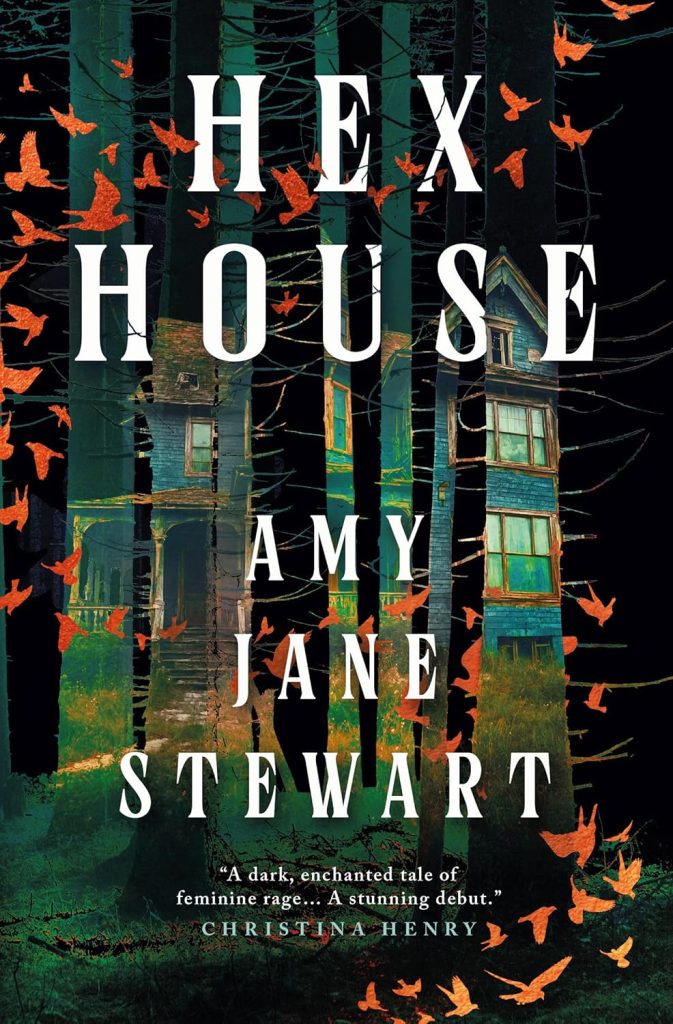
A beautifully told, dark and unsettling fairy-tale about a safe haven for women which transforms them into vessels of revenge, perfect for fans of T. Kingfisher, A. G Slatter and Julia Armfield
A woman in the woods alone is never the beginning of the story. It’s usually the end.
ELLY
Elly is running. Pregnant and still in her wedding dress, she flees the cottage that her new husband, Ethan, has rented for their wedding night. Because he’s not what people think he is, and she knows that one day he’ll hurt her in a way she can’t fix.
Freezing and alone in the woods in the dead of night, she accepts that she’s going to die. But just as she has given up all hope, a house appears out of nowhere, and a woman beckons her in. Welcome to Hex House. A place that can only be found by those who truly need it. A place that teaches broken women how to access a power more beautiful and more horrifying than anything they could have imagined.
SIOBHAN
Edinburgh, present day: Siobhan’s life is in ruins. Once a promising documentary filmmaker, she has given up on her dream, and kept all the terrifying footage she has of Hex House hidden away. She tries to erase all the horrors she witnessed with drugs and alcohol, and spends her time toying with a man in increasingly feral and dangerous ways. Her brother won’t speak to her, and she ignores the scar on her stomach that never fully heals
But despite everything, always, she feels the presence of that place.
And she knows, deep down, that she has to return.
Amy Jane Stewart
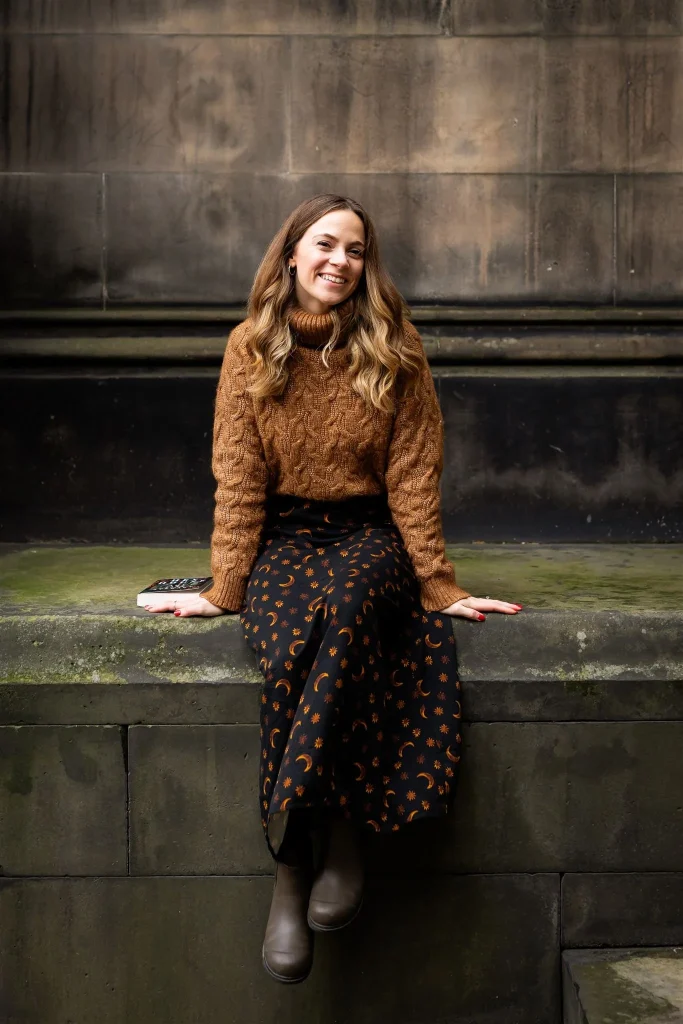
Amy grew up in Edinburgh, but now lives in the beautiful Scottish Borders with her husband and son. Her debut novel, Hex House, is a feminist horror fairy-tale, and will be published in the UK and US by Titan Books in Spring 2026. She is represented by Marilia Savvides at The Plot Agency.
After gaining a BA in English Language and Literature from Newcastle University and an MA in Creative Writing from York St John University, Amy started her PhD with the University of Sheffield in 2020. Her thesis explores the transgressive potential of ‘winged women’, from harpies and angels to circus artists and aviators. In 2023, she was awarded funding from Creative Scotland to complete Hex House.
Her writing tends towards the speculative and strange, and has won or been shortlisted for a number of awards, including a Northern Writers Award and the Mairtín Crawford Award. Visitors are encouraged to check out her writing or get in