- Writing Horror as an Act of Resistance: Amy Jane Stewart on Her Debut Hex House
- Hex House Review: Amy Jane Stewart’s Dark Fairy Tale of Feminine Revenge
- Amy Jane Stewart Interview: Hex House and Feminist Horror
Amy Jane Stewart’s Hex House is not a straightforward sanctuary story. It asks whether healing and transformation can ever be truly separate from the violence of imposition.
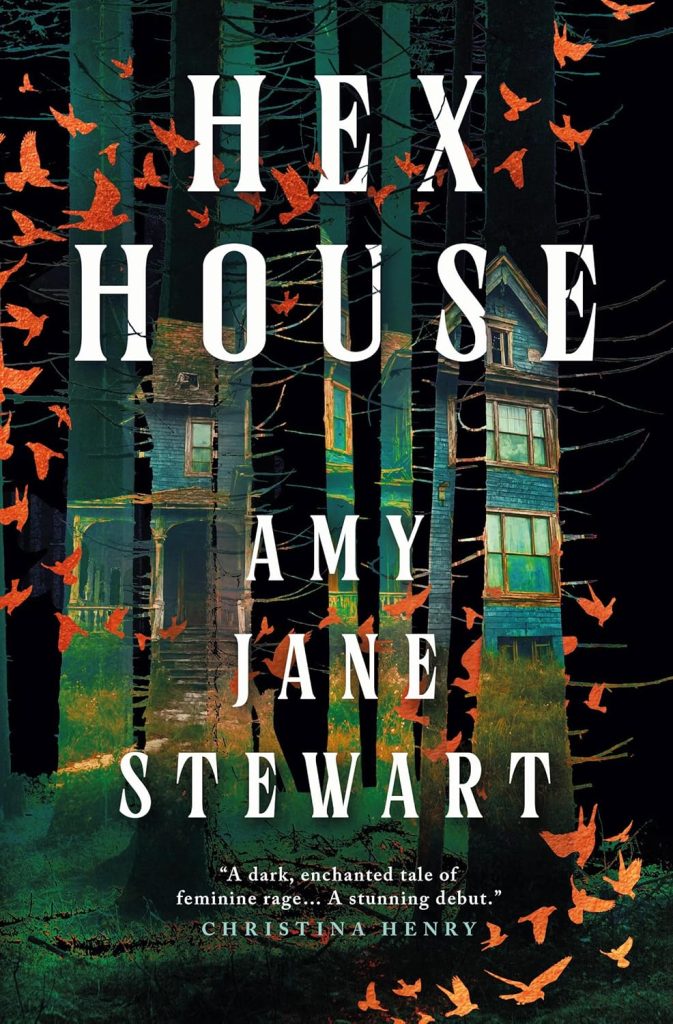
The house appears only when you need it. That’s the rule. Passersby see only abandonment, rot, an ordinary wreck. But for a woman running from a wedding night she knows will curdle into violence, the structure materialises from the dark like a promise kept. This is the premise of Amy Jane Stewart’s debut novel, Hex House, a feminist horror fairy tale that lands April 28 from Titan Books. The book follows two women, Elly and Siobhan, whose lives intersect at a hidden sanctuary in the Scottish woods. The place offers refuge. It delivers something far more dangerous: transformation into vessels of revenge.
Stewart arrived at this premise after a career in short fiction that earned her significant recognition. She won the New Writing North & Word Factory Northern Apprentice Award in 2021 and the Mairtín Crawford Prize for Short Story in 2022. Her work has appeared in New Writing Scotland, Visual Verse and Test Signal, and she has been Highly Commended in the Bridport Prize. She holds a Creative Writing MA from York St John and is pursuing a PhD at the University of Sheffield. Her forthcoming collection, Cruelties, continues her examination of folklore and myth as lenses for contemporary women’s issues.
A Creative Scotland grant helped fund the writing of Hex House, and early reviews have praised its calculated twists and its refusal to offer clean moral categories. One reader notes the line between saviour and sinner is “horribly thin.” Another describes the narrative as “darkly manifesting” rather than fast-paced. The book operates in the space between fairy tale and body horror, between sanctuary and trap.
In the interview that follows, Stewart talks about the Scottish Borders as a liminal geography, the folk tradition of Thomas the Rhymer embedded in her landscape, and why she rejects one-note villains in favour of characters who are simultaneously unlikeable and desperate. She discusses the challenge of balancing body horror with emotional heft, and the scene that fought her hardest across multiple drafts.
This is a conversation about fear and transformation, about the difference between empowerment and instrumentalisation, and about the terror of a place that only appears when you need it most.
Here is Amy Jane Stewart on Hex House.
Amy Jane Stewart Interview: Hex House and Feminist Horror
You structure Hex House around two protagonists separated by four years, yet their stories intertwine rather than running in parallel. Why resist the obvious chronological split? Did you ever map this as Part One/Part Two before settling on the woven structure?
I always knew that I wanted to show both how someone might find the house, and also what after-effects it might incur, so the dual timeline felt essential. I always write chronologically, and the way Elly and Siobhan’s chapters unfold in the book is the exact order the story arrived in my mind. It never even occurred to me to have one part follow another, rather than interweaving their voices.
To me, it was important to have that flipping back and forth, both to try and keep narrative tension in both timelines, and also to highlight the contrast between these two characters. Ultimately, I wanted to show that no matter what sort of person you are, whether you’re quiet or confident, ‘good’ or ‘bad’, the house will sink its claws into you, and it won’t let you go.
The book’s logline announces: “A woman in the woods alone is never the beginning of the story. It’s usually the end.” That’s a thesis about narrative expectation as much as it is about survival. How does that line function as a structural contract with the reader, and where do you deliberately violate its promise?
We all know that common trope in horror: that a woman alone in the woods is not likely to last very long. So, I wanted that line to serve as a callback to that, but also to be a sort of wink that might suggest, wait, this is not that kind of story. I suppose it was me also acknowledging a very unfortunate truth in the world we live in, which is that violence against women is an epidemic. That line was my way of placing the book within that context.
As soon as the house appears, before the end of the first chapter, I hope that it becomes clear that this book intends to rally against that narrative convention. These particular women alone in the woods are writing their own stories, actively resisting the narrative they might otherwise be placed in.
One early reader describes each chapter ending as “a cliffhanger.” But cliffhangers in literary horror can lead to exhaustion. How did you calibrate the rhythm of withholding and revelation in the novel’s length?
Hex House is a book with a central secret that is so foundational to the true nature of the house and what it offers, that it was very important for me to find the right place to reveal it. It was tricky to choose which clues to give in the lead up to the reveal, so I’m glad that this particular reader felt compelled to read on after each chapter!
For me, it felt instinctual where each chapter should end, and I didn’t see those moments so much as cliffhangers but simply as part of a breadcrumb trail leading to the larger truth. I think – and hope – that the dual timeline was helpful in avoiding a feeling of fatigue. Siobhan and Elly are on similar journeys in very different ways, and so the natural places to leave their sections were always varied.
The sanctuary reveals itself only to those who need it. That’s a brilliant narrative filter. How did this rule shape your plotting in reverse? Which scenes existed purely because you needed to test whether a character qualified for entry, and did any fail the test in a draft?
I needed a way to make sure that the house was somehow removed from all the very sensible trappings of our society; that it couldn’t be found by people who might expose it or find out what was really taking place there. The police, for one! The house only being visible to those who needed it was a useful tool in making sure that every character I introduced had a story to tell. Hopefully, it also helps to create an image of the house as an ethereal place existing almost out of time.
There were definitely characters from earlier drafts who didn’t make the cut, because ultimately, I’d placed them there for the wrong reasons – to create tension or drive plot – and they didn’t belong there. It was a fun challenge to create the final roster of the house’s guests, as I also didn’t want them to be seen as one-note, as victims and nothing else. I was keen that they were also complicated people, sometimes violent, irrational and sometimes unlikeable. Partly because of their trauma, partly because that’s how people are. There’s so much light and shade in all of us.
You embed a documentary filmmaker as a protagonist. That choice invites meta-commentary on storytelling itself. How much of Siobhan’s relationship to the camera is a stand-in for your own anxieties as a debut novelist trying to capture something that resists documentation?
That’s a really interesting question. I hadn’t thought about Siobhan’s filmmaking as a mirror for my own presentation of events, but I suppose that, like me, she is trying to wrangle something complicated and unwieldy into a cohesive narrative package. It isn’t for me to say how successful either of us were!
But the documentary element was definitely helpful for me in terms of offering a sort of objective truth. We have Elly’s POV, and we have Siobhan’s, and then we see through the camera lens what actually happened. The footage is the only perspective you can’t argue with: here’s what happened, in all of its brutality and beauty. I think having the reliability of the videotape acted as a sort of middle-ground between the versions of the house we were being presented by both Elly and Siobhan.
The blurb hints that Elly’s transformation involves “a power more incredible – and more terrifying – than anything she could have imagined.” That suggests a moral event horizon. How do you manage dramatic irony when the reader suspects the sanctuary is dangerous long before Elly does, and at what point does that irony curdle into dread?
When thinking about Elly’s characterisation, I knew there would need to be an innocence about her, a naivety combined with a desperate longing for refuge at all costs that would make it believable for a reader that she would buy into the concept of Hex House without asking more questions, without looking more closely.
She is smart, but she’s also desperate, and she’s willing to overlook what’s right in front of her if it means she can be safe. I think withholding information was key here, too. I had to make sure that when Elly realises what’s happening at the house, that even though the reader perhaps suspected something ominous 50 pages ago, they are finding out the specifics at the same exact moment. I felt the reader needed to experience that transformation through her eyes, through her body.
Elly flees her wedding night pregnant, still in her dress. That’s a survival instinct, but also a surrender of agency. She runs to a house. She enters at a stranger’s beckoning. How much of her arc is about reclaiming choice, and how much is about learning that some choices are illusions? Where does her moral ambiguity surface most sharply?
I think of Elly in the very beginning of the novel as being like a willow tree. She will go whichever way the wind blows her. Part of this is because she’s had a very sheltered, safe life so far, and part of it is her passive personality. Her relationship with her new husband Ethan shines a light on this – he realizes quickly that she is the type of person who will bend, and he is the type of person who will push until she breaks.
As much as her running away into the woods at night is a dangerous decision that could be read as a surrendering of kinds, it is also the first decision Elly makes for herself, for her own survival, and so I see it as her first step into reclaiming her agency, and more than that, figuring out who she actually is as a person. With her arc, I wanted to continue that sense of building her backbone from nothing, making choices, not always the right ones, but ones that are ultimately hers.
A key motivator for Elly is wanting to be a good enough mother for her unborn child. She wants to become strong, to be the sort of person that would never need Hex House, both for herself and for her baby. I think this blinds her a little, particularly as she gets to know Haina and it becomes more and more obvious that what is happening at the Hex House is morally questionable, to say the least. She’s learning where the limits are; she’s learning the edges of herself and what she will tolerate.
I think Hex House itself, the reality of it, is an acknowledgement that for a lot of people, there isn’t really such a thing as a ‘safe space’ anymore. It’s also a commentary, I suppose, on complicity. It questions our urge to hide away and ignore the world. The house insists: no, you must look, you must feel, you must overcome. There is a moral ambiguity around this choice that I didn’t want to dictate one way or another.
Theo, Siobhan’s brother, exists largely in the negative space of her trauma. We know he won’t speak to her. We know he witnessed horrors. But his interiority remains opaque. Was that strategic withholding or a recognition that some male characters in women’s horror function better as absence than presence? Do you know what Theo would say if he finally spoke?
Yes, Theo was an interesting character to write. The other male characters in the book – Ethan, Owen – are quite obviously morally flawed, and so I wanted to also include a man who is thoughtful, gentle, well-meaning. That doesn’t mean he’s beyond reproach (I like to think that none of my characters are, whatever their gender), but it does perhaps throw up a few more questions when he’s able to just walk away from the house, and Siobhan doesn’t seem able to.
I didn’t include a lot of his inner monologue because for him, everything was simpler. His trauma is straightforward and understandable. He is able to put it away in a neat box, because the house was never for him, anyway. I also wanted him to be a counterweight for Siobhan. In their sibling relationship, he is sensible where she is wild, he is measured where she is reckless. If he could speak, Theo would say he wishes everything had worked out differently. Which would betray, I think, just how much he still doesn’t understand about the true nature of the things he was witnessing.
The antagonist (or is it the house itself?) blurs the line between “saviour and sinner.” Do you feel empathy for whatever force operates Hex House, or do you experience it as purely mechanistic – a trap disguised as hospitality? If you feel empathy, what specific scene made that feeling unavoidable?
For me, it was also key that Haina, the matriarch of Hex House, believed fiercely in her mission. That belief started in empathy. That’s the thing about power of any kind though, I think: it takes that empathy and warps it, corrupts it until either a person can’t remember why they started in the first place, or it makes them blind to the reality of what they’re doing, convinces them that the end justifies the means.
There is a lot of love in Haina. But over time, the more horrors she’s exposed to, that love has been twisted into something much darker and sharper. She is tactile with the women; she calls them her ‘angels’. In my mind, there’s nothing forced about that: she loves them. She wants the best for them, in her own way. She believes that’s what she’s delivering.
Both Elly and Siobhan carry past trauma that manifests in subtext rather than confession. Elly’s husband “isn’t what people think he is.” Siobhan’s scar “never fully heals.” You avoid the therapeutic backstory dump. How do you trust the reader to infer the full weight of damage from fractured gestures, and where did you cut explicit explanation because it cheapened the silence?
Thank you for that. This is a hard line to toe, and it did take me a few drafts to get closer to how I wanted it to read. I needed both women to have stories that would mean their choices made sense, particularly Siobhan – but as you say, I wanted to avoid tons of heavy exposition. For Elly, this is where the documentary/interview framing device came in. She is able to answer questions directly posed by Theo, questions a reader might also want the answers to, in a way that hopefully doesn’t feel forced.
I think that generally, as a writer, I’m prone to giving less rather than more information. Sometimes too little, maybe. I don’t know. But you phrased it right, in that I trust readers. The worst thing in a book, for me personally anyway, is to feel as if you’re constantly being explained to. I like a little ambiguity, for a reader to fill in the gaps and make the book theirs.
Hex House is marketed as a “feminist horror fairy-tale.” But fairy tales traditionally punish women who seek power outside domesticity. Your sanctuary promises power and delivers something else. Is this a critique of the “safe space” fantasy, or an acknowledgement that safety and transformation are fundamentally incompatible? Where does the book’s subtext undermine its stated politics?
Hex House very much exists within and draws from the fairytale tradition, but seeks to critique it from the inside out. Angela Carter is perhaps the most recognisable example of how this can be done from a feminist perspective, but I feel as though there are more and more female writers looking to unpick these old stories, to drag them up to date, either by placing them in a modern context or simply by centralising the female experience.
I think Hex House itself, the reality of it, is an acknowledgement that for a lot of people, there isn’t really such a thing as a ‘safe space’ anymore. It’s also a commentary, I suppose, on complicity. It questions our urge to hide away and ignore the world. The house insists: no, you must look, you must feel, you must overcome. There is a moral ambiguity around this choice that I didn’t want to dictate one way or another.
You set the story in the Scottish Borders, a liminal geography between countries, cultures, and histories. That’s not accidental. How does the physical landscape function as a shadow to the novel’s central argument about liminal psychological states? Which specific location carries symbolic weight that readers might miss on first read?
I love your reading of it there, that the physical landscape mirrors the liminal psychological state of the house’s guests. It also reflects the temporal ambiguity of the house itself – where is it? The landscape of the Borders – stretching, wild, mostly overlooked by those passing through to Edinburgh – is an excellent place to get lost. And also, to hide something.
The Borders is a region rich in folklore and tradition, so it felt like a place where somewhere like Hex House might feasibly exist as a sort of tall story everyone knows from childhood. The very roots of Hex House are grounded in the Borders legend of Thomas the Rhymer, a 13th century laird who was supposedly taken away to the faerie realm for seven years, before returning with the power of prophecy.
The landmarks associated with this story are peppered around the Borders, and served as a primary source of inspiration for the novel. The three hills that loom over Elly when she first runs from the wedding night cottage are based on the Eildon Hills. Thomas the Rhymer was said to be sitting beneath the Eildon Tree when the Faerie Queen came for him.
The house transforms women into “vessels of revenge.” Vessels are containers, not agents. That word choice is precise and troubling. Are the women of Hex House empowered or instrumentalised? Does the novel have a stable answer, or is that ambiguity the point? What would a misreading that sees this as straightforward empowerment miss about the book’s philosophical core?
I think that word choice reflects the fact that what ultimately happens to the women of Hex House, the transformation they undergo, is very much guided and informed by the matriarch of the house, Haina. Without giving too much away, it is her who is holding their hands as they discover these hidden parts of themselves. It is her telling them how they should use the power they find, and on whom.
So, there isn’t a great deal of choice there. Haina is furious – at the outside world, at what it’s done to the women who come into her care – and she uses the women as vessels for both her fury and the potential of their own, whether they like it or not. Becoming strong and overcoming trauma is of course, empowering, but Haina makes the women push themselves further than they ever would alone. I suppose the ultimate question that the novel asks, and one I hope comes across is, is it ever okay to take an eye for an eye?
You’ve said that your forthcoming collection, Cruelties, uses folklore to explore contemporary women’s issues. Hex Housedraws on Scottish lore about hidden sanctuaries. Which specific folk tradition informed the house’s rules, and how did you update it for a modern audience without losing the eerie logic of the original? Where did you break from tradition deliberately, and why?
I suppose that there wasn’t one specific folk tradition that informed what Hex House would look like, or how its ‘magic system’ would operate. It does, however, draw upon some well-established stories: a woman wandering alone into the dangers of the forest (Little Red Riding Hood) and finding a house run by someone who may exact a price for sanctuary (Hansel and Gretel).
But while Hex House does, in some ways I suppose, feel like a timeless place (there’s no internet or tech, the guests instead engaging in activities like baking, mending clothes and gardening) I did want to ground it in a very contemporary context to sort of accentuate the weirdness of it all. That was one of the main reasons for the inclusion of the filmmakers.
I also wanted to play with how something like Hex House might slot into our culture, which is why there’s the online forum called HexHeads, a sort of conspiracy theory/fandom situation.
Which scene fought you the hardest? Not the one that required research or technical precision, but the one where you knew what needed to happen emotionally and couldn’t make the page cooperate. Did you eventually win that fight, or did you compromise and later realise the compromise was the right choice?
There are scenes that stayed almost identical from first draft to last (Elly running into the woods), and others which took many, many drafts to get right. The one that springs to mind first I can’t talk about for spoiler reasons – but I can say that it really required an equal balance of body horror and emotional heft.
There’s nothing to say those two things can’t go hand in hand, but in this particular instance, both felt equally important and needed equal amounts of attention. The scene needed to reveal the horror of what Hex House really is, while also serving as a key part of a central character’s narrative arc. It felt a bit like walking a tightrope. I still have no idea whether I got it right.
Was there a character intended as minor who usurped a larger role? Or conversely, a character you planned to develop who remained stubbornly flat despite your efforts? What did that usurpation or flatness teach you about the novel’s actual needs versus your original plan?
Margot is one of the guests at the house, and her role was never really supposed to be large, but her voice – spry, strange, intense – came so naturally that she ended up occupying more space than I thought she would. She was one of those characters who just felt very real to me from the off. It was as though I could see her looking at Elly with her single eye, calling her ‘little mouse’. She ended up being important for the plot, too, although whether that’s because I’d already written her a larger part, I can’t be sure.
The balance of research to imagination for a hidden sanctuary in the Scottish woods: what did you need to know concretely (forest ecology, Scottish property law, folklore archives) and what did you invent entirely? Was there a moment when research threatened to overwhelm invention, and how did you pull back?
I’m actually not very good at research, I don’t think. When I’ve had an idea, I’m often very impatient to start writing and get frustrated if I’m being held back by details I don’t know or might get wrong (one of the reasons I wouldn’t attempt to write true historical fiction!). But there is a certain amount of research that needs to be done for every story, whether that’s information that’s been gathered through interests and through osmosis along the way, or intentional research done for the purpose of the novel.
There was a mixture in Hex House. You’re right in that forest ecology was a prime focus of mine. The woods needed to feel very real, layered and textured in a way that was distinctly Scottish.
What convention in feminist horror do you personally hate, and how did Hex House attempt to dismantle it? Not by avoiding it, but by engaging with it and twisting it into something uncomfortable?
I wouldn’t say there’s anything I hate, necessarily, but one thing I do actively try to avoid is writing characters that are all ‘good’ or all ‘bad’. It can be tempting sometimes, in feminist fiction that’s aiming to create a sense of empowerment, to make the villains vile and irredeemable in order to maximise the emotional pay-off of the plot. But to do so risks characters becoming overly simplified and cartoonish, so I’m always trying to add complexity and nuance where I can, even to the most unlikeable of characters.
You’re compared to T. Kingfisher, A. G. Slatter and Julia Armfield in marketing materials. Those are useful commercial signposts, but which writer working in a completely different genre influenced Hex House more than any horror or fantasy author? What did you steal from them, and did you feel guilty about it?
There’s a brilliant book called Shark Heart by Emily Habeck, which I read in between delivering the draft of Hex House and receiving my edits. It’s an exquisitely crafted literary love story about a pair of newlyweds, and what happens when the husband slowly starts turning into a shark. The premise is out there, but it’s treated with such tenderness and care, the characters and their struggles so believably written, that it sweeps you along with it. It definitely helped me think about the physical transformation scenes in the book, and also compelled me to up the emotional ante. I find horror and love to be unlikely, but very well-suited, bedfellows.
The book is your debut novel, but you’ve published short fiction widely. How does the short story form’s compression and economy shape your novel instincts? Where did you catch yourself trying to end a chapter like a short story, and why did that not work for novel pacing?
This is something that I’ve really had to work on. For me, novel-writing takes patience and a lot of discipline. If I’m to sit down and write something spontaneously, it’s a short story that comes out. I often think it’s the form that suits me best.
Part of that, I think, is having spent a decade as a freelance copywriter. All day, every day, I was writing compact sentences, often to tight word counts, so I couldn’t waste a word. It’s hard to let go of that kind of mindset when writing. I remember delivering my first draft of Hex House to my agent and her saying, “it’s okay to add a bit of breathing room.” Breathing room. It’s not really something I’d ever thought about, because I’d never had space. But her saying that gave me permission. I let the house and its guests relax, and I let them breathe. I didn’t pack development and plot into every sentence.
If you could implant one single line or image from Hex House into a reader’s brain permanently, what would it be? Not the most quotable line, but the one that captures the book’s emotional core so precisely that forgetting it would mean forgetting the experience of reading.
There’s a line said by one of the filmmaker characters, Zara, when she finds out what Siobhan really saw at Hex House. It’s then repeated by Siobhan because she’s never heard someone understand her trauma so accurately. The line is: “If Siobhan had to describe the feeling that had eaten away at her for the last four years, rotting her brain chemistry and gnawing at her nerves, she wouldn’t have been able to put it better than that. I don’t know what to do with all this knowing.”
That line encapsulates something about the book for me: the weight of trauma, how impossible it is to put down, how it can change who you are and how you move through the world. Siobhan does reprehensible things, but if the people around her could see inside her head and see how much she’s suffering, maybe they could begin to understand.
If a sanctuary only appears to those who need it, and those who don’t need it see only abandonment, does the house create the need it claims to answer, or does it merely reflect a need that already exists? And if the answer is the former, is any act of rescue ever free of the violence of imposition?
To me, Hex House was always intended to answer a need that already exists. As if all the desperation and pain and anguish surrounding it have forced it to build itself from nothing. But no path to healing is ever straightforward, and Hex House is no different. It is, ultimately, an abuse of power, masquerading as safety. These women can see that, but for them, they still choose it. They choose potential violence and the unknown over the trauma they’ve run from. Constantly, throughout the book, I wanted to pose a question to the reader: do you think it was worth it?
Hex House by Amy Jane Stewart
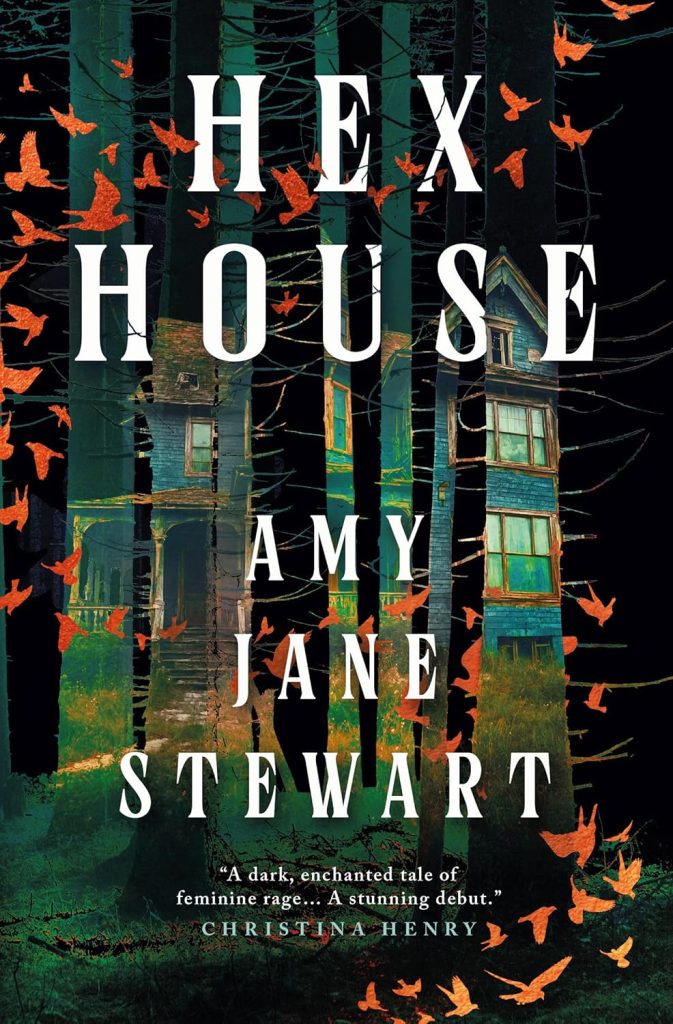
A beautifully told, dark and unsettling fairy-tale about a safe haven for women which transforms them into vessels of revenge, perfect for fans of T. Kingfisher, A. G Slatter and Julia Armfield
A woman in the woods alone is never the beginning of the story. It’s usually the end.
ELLY
Elly is running. Pregnant and still in her wedding dress, she flees the cottage that her new husband, Ethan, has rented for their wedding night. Because he’s not what people think he is, and she knows that one day he’ll hurt her in a way she can’t fix.
Freezing and alone in the woods in the dead of night, she accepts that she’s going to die. But just as she has given up all hope, a house appears out of nowhere, and a woman beckons her in. Welcome to Hex House. A place that can only be found by those who truly need it. A place that teaches broken women how to access a power more beautiful and more horrifying than anything they could have imagined.
SIOBHAN
Edinburgh, present day: Siobhan’s life is in ruins. Once a promising documentary filmmaker, she has given up on her dream, and kept all the terrifying footage she has of Hex House hidden away. She tries to erase all the horrors she witnessed with drugs and alcohol, and spends her time toying with a man in increasingly feral and dangerous ways. Her brother won’t speak to her, and she ignores the scar on her stomach that never fully heals
But despite everything, always, she feels the presence of that place.
And she knows, deep down, that she has to return.
Amy Jane Stewart
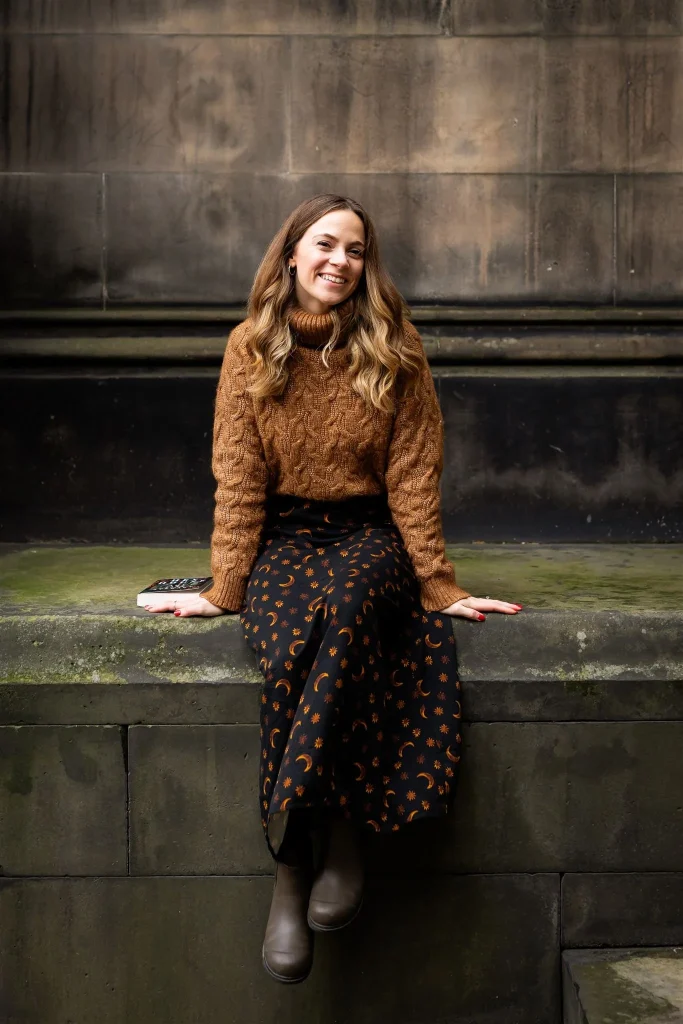
Amy grew up in Edinburgh, but now lives in the beautiful Scottish Borders with her husband and son. Her debut novel, Hex House, is a feminist horror fairy-tale, and will be published in the UK and US by Titan Books in Spring 2026. She is represented by Marilia Savvides at The Plot Agency.
After gaining a BA in English Language and Literature from Newcastle University and an MA in Creative Writing from York St John University, Amy started her PhD with the University of Sheffield in 2020. Her thesis explores the transgressive potential of ‘winged women’, from harpies and angels to circus artists and aviators. In 2023, she was awarded funding from Creative Scotland to complete Hex House.
Her writing tends towards the speculative and strange, and has won or been shortlisted for a number of awards, including a Northern Writers Award and the Mairtín Crawford Award. Visitors are encouraged to check out her writing or get in touch—she would love to hear from them.