
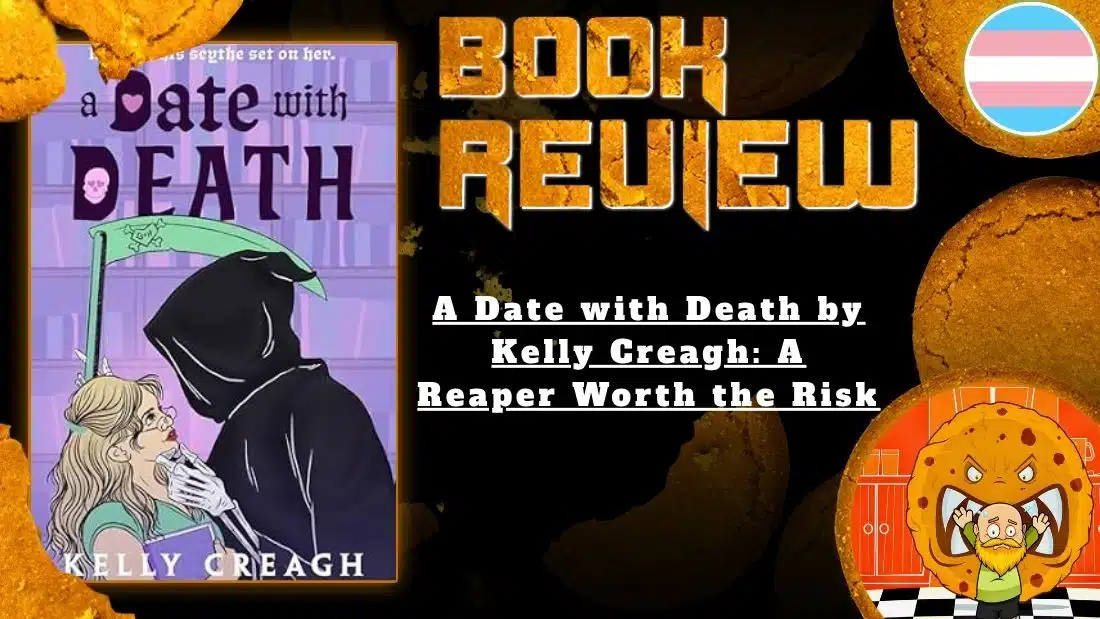
- “A Fate Far More Dangerous Than Death”: Kelly Creagh on Falling for the Reaper
- A Date with Death by Kelly Creagh: A Reaper Worth the Risk
Death has a line manager in A Date with Death, and that single detail tells you Kelly Creagh is up to something cleverer than the cover promises. Her grim reaper romance hands a skeleton on the clock a forbidden crush on a children’s librarian, then watches the trouble pile up. What looks like a cosy-horror, grumpy-sunshine paranormal romance turns into a sharp little meditation on mortality, found family, and the dignity of a worker whose boss can end him on a whim. Funny, camp, and quietly subversive, this is monster romance with a genuine spine. Here is why it works.
A Date with Death | Kelly Creagh | Gallery Books | 14 July 2026 |
Kelly Creagh smuggles a genuine idea inside a romance that keeps giggling at itself. Her reaper is not a king of the underworld but an employee on a clock, and the real horror is not death but the management that owns him. A camp, cosy, quietly subversive book that left me thinking about my own borrowed time.
A Date with Death by Kelly Creagh: A Reaper Worth the Risk
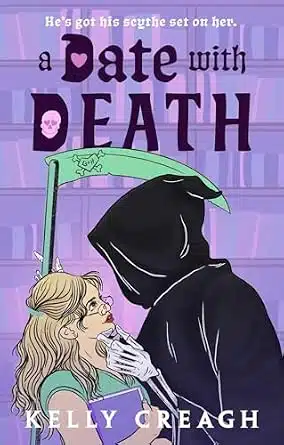
Death has a line manager. That single detail does stranger and lovelier work than most of the monsters I have met on the page this year. Kelly Creagh’s Grim, the reaper at the centre of A Date with Death, is not a brooding chief executive of the afterlife or some velvet-voiced lord of the underworld with a marble throne.
He is staff. He clocks on, he clocks off, he collects the souls he is told to collect, and somewhere above him sit superiors who can reduce him to dust the moment he steps out of line. Drop that man into a children’s library, hand him a crush he is forbidden to have, and you get a book that smuggles a genuine idea inside a romance that keeps giggling at itself.
Let me lay out the setup, and I will hold it to what the back cover already gives away. Helena Hart is having a rotten Halloween. Her date has bailed, her costume has flopped, and the one person willing to listen to her is a silent stranger dressed as the Grim Reaper. Then she goes off a balcony. A real skeletal hand catches her, and the party guest turns out to be the genuine article. Grim is not meant to save souls. He reaps them. He has no idea why he spared this particular librarian, and he knows that wanting to find out could cost him everything that passes for a life.
Creagh builds her tension out of time rather than terror, and time turns out to be the more frightening of the two. There is always a meter running. The longer Grim lingers near Helena, the closer his superiors edge towards noticing, and that slow tightening does more to your pulse than any jump scare could manage.
The atmosphere is camp and cosy and unembarrassed about both. There are bad library puns. There are kid-friendly curses. There is a possessed bookmobile, a dog called Pluto who earns his place in the found family, and at one point a character holds an actual conversation with a pineapple. None of this should work alongside a meditation on mortality. Somehow it does. The silliness is not a distraction from the ache underneath; it is the spoon the medicine arrives on.
And the pacing is patient in a way I respect. Creagh holds the romance back, lets it accumulate, makes you wait. By the time the two of them stop pretending, you have spent enough hours in their company that the payoff lands with weight. This is a slow burn that understands why slow burns exist.
The man is mostly bones for most of the book, and yet she gives him hobbies, collections, a personal style, a way of moving through his job that feels lived in. That choice is the whole engine of the thing. We never have to be told he is more than a skeleton. We watch him be more than a skeleton, one small specific detail at a time.
The dual interiority is where her years of practice show. Helena reads as a complete person rather than a sunshine cardboard cut-out, even when her relentless brightness threatens to tip into ditziness, and Creagh is canny enough to let that brightness carry its own private loneliness. Grim, for his part, gets a full inner life rather than a brooding silhouette. Two lonely people in two incompatible worlds, each convinced the other could not possibly want them. That is the oldest engine in romance, and Creagh tunes it well.
Her prose runs bright and quick and funny, with a theatricality that makes sense once you remember she trained in theatre arts and has spent years performing. She knows how to time a line. She knows when to let a scene breathe and when to snap it shut. The dialogue crackles, the banter has genuine spark, and the comic set pieces never lose sight of the emotional thread running beneath them.
If I have a note, and on a celebratory read like this I offer it as character rather than complaint, the book occasionally wears its own cleverness on its sleeve. The callbacks, the puns, the detail-rich worldbuilding all reward close attention, and a reader skimming for plot might feel the machinery whirring. I would rather have a book that trusts me to pay attention than one that does not bother.
Strip away the skeleton romance and the talking fruit, and this is a book about how you choose to live once you can feel the clock. Grim spends eternity in proximity to endings. Helena spends her days handing stories to children who have barely started. Between them sits the question the whole book keeps circling, gently, without ever turning preachy: what is the point of a life you are too frightened to actually live?
What moved me most, though, is smaller and sharper than that. It is the portrait of death as labour. Creagh’s reaper is not a god. He is a worker. He has a shift, a quota, a hierarchy above him that can end him on a whim, and the real horror of his situation is not the dying he facilitates but the boss who owns him.
I have spent years arguing that the most British thing about a frightening space is that someone is still in charge of it, that the supervisor is the monster, and here is an American author arriving at the same nerve from the side of romance. The thing that threatens this love is not death. Death is just the day job. The thing that threatens it is management. That is a sharper piece of social observation than the cover lets on, and it gives the cosiness a genuine spine.
To see how far Creagh has travelled, you only have to look at what she built before this. The Nevermore trilogy, beginning in 2010, ran on Edgar Allan Poe and adolescent obsession. Phantom Heart in 2021 took Gaston Leroux apart and rebuilt him as a teenage gothic dreamworld. Strange Unearthly Things in 2023 did the same to Jane Eyre, dropping a demon-entangled Rochester into a manor and a psychic into the role of Jane. Three books, three borrowed cathedrals.
The throughline is unmistakable. Creagh has always written the girl who falls for the monster, the beauty learning to read the macabre, the love interest who is dangerous precisely because he is not human. Erik the phantom, Elias and his demon, and now Grim and his bones all belong to the same lineage.
A Date with Death is where she stops borrowing the building and draws her own blueprint. No canonical scaffolding this time. No Brontë, no Leroux, no Poe looking over her shoulder. She has aged the work up from young adult into adult romance, loosened the gothic solemnity into comedy, and kept the one obsession that has driven her since the start. This is the book where her recurring subject finally gets to wear its own clothes. It reads, in the best way, like an author who has finished her apprenticeship and opened her own shop.
This belongs to the cosy end of monster romance, the same warm corner that has carried T.J. Klune’s Under the Whispering Door to so many shelves, with its dead protagonist learning what living was for. It shares DNA with Hannah Nicole Maehrer’s Assistant to the Villain, that giddy fusion of supernatural workplace and slow-burn flirtation, and with Megan Bannen’s The Undertaking of Hart and Mercy in its appetite for romance built on the furniture of death. The broader wave is the romantasy fascination with death as a leading man, the long shadow of every Hades and Persephone retelling now crowding the tables.
What sets Creagh’s version apart is the ordinariness of her reaper and the specificity of her library. Most death-romances make their lead a king. She makes him an employee. Most make the underworld grand. She makes it a workplace with a chain of command. That choice is quietly subversive, and it points at where this stretch of the genre is heading, towards stories that keep the monster but trade the gothic castle for something that looks unnervingly like our own working week.
A children’s librarian and a skeleton on a clock, falling for each other while the management watches. I went in braced for novelty and came out thinking about my own borrowed time, which is a far better trick than a book this charming has any obligation to pull. Read it before the date comes due.
A Date with Death by Kelly Creagh
When the Grim Reaper develops feelings for the children’s librarian whose soul he is supposed to collect, he finds that with feelings comes something far worse than death—life.
Helena Hart isn’t having the best night. Her date just ditched her, her Halloween costume bombed, and her only sympathetic ear is a dead silent partygoer in a Grim Reaper get-up. But when she falls off a balcony and he catches her with a very real skeletal hand, she realizes he may not be a party guest at all. Before she can process the near-death experience, he vanishes, leaving her to wonder if she hallucinated the whole thing.
Grim isn’t supposed to save souls. He’s supposed to reap them. And while he’s not sure why he spared Helena, he does know that if his superiors find out, he’s as good as dust—which is saying something for a guy who’s mostly bones. But keeping away from Helena is proving harder than expected—especially when she isn’t the least bit afraid of his monstrous form.
Worse, to his horror, Helena makes him feel. And for a reaper, feeling is a fate far more dangerous than death.
Ginger Nuts of Horror: The Heart and Soul of Horror Reviews
Looking to get your horror book or film in front of the genre’s most dedicated audience? Ginger Nuts of Horror is one of Europe’s largest independent horror review websites, with over 30 contributors publishing horror book reviews and horror movie reviews almost every single day.
We offer far more than reviews. Authors, filmmakers and publishers can promote their work through in-depth horror book reviews, horror film reviews, comic and video game coverage, news features, and our popular author and director interviews like Five Minutes With. Our guest feature series, The Horror of My Life, Childhood Fears, The ? That Made Me and more, let creators tell their story while promoting their latest release.
Every feature is built to sell your work. We include backlinks to your website or Amazon author page, a full synopsis, and a universal purchasing link that sends readers straight to their local store. Add a large, engaged social following and an 18-year archive of trusted horror coverage, and you have a platform genuinely built to grow your readership.
Whether you’re an established author, an indie filmmaker, or a debut voice in indie horror, there’s a way for us to help you reach more fans. Explore our horror book reviews and horror movie reviews, then get your horror book or film featured today.


