
A folk horror that knows exactly which body it wants to haunt, and isn’t always willing to let the haunting stay quiet.
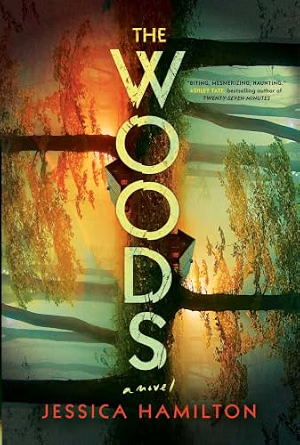
The Woods | Jessica Hamilton | Simon & Schuster Canada | 25 August 2026 |
Alice moves her grieving family into a secluded house bordered by ancient woods, not knowing the previous owner murdered her own family there and blamed it on the trees. Jessica Hamilton’s folk horror novel The Woods pairs a true crime podcast framing device with a slow-burn haunted house plot, using perimenopause as both plot engine and metaphor for a woman nobody quite believes. It’s an inventive, unsettling entry in the wave of body horror some critics are calling “femgore”, strongest when it trusts its own folklore to do the unsettling quietly.
Jessica Hamilton builds a genuinely nasty piece of folklore in The Woods: the woods offer a second life free of grief, but never to the mothers, who are left to carry the memories instead. It’s the best idea in a strong horror debut, one I only wish she’d trusted enough to stop repeating.
The Woods by Jessica Hamilton: folk horror makes menopause the monster, mostly on its own terms
Horror has always treated a woman’s body as the easiest haunted house on the street, because nobody needs to draw up a floor plan. You’re already living in one.
Puberty gets the poltergeist. Pregnancy gets the demonic conception. Perimenopause, for reasons the genre took its time getting around to, has mostly sat there as an unclaimed attic nobody thought to check. Jessica Hamilton throws that door wide open in The Woods. She turns ageing, grief, motherhood and the fear of no longer recognising your own family into a deeply effective piece of domestic horror.
The Woods by Jessica Hamilton: A Family Moves Too Close to the Trees
The Woods begins with the satisfying familiarity of classic haunted-house fiction, but Jessica Hamilton quickly finds new territory inside it.
Alice is fifty, a pharmaceutical rep carrying the weight of an exhausted marriage and the death of a daughter she cannot stop grieving. She moves her husband Geoff, teenage children Polly and Quinn, and elderly mother Beverley out of the city and into a Craftsman-style bungalow backing onto fifty acres of woodland.
The price is suspiciously reasonable. The estate agent is suspiciously chipper.
More importantly, the previous occupant, Justine Gordon, murdered her entire family there in 2021. She later told police that she had not killed her husband and sons at all. She had killed the things the woods had swapped in for them. Readers who know their horror will recognise those warning signs immediately, and Hamilton has great fun with that familiarity.
The pleasure of The Woods is not simply discovering what waits among the trees. It is watching Alice encounter one impossible thing after another and attempt to fit each of them into the language of ordinary life. Grief. Hormones. Stress. Family tension. Ageing. Coincidence. There is always another rational explanation available, right up until rationality itself starts feeling dangerous.
One of Jessica Hamilton’s smartest choices in The Woods is the true crime podcast threaded through the novel like rot through a fence post. Episodes of Killing Their Own, hosted by the chipper and slightly ghoulish Cleo Watson, bookend the story and surface throughout it. The programme walks listeners through the Gordon family murders in true crime’s grimly familiar cadence of ominous questions, carefully timed revelations and commercial breaks.
It is an inspired structural choice because it places the mythology of the house beside the family’s immediate experience of living in it. Justine Gordon exists simultaneously as murderer, local legend, podcast content and potential warning. The reader knows what happened to the previous family, or at least knows the version that has survived, while Alice is busy constructing reasons why none of it could possibly happen again.
When Cleo eventually returns for a bonus episode centred on Alice herself, the structure snaps satisfyingly into place. What once seemed like somebody else’s terrible story has become content for the next audience. The podcast is therefore more than an exposition device. It becomes another version of the woods themselves, endlessly absorbing human suffering and turning it into something other people can consume.
The Woods Haunts an Entire Family, Not Just Alice
The Woods also spreads its point of view around rather than remaining locked entirely to Alice, and that decision gives the haunting a wonderfully invasive quality. Quinn’s stoner paranoia becomes increasingly difficult to dismiss. Polly retreats towards a whispering presence only she seems able to hear.
Geoff, who has spent years trying and failing to finish a novel, suddenly finds creativity flowing with suspicious ease once the woods begin exerting their influence. Even Beverley, Alice’s elderly mother, becomes part of the unsettling uncertainty surrounding the house.
Every member of the family seems capable of noticing that something is wrong while simultaneously becoming part of whatever is wrong. That makes the horror feel communal rather than isolated. Alice is unquestionably the emotional centre of Jessica Hamilton’s novel, but The Woods understands that the most frightening version of a family haunting is one that changes everyone at slightly different speeds.
One person seems wrong.
Then another.
Then you begin wondering whether the person doing the noticing might be changing too.
Spoiler Warning: The Cruel Folklore at the Heart of The Woods
The mythology Jessica Hamilton eventually reveals in The Woods is beautifully cruel.
Neighbour Ruth Crowley explains the woods’ particular form of mercy during an almost dreamlike encounter over tea and cake in a woodland clearing. The gift, Alice discovers, is never really intended for the mothers because someone must remain behind to carry the memories. It is a nasty piece of folkloric logic precisely because it transforms love into punishment.
Forgetting might be merciful. Remembering means knowing exactly what has been taken from you and understanding why everybody else can continue as though nothing has happened. Alice’s growing recognition of what the woods offer gives the final movement of the novel a strange, mournful calm. That stillness works beautifully against the violence implied by everything that has come before it.
Menopause Becomes Part of the Horror in The Woods
The treatment of menopause in The Woods deepens the novel’s central ideas about memory, identity and credibility.
Alice is repeatedly forced to ask whether her mind is becoming unreliable because of the changes taking place inside her body or because something outside it is genuinely altering the world around her. Jessica Hamilton takes one of horror’s oldest devices, the woman whose perfectly reasonable fear is explained away by everybody around her, and connects it to the experience of ageing in a culture remarkably comfortable with telling women that distress is simply hormonal. A visit to Alice’s doctor crystallises that theme beautifully.
Alice attempts to explain what is happening and receives a menopause pamphlet instead.
It is simultaneously mundane and frightening. The supernatural explanation may be extraordinary, but the experience of not being heard is painfully ordinary. That is where The Woods finds much of its power.
Hamilton does not use menopause simply as a biological trigger for horror. She uses it to examine visibility, credibility and the peculiar vulnerability of reaching an age when other people become increasingly willing to explain your own mind back to you.
One of The Woods’ Most Disturbing Images Needs Almost No Explanation
One of the strongest scenes in The Woods arrives when Alice finds Beverley stumbling back from the treeline. Beverley offers brisk, faintly irritated denials. Alice cleans her mother’s face with the tenderness of a parent wiping a child’s mouth.
The domestic and the monstrous occupy exactly the same space.
What makes the moment particularly effective is that several possible horrors coexist within it.
Something supernatural may have happened to Beverley. Age may be changing her. Alice’s perception may be changing. The woods may be changing all of them. Hamilton understands that uncertainty does not need fireworks when an old woman calmly explaining away a mouthful of earth will do perfectly well.
The prose in The Woods is unfussy, immediate and built for momentum. Hamilton keeps the chapters moving, trusts dialogue to establish the family’s fractures and knows exactly when an unsettling image should be dropped into an otherwise ordinary domestic exchange. That accessibility suits the novel perfectly.
The Woods sits comfortably at the crossroads of supernatural horror, domestic thriller and folk horror. It carries enough momentum to make it easy to devour while still leaving plenty underneath the surface to unpack afterwards.
Buried histories, compromised families and landscapes that refuse to remain passive were already part of her fictional vocabulary. Here the metaphor becomes gloriously literal. The woods do not merely contain secrets. They actively participate in them.
Genre-wise, The Woods knows exactly which shelf it wants to sit on.
The comparison with Marcus Kliewer’s We Used to Live Here and The Amityville Horror makes immediate sense. Echoes of John Wyndham’s The Midwich Cuckoos can also be felt in the creeping terror of family members who look correct while somehow no longer feeling entirely themselves. Jessica Hamilton’s novel also plants a confident flag in the increasingly visible territory of femgore.
This is horror that treats the female body not simply as something threatened by horror, but as a site through which horror, anger, transformation and social pressure can all be explored. Hamilton’s version is especially compelling because the body horror is inseparable from grief.
Alice is not simply frightened of ageing. She is a mother whose understanding of herself has already been violently reorganised by loss. Her body is changing. Her family is changing. The landscape surrounding them appears to be offering its own terrible solution.
The Woods Is Ultimately a Horror Novel About Memory
Strip away the supernatural trees and The Woods is ultimately a novel about the unfairness of being the person who has to remember. Ruth’s rule, that the gift spares everyone except the mothers, is one of the novel’s most potent ideas. It turns the emotional labour of grief into folklore.
Somebody has to hold the history of a family. Somebody remembers the birthdays, the arguments, the mistakes, the missing chair at the table and the person who should still be sitting in it. In Jessica Hamilton’s woods, that burden becomes literal. Alice’s journey gives The Woods genuine emotional force.
She begins as a woman consumed by the guilt surrounding the car accident that killed one twin daughter. She eventually becomes someone confronting the possibility of surrendering memory itself. Horror stories often ask what someone would sacrifice to save their family. The Woods asks something more uncomfortable: what if the sacrifice offered was your ability to remember what needed saving?
The Woods by Jessica Hamilton is propulsive, atmospheric and genuinely clever in the way it combines domestic horror with true crime, female ageing and the seductive possibility of simply allowing something else to carry your pain.
Hamilton has found a rich seam of horror in the place where motherhood, memory and menopause meet.
The Woods doesn’t need you to believe in what’s waiting out there.
It only needs you to understand how relieved you’d be if it offered to take the remembering off your hands.
The Woods by Jessica Hamilton
We Used to Live Here meets The Amityville Horror in this haunting novel about Alice, a frustrated wife and grieving mother whose life is turned upside down when she moves her family into a secluded house sheltered by ancient woods.
After the devastating death of her teenage daughter Lucy, Alice and her family need a fresh start. Their home in the city is full of painful reminders of what they’ve lost, and Alice is worried about the mental health of her other two children, Quinn and Polly, and the state of her marriage. So when she accidentally discovers a gorgeous, renovated bungalow nestled in the shadow of lovely old woods with a FOR SALE sign at the curb, Alice immediately emails the estate agent for a viewing. She can’t believe the list price—until the agent discloses the history of the house.
Years earlier, a woman named Justine Gordon murdered her family there, claiming they were imposters and that her real family had been taken by the woods. Undeterred by the sad story, Alice makes an executive decision as the chief breadwinner. Though neither of her kids are happy to leave their friends behind, her mother Beverley thinks the granny flat in the backyard is cramped, and her husband Geoff, a failed novelist, can’t put down the bourbon long enough to help the family unpack, Alice prevails.
As her family reluctantly settles in, the cracks in their relationships become more pronounced. And when inexplicable things start happening, including sightings of strange figures in the yard, and Geoff vanishing into the woods one night and returning hours later wearing different clothes and remembering nothing, Alice must confront the possibility that her refuge may be her undoing. Is her menopausal mind playing tricks on her, or is there something ancient and malevolent in the woods?
Jim "The Don" McLeod has been reading horror for over 35 years and reviewing it for more than 16. He's the editor of Ginger Nuts of Horror, Europe's largest independent horror review and culture site, and a British Fantasy Award nominee for his work in the genre. When he's not busy inflicting his opinions on the horror community, he can be found annoying his family or getting thoroughly outwitted by his two dogs, Casper and Molly.
Ginger Nuts of Horror: The Heart and Soul of Horror Reviews
Every feature is built to sell your work. We include backlinks to your website or Amazon author page, a full synopsis, and a universal purchasing link that sends readers straight to their local store. Add a large, engaged social following and an 18-year archive of trusted horror coverage, and you have a platform genuinely built to grow your readership.
Whether you’re an established author, an indie filmmaker, or a debut voice in indie horror, there’s a way for us to help you reach more fans. Explore our horror book reviews and horror movie reviews, then get your horror book or film featured today.