


- Peace Mbengei Interview: We Run the Night and the Luo Night Runners
- We Run the Night Review: Kenyan Folklore After Lights Out
The dark is frightening. The adults who refuse to see it are worse.
We Run the Night | Peace Mbengei | Soho Teen | 15 September 2026 |
Peace Mbengei’s We Run the Night is a Kenyan YA horror novel that turns a boarding school into a pressure cooker of grief, secrecy and supernatural dread. Sixteen-year-old Shani returns to Taji Academy after her father’s death, only to find students haunted by night runners, strange bodily changes and an administration more interested in control than truth. Rooted in Kenyan folklore, the novel blends boarding school mystery, body horror and coming-of-age drama without losing sight of Shani’s grief. Fast, eerie and sharply observed, it gives familiar YA horror machinery a setting, mythology and emotional charge that feel wholly its own.
Peace Mbengei makes fear physical, social and institutional, then gives Shani nowhere to hide from any of it.
We Run the Night Review: Kenyan Folklore After Lights Out
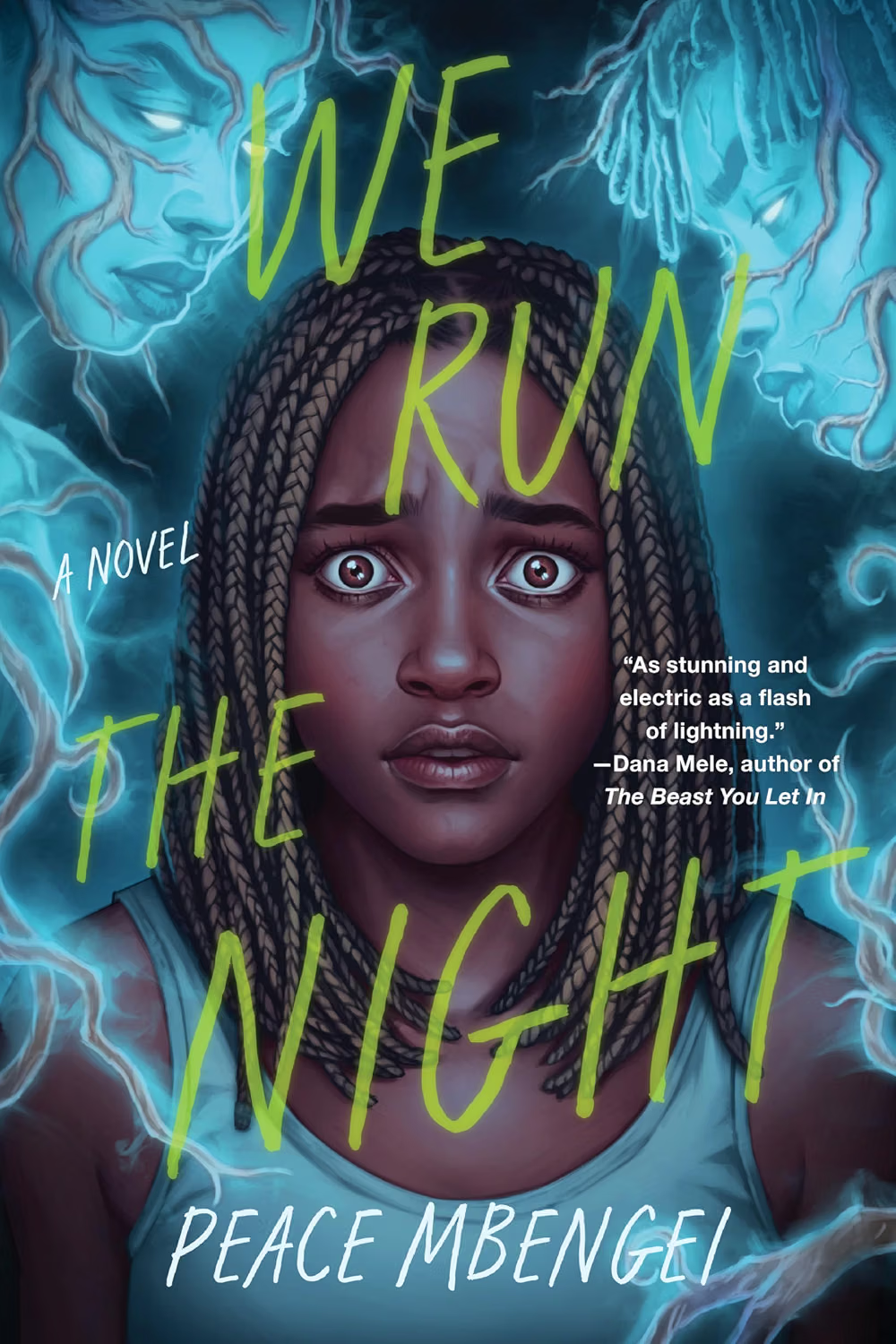
Fear is easiest to mock when someone else is carrying it. That is one of the sharpest ideas running through Peace Mbengei’s debut, and it gives the horror a mean little pulse from the start. Shani knows something is wrong at Taji Academy. She knows it before the adults do, or at least before they admit it. A figure comes to her dorm window at night. Students are exhausted. Bodies begin to change. The school answers with rules, denial and more pressure. The clever move in We Run the Night is that the supernatural threat never has the campus to itself. Authority is always there beside it, smiling, filing forms and telling frightened children that everything is under control.
That would be enough for a tense boarding school horror novel. Mbengei wants more.
Shani returns to Taji carrying fresh grief after her father’s death in a car crash. She is also carrying the fear that her scholarship, and therefore the future she has planned, can vanish if her grades slip. That makes the school feel unsafe before the first true horror arrives. Taji is polished, wealthy and proud of itself, but Shani’s place inside it is conditional. She has moved from privilege into financial strain almost overnight. The social order around her has not changed, only her ability to pretend that she belongs to it.
Mbengei uses that shift well. The book never turns class into a lecture. It sits in the small things. Clothes. Fees. Who can afford to fail. Who can make a mess and expect someone else to clean it up. Who gets believed when something goes wrong. Shani watches classmates perform wealth as if it is a birthright, while she counts the cost of every mistake. Her fear of losing her scholarship is not a side issue. It shapes the way she speaks, what she hides and how long she tolerates danger. Horror works best when leaving is not simple. Taji gives her nowhere easy to go.
The novel’s first real gift, though, is the night runner itself.
Mbengei opens with the lore of the strangler fig, a tree tied to wrongful death, memory and punishment. The prose is plain, almost like a story passed from one person to another until every spare word has been rubbed smooth. Then Chapter One snaps into Shani’s voice with the blunt fact that something is outside her window again. That shift matters. The prologue gives us myth. Shani gives us irritation, fear and a teenager’s need to keep functioning despite both. Within a few pages, the old story and the modern school have been forced into the same room.
The close reading is worth doing because Mbengei knows exactly how to stage the scare. The night runner does not simply appear. First there is sound. Then a gap in the curtain. Then a head against glass. The details grow stranger in steps: the eyes, the body, the grin, the tongue. Each beat arrives a fraction later than comfort would allow. It is like watching a hand push slowly through thin ice. You know the surface will break, but the delay is what gets under the skin.
That control of pace keeps returning. The horror is rarely built from gore alone, though there is enough body horror to make feet and skin feel newly untrustworthy. Mbengei is better at the moment before the thing becomes visible. A smell that should not be there. Mud where there should be clean flooring. A body moving while the mind seems absent. A branch in the wrong place. A memory gap. The book trains the reader to look for evidence, which is exactly what Shani begins to do.
This is where We Run the Night becomes more than a creature story. It is also a mystery, and a very clean one. The plot keeps opening new doors without making the earlier rooms feel pointless. Adila’s disappearance, the school’s secrecy, the night running, Shani’s father’s death, the strange physical changes and the question of who can be trusted all feed the same machine. There are a lot of moving parts, but they are not random. By the time the story reaches its final stretch, earlier details have shifted meaning rather than simply been replaced by a new twist.
That is hard to pull off in YA horror, where a fast pace can often make every reveal feel disposable. Here, the revelations usually deepen the emotional problem.
Pendo is a good example. She could have been the standard fearless best friend, the loud one who makes Shani braver by association. She is fun in that role, especially when her future-journalist instincts turn every school crisis into a possible scoop. Yet the book lets that instinct become a moral fault. Pendo wants the truth out, but her idea of evidence collides with Shani’s right to privacy. Their conflict lands because both motives make sense. The book does not flatten friendship into loyalty or betrayal. It asks what happens when helping someone and using them begin to look alarmingly similar.
That choice also sharpens one of the novel’s strongest themes: being seen is not the same as being heard.
Shani spends much of the book surrounded by people who can see that she is tired, grieving, frightened or changing, yet still refuse to listen to what she says. Her mother hears excuses where Shani is trying to describe danger. The school sees disorder where students are trying to survive. Adults use the language of care while making choices that protect reputation and control. Even friendship can turn observation into exposure. Mbengei keeps returning to that gap between looking at a person and believing them.
It is a simple idea, but the horror gives it teeth.
The school setting is perfect for this. Taji is enclosed, rule-bound and obsessed with image. Phones are banned. Internet access is controlled. Movement is watched. The result is a place where rumour spreads faster than facts and where authority can shape reality by deciding which words are allowed. Calling the night runners “intruders” becomes more than a bit of bureaucratic denial. It is an attempt to keep the supernatural outside the school’s official language. If you can rename a problem, perhaps you can pretend you have contained it.
Mbengei has fun with that tension between folklore and modern systems. The novel never treats Kenyan belief as a quaint ornament pasted onto a familiar boarding school plot. The strangler fig and the night runner tradition drive the story’s logic. At the same time, medicine, psychology and institutional power remain part of the threat. That blend is especially effective because Mbengei is a medical doctor. The science in the book feels close enough to be convincing when characters reach for rational answers, yet the novel is never interested in making folklore lose so that modern knowledge can win.
Instead, it asks what happens when certainty becomes arrogance.
That is one reason the book sits so comfortably beside Trang Thanh Tran’s She Is a Haunting and Tiffany D. Jackson’s White Smoke. All three understand that haunted places are rarely only haunted by ghosts. Family pressure, class, race, memory and the wish to be believed can make a house, a school or a room feel dangerous before anything supernatural moves. Mbengei adds a distinctly Kenyan frame and a stronger mystery engine. The result feels part of current YA horror without feeling designed by committee.
As a debut novel, there is no earlier book to weigh it against. Mbengei published short fiction before this, and that economy shows in the way scenes cut away once their work is done. The novel feels ambitious, but never like a writer trying to prove she can do everything at once.
There is also a welcome lack of distance in Shani’s voice. She is not written as the brave girl waiting to discover that she was brave all along. She is frightened often, sometimes embarrassingly so. She avoids conflict. She cares what people think. She wants safety, privacy and a future she can predict. That makes her eventual acts of courage matter because they cost her something.
Fear is not removed from her character so that growth can begin. Fear is the material the growth is made from.
The same is true of grief. Shani’s father is not a neat tragic backstory designed to make the plot sadder. His death keeps changing shape. At first it is shock. Then anger. Then money trouble. Then shame. Then unanswered questions. Then the awful problem of what to do when the person you miss is tied to truths you do not want. Mbengei understands that grief is repetitive without being static. You can think you have reached the centre of it and still find another room.
The prose handles that emotional material with more restraint than the plot might suggest. Mbengei can go big when the bodies change and the forest seems alive, but she is often strongest with a small visual fact. A worn handbag. A room that smells wrong. A piece of clothing that still carries someone else’s scent. Those details stop the novel becoming a chain of set pieces. They keep Shani’s private life close even as the mystery grows.
The body horror deserves praise too. The transformations work because they are tied to loss of control rather than shock for its own sake. Cracked skin, damaged feet, strange eyes and the sense that the body has begun obeying another system all play into Shani’s fear that she can no longer trust herself. The night running is frightening because consciousness is no protection. The body can leave without permission and return with evidence.
That is a nasty idea. Mbengei keeps finding new ways to make it worse.
Mbengei also knows when not to explain. The novel gives us enough folklore to understand the rules, then lets fear do the rest. The night runner tradition stays partial, repeated and argued over. That choice keeps it alive on the page. It behaves like a story people carry, not a specimen pinned down for the reader.
The final third is where the book earns the fifth star.
Everything tightens. Social threats and supernatural ones stop taking turns. Friendships crack. Old assumptions fall away. The school becomes more openly dangerous, and Shani is forced into choices that would have been unthinkable for the girl hiding under her duvet at the start. The plotting gets faster, but it does not abandon the book’s emotional centre. Even when the scale widens, the question remains personal: what do you do with fear, guilt and grief when running from them has stopped working?
The answer is not a cheap victory. Mbengei understands that surviving something does not turn it into a lesson you can frame and hang on a wall. People remain hurt. Trust has to be rebuilt. Grief does not vanish because a mystery has been solved. The ending allows consequence to stay in the room.
That matters because We Run the Night could easily have been sold on the night runners alone. They are a strong hook: eerie, physical, rooted in Kenyan folklore and visually vivid enough to lodge in the mind. But the novel works because Mbengei knows the darker thing is what happens when a frightened young person tells the truth and the people in charge decide that disbelief is more convenient.
That is where the book bites hardest.
Peace Mbengei has written a debut that is fast without feeling thin, emotional without turning soft, and culturally specific without pausing to translate itself into something safer. The horror moves through skin, trees, school corridors and memory. The mystery keeps pulling. Shani keeps running, until she understands what running can and cannot save her from.
The night belongs to the runners now, and Mbengei knows exactly where they are going.
We Run the Night by Peace Mbengei
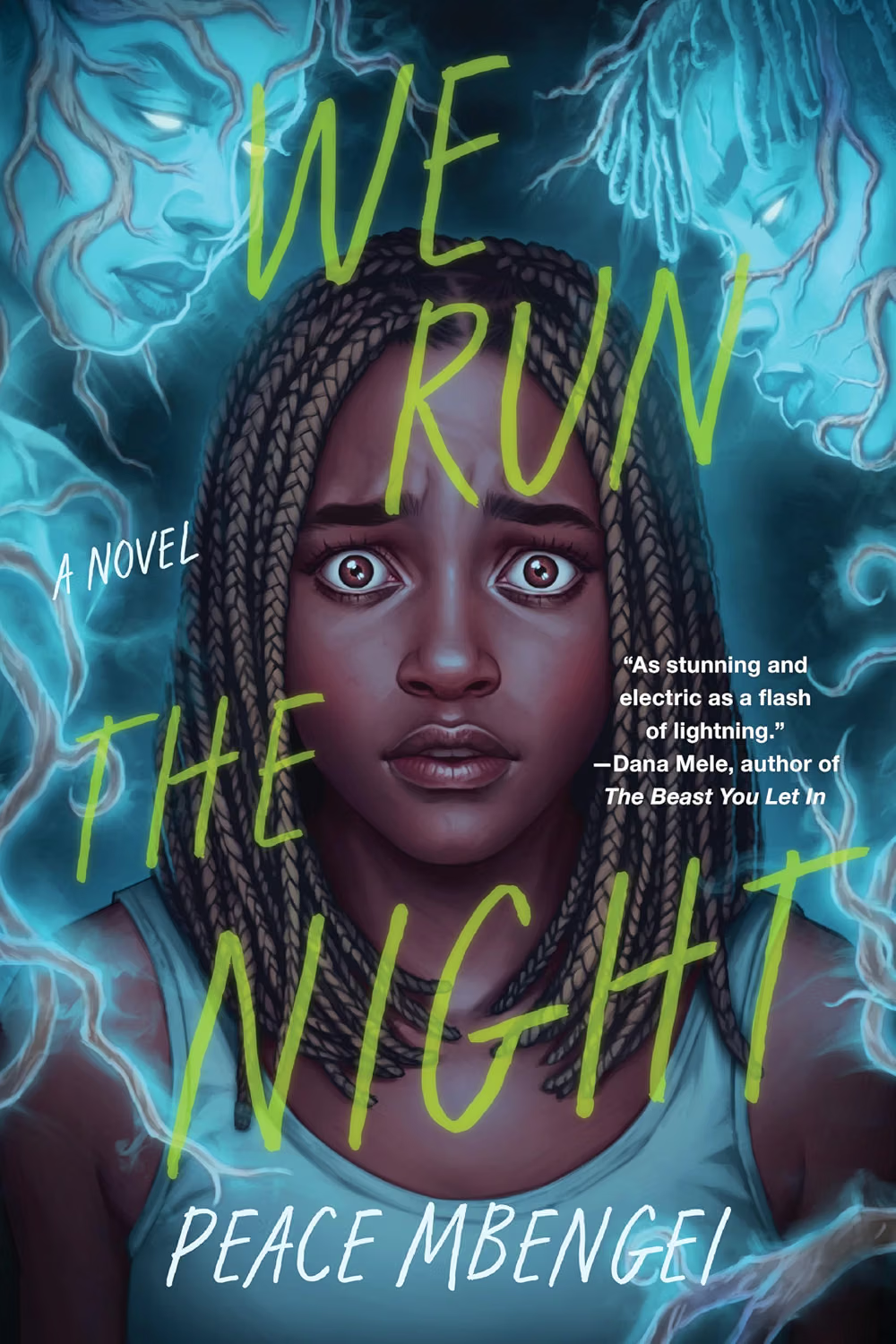
An elite, isolated Kenyan boarding school is terrorized by supernatural entities, grotesque maladies, and strange transformations in a chilling YA horror debut inspired by the urban legend of “night runners.”
Perfect for fans of She Is a Haunting and White Smoke
When Shani returns to her elite, isolated boarding school after her father’s mysterious death, she just wants to finish senior year with her scholarship intact—which means focusing on her work and staying out of trouble. Even with her best friend, Pendo, by her side, she’s never quite fit in at Taji Academy. But soon, strange things start happening at school—not only are students coming down with odd, grotesque skin maladies, someone is causing chaos on campus after curfew. Are they night runners, the supernatural entities that terrorize rural neighborhoods in the dark?
The strict administration insists it’s just students pulling pranks. Everyone knows that night runners are just an urban legend. But when one of the popular students, Adila, goes missing—and Shani wakes up one morning with mud on her feet, torn clothes, and a pounding headache—she knows it’s more than that. As she and others at Taji begin to transform with no way to contact the outside world, she must figure out what is happening—before it’s too late.
Jim "The Don" McLeod has been reading horror for over 35 years and reviewing it for more than 16. He's the editor of Ginger Nuts of Horror, Europe's largest independent horror review and culture site, and a British Fantasy Award nominee for his work in the genre. When he's not busy inflicting his opinions on the horror community, he can be found annoying his family or getting thoroughly outwitted by his two dogs, Casper and Molly.
Ginger Nuts of Horror: The Heart and Soul of Horror Reviews
Every feature is built to sell your work. We include backlinks to your website or Amazon author page, a full synopsis, and a universal purchasing link that sends readers straight to their local store. Add a large, engaged social following and an 18-year archive of trusted horror coverage, and you have a platform genuinely built to grow your readership.
Whether you’re an established author, an indie filmmaker, or a debut voice in indie horror, there’s a way for us to help you reach more fans. Explore our horror book reviews and horror movie reviews, then get your horror book or film featured today.