- Our Top 5 Mark Morris Novels: Blood, Floods, Folk Legends, and Whatever’s Standing Outside
- Mark Morris: Bad Things Happen Here and a Life in Horror
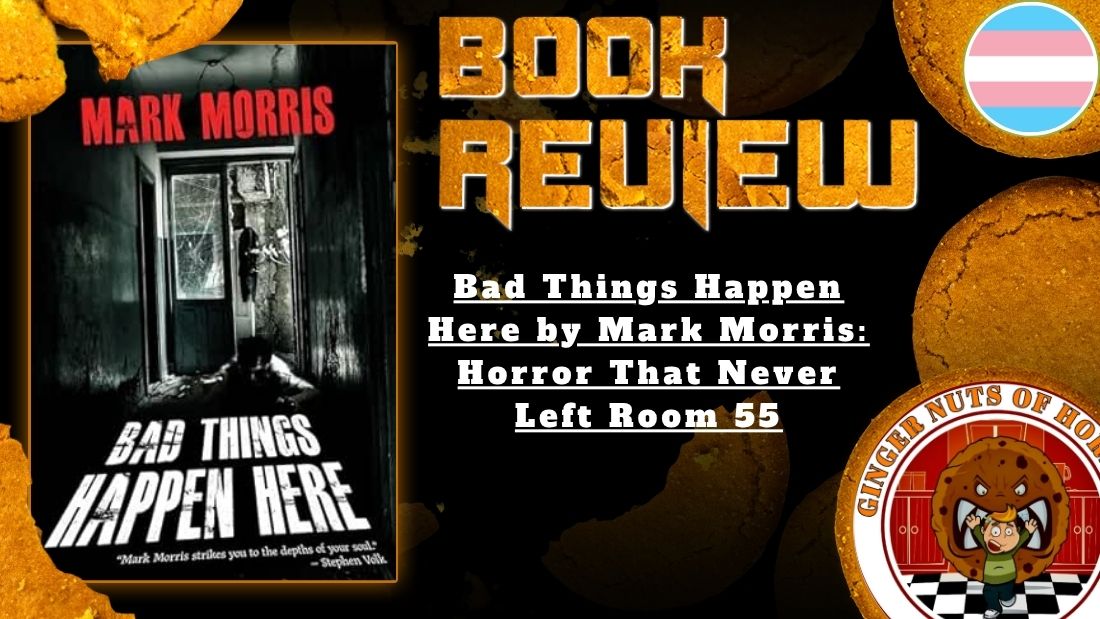
- Bad Things Happen Here by Mark Morris: Horror That Never Left Room 55
The past didn’t stay behind in Room 55. It never does.
Bad Things Happen Here | Mark Morris | Flame Tree Press | 30 June 2026 |
Mark Morris has been one of British supernatural horror’s most dependable voices since 1989, and Bad Things Happen Here, his new novel from Flame Tree Press, arrives in June 2026 as the work of a writer who has spent decades learning exactly how much darkness a narrative can hold. Built around five university friends reunited after twenty years when the horror from Room 55 begins seeping into their present lives, this is slow-burn ensemble horror fiction that takes past trauma as seriously as it takes the supernatural. Atmospheric, psychologically precise, and methodically terrifying, it confirms what his readers have always known about this writer.
Bad Things Happen Here by Mark Morris: Horror That Never Left Room 55
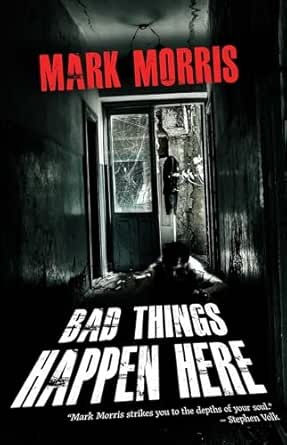
Bad Things Happen Here is slow-burn horror done with complete conviction, and the slow burn is entirely the point. Morris builds dread the way water finds a crack in a wall: quietly, persistently, without announcing itself, until the structure shifts. The first third of the novel is essentially a portrait of five separate lives, each under low-grade but recognisable strain.
Hannah Prentice is navigating a divorce, two children, the youngest of whom is being badly bullied at school, and a mother whose memory is becoming unreliable. Jess Maple is on the verge of a professional breakthrough she has been working toward for years, which should feel like triumph and somehow doesn’t. Steve Lazenby’s eight-year-old daughter is having nightmares and waking with delusions that fall outside any ordinary developmental range.
Max Bradshaw’s teenage son is drifting somewhere worrying and Max can’t seem to reach him. And Michael Vance, the most charismatic of the six friends at university, has descended into drug addiction and homelessness, carrying what the novel describes as a terrible secret.
This is deliberate architecture. Morris establishes each character’s existing vulnerabilities before the horror targets them, which means the horror, when it arrives, doesn’t feel arbitrary. It goes after what each person is already afraid of losing. A daughter’s stability. A son’s future. A mother’s mind. That’s not a coincidence, and the novel knows it isn’t. The connections between the present-day suffering and the events of 2004 take time to form, but they form solidly, and with a cause-and-effect logic that is both supernatural and disturbingly psychological.
The dual-timeline structure is one of the novel’s most interesting technical choices. Both the 2004 university sequences and the present-day narrative are written in present tense. Most novels with flashback structures use past tense for the historical sections, to signal temporal distance. Morris refuses it. The effect is that the events of Room 55 don’t feel historical. They feel concurrent, unresolved, happening in a parallel register alongside the present. For a novel about trauma that refuses to stay buried, this is a structurally honest decision, and it holds throughout.
Pacing in ensemble horror is a problem most writers never quite solve. With five distinct protagonists and a dual timeline, the risk of diffusion is real. Bad Things Happen Here doesn’t diffuse. Morris manages the narrative momentum carefully, keeping chapters tight and the sense of wrongness accumulating even in the stretches of domestic normality. The horror here isn’t atmospheric in the set-dressing sense; it isn’t fog and old houses and significant weather. It seeps into ordinary life: into a daughter’s sleep, into a teenager’s social choices, into the grief a mother is trying to manage. That’s the specific texture of this kind of horror. The kind that doesn’t stay in its designated area.
The POV choices across five protagonists maintain individual distinction without tipping into affectation. Hannah’s chapters filter events through a particular kind of domestic exhaustion and unresolved anger. Michael’s register is rawer, more immediately desperate. Jess reads differently again, her attention shaped by the aesthetic eye she has developed as a working artist. With five separate viewpoints in play, a writer’s instinct might be to differentiate through stylistic quirks. Morris differentiates through the concerns that filter each character’s attention, the things they notice because of who they are and what they fear, and the result is a cast that coheres without homogenising.
The structure doesn’t waste pages. Bad Things Happen Here does not carry spare capacity. Each chapter advances something: the slow revelation of what Room 55 did to Ben, the growing pattern of contamination spreading outward to the friends’ families, and the question of what Michael knows and has been carrying alone for two decades.
Beneath the supernatural apparatus, Bad Things Happen Here is a novel about the specific weight of a shared traumatic event on the people who survive it. Ben’s death in 2004 was the rupture that scattered the group. The forces in Room 55 may have been the proximate cause, but what the novel examines is how five people built the next twenty years around that absence, including around each other’s absence. They scattered. They didn’t process. The novel’s central argument is that this doesn’t work, and that the cost extends beyond the five themselves.
The horror’s reach into the friends’ children is the novel’s most unsettling structural move. The five didn’t just fail themselves by walking away from Room 55 and never addressing what happened; they exposed the people who came after them. There is something genuinely disturbing in a novel that positions a child’s unexplained nightmares and a teenager’s drift toward dangerous company as partially the consequence of parental avoidance. That’s a recognisable dynamic in entirely non-supernatural contexts, and Morris doesn’t make it comfortable by translating it into horror. The horror makes it more concrete.
Michael Vance functions as the novel’s unlikely conscience. He is the most externally damaged of the five, the furthest from the stable, ordered lives the others have assembled over two decades. But he is also the one who has most honestly reckoned with what Room 55 started. His decline might read as punishment; I think it reads more accurately as the cost of honesty in the face of something the others chose not to look at directly. The book doesn’t judge its characters simply, and Michael is where that complexity is most concentrated. He sacrificed a great deal for people who had already stopped thinking about him.
Morris never editorialises about his characters’ psychological states. He dramatises them and trusts the reader to make the connections. The mental health thread running through the novel, which is considerable, never tips into messaging. It remains, as it should, entirely in the service of the story.
Mark Morris has been writing horror fiction since 1988, long enough that any new novel exists in conversation with a substantial body of work. Two British Fantasy Awards, a New York Festival Radio Award for Best Drama Special, the New Fears anthology and its British Fantasy Award for Best Anthology: he carries a settled reputation rather than an emerging one, and Bad Things Happen Here confirms what that reputation is founded on.
His previous novel, That Which Stands Outside (2024), located its horror in folk tradition and physical isolation. Todd Kingston, drawn into an ancient conflict on a remote Norwegian island through his relationship with the mysterious Yrsa Helgerson, faces horror that arrives from outside: from landscape, from a mythology that predates him, from a community whose hostility expresses itself in supernatural as well as social terms. It’s an outward-facing novel. Bad Things Happen Here turns inward. The horror here isn’t arriving from outside the characters’ lives; it has been inside them, growing in the dark, since 2004.
That’s a meaningful pivot. Before That Which Stands Outside, Morris constructed the Obsidian Heart trilogy, three novels across three time periods: The Wolves of London in contemporary London, The Society of Blood in Victorian London, The Wraiths of War during the First World War. Those books demonstrated his ability to sustain complex world-building and temporal architecture across a long narrative arc. Bad Things Happen Here demonstrates a different kind of control: intimate, concentrated, doing more with less. The ensemble is not a vehicle for spectacle; it’s a vehicle for psychological precision, and that demands an entirely different discipline.
The consistent throughline across Morris’s career, if you’re looking for one, is a preoccupation with what the supernatural reveals about human failure rather than the supernatural as spectacle in itself. Room 55 didn’t descend on innocent people who happened to be nearby. It found people whose existing fractures gave it somewhere to work. That’s a recurring interest in his fiction: the dark that gets in because something was already slightly open.
Bad Things Happen Here sits squarely within British supernatural horror’s most productive tradition: character-first, atmosphere-second, revelation held back until it has been earned. The obvious structural ancestor is Peter Straub’s Ghost Story, the definitive template for the novel in which a group is haunted by a past event they collectively failed to resolve. Morris updates the framework with contemporary concerns: parenting anxiety, mental health, addiction, the specific textures of middle-aged regret, while keeping the essential architecture intact and pressurising it.
The novel is in conversation with a broader current of literary horror that takes psychology as seriously as it takes the supernatural: Paul Tremblay’s careful ambiguities, Catriona Ward’s structural ingenuity, Adam Nevill’s bleaker atmospheric work. What distinguishes Morris in this company is his generosity toward characters who are not, in any straightforward sense, easy to like. Hannah and Max and Jess and Steve carry bitterness that hasn’t softened over twenty years. They have done damage to each other and to the people around them that the novel doesn’t resolve neatly. Morris doesn’t resolve it. He makes space for the complexity and lets the horror operate within it, which is a harder thing to do than it might appear.
Flame Tree Press has been building a list of atmospheric, character-driven horror fiction since 2018, and Bad Things Happen Here is precisely the kind of novel that indicates what that imprint is for. It isn’t extreme horror. It isn’t cosmic horror in the tradition of indifferent, inhuman forces. It’s something quieter and, in some ways, harder to write: horror that knows exactly what it’s doing to you, and takes its time doing it.
Room 55 never looked like anywhere special; that, in the end, is the whole point. Whatever opened in that building in 2004, Morris makes absolutely certain it follows you home.
Bad Things Happen Here by Mark Morris
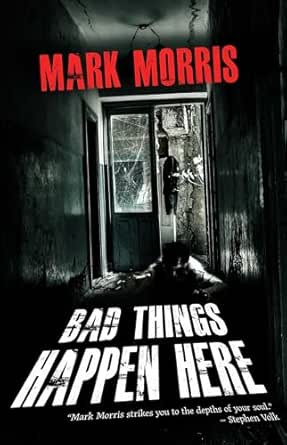
Hardcover with sprayed edges. A new chiller from multi award winning author of over 50 novels, winner of the New York Festival Radio Award for Best Drama Special and Festival Radio Awards.
In 2004 a group of six students, who have newly arrived at university and quickly become friends, are beset by supernatural forces, which seem to centre around a 5th floor room in an otherwise innocuous student hall of residence. So insidious and terrifying is their ordeal that one of the six commits suicide, an act which drives an irreparable wedge between the rest.
Twenty years later, the remaining five friends are all living very different lives. Hannah Prentice is a divorcee with two children, the youngest of whom is being badly bullied at school, and a mother who is showing the first signs of dementia; Jess Maple is a professional artist, who is just about to break into the big time; Steve Lazenby is a successful architect, whose eight-year-old daughter is suffering from delusions and nightmares; Max Bradshaw is a self-employed plumber, happily married with three children, whose fourteen-year-old son has fallen in with the wrong crowd; and Michael Vance, bohemian and charismatic at university, is now a drug-addicted vagrant, who harbours a terrible secret…
Although the five friends have not been in contact for almost two decades, they are gradually drawn back together when their lives begin to fall apart. What happened to them twenty years ago seems to be seeping back into the present, affecting not just them this time, but their children, their partners, their loved ones.
As the terrifying visions, the violence and the madness escalate, they must mobilise forces and once again confront the horror in Room 55.