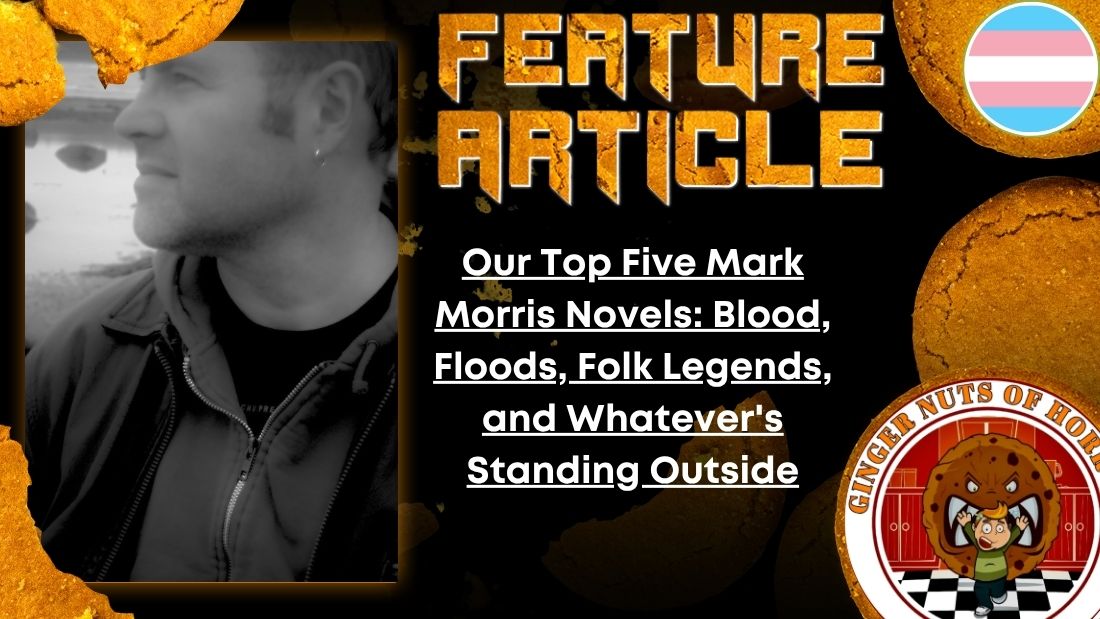
- Our Top 5 Mark Morris Novels: Blood, Floods, Folk Legends, and Whatever’s Standing Outside
- Mark Morris: Bad Things Happen Here and a Life in Horror
- Bad Things Happen Here by Mark Morris: Horror That Never Left Room 55
The first time you read Mark Morris, the thing that stays with you isn’t the monster or the event but the feeling that the world has been arranged very slightly wrong. Something is off by a fraction of a degree, and Morris holds that angle patiently until you can’t find your way back to level. He has been doing this since 1989, when his debut novel Toady announced a writer who understood that genuine horror has to earn its horror, that atmosphere is not decoration but architecture.
In the thirty-seven years since, he has published more than forty novels, novellas, collections, and anthologies. He has written folk horror rooted deep in English soil, cosmic dread that refuses to explain itself, psychological thrillers running supernatural and rational registers at the same time, Victorian dark fantasy with genuine emotional weight, and post-apocalyptic creature horror that takes its B-movie premise completely seriously. He has also edited some of the most important horror anthologies of the past decade. The one constant across all of it: Morris writes characters who feel real, in situations that feel genuinely threatening, in prose that respects your intelligence.
This week, Ginger Nuts of Horror is marking the release of his new novel, Bad Things Happen Here, with three consecutive days of Mark Morris. Today, we are running our Top 5 Mark Morris novels, five books drawn from across his career that show what he does when he is operating at full power. On Wednesday, Jim McLeod sits down with Mark for an in-depth interview. On Thursday, we publish our full review of Bad Things Happen Here.
The list is below. What we will tell you is that the five span nearly three decades, move across multiple corners of horror, and share one quality: the specific texture they leave on the inside of your skull.
Three days. Three pieces. One of British horror’s most consistent writers. Start here.
Our Top 5 Mark Morris Novels: Blood, Floods, Folk Legends, and Whatever’s Standing Outside
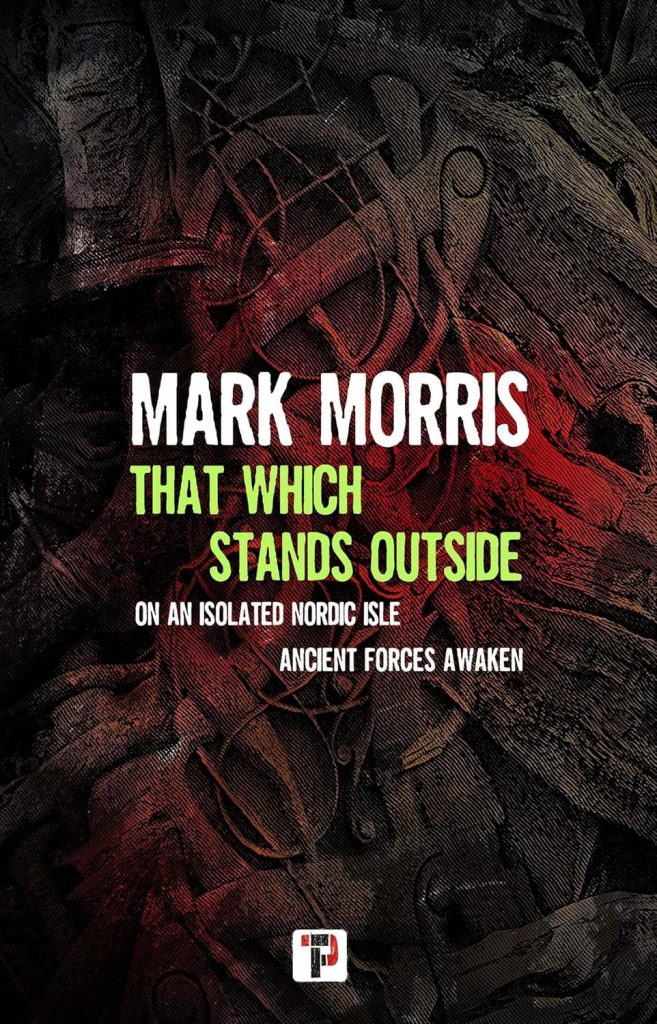
1. That Which Stands Outside (2024, Flame Tree Press)
Norse mythology, body horror, and the human cost of mythic inheritance in Mark Morris’s most atmospheric novel
The moment Todd Kingston sets foot on that island, you already know something is watching him. Morris doesn’t announce this, doesn’t prompt you to be afraid; he simply arranges the cold and the silence until fear assembles itself.
That Which Stands Outside divides into two distinct movements. The first is a slow descent into Nordic folk horror, as Todd accompanies his partner Yrsa Helgerson back to the remote island of her childhood following her mother’s death. The islanders insist Yrsa is the child of the Jötnar, the giants of Norse mythology, a claim she dismisses as superstition. Morris builds dread here through accumulation: the particular quality of light on ice-cold water, the way the islanders regard Yrsa with something between reverence and barely managed fear. The atmosphere is genuinely thick, borrowing from Scandi-noir traditions without becoming pastiche.
The second movement erupts. When the novel pivots into full body horror and cosmic confrontation, Morris handles the gear-shift with confidence, and neither phase feels like a betrayal of the other.
At the sentence level, Morris is precise without being showy. His prose does what good horror prose must do: it disappears into the experience. POV is tight third person, which keeps Todd’s bewilderment and encroaching terror immediate without overcooking it. The structural split mirrors the novel’s thematic divide; the rational world and the mythological one cannot coexist, and eventually one must swallow the other.
Beneath the supernatural machinery lies a meditation on identity, belonging, and the stories a family tells itself to keep the dark out. Yrsa’s relationship to her heritage, the question of what you are when the community you grew up in insists you are something other, carries genuine emotional weight. Todd, the outsider, becomes the reader’s surrogate in the most honest sense: someone trying to love someone else enough to follow them into a world that makes no room for him.
Within Morris’s career, this represents a deepening engagement with folk horror that his anthology work had been circling for years. In its Nordic bleakness it sits alongside Adam LG Nevill’s The Ritual, but is warmer, stranger, and more interested in the human cost of mythic inheritance.
The Jötnar do not explain themselves, and the novel is stronger for it.
2. The Society of Blood: Obsidian Heart Book 2 (2015, Titan Books)
Time travel, Victorian London, and a father’s refusal to accept loss in the second Obsidian Heart novel
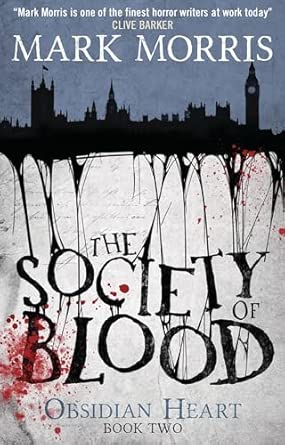
Alex Locke arrives in 1895 London with blood on his hands and the smell of something wrong already in the fog. The second volume of the Obsidian Heart trilogy doesn’t waste time reorienting you; it assumes you’re already running.
Still searching for his abducted daughter, Locke navigates a London of opium dens, serial murders, and the hidden corridors of the Society of Blood, a cabal whose purposes remain deliberately obscure. Morris renders the city as something close to a living antagonist: sooty, dense, morally indeterminate, the kind of place where the supernatural feels less like an intrusion and more like an inevitability. The murders are Ripper-adjacent, and the novel wears its Victorian gothic inheritance proudly.
What distinguishes this from other historical horror is the pacing architecture. Morris never allows the reader to feel safe within any episode; every solved mystery generates two more, and the Obsidian Heart itself remains fascinatingly opaque. The object doesn’t explain itself. Its power is shown rather than glossed, which gives the novel a proper cosmic horror undercurrent beneath its period trappings.
Craft-wise, Morris handles the structural challenge of the middle installment with considerable skill. The book is fully readable in isolation while also functioning as a bridge, extending the mythology without collapsing under its own exposition. Dialogue is clipped and period-appropriate without tipping into pastiche. Chapter breaks are surgical, and the sense of time pressure around Locke’s search keeps the whole structure taut.
The novel’s emotional core is grief; specifically, a father’s refusal to accept loss. Locke is a man outside his own time in every sense, and his disorientation in Victorian London becomes a physical manifestation of what grief does to a person. You are somewhere you don’t belong, and nothing follows the rules you thought you knew.
In the tradition of British dark fantasy, alongside Tim Powers’s The Anubis Gates in its intricate time-locked plotting, this book occupies a distinctive niche: rigorously plotted, emotionally sincere, and genuinely dark. The Society of Blood confirms Morris as a craftsman who can sustain long-form tension without surrendering the nerve that short fiction demands.
The Obsidian Heart asks nothing of you it isn’t willing to repay.
3. The Black (2014, PS Publishing)
The fear you had at eight years old never actually left.
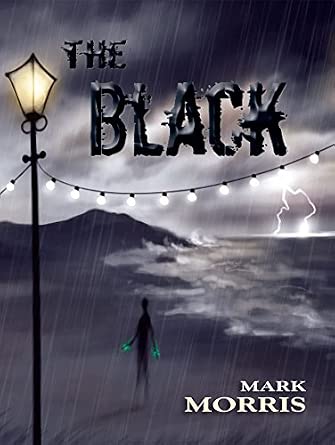
Kate Nolan doesn’t want to be afraid of the dark; she just never stopped being a child in the way that matters. That private, pre-rational terror, the kind that exists below the reach of reassurance, is what The Black is really doing, even when it looks like it’s doing a thriller.
When Kate receives a call from her clearly distressed husband James, asking her to meet him at midnight outside a beach café in Seahaven, the seaside town where they both grew up, the novel’s dread engine starts quietly. Seahaven in recent weeks has become a hunting ground for a child killer who calls himself Dominic. Kate arrives at the café. Neither James nor their five-year-old son Max are there. What follows is a tightening web of buried secrets, childhood guilt, and the creeping suspicion that the darkness Kate has feared since childhood is not metaphorical.
Morris constructs the book around a psychological and supernatural simultaneity. You can read The Black as a straightforward thriller if you choose, but the imagery keeps pulling the floor away. The darkness, “the black,” functions the way the best horror symbols do: it is literal and figurative at once, and no explanation ever quite neutralises it.
At the prose level, this is Morris working in a more genre-inflected register than his literary fiction, but the character work is precise. Kate is drawn with care rather than convenience; her fear feels earned. The novel’s dialogue is grounded, and the pacing moves in smart irregular pulses, quick where it needs momentum, slow where it needs you to dread what’s coming.
Thematically, The Black is interested in the archaeology of childhood: what we bury, and what buries us. The seaside town as a site of return is a classic horror move, and Morris knows it, but he commits to the emotional logic rather than coasting on the trope. The reunion of a woman with her childhood terror, with the specific texture of it, gives the novel a psychological weight that earns its supernatural payoff.
The darkness was always going to come back. Kate just didn’t know it had been keeping count.
4. Longbarrow (1997, Piatkus Books)
Yorkshire soil holds its horrors deep and patient.
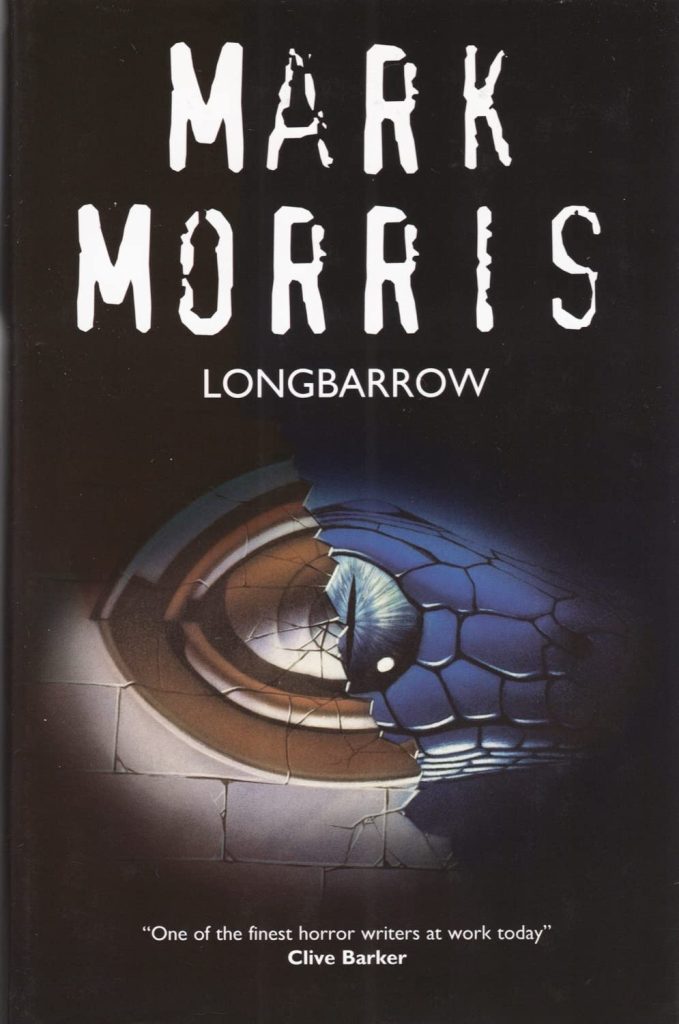
Something has been sleeping under that village for a very long time, and David Wisher has made the mistake of feeling at home. When his mother inherits a house in a remote Yorkshire village, David arrives with the particular unease of someone who has dreamed of a place before seeing it. Morris gives that unease its proper weight from the first chapter.
Longbarrow works in the tradition of British rural horror with a genuine love for the form. The Yorkshire landscape is rendered with precision, the kind that makes you feel the specific quality of light on a northern autumn afternoon, the way old villages keep their history not in archives but in postures, in the way certain residents won’t quite meet your eye. The cast of supporting characters, Jonas Dyer with his mystical visions curdling at the edge of madness, the ambiguous Mr. Toot who traffics in folk remedies, the strange small figures said to come from the river, all feel rooted in genuine folkloric imagination rather than genre shorthand.
The novel’s horror grows from local legend: the Seven Sleepers, seven corrupt apprentices put to sleep by a mage after a catastrophic battle, to be awakened if someone runs seven times anti-clockwise around the village church. It’s the kind of legend that feels old enough to be true, and Morris handles the escalation from rural unease to full supernatural eruption with care.
What impresses most at the craft level is the restraint. Morris doesn’t reach for obvious intensifiers; he lets the setting do the work, trusting the reader to find the landscape threatening on its own terms. The close third person POV gives access to David’s growing confusion without reducing him to a passive camera. A novel this reliant on atmosphere could easily become sluggish; Morris keeps it moving.
Beneath the folk horror surface, Longbarrow is about inheritance in the widest sense: what a place passes down, what a family doesn’t discuss, and the way silence accumulates until it becomes something you can almost touch. Sitting in the tradition of James Herbert’s rural horrors and Ramsey Campbell’s similarly rooted British dread, this early Morris holds its ground.
What’s buried doesn’t stay buried. It just waits for the right weight above it.
5. Deluge (2007)
The flood came first. What followed is the actual horror.
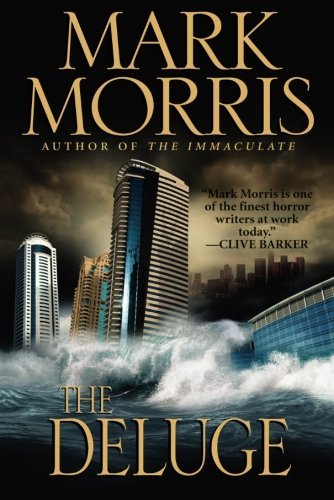
The flood is not the worst of it. The flood is just what cleared the way. Morris opens Deluge in disaster and accelerates from there, and what the novel understands, and what elevates it above its premise, is that the apocalypse is merely the stage. The real drama happens underneath.
When a catastrophic flood leaves most of Britain submerged, survivors band together in the way survivors always do: with temporary solidarity, rising suspicion, and the gradual realisation that humanity is rarely the most dangerous thing in the room. But Morris adds something that fundamentally changes the nature of the novel. There are things beneath the water. Things that are not fish, and not coincidence, and not going away when the floodwaters recede.
The atmosphere in Deluge is dense and pressured, the specific claustrophobia of people forced together by catastrophe. Morris maintains it through clean, propulsive prose. The book moves like water: fast in the open and constricted in the narrow places. Group dynamics are handled with a novelist’s instinct for friction; character distinctions are earned through action rather than description, which keeps the pace honest.
At the craft level, Morris is working in a more visceral register here than in his literary fiction, deliberately B-movie adjacent in the way that the best horror can afford to be when it fully commits. The creature-reveal sequences are calibrated for maximum disorientation, and there is a genuine Lovecraftian refusal to explain the thing behind the thing, which keeps the horror from deflating into categorisation. The unknown stays unknown.
Fun fact, our spunky band of heroes travels to the military base at Edinburgh Castle, when in reality they should have stopped just down the road from me at the local army base, because and here’s the fun fact, the lowest point in Penicuik is higher than the highest point in Edinburgh. It’s been close to 20 years since I first read this book, and I still think about that. Sad, I know.
Deluge speaks to a deep cultural anxiety about the natural world and its capacity for indifference. Flood mythology is one of the oldest human stories; almost every culture possesses one, a reckoning delivered through water. Morris taps into that primal resonance while updating it with something weirder and more contemporary: the fear that what lies beneath is not just unknown but purposefully hostile. Not flood as divine punishment, but flood as preparation.
In the tradition of the British catastrophe novel, from Wyndham’s quiet dread through Conrad Williams’s more recent body-blow apocalypses, Deluge earns its place as a confident, propulsive entry.
The water goes down. What came with it does not.