
She built the perfect life. Her body had other ideas.
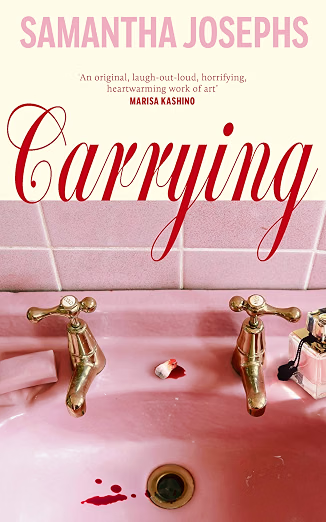
Carrying | Samantha Josephs | 4th Estate (HarperCollins) | 28 January 2027 |
Carrying is Samantha Josephs’s debut novel, arriving from 4th Estate on 28 January 2027, and it lands as one of the boldest new voices in trans body horror this decade. Martha is stealth: a picture-perfect Los Angeles wife and stepmother whose transness is a secret even her husband doesn’t know. When a mysterious illness pushes her toward stranger and stranger treatments, and those treatments leave her seemingly, impossibly, pregnant, the novel turns the daily performance of femininity into something genuinely monstrous. Equal parts camp comedy and gut-deep horror, Carrying earns its comparisons to The Substance and Rosemary’s Baby while sounding like absolutely nothing else on shelves this year.
Carrying doesn’t just get under your skin, it moves in, redecorates, and starts eating what’s in the fridge.
Carrying by Samantha Josephs Review: The Trans Body Horror Debut You’ll Be Talking About in 2027

There’s a particular exhaustion that comes from performing normal for an audience that never claps. The blowout that looks like you rolled straight out of bed with it. The dinner that appears effortless because nobody saw the three failed attempts before it. The miscarriage, staged with butcher’s meat and a squeeze bottle of blood, timed to the minute so nobody thinks to ask a follow-up question. Martha has been performing normal for most of her adult life. She’s extremely good at it. That’s exactly the problem.
Samantha Josephs’s debut novel takes that performance and puts it under surgical light. Martha is stealth, a trans woman married to Leon, a man who has no idea, and stepmother to his daughter Enid, who adores her without ever suspecting there’s anything to know. Martha wants what she’s built to stay built, so when Leon starts talking about more children, she does what she’s always done: she manages it. She fakes the miscarriages.
She manages the grief performance that follows them, too. Then her body starts doing something she didn’t stage, a strange illness with no diagnosis, no obvious cause, and a set of symptoms that get stranger the longer she ignores them, and the management stops being something she’s in control of.
What Josephs is doing here is smarter than the log line suggests. This isn’t body horror as spectacle for its own sake, though it earns its gross-out moments honestly and repeatedly. It’s body horror as a metaphor that refuses to sit still and be a metaphor. Martha’s illness, and the experimental treatments she pursues after finding a community of fellow sufferers, function simultaneously as literal plot and as something closer to the bone: the cost of keeping a secret in your own body for decades, the toll of loving people who only love the version of you they’ve been shown.
The book never explains the illness in clinical terms, and it’s right not to. An explanation would shrink it. Left open, it becomes everything Martha has swallowed to survive, made suddenly and horribly literal.
There’s also a structural confidence here that’s easy to undersell. Debuts this openly hybrid, part domestic satire, part creeping illness narrative, part full-blown creature horror, usually pick a lane by page fifty because holding three genres steady is difficult and holding them steady while also being funny is harder still. Josephs doesn’t pick a lane. She builds an on-ramp for each one and merges them so cleanly that by the time you notice how far you’ve travelled from the marriage-comedy opening chapters, there’s no getting back to shore. That’s pacing as argument, not just pacing as competence, and it’s the kind of thing that usually takes a writer two or three books to trust herself enough to do.
Spoiler warning: the two paragraphs below discuss plot developments from roughly the novel’s midpoint onward.
The treatments Martha pursues, sourced through an online community that finds her before she finds them, escalate in a way that’s genuinely unexpected, tipping the book from body horror with camp inflections into something closer to full transformation horror by its final third. It’s a bold structural choice.
The novel more or less rewires its own genre engine halfway through, and that kind of gear change is where a lot of debuts lose their nerve or lose the thread. Josephs keeps hold of both. The tonal whiplash is the point: motherhood sold to Martha as elevation, as the final proof of womanhood she’s spent her life defending, curdling into something that demands more of her body than she agreed to give.
The online community Martha falls in with deserves its own mention, because it’s doing more work than a simple plot mechanism. These are strangers who recognise her symptoms before her own doctors do, who trade unorthodox remedies with the easy familiarity of people who’ve stopped waiting for the medical establishment to catch up with them. Josephs plays this for both comedy and genuine tenderness, and the fact that it can hold both at once, absurd home remedies alongside real belonging, is one of the clearest signs of how sure-footed this debut actually is.
Take the early miscarriage-staging scene, sketched out in the marketing copy and corroborated across every early account of the book: butcher’s meat, a squeeze bottle of blood, a bathroom door locked at exactly the right moment. What’s striking about it isn’t the mechanics of the fake-out itself. It’s the competence. Martha doesn’t fumble this. She’s done it before, she knows her own bathroom’s acoustics, she knows how long to wait before calling out to Leon.
The horror isn’t in the deception; it’s in how rehearsed the deception has become, and how that rehearsal has hollowed out the very femininity it’s meant to protect. A first-time novelist showing you a character’s whole life through the choreography of a single ten-minute scene is not a small trick to pull off, and Josephs pulls it off in the opening chapters, before you’ve even decided how you feel about Martha.
Reading Josephs’s prose is like watching someone perform surgery with a manicure kit. The instruments look too delicate for the job, filed to a point, catching the light, and then they go in anyway, precise and horribly effective. Her sentences are clipped where a lesser writer would sprawl, which suits Martha’s own controlled interior voice, a woman who has spent years narrating her own life for an audience that must never see the seams.
It’s a style that trusts white space. It doesn’t explain the joke, and there is a genuine vein of dark comedy running under all of this, it just lands it and moves on, which is harder to do than it sounds and rarer than it should be in horror debuts.
What’s most impressive is how funny Josephs allows herself to be without ever letting the comedy soften the horror underneath it. Martha’s narration has the timing of someone who has spent a career in rooms full of people who could turn on her, which, not coincidentally, is exactly the life she’s lived. A joke lands, and then two sentences later the ground drops out from under it, and that whiplash never once feels cheap. It feels earned, because the humour was never separate from the dread in the first place. It was always the same muscle.
“Carrying doesn’t ask to be liked, it asks to be reckoned with, and once Martha gets her hooks into you, there’s no putting her down. This is the best horror debut in years, and the last page won’t be the last time you think about it.”
Josephs comes to fiction from screenwriting, television writing, and a scattered background in podcasts, video games, and erotica, and Carrying reads like someone who has spent years learning exactly how long an audience will wait before they need the next beat. Scenes are shaped with a director’s instinct for where to cut, and chapters tend to end on the line that does the most damage rather than the one that ties things up neatly.
There isn’t a prior novel to set this one against, which is its own kind of statement: most writers need two or three books to find a voice this confident. Josephs arrives with it already loaded, and it makes you curious, in a slightly alarming way, about what she does next.
Carrying sits in a lineage that’s grown sharper and stranger in recent years, alongside Gretchen Felker-Martin’s Manhunt and Alison Rumfitt’s Tell Me I’m Worthless, novels that use body horror to say things about transition and survival that realism keeps flinching from.
What Josephs adds to that shelf is camp, real camp, the John Waters strain that other trans horror has mostly left on the table, and a pregnancy horror lineage running back through Rosemary’s Baby that she twists until it’s unmistakably her own. The Substance comparison holds too, not because the books share a plot but because both understand that the female body under pressure to perform youth, fertility, and perfection will eventually send the bill. Carrying just addresses the bill to a woman the culture insists shouldn’t be able to receive it at all.
There’s a sharper distinction worth making, too. Most trans horror of the last few years has been openly, sometimes furiously, about visibility: what it costs to be seen, to be targeted, to be legible as trans in a world that’s decided that legibility is a threat. Carrying comes at the same fear from the opposite direction. Martha’s horror is the horror of not being seen, of a life built so successfully around concealment that the concealment itself starts to rot her from the inside. It’s a genuinely fresh angle on well-worked material, and it’s one of the reasons this debut feels less like it’s joining a conversation than opening a new one.
Underneath the gore, and there is real gore, is a novel about motherhood as inheritance rather than instinct: what Martha thinks she owes Leon, what she thinks she owes Enid, what she’s decided she owes some earlier, unseen version of herself. It’s a novel about the specific violence of being loved conditionally and calling it love anyway. And it’s a novel about found family arriving in the strangest possible packaging, an online community of the similarly afflicted who understand Martha in ways her actual family never will, because they’ve never needed the performance to be perfect. That thread is the novel’s tenderest, and Josephs is smart enough not to sand off its edges to make it comfortable.
Bodily autonomy runs under every page of this without ever once being announced as a Theme with a capital T. Martha’s body has been hers to shape from the beginning, and the horror of the illness, and everything it demands of her afterwards, is that her body stops asking permission. That reversal, control handed over and then violently reclaimed by the body itself, is where the novel’s politics and its horror mechanics fuse completely. You could strip out every ounce of subtext here and still have an effective, propulsive horror novel. You’d just be left with a lesser one.
There is a lot going on here, illness narrative, gender horror, domestic satire, creature-feature escalation, and Josephs earns the right to all of it because every strand answers back to the same question: what happens to a body that’s been managed for too long. Few debuts commit this hard and land this clean.
Carrying doesn’t ask to be liked, it asks to be reckoned with, and once Martha gets her hooks into you, there’s no putting her down. This is the best horror debut in years, and the last page won’t be the last time you think about it.
Carrying by Samantha Josephs
AN AUDACIOUS, INVENTIVE DEBUT AND A CULT CLASSIC IN THE MAKING, FROM A THRILLING NEW TALENT IN FICTION
‘CAMPY, EROTIC, PROVOCATIVE AND UTTERLY ESSENTIAL’ LUCY ROSE
‘A TOTALLY ORIGINAL, LAUGH-OUT-LOUD, HORRIFYING WORK OF ART’ MARISA KASHINO
‘I COULDN’T STOP TALKING ABOUT IT’ TOMMY DORFMAN
Martha is a flawless woman. After primping, waxing and maybe a little surgical help, she’s finally become the impeccable housewife she dreamed she’d be, with an adoring husband, a loving stepdaughter and a body to die for. But Martha is so stealth that even her husband has no idea that she’s actually trans. Everything she’s ever wanted, she’s made for herself. But, while pretending to be trying for a baby, even Martha is shocked to find herself pregnant.
As her body begins to rapidly transform, and a mysterious chronic illness threatens to upend her existence, she starts a series of experimental treatments and gives in to some new, unsettling cravings … until it looks like her perfect life might crumble around her.
Equal parts inventive, funny and compulsive, Carrying mixes the sensational body horror of The Substance with the transgressive camp comedy of John Waters in a style that’s all its own, and announces the arrival of a thrilling new talent in fiction.
Jim "The Don" McLeod has been reading horror for over 35 years and reviewing it for more than 16. He's the editor of Ginger Nuts of Horror, Europe's largest independent horror review and culture site, and a British Fantasy Award nominee for his work in the genre. When he's not busy inflicting his opinions on the horror community, he can be found annoying his family or getting thoroughly outwitted by his two dogs, Casper and Molly.
Ginger Nuts of Horror: The Heart and Soul of Horror Reviews
Every feature is designed to help sell your work, build your audience and connect your horror story with readers who are actively looking for their next frightening read. Our horror book reviews and features include backlinks to your website, publisher page or Amazon author page, a full synopsis, relevant author information and a universal purchasing link that directs readers to their local bookseller or preferred retailer.
All editorial coverage is provided completely free of charge. We do not charge authors, publishers, filmmakers or creators for reviews or features. Ginger Nuts of Horror exists to support the horror community and help great books, films and independent voices find the audiences they deserve.
With a large, engaged social following and an 18-year archive of trusted horror coverage, Ginger Nuts of Horror is a horror review website built to support authors, filmmakers and creators. Our coverage spans horror novels, indie horror, gothic fiction, folk horror, psychological horror, supernatural fiction, dark fantasy, horror films and the wider creative world surrounding the genre.
Whether you’re an established horror author, an indie filmmaker, a publisher, or a debut voice in indie horror, we offer opportunities to place your work in front of dedicated horror fans, readers, viewers and genre enthusiasts. A feature on Ginger Nuts of Horror can help improve discoverability, strengthen your online presence and give potential readers a clear route from discovering your work to finding out more or making a purchase.
Although our coverage is free, we do have a Ko-fi page for readers, authors and supporters who would like to help us continue promoting horror books, films and creators. All donations are entirely voluntary and greatly appreciated. Every contribution helps support the time, research and ongoing work involved in running an independent horror review website.
Explore our horror book reviews and horror movie reviews, discover the kind of horror coverage we publish, then get your horror book or film featured today.